
Specifying steel fabrications for high-stress industrial components often stems from a fear of brittle failure, yet this choice frequently overlooks a more efficient metallurgical solution. While gray iron is prized for its vibration dampening qualities, its lack of ductility can be a liability in demanding environments. Ductile iron material bridges this gap by offering the tensile strength of steel alongside the superior castability and wear resistance of iron. It’s the engineered middle ground that provides reliability without the prohibitive costs associated with complex weldments.
We understand that the transition from fabrications to castings can feel uncertain, especially when deciphering the nuances of ASTM A536 nomenclature. You need to be certain that your chosen grade will perform under pressure. This guide provides the technical clarity required to master ductile iron mechanical properties and industrial advantages, helping you optimize your procurement process. We’ll examine the specific grades available, compare their performance metrics, and outline how to partner with a specialized Canadian foundry to secure ready-to-use, precision-machined components.
Key Takeaways
- Understand how the transition from flake to spheroidal graphite nodules provides the ductility and impact resistance necessary for high-stress environments.
- Master the ASTM A536 nomenclature to select the precise ductile iron material grade based on specific tensile strength, yield strength, and elongation requirements.
- Evaluate the engineering advantages of replacing complex steel fabrications with iron castings to improve vibration damping and realize production efficiencies.
- Identify critical industrial applications, from hydraulic systems to heavy machinery, where pressure containment and fatigue strength are paramount.
- Learn how to streamline your procurement process by partnering with a Canadian foundry that provides integrated machining and heat treating services.
Understanding Ductile Iron Material and Its Spheroidal Microstructure
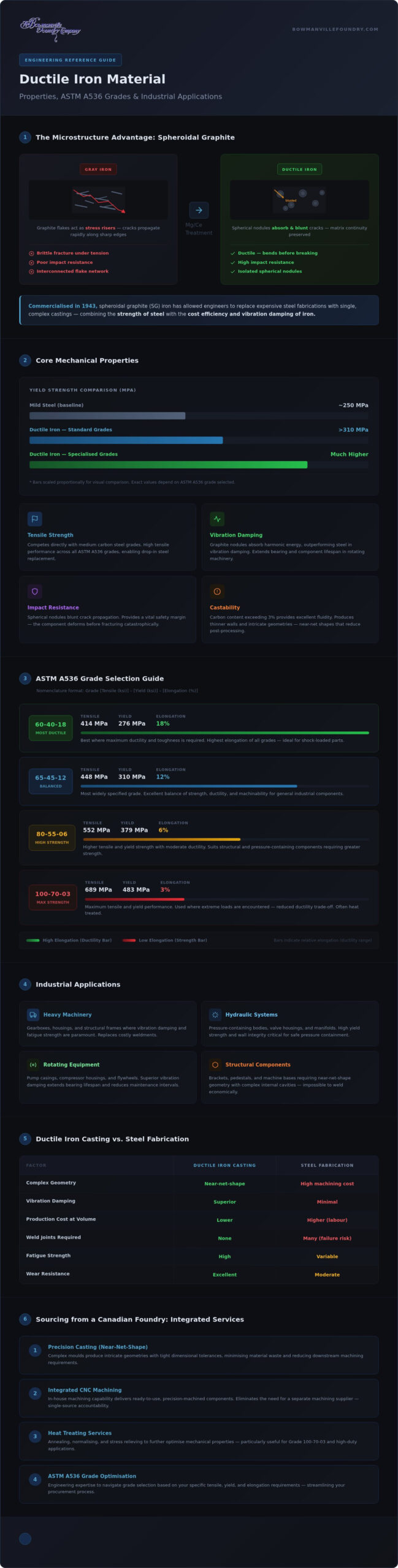
Ductile iron is often described as a modern metallurgical evolution of traditional cast iron. It typically contains a high carbon content, often exceeding 3%, which provides the excellent fluidity required for complex casting geometries. However, the defining characteristic of ductile iron material is not just its chemistry, but the specific shape of its graphite inclusions. In standard gray iron, graphite forms into sharp, interconnected flakes that compromise structural integrity under tension. By contrast, ductile iron undergoes a specific treatment process that fundamentally alters its internal architecture.
The transformation occurs through the addition of a magnesium or cerium inoculant to the molten metal. This chemical reaction forces the graphite to precipitate into discrete, spherical nodules rather than elongated flakes. This spheroidal microstructure is the reason the material is also known as nodular iron. By isolating the graphite into spheres, the continuity of the metal matrix is preserved. This allows the material to realize high impact resistance and tensile strength. It effectively bridges the gap between the brittle nature of gray iron and the high-strength performance of carbon steel.
This “stop-crack” nature is a critical advantage in engineering. When a material is under stress, any internal flaw or inclusion can serve as a starting point for a fracture. In gray iron, a crack follows the path of the graphite flakes, moving rapidly through the part. In ductile iron material, a propagating crack is blunted when it hits a graphite sphere. The sphere absorbs the energy and halts the crack’s progress. This mechanical behaviour ensures that the component can bend or deform before failing, providing a vital margin of safety in high-stress environments.
Nodular Iron vs. Gray Iron: The Structural Difference
Gray iron is defined by its graphite flakes, which act as internal stress risers. These sharp edges provide easy paths for crack propagation, leading to brittle failure. Ductile iron eliminates this risk through its spherical nodules. Because spheres have no sharp points, they don’t concentrate stress. This allows the surrounding metal matrix to remain tough and capable of plastic deformation. It’s the difference between a material that shatters and one that yields under extreme load.
The Discovery and Evolution of Spheroidal Graphite (SG) Iron
Since its commercialization in 1943, SG cast iron has allowed engineers to replace expensive steel fabrications with single, complex castings. It offers the strength of steel combined with the cost-effective manufacturing and vibration damping of iron. Because ductile iron flows easily into intricate moulds, it produces near-net shapes that require less post-processing. This evolution has made it a staple in heavy machinery and automotive industries where weight reduction and durability are equally important. At Bowmanville Foundry, we leverage this history to help clients optimize their component designs.
Core Mechanical Properties and Engineering Benefits
The mechanical performance of ductile iron material provides a compelling alternative to carbon steel fabrications. It offers high tensile and yield strengths that directly compete with many medium carbon steel grades. Unlike standard gray iron, which is brittle, this material provides a reliable combination of strength and toughness. It’s a pragmatic choice for engineers who require the durability of steel but prefer the manufacturing flexibility of a casting. This versatility is why it’s a foundational material in modern heavy industry.
Industrial machinery often faces significant harmonic resonance and vibration. Ductile iron excels here because the graphite nodules absorb energy, providing superior vibration damping compared to steel. This property extends the lifespan of bearings and connected components. Additionally, the material’s excellent fluidity during the pouring process allows for thinner walls and more intricate geometries than are typically achievable with steel castings. This efficiency often leads to a better weight-to-strength ratio for large-scale industrial components, reducing overall machine mass without compromising safety.
Strength and Ductility: The Steel-Like Performance
Common mild steel grades typically have a yield strength around 250 MPa. In comparison, standard ductile iron grades often exceed 310 MPa, with specialized grades reaching much higher thresholds. Elongation, measured as a percentage, indicates how much the material can stretch before it breaks. High-toughness grades can achieve over 18% elongation. This ductility ensures that components can withstand shock loads and high-stress cycles without sudden failure. It provides the “give” necessary in environments where rigid materials would simply snap.
Machinability and Surface Finish Quality
The presence of graphite nodules acts as a natural lubricant during the cutting process. This makes ductile iron material significantly easier on tooling than many steel alloys. Machinists often report reduced tool wear and faster cycle times, which directly translates to lower production costs. The resulting surface finish is clean and uniform, with a consistent surface colour and texture that reflects professional craftsmanship. To better understand how these properties can improve your specific project, reviewing a Free Casting Buyer’s Guide can help you align your design with these manufacturing advantages. Choosing the right material early in the design phase prevents costly tooling replacements later in the production cycle.
Navigating ASTM A536 Grades for Optimal Selection
The ASTM A536 specification serves as the industry standard for classifying ductile iron material. For procurement professionals and engineers, the most critical step is understanding the three-number designation that defines each grade. These numbers represent tensile strength, yield strength, and elongation. For instance, in Grade 65-45-12, the “65” denotes a minimum tensile strength of 65,000 psi, the “45” indicates a minimum yield strength of 45,000 psi, and the “12” represents a 12% minimum elongation. This standardized system allows for precise communication between the design engineer and the foundry.
The mechanical properties of a specific grade are primarily determined by the material’s matrix. This is the metallic structure surrounding the graphite nodules. A ferritic matrix is softer and more ductile, providing excellent impact resistance. A pearlitic matrix is harder and stronger, offering superior wear resistance. Many grades utilize a combination of both to balance these characteristics. Selecting the incorrect grade often leads to premature component failure. A part designed for high impact may crack if a fully pearlitic grade is used, while a part requiring wear resistance will fail if a ferritic grade is specified.
Common Ductile Iron Grades and Their Use Cases
Choosing the right grade requires a clear understanding of the application’s primary stress factors. The following grades represent the majority of industrial requirements:
- Grade 60-40-18: This is a fully ferritic grade. It provides maximum ductility and exceptional impact resistance, even at low temperatures. It’s ideal for components subject to sudden shock.
- Grade 65-45-12: Often considered the general-purpose standard, this grade offers a reliable balance of strength and ductility for most industrial components.
- Grade 80-55-06: This grade contains a mix of ferrite and pearlite. It provides higher strength than the standard grades while maintaining moderate ductility for structural applications.
- Grade 100-70-03: A pearlitic grade designed for high strength and wear resistance. It’s frequently used in gears and crankshafts where surface durability is essential.
High-Strength and Specialty Grades (ASTM A536 120-90-02)
For extreme load environments, Grade 120-90-02 provides the highest strength within the standard ASTM A536 classification. This grade is achieved through specialized heat treatment processes like normalizing or quenching and tempering. While it offers immense load-bearing capacity, it comes with a trade-off in reduced elongation, typically limited to 2%. For even higher performance, austempered ductile iron (ADI) can be utilized. ADI offers double the strength of standard ductile iron material while maintaining high levels of toughness and fatigue resistance. These specialty grades require careful coordination with your manufacturing partner to ensure the final component meets all safety and performance criteria. Engineers navigating these high-performance options will benefit from reviewing the technical reference for SG cast iron grades and ASTM A536 standards to confirm the correct metallurgical specifications for their application.
Industrial Applications for High-Stress Ductile Iron Components
Ductile iron material is selected for industrial applications where the cost of component failure is high. Its ability to absorb energy and resist fatigue makes it indispensable for heavy machinery and transportation sectors. In automotive manufacturing, parts such as steering knuckles, crankshafts, and suspension components must endure constant shock loading. A material that can deform slightly without fracturing ensures vehicle safety and long-term reliability. Similarly, in the agricultural and construction sectors, frames and housings must withstand the rigours of uneven terrain and high-impact work cycles.
Outdoor durability is another factor driving the use of this material. Electrical hardware and construction components often face harsh weather and corrosive environments. While ductile iron possesses natural corrosion resistance, its structural integrity remains its primary draw. It provides the necessary strength to support massive loads in electrical grids or bridge components while remaining more cost-effective than stainless steel or complex fabrications. This resilience ensures that infrastructure remains stable over decades of service.
Pumps, Valves, and Pressure Vessels
Pressure containment requires a material with high yield strength and predictable mechanical behaviour. Ductile iron is often the preferred choice for industrial fluid handling because it manages thermal cycling effectively. Whether in a pump housing or a high-pressure valve, the material’s ability to expand and contract without developing stress cracks is vital. From a safety perspective, the ductility of the iron provides a warning sign; a component will typically bulge or leak before a catastrophic burst occurs. This predictable failure mode is a critical engineering safeguard in pneumatic and hydraulic systems.
Gears, Brackets, and Structural Frameworks
Power transmission components like gears and gearboxes rely on the material’s combination of wear resistance and toughness. As discussed in previous sections, pearlitic grades are especially suited for these high-friction environments. Structural brackets and frameworks benefit from the high yield point of ductile iron material, which allows them to maintain their shape under permanent loads. To ensure your components meet these rigorous industrial tolerances, you can source precision-engineered Ductile Iron Castings that are ready for immediate assembly. Custom-engineered iron ensures that every bracket or gear performs exactly as specified in your technical documentation.
Sourcing and Post-Processing: Realizing the Finished Component
Sourcing ductile iron material requires a focus on the final application rather than just the raw casting. While the initial melt and pour establish the metallurgical foundation, the secondary processes determine the component’s ultimate reliability in the field. Partnering with a foundry that offers integrated engineering support allows for the early identification of potential design flaws. This collaborative approach ensures that the casting geometries are optimized for both the solidification process and subsequent machining operations. It’s a pragmatic strategy that reduces the risk of discovering internal porosity or structural inconsistencies during the final stages of production.
Beyond the casting itself, surface finishing and specialized coatings provide the final layer of protection against industrial wear. Options such as primers, powder coatings, or specialized plating can be applied to enhance corrosion resistance and achieve a specific aesthetic appeal. These finishing services ensure the part is ready for immediate integration into larger assemblies. By consolidating these steps with a single manufacturing partner, you maintain a higher level of quality control and ensure that the finished part reflects the precision required by your technical specifications.
The Role of Heat Treatment in Ductile Iron Performance
Heat treatment processes like annealing or normalizing are fundamental to refining the matrix structure of ductile iron material. Annealing is often utilized to maximize ductility by creating a fully ferritic matrix, while normalizing produces a uniform pearlitic structure for higher strength and hardness. Foundries also utilize stress relieving to ensure dimensional stability. This process removes internal stresses that could otherwise cause the part to warp during high-precision machining. These controlled thermal cycles are how a professional foundry realizes the specific mechanical properties required by various ASTM grades.
Ready-to-Use Components and Finishing Services
Sourcing ready-to-use components from a single national supplier eliminates the logistical complexity of managing multiple vendors. When a foundry provides integrated post-processing, the transition from raw metal to a finished part is seamless. This integration reduces total project lead times and ensures that critical engineering tolerances are met under a single quality management system. To ensure you’re making the most informed metallurgical decisions for your next project, you should Download the Free Casting Buyer’s Guide for deeper selection insights. This resource bridges the gap between raw technical data and practical procurement strategy, helping you select the right grade for your specific industrial environment.
Optimizing Your Casting Procurement Strategy
Mastering the technical nuances of ductile iron material allows you to design components that offer the durability of steel with the vibration damping and castability of iron. By understanding the relationship between the spheroidal microstructure and mechanical performance, you can select ASTM grades that prevent brittle failure and extend service life. Transitioning from complex fabrications to precision castings requires a partner who understands these metallurgical complexities. It’s a process that demands transparency and technical mastery to ensure long-term industrial safety.
Since 1902, Bowmanville Foundry has provided the engineering support and post-processing services needed to deliver ready-to-use industrial components. We provide comprehensive finishing, including heat treating and machining, to ensure every casting meets your exact tolerances and performance requirements. Download Your Free Casting Buyer’s Guide to Select the Right Iron Grade and gain the technical data required for your next custom project. We look forward to helping you realize the full potential of your industrial designs through expert craftsmanship and dependable service.
Frequently Asked Questions
What is the main difference between ductile iron and gray iron?
The primary difference lies in the shape of the graphite inclusions within the metal matrix. Gray iron contains graphite flakes that create internal stress points; ductile iron material features spherical nodules that prevent crack propagation. This structural change allows the material to bend or deform under load, whereas gray iron remains brittle and prone to shattering. It’s the difference between a material that yields and one that fails catastrophically.
Is ductile iron as strong as steel for industrial applications?
Ductile iron provides tensile and yield strengths that are comparable to many medium carbon steel grades. While steel often has higher absolute toughness, this iron offers superior vibration damping and castability. This makes it a more efficient choice for complex industrial components. It’s frequently used as a direct replacement for steel fabrications in high-stress applications like crankshafts and heavy machinery frames.
What does the ASTM A536 65-45-12 grade actually mean?
This designation represents the minimum mechanical requirements for that specific grade. The “65” stands for 65,000 psi minimum tensile strength, the “45” represents 45,000 psi minimum yield strength, and the “12” indicates a 12% minimum elongation. This three-number system allows engineers to quickly identify the material’s load-bearing capacity and ductility for precise application planning. It’s a standard language for industrial procurement.
Can ductile iron be welded or machined easily?
Ductile iron is highly machinable because the graphite nodules act as a natural lubricant, reducing tool wear and improving surface finish quality. Machinists often realize faster cycle times compared to working with alloy steels. Welding is possible but requires specialized procedures, such as preheating and controlled cooling, to prevent the formation of brittle structures. Most industrial components are cast to near-net shape to minimize the need for extensive welding.
When should I choose ductile iron over malleable iron?
Ductile iron is typically preferred for larger components or parts with thicker cross-sections because its properties are achieved during the initial casting process. Malleable iron requires a lengthy heat treatment to transform white iron into a tougher material, which limits its effective section thickness. For heavy-duty industrial hardware and pressure-retaining parts, it’s generally the more versatile and reliable engineering choice.
What are the typical lead times for custom ductile iron castings in Canada?
Lead times for custom castings in Canada vary based on the complexity of the pattern design and the volume of the production run. Typically, initial tooling and sample approval can take several weeks; production runs follow a steady schedule thereafter. Partnering with a domestic foundry reduces logistical delays and ensures that technical support is available throughout the manufacturing cycle. You should consult with your manufacturing partner for specific timelines.
How does temperature affect the performance of ductile iron material?
Temperature significantly influences the mechanical performance of ductile iron material, particularly in sub-zero environments. While standard grades may become more brittle in extreme cold, specialized ferritic grades like 60-40-18 are engineered to maintain high toughness. Conversely, at elevated temperatures, the material’s tensile strength may decrease. Engineers must consult technical data sheets to ensure the chosen grade suits the specific operating environment of the finished component.
Is ductile iron more expensive to produce than other iron grades?
Ductile iron is generally more expensive to produce than gray iron because it requires high-quality raw materials and specialized magnesium inoculants. However, it’s often more cost-effective than steel fabrications or alloy steels due to its superior castability and reduced machining requirements. The long-term value is realized through improved component lifespan and lower maintenance costs in demanding industrial settings. It’s an investment in reliability and performance.
