
Selecting the lowest bid on an industrial quote is often the most expensive mistake a procurement professional can make. You likely realize that a simple line item for “cost per kilogram” rarely accounts for the mechanical reality of the finished component. It’s a common frustration to see initial savings evaporate when faced with secondary machining corrections, unexpected heat treating fees, or premature part failure due to incorrect grade selection. This iron casting RFQ guide provides the framework you need to master the technical and financial variables that dictate the success of your industrial project.
By shifting your focus from the initial price to the total cost of ownership, you can ensure the mechanical integrity of every component while maintaining a predictable production schedule. We’ll explore how to evaluate foundry capabilities, identify hidden cost drivers in post-processing, and utilize specialized metallurgical knowledge to achieve optimal value. Whether you’re sourcing ductile, gray, or malleable iron, this guide serves as a steady hand to help you navigate the complexities of the Canadian manufacturing landscape with confidence and technical certainty.
Key Takeaways
- Adopt a Total Cost of Ownership (TCO) framework to evaluate iron casting quotes, moving beyond simple unit prices to account for long-term component reliability.
- Understand how specific mechanical requirements dictate the selection between gray, ductile, and malleable iron grades to avoid costly over-specification or part failure.
- Use this iron casting RFQ guide to manage initial tooling and pattern investments by aligning pattern materials with your projected production volumes.
- Reduce logistical complexity and hidden costs by integrating secondary operations, such as machining and heat treating, into a single-source procurement model.
- Leverage the strategic advantage of Canadian engineering expertise to ensure technical certainty and streamline communication throughout the production process.
Beyond the Bottom Line: Why Iron Casting Quote Comparison is a Multidimensional Process
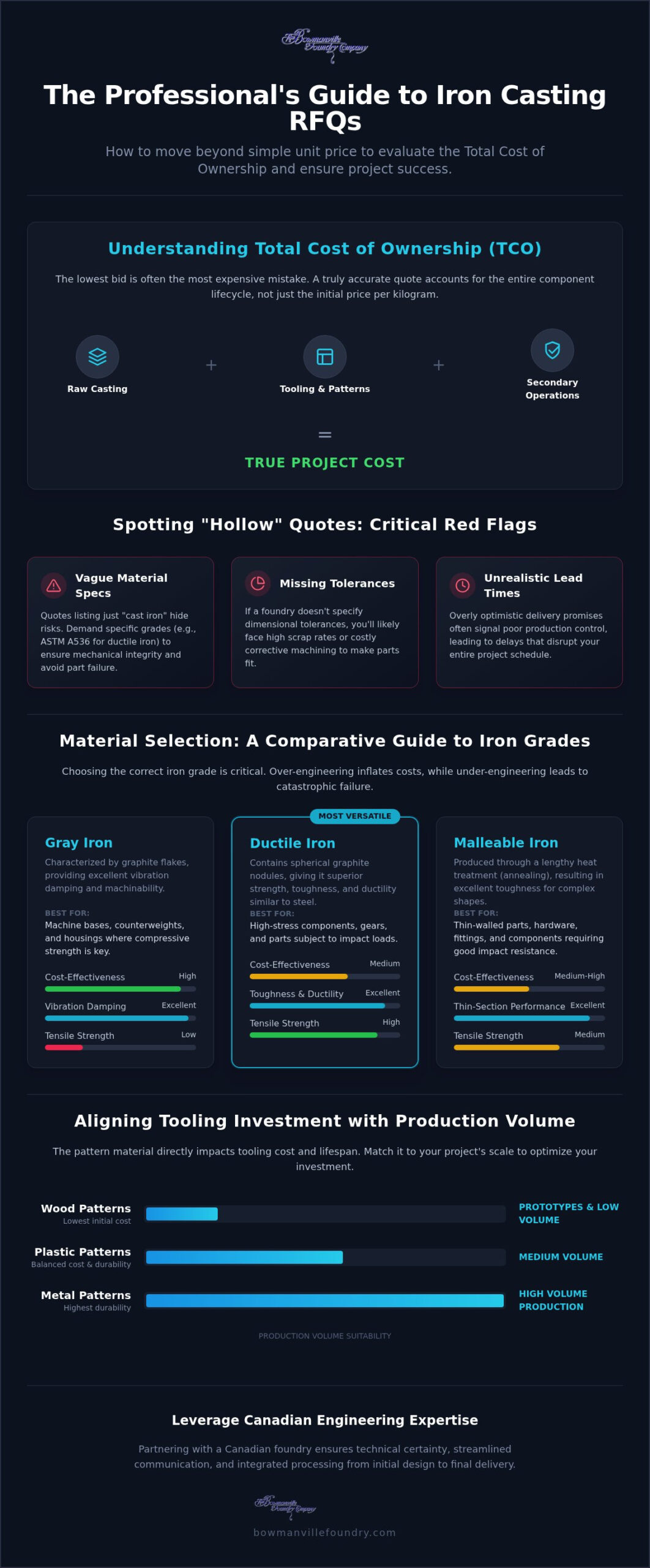
A custom iron casting quote is far more than a simple unit price; it represents a comprehensive engineering agreement between a foundry and a procurement professional. When you evaluate submissions, you’re essentially looking at the Total Cost of Ownership (TCO). This metric includes the raw casting cost, the longevity of the tooling, and the efficiency of secondary processing. Relying on this iron casting RFQ guide helps you identify the three pillars of any accurate quote: material selection, tooling precision, and integrated processing. Quotes that omit these details are often “hollow.” They hide future expenses behind an attractive but incomplete initial figure. A professional quote should account for the entire lifecycle of the component, from the initial melt to the final inspection.
The Complexity of Custom Engineered Iron Components
Iron requires specific metallurgical expertise because its properties change significantly based on cooling rates and chemical composition. Unlike simpler alloys, the metal casting process for iron involves managing carbon flakes or nodules to achieve desired strength and ductility. Professional foundries use Design for Manufacturability (DFM) during the quoting phase to ensure the component can be cast without internal defects. This early engineering support is a critical value-add. It prevents casting failures that might otherwise only appear during final assembly or, worse, in the field. When a foundry engages with your design early, they help optimize the geometry to reduce weight and material waste without sacrificing structural performance.
Initial Red Flags in Low-Cost Casting Quotes
A suspiciously low quote often signals a lack of technical rigour. One major red flag is the absence of detailed dimensional tolerances. If a foundry doesn’t specify how tightly they can hold a dimension, you’ll likely face high scrap rates or expensive corrective machining later. Vague material descriptions are another concern. A quote should never simply say “cast iron.” It must specify an exact ASTM grade, such as those found in ASTM A536-24 for ductile iron, to ensure the mechanical integrity of the part. Finally, be wary of unrealistic lead times. Foundries with poor production control often promise fast turnarounds to win contracts, only to deliver late and disrupt your entire project schedule. Using a structured iron casting RFQ guide ensures you’re comparing quotes based on technical reality rather than optimistic marketing. A quote that seems too good to be true usually is, and the hidden costs of delays or rework will quickly exceed any initial savings.
Evaluating Material Specifications: How Iron Grade Selection Impacts Your Quote
Material choice is the foundation of any accurate quote. It dictates the base metal cost and the energy required for melting and heat treatment. This iron casting RFQ guide emphasizes that transparency starts with adherence to global standards. When you review a quote, ensure it references specific grades like ASTM A536-24 for ductile iron or the general ASTM A834 requirements. These specifications provide a baseline for quality assurance and testing protocols. Choosing the wrong grade often results in two extremes. You either over-engineer the part, which inflates your C$ per unit cost, or you select a grade that cannot handle operational stress, leading to catastrophic failure in the field.
Malleable vs. Ductile Iron: Cost and Performance Trade-offs
Malleable iron and ductile iron both offer high strength and ductility, but they achieve these properties through different metallurgical processes. Malleable iron is particularly effective for complex, thin-walled sections where consistent toughness is required. It’s a dependable choice for hardware and small fittings. However, it requires a lengthy annealing process that can extend production lead times compared to as-cast materials. On the other hand, ductile iron mechanical properties often justify a higher price point for heavy-duty applications due to superior impact resistance and tensile strength. Selecting a material isn’t just about strength. It’s about how that metal behaves under pressure. If your project requires high-load capacity without the need for extensive heat treatment, ductile iron might be the more efficient choice for your budget.
Gray Iron: The Economical Choice for High Vibration Dampening
Gray iron remains the most economical option for many industrial components. Its unique micro-structure, characterized by graphite flakes, provides exceptional vibration dampening and thermal conductivity. This makes it ideal for machine bases, engine blocks, and brake components where stability is paramount. You can find more detailed technical data in our gray iron casting applications guide. While cost-effective, gray iron is relatively brittle. It lacks the tensile strength and elongation of ductile or malleable grades. It shouldn’t be used in high-impact scenarios where sudden failure could pose safety risks. If you’re unsure which material best suits your design requirements, consulting with an experienced Canadian foundry can help refine your material selection before you finalize your RFQ. This early collaboration ensures you don’t pay for performance you don’t need or compromise on safety.
Tooling, Patterns, and Volume: Understanding the Initial Investment
The pattern development fee is often the most significant line item in a custom quote, representing the physical bridge between your engineering drawings and a finished component. This iron casting RFQ guide highlights that tooling is a strategic investment rather than a mere administrative cost. A master pattern must account for metal shrinkage, draft angles, and core placements to ensure dimensional accuracy. Choosing the right pattern material is a function of your projected production volume. For short runs or prototypes, wood or plastic patterns offer a lower entry cost. However, for high-volume industrial projects, metal patterns made from aluminum or iron provide the durability needed to produce thousands of parts without losing precision.
Investing in high-quality tooling directly reduces your total component cost. Cheap patterns often suffer from wear and tear, leading to dimensional drift and higher scrap rates. When a pattern is imprecise, the foundry must add extra material “stock” to the casting to ensure it cleans up during machining. This adds weight and increases the time your CNC shop spends cutting away excess metal. By prioritizing tooling precision at the start, you minimize these expensive secondary operations and ensure consistent quality across every production lot.
Sand Casting Tooling Cost Advantage
Sand casting remains the standard for industrial iron in Canada because it offers an excellent balance between tooling costs and design flexibility. Unlike permanent mould processes that require expensive steel dies, sand casting patterns are relatively affordable to manufacture and modify. This allows for the amortization of tooling costs over much smaller production runs, making it viable for specialized machinery or infrastructure components. The process is also uniquely capable of supporting complex internal geometries using sand cores, providing engineers with the freedom to design integrated components that would be impossible to manufacture through other methods.
Pattern Ownership and Maintenance
Transparency regarding pattern ownership is essential for long-term procurement stability. Your RFQ should clearly state that the customer retains ownership of the physical tooling once the final invoice is settled. A dependable foundry will also include provisions for pattern storage and routine maintenance. Over time, patterns require cleaning, gating repairs, and occasional refurbishment to maintain their original tolerances. Modern foundries optimize custom iron casting production by using advanced simulation software to refine pattern designs before a single C$ is spent on construction. This predictive approach ensures the tooling is right the first time, protecting your investment and your schedule.
Secondary Operations and Engineering: Accounting for the Total Component Cost
A raw casting is seldom the end of the procurement journey. Most industrial projects require ready-to-use components that have undergone precise machining, heat treatment, and surface finishing before they reach the assembly line. This iron casting RFQ guide emphasizes that accounting for these secondary operations at the start is the only way to arrive at a true total component cost. When you separate casting from post-processing, you often encounter hidden logistical fees and increased scrap rates. By integrating these services, you simplify your supply chain and ensure the mechanical integrity of every part you receive.
The Value of Integrated Iron Casting and Machining
Choosing integrated iron casting and machining in Canada significantly reduces your logistical risk. When a single foundry manages both the pour and the precision cutting, they take a Single Point of Accountability for dimensional tolerances. If a casting doesn’t clean up during machining, it’s the foundry’s responsibility to correct the pattern or the process. This eliminates the common “finger-pointing” that occurs when parts are shipped between different vendors. Sourcing machining-ready castings also reduces your internal labour and equipment costs. It allows your team to focus on final assembly rather than basic component preparation, which streamlines your entire production timeline.
Heat Treating and Surface Finishing
Heat treating is a fundamental step for achieving specific mechanical properties, especially in malleable and ductile iron. Malleable iron, for example, requires a controlled annealing cycle to transform brittle white iron into a tough, ductile material. If this isn’t quoted upfront, your lead times and costs will fluctuate unexpectedly. Similarly, industrial environments in Canada demand robust surface protection. Options like powder coating or galvanizing are essential for long-term corrosion resistance and component longevity. Powder coating provides a durable barrier against chemicals and abrasion, while hot-dip galvanizing offers superior protection for components exposed to the elements.
These secondary costs should never be an afterthought in a professional quote. Including them in your initial RFQ ensures that every foundry is bidding on the same finished specification, preventing “scope creep” later in the project. These finishes add to the initial unit price, but they drastically extend the service life of the part and reduce long-term maintenance expenses. To ensure your next project is quoted accurately from the start, consult with our engineering team to define your post-processing requirements and lock in a comprehensive total component cost.
Qualifying Your Foundry Partner: The Strategic Advantage of Canadian Expertise
The final stage of this iron casting RFQ guide focuses on the strategic selection of a manufacturing partner. Sourcing iron castings within Canada offers more than just logistical convenience; it provides a level of technical certainty that international platforms often fail to match. When you work with a domestic foundry, you gain access to on-site engineering collaboration and direct technical support. This relationship allows for real-time adjustments to your design, ensuring that the final component meets every mechanical requirement. A foundry with over a century of experience, such as one operating since 1902, provides a no-nonsense partnership built on a vast library of institutional knowledge.
Vetting a supplier requires a structured approach to ensure they possess the metallurgical mastery your project demands. You should use a how to choose iron casting grade framework to test a foundry’s expertise. Ask specific questions about their experience with gray, ductile, and malleable iron to see if their technical recommendations align with industry standards. When you compare two or more quotes, use the following checklist to ensure a fair evaluation:
- Confirmation of exact ASTM material grades and testing protocols.
- Clear breakdown of tooling costs and explicit statement of pattern ownership.
- Inclusion of all secondary operations like machining, heat treating, and surface coating.
- Verified quality certifications and a history of similar industrial projects.
- Realistic lead times that account for current Canadian market conditions.
National Supply Chain Reliability
Domestic sourcing significantly improves project agility by reducing lead times and eliminating the unpredictability of international shipping. You avoid the hidden costs associated with import duties, customs delays, and currency fluctuations that can quickly inflate a C$ budget. A Canadian partner understands local regulations and standards, ensuring that your components are compliant with national safety and environmental requirements. This proximity also facilitates easier quality audits and faster resolution of any technical issues that may arise during the production cycle.
Requesting Your Quote: Information You Must Provide
To receive an accurate, comprehensive quote, your RFQ package must be as detailed as possible. Providing a sample part or a detailed application guide helps the foundry’s engineering team understand the functional environment of the component. Ensure your request includes:
- Complete 2D drawings and 3D CAD files with clearly defined tolerances.
- Material specifications and specific load or stress requirements.
- Estimated annual volumes and preferred batch sizes.
- Requirements for heat treatment, machining, or specialized surface finishes.
Providing this level of detail at the start prevents expensive scope changes later. You can download our Free Casting Buyer’s Guide to further refine your procurement process, or request a technical quote today to begin collaborating with our engineering team on your next industrial project.
Securing Technical Certainty for Your Next Industrial Project
Successfully managing an industrial procurement project requires looking past the initial unit price to understand the total cost of ownership. By correctly aligning material grades with mechanical stress and investing in high-quality tooling, you protect your project from the hidden costs of failure and rework. This iron casting RFQ guide has provided the framework to evaluate foundry capabilities and integrate essential post-processing services from the start. A methodical approach ensures that every component performs as intended within its operational environment.
Since 1902, we have specialized in the production of malleable, ductile, and gray iron castings. Our comprehensive post-processing services ensure you receive ready-to-use components that meet your exact specifications. When you choose a partner with deep Canadian heritage and technical mastery, you gain more than a supplier; you gain a dependable mentor in the manufacturing space. We prioritize transparency and precision to help you realize your engineering goals with confidence.
Request an Accurate Custom Iron Casting Quote today to ensure your component achieves optimal performance and value. We look forward to helping you navigate your next project with integrity and technical excellence.
Frequently Asked Questions
What information is required to receive an accurate iron casting quote?
An accurate quote requires comprehensive technical data. You must provide detailed 2D drawings and 3D CAD files that specify critical dimensional tolerances. Including the exact ASTM material grade, such as those found in this iron casting RFQ guide, ensures the foundry bids on the correct mechanical properties. You should also state the estimated annual volume and any required secondary operations like heat treating or surface coating to avoid future cost discrepancies.
How do material grades like malleable or ductile iron affect the price?
Material grades impact cost through chemistry and processing requirements. Gray iron is generally the most economical due to its simpler melting process. Ductile and malleable iron require precise alloy additions and, in the case of malleable iron, lengthy heat treatment cycles to achieve high ductility. These additional metallurgical steps increase the energy and labour required for production, which is reflected in the final C$ per component price.
Why do tooling and pattern costs vary so much between foundries?
Tooling costs vary based on the pattern material and the precision required for your design. Wood or plastic patterns are less expensive but wear out quickly, making them suitable only for short runs. Metal patterns offer superior longevity and dimensional stability for high-volume production. Investing in more expensive, precise tooling often results in lower total costs by reducing the amount of material that must be removed during secondary machining.
Can I get a quote for ready-to-use iron components including machining?
You can certainly request a quote for components that are ready for assembly. Integrated foundries provide post-processing services like CNC machining, heat treating, and protective coatings under one roof. This single-source approach establishes a clear point of accountability for quality and reduces the logistical complexity of managing multiple vendors. It’s often the most efficient way to lower the total cost of ownership for complex industrial parts.
What are the typical lead times for custom iron casting in Canada?
Lead times in the Canadian market vary based on the complexity of the tooling and the current production schedule. Initial pattern development typically takes several weeks, followed by sample approval and production runs. While international lead times can sometimes exceed 20 weeks due to shipping and customs, domestic sourcing often provides more agility. Providing a complete iron casting RFQ guide at the start helps foundries provide realistic timelines based on your specific project needs.
How does production volume impact the unit price of an iron casting?
Production volume is a primary driver of unit pricing. High-volume orders allow the foundry to amortize the initial setup and tooling costs over a larger number of parts. This reduces the fixed cost assigned to each unit. Additionally, higher volumes justify the use of automated molding systems and more durable metal patterns, which improve efficiency and consistency. Small batches often carry a higher unit price due to the relative impact of setup time.
Is it better to source iron castings domestically or internationally?
Sourcing domestically often provides a strategic advantage through better technical collaboration and reduced supply chain risk. You avoid the hidden costs of international freight, import duties, and currency fluctuations. Domestic foundries also offer easier on-site engineering support, which is critical for complex components. While international prices might appear lower initially, the technical certainty and faster response times of a Canadian partner often result in a lower total cost of ownership.
How can I ensure the dimensional tolerances in the quote will be met?
To ensure tolerances are met, you should qualify the foundry’s quality management systems and technical capabilities. Request documentation such as ISO 9001 certifications, material test reports, and dimensional inspection results. A professional foundry will use Design for Manufacturability (DFM) software during the quoting phase to predict and prevent dimensional drift. Establishing clear communication regarding your critical-to-quality dimensions at the RFQ stage ensures the foundry can consistently deliver parts that meet your specifications.
