
Could the most affordable tooling option be the very thing that stalls your production line six months from now? Many procurement professionals view the initial cost of iron casting patterns as a necessary but frustrating barrier to project launch. It’s understandable to feel hesitant about high upfront investments, especially when the technical differences between wood, resin, and metal patterns aren’t always clear. You want a solution that balances durability with your budget without risking a failure during a critical run.
This guide provides a transparent look at how material choice, design complexity, and production volume dictate your total investment. We’ll help you realize which pattern materials are essential for your specific output and how subtle design choices can significantly reduce long-term expenses. By the end, you’ll have a clear framework for selecting the right tooling and finding a reliable Canadian partner to support your foundry needs. We’ll move from broad cost overviews into the granular technical specifications that ensure your project stays on schedule and within budget.
Key Takeaways
- Determine whether wood, resin, or metal patterns are most suitable for your project by aligning material durability with your anticipated production volumes.
- Understand how design features like internal cavities and undercuts necessitate complex coremaking, which impacts the total tooling investment.
- Analyze the cost of iron casting patterns as a strategic investment in casting integrity and long-term production reliability.
- Learn to implement maintenance protocols that mitigate the effects of sand abrasion and preserve critical dimensional tolerances over time.
- Explore the benefits of partnering with a Canadian foundry to streamline pattern development and ensure compliance with rigorous ASTM standards.
Factors Influencing the Upfront Cost of Iron Casting Patterns
The initial investment in a project often hinges on the cost of iron casting patterns. A casting pattern is far more than a simple replica of the final part; it is the master tool used to create the sand moulds that define the casting’s shape. Patternmakers play a critical role in this process by translating 2D drawings or 3D CAD files into physical tooling. They must account for the physical realities of the foundry floor, ensuring the design can be repeated thousands of times with absolute precision. This translation process requires a deep understanding of metallurgy, as the pattern must compensate for the natural contraction of molten metal.
The Relationship Between Material Choice and Initial Investment
Precision patternmaking is inherently labour-intensive. Skilled technicians spend hours refining surfaces to ensure they meet exact specifications. One of the primary factors in pattern engineering is the calculation of draft angles. These are slight tapers added to the vertical faces of the pattern, allowing it to be withdrawn from the sand mould without causing the mould walls to collapse. Without proper draft, the mould will break, leading to casting defects and production delays.
The specific iron grade you select, including gray, ductile, or malleable, directly dictates the pattern’s design requirements. For instance, the specific shrinkage rates for malleable iron casting Canada differ significantly from those of gray iron. Each material behaves differently as it cools, necessitating unique gating and riser systems. Gating refers to the network of channels that distribute molten iron into the mould cavity, while risers act as reservoirs to feed the casting as it shrinks.
Ductile iron generally requires more robust riser systems than gray iron to prevent internal voids or porosity. Engineering time spent on solidification modelling is a vital part of the pattern development process. By using advanced software to simulate how the iron will freeze within the mould, engineers can identify potential hot spots or structural weaknesses before any physical tooling is built. This proactive approach ensures the pattern can withstand the intense thermal stresses of the pouring process, securing the long-term integrity of your components.
Comparing Pattern Materials: Wood, Resin, and Metal
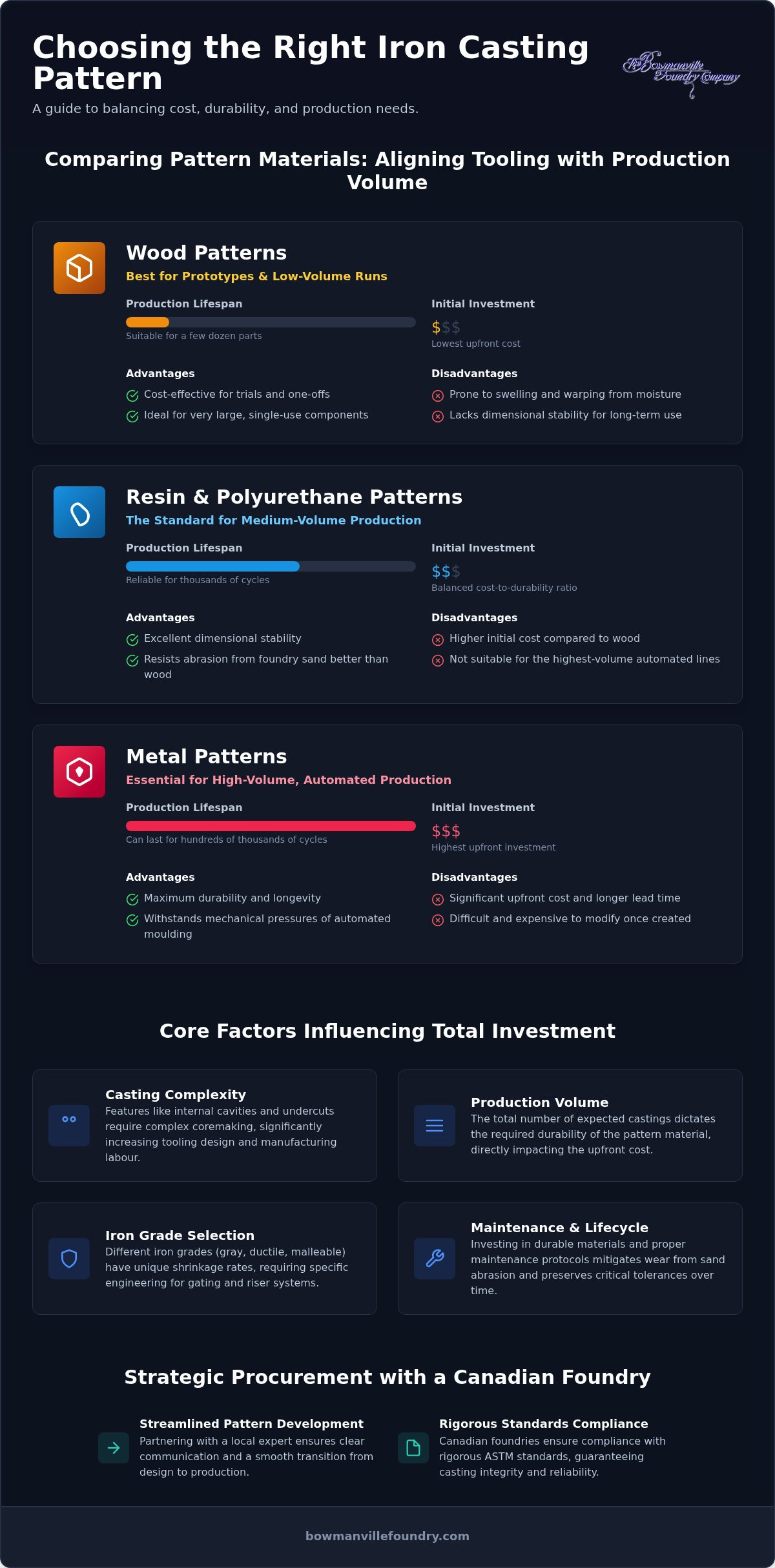
Selecting the appropriate material is the most significant lever in managing the cost of iron casting patterns. This decision involves balancing three primary criteria: durability, dimensional accuracy, and the available budget. The choice determines how many times the pattern can be cycled through the sand moulding process before it loses its critical tolerances. While the initial investment might be lower for certain materials, the long-term expense of repairs or replacements can quickly shift the financial equation. Understanding the specific capabilities of each material allows procurement teams to align their tooling strategy with their production goals.
Wood Patterns: Cost-Effective Prototyping
Wood remains a staple for initial casting trials and extremely large components where the sheer volume of material makes other options prohibitive. Patternmakers often use pine for one-off prototypes, while mahogany or high-density plywood provides slightly more resilience for short production runs. However, wood is naturally hygroscopic. It absorbs moisture from the environment and the wet foundry sand, which can lead to swelling or warping. This lack of dimensional stability means wood patterns are rarely suitable for long-term storage or high-precision industrial applications. If you expect to produce more than a few dozen parts, transitioning to a more permanent material is necessary to maintain consistency.
Resin and Metal Tooling for Long-Term Production
Resin and polyurethane patterns have become the industry standard for medium-volume production. These materials offer an excellent balance of detail and durability. Unlike wood, they are impervious to moisture and provide a smoother surface finish, which reduces friction during the moulding process. When moving into high-speed, automated production lines, CNC-machined aluminum or cast iron patterns are required. These metal tools offer the highest level of precision and can endure hundreds of thousands of cycles without significant wear.
Understanding Tooling and Pattern Costs in Sand Casting is essential when calculating your “break-even” point for these investments. While metal tooling requires a larger upfront cost of iron casting patterns, its longevity reduces the cost per part over the life of the project. For high-tolerance components, the precision of aluminum ensures that post-processing requirements are minimized, further protecting your margins. If you are unsure which material fits your specific volume requirements, consulting our Free Casting Buyer’s Guide can provide the technical framework needed to make an informed decision.
How Casting Complexity and Coremaking Impact Pattern Expenses
Complexity in iron casting is defined by features that prevent a simple two-part mould from being pulled apart. Internal cavities, undercuts, and thin wall sections add layers of technical difficulty that directly influence the cost of iron casting patterns. While a simple shape might only require a single pattern, intricate designs often necessitate the creation of multiple cores to form internal voids. If these elements aren’t optimized during the engineering phase, the risk of casting defects like gas porosity or core shifts increases significantly. There’s a strategic trade-off to consider; investing in a more complex pattern can often eliminate the need for expensive post-processing machining, as the part is cast much closer to its final dimensions.
The Role of Core Boxes in Iron Casting
A core box is a specialized piece of tooling used to create sand cores. Unlike the primary pattern, which forms the exterior shape of the casting, the core box creates the internal geometry. Each core box represents an additional upfront expense in your tooling budget. Just like the primary pattern, these boxes can be constructed from wood for low volumes or metal for high-speed production. It’s important to realize that every additional core increases the assembly time on the foundry floor. Labour costs rise as technicians must precisely place and secure each core within the mould before the iron is poured.
Designing for Castability to Control Costs
One of the most effective ways to manage the cost of iron casting patterns is to simplify part geometry to eliminate unnecessary cores. By adjusting the design to remove undercuts or by using more generous draft angles, you can often reduce the number of separate pieces required. Early collaboration with your manufacturing partner is essential for this type of optimization. When you optimize custom iron casting production through design-for-manufacturability (DFM) reviews, you identify these cost-saving opportunities before the first piece of tooling is cut. This proactive engineering ensures that your design is not only castable but also cost-efficient over the entire production run.
Maximizing ROI: Maintenance and Pattern Lifecycle Management
Protecting your initial investment in tooling is as critical as the engineering phase itself. While the upfront cost of iron casting patterns represents a significant capital outlay, the true value of that investment is realized over years of consistent production. Pattern maintenance is essential for preserving dimensional accuracy. Sand is inherently abrasive; every time a pattern is used to create a mould, the friction of the silica particles gradually wears down high-relief features and sharp edges. Mechanical handling by automated moulding equipment also introduces the risk of chips or dents. If these issues aren’t addressed, the pattern will eventually produce castings that fall outside of tolerance, leading to expensive scrap or rework.
Storage conditions are another often overlooked factor in lifecycle management. Patterns must be protected from extreme temperature fluctuations and humidity to prevent material degradation. Wood patterns are particularly sensitive to moisture, which causes swelling, while metal tooling can suffer from oxidation if not stored in a climate-controlled environment. Maintaining a clean, organized storage facility ensures that patterns remain ready for use, reducing the lead time required for repeat orders.
Scheduled Maintenance and Repair Strategies
High-volume tooling requires a disciplined inspection schedule. For resin patterns, this might involve using specialized epoxy fillers to repair minor surface abrasions. Metal patterns, while more durable, may eventually require precision welding and re-machining to restore critical surfaces. Establishing clear criteria for when to retire a pattern is vital. Continuing to use a “tired” pattern often costs more in production delays and failed quality checks than the price of a replacement. By tracking the number of cycles each tool has completed, you can predict when repairs will be necessary, preventing unscheduled downtime during a critical run.
The Total Cost of Ownership (TCO) Approach
Evaluating the cost of iron casting patterns through a Total Cost of Ownership lens provides a more accurate picture of project profitability. This approach factors in storage, insurance, and routine maintenance into the per-part cost. High-quality patterns significantly reduce scrap rates, which protects your margins over thousands of cycles. Documenting the history of each pattern, including any repairs or modifications, also ensures that future engineering revisions are based on accurate physical data. If you’re ready to discuss a long-term production strategy, consult with our engineering specialists to explore how we manage tooling for maximum longevity.
Strategic Pattern Procurement with a Canadian Foundry
Sourcing tooling domestically offers logistical and technical advantages that offshore manufacturers simply cannot match. When you co-locate pattern development with iron casting production, you eliminate the communication gaps that frequently lead to manufacturing errors. Procuring your tooling within Canada ensures that all designs adhere to rigorous ASTM standards, providing a level of reliability essential for heavy industrial performance. By reducing the distance between the pattern shop and the foundry floor, you also significantly lower shipping expenses and shorten lead times. This proximity allows for rapid adjustments and face-to-face technical reviews, ensuring that the cost of iron casting patterns remains a controlled, transparent part of your project budget.
Bowmanville Foundry has been a cornerstone of the Canadian manufacturing landscape since 1902. This legacy of over a century provides us with a vast library of institutional knowledge. We understand the physical realities of the foundry environment and how different iron grades interact with various tooling materials. This expertise allows us to act as a technical mentor for our clients, helping them navigate the complexities of industrial procurement with pragmatic, no-nonsense advice.
Ensuring Accuracy with Integrated Engineering
A foundry-led pattern design process is the most effective way to prevent costly manufacturing errors. When our engineers oversee the creation of your tooling, they ensure that every draft angle, shrinkage allowance, and gating system is optimized for our specific moulding lines. This integrated approach is particularly valuable when working with malleable and ductile iron, which have unique solidification characteristics. By maintaining a single point of accountability for both the tooling and the final parts, we eliminate the “finger-pointing” that often occurs when patterns are sourced from independent third-party shops. If a pattern requires a minor adjustment after the initial sample pour, our team can execute those changes immediately, keeping your production schedule on track.
The Future of Iron Casting Patterns in Canada
The modern foundry environment successfully integrates advanced digital designs with traditional craftsmanship. We utilize 3D CAD modelling and CNC machining to create patterns with absolute precision, yet we still rely on the steady hand of experienced patternmakers to finalize the surfaces for optimal sand release. This blend of technology and heritage allows Bowmanville Foundry to support Canadian industry with custom-engineered components that stand the test of time. Whether you require gray iron for its dampening properties or malleable iron for its superior ductility, our team is ready to help you realize your project goals. Your next step is to contact our engineering department to request a detailed quote and discuss how we can optimize the cost of iron casting patterns for your specific production volumes.
Optimizing Your Tooling Investment for Long-Term Success
Managing the cost of iron casting patterns is a strategic balancing act between immediate capital expenditure and long-term production efficiency. Selecting the right material, such as cost-effective resin for medium volumes or precision-machined metal for high-speed lines, ensures your project remains viable throughout its lifecycle. By simplifying internal geometries and collaborating with engineers during the design-for-manufacturability phase, you can reduce the need for complex core boxes and minimize expensive post-processing machining. Sourcing your tooling from a domestic partner further secures your supply chain and guarantees adherence to rigorous industrial standards.
Bowmanville Foundry has been a Canadian industry leader since 1902, specializing in ASTM-grade malleable, ductile, and gray iron. We provide comprehensive technical support to help you optimize your pattern designs for maximum durability and accuracy. Our team is ready to act as your technical mentor, ensuring your components are manufactured with the precision your application demands. It’s about more than just a single order; it’s about building a dependable foundation for your project’s success.
Request an Accurate Iron Casting Quote for Your Project to begin your next industrial project with a partner who values technical mastery. We look forward to helping you achieve your production goals with confidence.
Frequently Asked Questions
What is the average lifespan of a metal iron casting pattern?
A high-quality metal pattern typically lasts between 100,000 and 500,000 cycles before requiring significant refurbishment. The exact lifespan depends on the abrasive nature of the sand and the pressure of the moulding equipment. Aluminum patterns are excellent for medium to high volumes, while cast iron patterns offer the maximum possible durability. Regular inspections help identify surface wear early, allowing for repairs that extend the tool’s service life beyond initial projections.
Can I use a 3D-printed pattern for high-volume iron casting?
3D-printed patterns are generally reserved for rapid prototyping or extremely low-volume production runs. While additive manufacturing allows for complex geometries, the materials used don’t possess the mechanical strength or abrasion resistance required for high-speed automated moulding lines. For long-term production, it’s more effective to use the 3D-printed part as a master to cast a durable resin or metal pattern. This ensures dimensional stability over hundreds of moulding cycles.
How much extra does it cost to add cores to an iron casting pattern?
Adding cores increases the total investment because each internal cavity requires a separate core box. These boxes are distinct tools that must be engineered and manufactured alongside the primary pattern. Beyond the initial tooling expense, cores increase the per-part labour cost due to the time required for manual assembly and placement within the sand mould. Simplifying your design to eliminate undercuts is a practical way to manage the total cost of iron casting patterns.
Who owns the pattern once the iron casting project is complete?
In standard industrial practice, the customer retains full ownership of the pattern once the tooling invoice is settled. Although the pattern belongs to you, it’s common for the foundry to provide secure, climate-controlled storage between production runs. This arrangement ensures the tooling is immediately available for repeat orders and remains under the care of technicians who understand its specific maintenance requirements. You can request the return of your patterns at any time.
Why are metal patterns more expensive than resin or wood?
Metal patterns require significantly more labour and specialized equipment to manufacture compared to wood or resin alternatives. They are typically CNC-machined from solid billets of aluminum or iron, a process that demands high precision and extended machine time. The material itself is more costly, and the engineering required to ensure proper thermal expansion and shrinkage is more rigorous. This higher upfront cost of iron casting patterns is justified by their superior longevity and dimensional consistency.
How does the iron grade affect the design of the pattern?
Each iron grade has a specific shrinkage rate that the patternmaker must account for during the design phase. For example, malleable iron contracts differently than gray or ductile iron as it cools from a liquid state. This necessitates different oversized dimensions for the pattern to ensure the final part meets tolerances. Additionally, the gating and riser systems must be tailored to the solidification characteristics of the specific alloy to prevent internal defects or porosity.
What maintenance is required for patterns stored at the foundry?
Patterns stored at a foundry require routine cleaning to remove residual sand and release agents that can cause surface degradation. Metal patterns are often treated with rust inhibitors, while wood patterns must be kept in climate-controlled environments to prevent warping from humidity. Technicians also perform periodic dimensional checks to ensure the tool hasn’t worn down from abrasive sand contact. These proactive steps preserve the integrity of your tooling for future production runs.
Is it cheaper to source patterns from a separate pattern shop or the foundry?
While a separate shop might offer a lower initial quote, sourcing patterns through the foundry is often more cost-effective over the long term. This integrated approach ensures the tooling is built specifically for the foundry’s moulding equipment and iron grades. It eliminates the risk of technical errors if a pattern fails to produce quality parts. Having a single point of accountability for both the tooling and the final casting reduces project risk and lead times.
