
Could your component’s weight be the primary driver behind your rising logistics costs and production delays? For many Canadian engineers, the frustration of high scrap rates and complex geometries is a constant challenge that stretches lead times and inflates budgets. You likely recognize that a design which looks perfect on a screen doesn’t always translate to a flawless pour on the foundry floor. This article provides a technical roadmap for iron casting design optimization, showing you how to refine your components to reduce production costs and prevent common casting defects before they occur. By integrating expert metallurgical insights into your early design phase, you’ll learn to create lighter, more efficient parts that meet strict ASTM standards without sacrificing structural integrity. We will examine the critical relationship between wall thickness, draft angles, and material selection for gray, ductile, and malleable iron. This ensures your next project is both manufacturable and cost-effective while aligning with current domestic sourcing expectations.
Key Takeaways
- Learn how iron casting design optimization balances part geometry and material specifications to achieve the lowest production cost and shortest lead time.
- Understand why selecting the correct material grade, such as malleable iron for complex thin-walled sections, is a prerequisite for successful geometric refinement.
- Master the fundamental rules of uniform wall thickness and draft angles to prevent internal stresses and ensure a defect-free casting process.
- Discover how to integrate post-processing requirements like machining allowances and heat treatment into your initial CAD designs to minimize material waste.
- Leverage early collaboration with an established Canadian foundry to identify potential manufacturing issues at the concept stage and prevent high scrap rates.
What is Iron Casting Design Optimization?
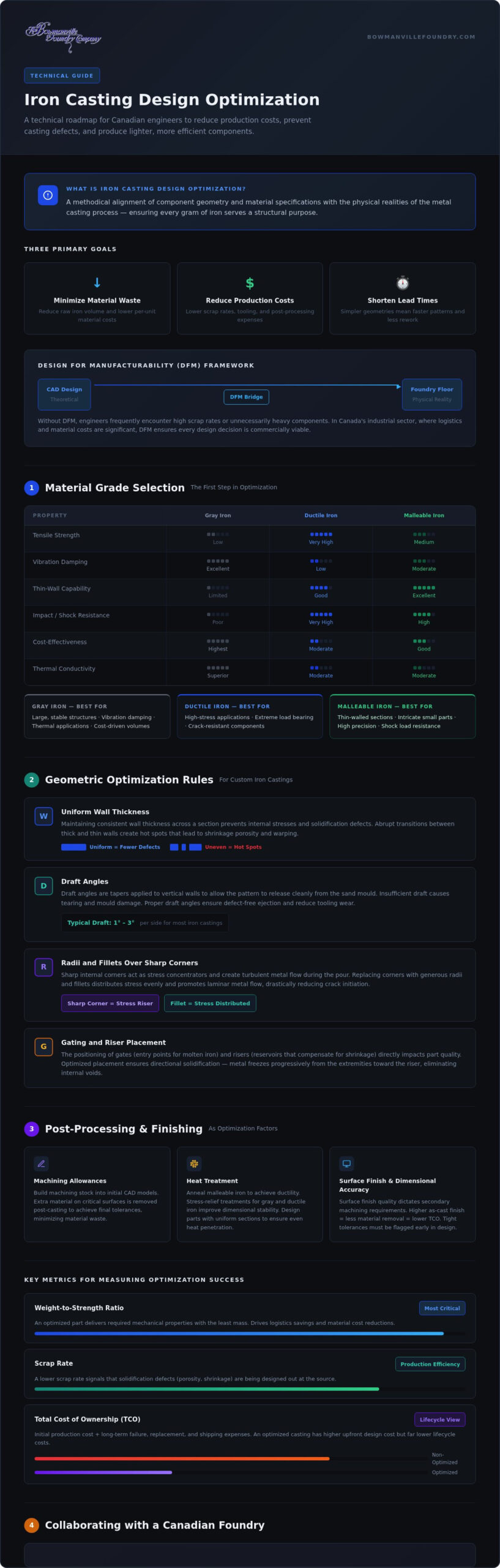
Iron casting design optimization is a methodical approach to refining a component’s geometry and material specifications. It’s more than just drafting a part in CAD; it’s a strategic alignment between engineering requirements and the physical realities of the metal casting process. The primary objective is to produce a high-performance component that minimizes material waste, reduces production costs, and shortens lead times. By focusing on the intersection of metallurgy and geometry, engineers can ensure their designs are not only functional but also commercially viable.
At its core, this process relies on Design for Manufacturability (DFM). DFM acts as the bridge between theoretical design and foundry capability. Without it, engineers often face high scrap rates or components that are unnecessarily heavy. In the Canadian industrial sector, where logistics and material costs are significant factors, iron casting design optimization ensures that every gram of iron serves a structural purpose. Adhering to established standards, such as those set by ASTM, ensures that these optimized designs remain safe and reliable for heavy-duty applications while meeting domestic quality expectations.
The Economic Impact of Optimized Design
Efficiency in design directly correlates with a healthier bottom line. By reducing the overall material volume, engineers can lower the raw material costs for each unit. This is particularly vital when dealing with large volumes of gray or ductile iron. Beyond the initial pour, optimized designs significantly decrease scrap rates. When a part is designed with proper solidification in mind, internal defects like porosity or shrinkage are less likely to occur. This reduces the need for secondary rework or expensive post-processing. Simpler geometries also lead to lower tooling costs, as complex patterns and core boxes are more expensive to manufacture and maintain over time.
Key Metrics for Measuring Optimization Success
Measuring the success of iron casting design optimization requires looking at several technical indicators. The weight-to-strength ratio is often the most critical metric for ferrous components. An optimized part provides the necessary mechanical properties with the least amount of mass. Surface finish quality and dimensional accuracy are also vital; they dictate how much machining will be required later. Finally, engineers should evaluate the total cost of ownership (TCO). This metric includes the initial production cost plus the long-term expenses related to component failure, replacement, and shipping. A well-optimized casting might have a slightly higher design cost upfront but will yield substantial savings throughout its lifecycle.
Material Grade Selection: The First Step in Optimization
Choosing the correct material grade is the foundational step of iron casting design optimization. Before a single line is drawn in CAD, an engineer must understand how the selected iron’s metallurgical properties will dictate the final part’s geometry. If the material choice is flawed, even the most sophisticated geometric refinements won’t prevent failure in the field or defects in the foundry. Each grade of iron offers distinct advantages that shape the boundaries of what’s possible in design. You can’t optimize a shape if the metal doesn’t flow correctly or provide the required strength for that specific form.
Malleable iron provides unique opportunities for engineers who need thin-walled sections without sacrificing toughness. Because it undergoes a specific annealing process, it achieves a level of ductility and impact resistance that gray iron lacks. This makes it ideal for intricate, small components that require high precision and the ability to withstand shock loads. Conversely, gray iron remains the preferred choice for applications requiring superior vibration damping or thermal conductivity. It’s often the most cost-effective solution for large, stable structures where high tensile strength is less critical than mass and stability.
Malleable vs. Ductile Iron: Design Constraints
Understanding the trade-offs between malleable and ductile iron is essential when choosing the ideal iron casting grade for a specific application. Ductile iron is generally prioritized for high-stress applications that require superior toughness and high tensile strength. It features graphite nodules that stop cracks from propagating, allowing it to handle extreme loads. However, the choice between these two impacts more than just strength; it dictates your minimum wall thickness limits. If you’re designing for tight spaces, malleable iron’s fluidity often allows for more complex, thinner geometries than other ferrous metals.
Engineers must also analyse elongation requirements carefully. If a part needs to bend or deform slightly under load without fracturing, the higher elongation of certain ductile or malleable grades is mandatory. Matching these material properties to the intended industrial environment prevents over-engineering. Over-engineering often leads to unnecessarily heavy and expensive components that increase shipping costs and material waste. For complex projects, consulting a technical resource from an established foundry can help clarify which grade aligns with your specific performance goals.
ASTM Standards and Metallurgical Optimization
Navigating ASTM specifications is the best way to ensure material consistency across different production runs. These standards define the required chemical composition and mechanical properties, which directly affect how the molten metal solidifies. Proper solidification is the key to part soundness; if the chemistry is off, you risk internal shrinkage or brittle sections. ASTM standards provide a reliable benchmark for Canadian engineering quality, ensuring that components meet the rigorous safety and performance criteria required in domestic infrastructure and manufacturing. By designing to these specific standards, you ensure that your iron casting design optimization efforts are grounded in measurable, repeatable metallurgical science.
Geometric Optimization Rules for Custom Iron Castings
Once you’ve selected the appropriate material grade, the focus shifts to geometric refinement. Physical form dictates how molten iron behaves during the pour and as it cools. Uniform wall thickness is the most critical rule in iron casting design optimization. When sections vary wildly in thickness, they cool at different rates, which leads to internal stresses, warping, or hot tears. Maintaining a consistent wall thickness ensures even solidification across the entire component, resulting in a structurally sound part with predictable mechanical properties.
Draft angles are equally vital for successful manufacturing. These slight tapers on vertical surfaces allow the pattern to be removed from the sand mould without damaging the cavity. While generic guides often suggest a standard one-degree draft, specific iron grades like malleable or gray iron require more nuanced adjustments based on their unique shrinkage rates. Proper draft angles prevent surface defects and reduce the time spent on mould repair. Similarly, implementing generous fillets and radii at every corner eliminates stress concentrators. Sharp internal corners are prone to cracking and can hinder the flow of molten metal, so rounding these areas is a fundamental requirement for durability.
Directional solidification is the ultimate goal of geometric planning. This involves designing the part so that the metal solidifies starting from the furthest points and moves toward the gating and riser placements. Risers act as reservoirs of molten metal that “feed” the casting as it shrinks during cooling. If a design prevents this flow, internal porosity will likely occur, compromising the integrity of the finished component.
Managing Section Transitions and Ribs
In cases where different thicknesses are unavoidable, engineers must use gradual transitions to blend the sections. A common technique is to use a 3:1 taper to move from a thick area to a thinner one, which avoids the creation of “hot spots” where heat remains trapped too long. If you need to increase the stiffness of a component without adding excessive weight, strategically placed ribs are an effective solution. Ribs provide structural reinforcement while allowing you to reduce mass in non-critical areas. This approach maintains the part’s strength-to-weight ratio, which is essential for reducing material waste and shipping costs.
Core Design and Internal Cavities
Internal cavities require the use of sand cores, which can significantly increase production costs and complexity. To optimize the design, engineers should minimize the use of complex cores whenever possible. When cores are necessary, they must have adequate core prints for support and proper venting to allow gases to escape during the pour. Without sufficient venting, gas bubbles can become trapped, leading to surface or internal defects. It’s a proven fact that simplified internal geometry speeds up the custom iron casting production cycle, allowing for faster turnaround times and a more reliable manufacturing process.
Post-Processing and Finishing as Optimization Factors
In the Canadian industrial sector, environmental factors also play a critical role in finishing. Components destined for outdoor infrastructure or heavy machinery must withstand extreme temperature fluctuations and corrosive road salts. Selecting the right surface coating or plating during the design stage ensures long-term durability in these harsh conditions. Sourcing these services from a single-source supplier who can handle both the pour and the finishing reduces logistical complexity. It also ensures a higher level of quality control over the entire lifecycle of the component. This same commitment to durability and quality is essential in local construction, where custom home builders durham region apply design-build principles to create lasting residential projects.
Engineers must provide adequate material on critical surfaces to meet tight tolerances without over-designing the entire part. Excessive allowances lead to increased tool wear and longer cycle times, while insufficient material can result in scrap if the casting shifts slightly during cooling. Identifying datum points early in the design process is essential; it allows the machinist to align fixtures accurately and ensures repeatable results across large production runs. It’s well-documented that integrated iron casting and machining reduces overall project lead times by eliminating the need to transport heavy components between multiple vendors.
Thermal Optimization via Heat Treatment
Heat treatment is a powerful tool for tailoring the mechanical properties of ferrous metals. For malleable iron, annealing is a mandatory step that transforms the hard, brittle white iron into a tough, machinable material. In complex gray iron castings, stress relieving is often necessary to ensure dimensional stability, preventing the part from warping after it has been machined. Ductile iron components can be further optimized through quenching and tempering to achieve specific hardness levels. If you’re looking to streamline your procurement process, you should partner with an expert foundry that offers these integrated thermal services under one roof.
Collaborating with a Canadian Foundry for Design Success
Success in iron casting design optimization isn’t achieved in isolation. While CAD software provides a theoretical baseline, it can’t replace the practical expertise of a seasoned foundry. Engaging with your manufacturing partner at the concept stage is the single most effective way to prevent costly design revisions later. Early involvement allows the foundry to identify potential issues like improper cooling or gas entrapment before any tooling is created. This proactive approach ensures the final component is optimized for both performance and manufacturability. Waiting until a design is “frozen” often leads to compromises that increase costs and extend lead times.
At Bowmanville Foundry, we leverage over 120 years of institutional knowledge to guide our clients through complex engineering challenges. Since 1902, we’ve seen how minor geometric adjustments can dramatically reduce scrap rates and improve part soundness. By standardizing patterns and tooling from the outset, you create a foundation for long-term production efficiency. This transition from a digital CAD model to a physical prototype becomes a controlled, predictable process rather than a series of expensive trials and errors. We focus on ensuring your design aligns with the specific solidification characteristics of malleable, ductile, or gray iron.
The Foundry Feedback Loop
A robust feedback loop between pattern makers and design engineers is essential for refining part geometry. Pattern makers understand how sand moulds behave under the pressure of molten iron; they can suggest subtle changes to draft angles or parting lines that improve surface finish. We encourage the use of technical data sheets to validate your design assumptions against real-world material performance. A clear Request for Quote (RFQ) process also helps. It ensures that all tolerances, material grades, and post-processing requirements are documented before production begins. This clarity reduces the risk of miscommunication and ensures the final part meets your exact specifications.
Your Resource for Iron Casting Excellence
Bowmanville Foundry serves as a dedicated technical partner for the Canadian manufacturing sector. We don’t just provide malleable, ductile, and gray iron castings; we provide the expertise needed to ensure your project succeeds. Our technical guides are designed to help you streamline your procurement process and avoid common pitfalls in the foundry. We believe an informed engineer is our best partner. To take the next step in your iron casting design optimization journey, Download our Free Casting Buyer’s Guide today. This resource offers deep metallurgical insights and practical advice to help you make informed decisions for your next project.
Advancing Your Casting Design Strategy
Achieving excellence in iron casting design optimization requires a disciplined approach to both metallurgical selection and geometric precision. By prioritizing uniform wall thickness and integrating post-processing allowances into your initial CAD models, you can significantly reduce material waste and production lead times. These technical refinements don’t just improve the “as-cast” component; they ensure the entire manufacturing lifecycle is efficient and cost-effective. Early collaboration remains the most reliable method for identifying potential defects and standardizing tooling for long-term success.
Since 1902, we’ve shared our expertise in malleable, ductile, and gray iron to help engineers navigate complex industrial landscapes with confidence. Our facility provides comprehensive technical data and full post-processing capabilities, acting as a steady hand from the first pour to the final finish. To gain deeper insights into material properties and procurement standards, Download our Free Casting Buyer’s Guide to optimize your next project. We’re committed to helping you realize your engineering goals through technical mastery and dependable craftsmanship. Your next successful component starts with an informed design decision.
Frequently Asked Questions
What are the most common defects caused by poor iron casting design?
The most common defects include internal porosity, shrinkage cavities, and hot tears. These issues often arise when sharp internal corners or abrupt section changes prevent the smooth flow of molten metal. When certain areas cool faster than others, the resulting internal stresses can lead to cracking or structural weaknesses. Proper design ensures that the metal solidifies directionally, which significantly reduces the risk of these manufacturing failures.
How much draft angle is typically required for iron casting optimization?
A standard draft angle of 1 to 3 degrees is typically required for effective pattern removal. This taper prevents the sand mould from being damaged as the pattern is withdrawn. For deeper cavities or more complex geometries in gray and malleable iron castings, a slightly larger angle may be necessary to ensure a clean surface finish. Precise draft selection is a key component of iron casting design optimization to minimize surface defects.
Can I optimize a design to use malleable iron instead of steel?
You can often optimize a design to utilize malleable iron as a high-performance alternative to steel. Malleable iron provides excellent toughness and shock resistance, making it suitable for many industrial applications where steel was previously the default choice. It also offers superior machinability, which can reduce your overall production costs. By refining the geometry to suit the specific solidification properties of iron, you can achieve comparable performance with better manufacturing efficiency.
What is the ideal wall thickness for a ductile iron component?
The ideal wall thickness for a ductile iron component generally starts at a minimum of 3mm to 6mm for smaller parts. While ductile iron has good fluidity, maintaining a thickness within this range ensures the molten metal fills the mould completely without premature cooling. Larger components require thicker walls to maintain structural integrity. Designers should aim for consistency across the part to avoid the internal stresses that occur during uneven cooling cycles.
How does design optimization impact the total cost of an iron casting?
Design optimization reduces the total cost by minimizing raw material volume and lowering scrap rates. When a part is designed for manufacturability through iron casting design optimization, it requires less post-processing and machining. This shortens the production cycle and lowers shipping expenses for lighter components. This approach reduces the total cost of ownership over the component’s lifecycle by ensuring high durability and fewer failures in the field.
Why is uniform cooling important in the design of gray iron parts?
Uniform cooling is essential for gray iron because it prevents the formation of internal stresses and warping. Gray iron relies on the controlled formation of graphite flakes to provide its characteristic vibration damping and thermal conductivity. If one section cools significantly faster than another, the resulting temperature gradient can cause the part to distort or become brittle. Consistent cooling rates ensure the metallurgical properties remain stable across the entire casting.
What information should I provide to a foundry for a design review?
You should provide a comprehensive set of CAD files, the desired material grade (malleable, ductile, or gray iron), and critical dimensional tolerances. It’s also helpful to include information about the intended application and estimated annual production volumes. This data allows the foundry to evaluate the gating requirements and suggest geometric refinements. Providing a clear Request for Quote (RFQ) with these details facilitates a more accurate and helpful technical design review.
How do heat treatment requirements influence the initial design phase?
Heat treatment requirements dictate how much machining allowance you must include in the initial design. For instance, malleable iron requires a mandatory annealing cycle that can cause slight dimensional changes. If your part needs stress relieving for dimensional stability, the geometry must be able to withstand the thermal cycle without distorting. Planning for these thermal processes during the design phase ensures that the final component meets all mechanical specifications after finishing.
