
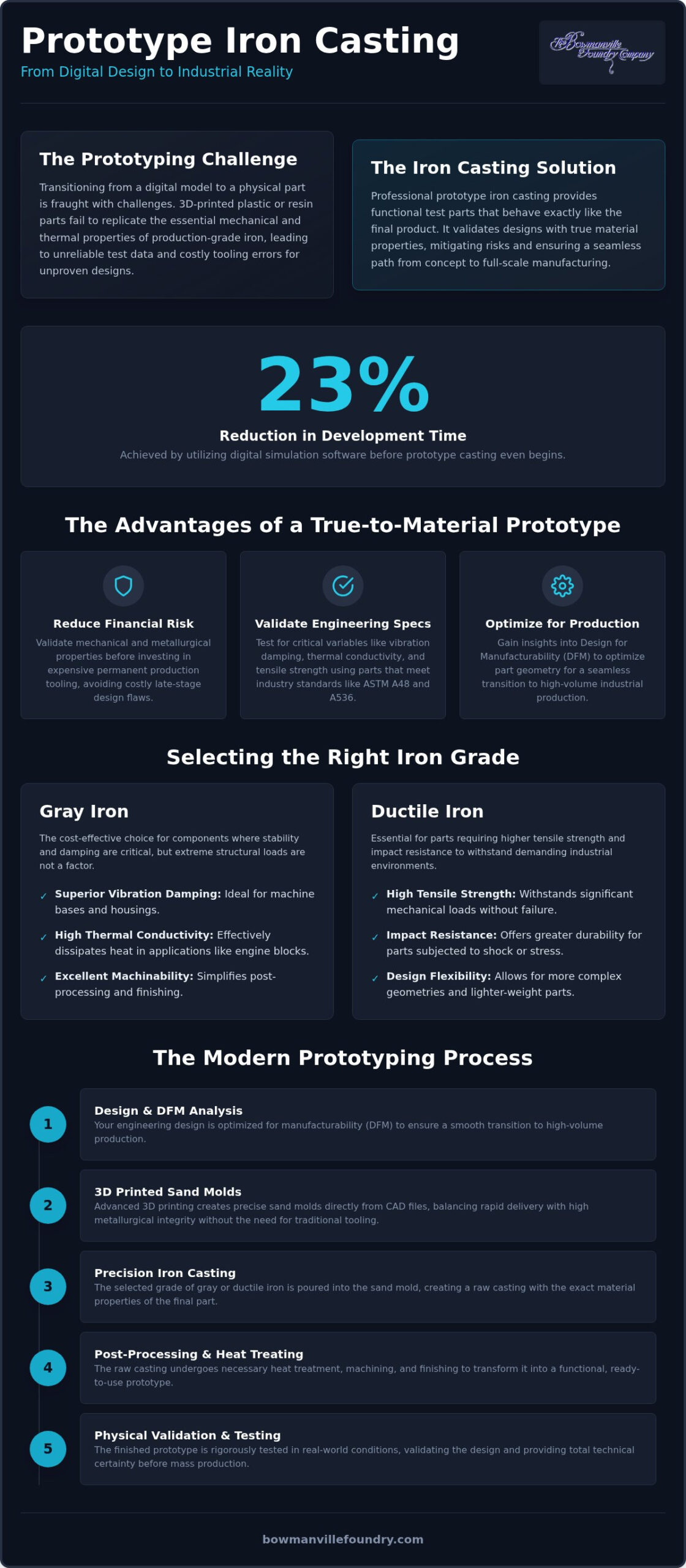
Did you know that utilizing digital simulation software can reduce prototype development time by 23% before full-scale production even begins? For many engineers, the transition from a digital model to a physical part is fraught with challenges, especially when 3D-printed alternatives fail to match the essential material properties of gray or ductile iron. Relying on unproven designs often leads to the high cost of initial tooling for parts that might not perform under real-world industrial stress. Utilizing professional prototype iron casting services ensures that your initial designs are validated through physical craftsmanship and technical precision.
We understand that you need functional test parts that behave exactly like the final product. You’ll find that professional prototype iron casting services provide the critical validation required to bridge the gap between your engineering design and a seamless industrial reality. This article outlines how to reduce the risk of casting failure while securing a clear path to manufacturing. You will learn about the latest metallurgical standards, such as ISO 629:2026, and how modern prototyping techniques help you avoid long lead times and unnecessary expenses. By the end, you’ll realize how to move from concept to production with total technical certainty.
Key Takeaways
- Learn how prototyping reduces financial risk by validating mechanical and metallurgical properties before you invest in expensive permanent production tooling.
- Understand the specific technical criteria for selecting gray, ductile, or malleable iron grades to ensure your prototype mirrors final production requirements.
- Discover how professional prototype iron casting services utilize 3D printed sand molds to balance rapid delivery with high metallurgical integrity.
- Gain insights into Design for Manufacturability (DFM) to optimize your part geometry for a seamless transition to high-volume industrial production.
- Identify the essential post-processing and heat-treating steps required to transform a raw casting into a functional, ready-to-use industrial prototype.
The Role of Prototype Iron Casting in Industrial Product Development
Prototype iron casting is a foundational stage in the manufacturing lifecycle. It allows engineers to verify mechanical and metallurgical properties before committing to the capital-intensive phase of mass production. While digital models and 3D-printed resin parts offer visual confirmation, they don’t replicate the physical behaviour of metal. Professional prototype iron casting services provide parts that possess the exact density, thermal conductivity, and structural integrity of the final component. Referencing a Cast Iron Overview reveals that the complex microstructure of these alloys is what gives them unique industrial advantages, such as superior vibration damping and wear resistance.
Using the actual production material is vital for meaningful field-performance validation. Plastic substitutes fail to provide accurate data regarding how a part will react to stress. If a component is destined for a high-heat or high-vibration environment, testing a resin model is often a wasted effort. A cast iron prototype allows for rigorous assembly testing, ensuring that mating surfaces and fastener points hold up under real mechanical loads without deformation.
Risk Mitigation and Cost Control
Prototyping acts as a safeguard against expensive production errors. Developing a permanent production mould is a significant investment; discovering a design flaw after the mould is finished can be a financial disaster. A prototype run is far more economical than a failed production tool. It also allows engineers to finalize the most cost-effective iron grade for the specific application. By testing different metallurgical compositions early, you can determine if a lighter gray iron will suffice or if the higher tensile strength of ductile iron is necessary for the part’s longevity.
Validating Engineering Specifications
Engineers use prototypes to test for specific variables like vibration damping, thermal conductivity, and tensile strength. These parts must meet rigorous industry benchmarks, such as ASTM A48/A48M for gray iron or ASTM A536 for ductile iron. Utilizing prototype iron casting services ensures that the test components align with these standards from the start. Digital simulation software has been shown to reduce prototype development time by 23% by predicting these outcomes, but physical testing remains the ultimate proof of design. Prototypes verify that all critical dimensions and tolerances are achievable before the project moves to full-scale industrial production.
Selecting the Right Iron Grade for Your Prototype: Gray, Ductile, or Malleable
Choosing the correct material for a prototype is as critical as the design itself. To gain accurate data from your tests, the iron grade must mirror the final production requirements. If you intend to manufacture high-volume parts in ductile iron, a gray iron prototype won’t provide the necessary performance data regarding tensile strength or impact resistance. Professional prototype iron casting services help engineers navigate these metallurgical choices early in the development cycle. Understanding The Iron Casting Process reveals how cooling rates and alloy compositions define these distinct material categories, which ultimately dictates the performance of your component.
Gray Iron for Vibration Damping and Stability
Gray iron is often the most cost-effective choice for industrial components that don’t face extreme structural loads. It’s prized for its superior vibration damping and high thermal conductivity. For prototypes of machine bases, engine blocks, or housings where stability and heat dissipation are paramount, gray iron is the standard. It also offers excellent machinability, which simplifies the post-processing phase for your test parts. If you’re unsure which grade fits your specific stress profile, you can consult our How to Choose the Ideal Iron Casting Grade: A Comprehensive Selection Guide for a detailed technical breakdown of classes and properties.
Ductile and Malleable Iron for Structural Integrity
When your application demands high shock resistance and elongation, ductile or malleable iron is required. Ductile iron is characterized by its nodular graphite structure, providing toughness that rivals some steels. It’s the ideal choice for high-impact automotive or heavy machinery components that must withstand significant stress without brittle failure. Conversely, malleable iron casting Canada is uniquely suited for thin-walled or intricate parts that require significant toughness and the ability to be cast in complex geometries without cracking during the cooling process.
Selecting between these grades involves balancing weight, machining needs, and mechanical stress. Our team specializes in helping you identify the optimal material to ensure your prototype performs exactly as intended in the field. You can contact our engineering team to discuss your specific material requirements today. Utilizing expert prototype iron casting services ensures your project remains on a clear path toward successful, high-quality full-scale manufacturing.
Modern Prototyping Techniques: Balancing Speed and Metallurgical Integrity
Modern manufacturing requires a precise balance between speed and technical accuracy. Traditional methods, while reliable, often struggle with the rapid iteration cycles demanded by contemporary engineering. The American Foundry Society highlights how digitalization is reshaping the industry, allowing for faster turnaround without compromising material properties. For those utilizing professional prototype iron casting services, the choice of technique significantly impacts both lead times and the fidelity of the final test part. In the Canadian market, lead times are being transformed by these digital advancements, allowing for more rigorous testing within tighter project schedules.
Rapid Tooling and 3D Printed Patterns
Rapid tooling often involves 3D printed patterns or even direct 3D sand printing for molds and cores. This approach bypasses the weeks-long process of carving wood or metal patterns, which is particularly useful when designs are still in flux. 3D printed cores allow for complex hollow designs in iron prototypes that would otherwise require intricate and expensive multi-part core boxes. These digital manufacturing solutions have been shown to reduce prototype development time by approximately 23%, providing a significant competitive edge. This flexibility allows engineers to iterate designs quickly based on initial test results without the financial burden of traditional tooling changes.
Traditional Sand Casting for Prototype Runs
Despite the rise of digital methods, traditional sand casting remains the standard for industrial-grade iron prototypes. It ensures the prototype mold accurately reflects production-level surface finishes and metallurgical conditions. For short-run or low-volume prototype batches, foundries often manage pattern costs by using loose patterns or simplified matchplates. This method allows for the creation of functional parts that are metallurgically identical to what will eventually roll off a high-volume production line. CNC-machined patterns are frequently employed here for prototypes that require high dimensional accuracy, ensuring the component meets exact specifications before any secondary machining begins.
Lead times for these various prototyping methods vary based on complexity. Industry data from Canadian foundries indicates that prototype tooling can be 25% cheaper and twice as fast to produce when compared to high-volume production tools. This speed allows for multiple iterations within the same timeframe as a single traditional pattern cycle, ensuring that the final design is fully optimized for industrial reality.
Bridging the Gap: Designing Prototypes for Full-Scale Production
Design for Manufacturability (DFM) is the essential link between a conceptual engineering drawing and a viable industrial product. In the context of iron casting, this means refining a design so it can be poured, cooled, and shaken out with high yield and minimal defects. Utilizing professional prototype iron casting services allows you to test these design assumptions in a physical environment before committing to the high costs of permanent production tooling. A successful prototype run doesn’t just validate the part’s performance; it validates the entire casting process, ensuring that the transition to high-volume manufacturing is predictable and cost-effective.
Engineering Collaboration and Design Review
Early collaboration with foundry engineers during the CAD design phase is one of the most effective ways to optimize a component. By reviewing the design early, engineers can identify potential casting defects like shrinkage or porosity that might not be obvious on a screen. Adjusting the geometry at this stage is significantly cheaper than modifying a finished production mould. We recommend utilizing our free Casting Buyer’s Guide to align your design specifications with our foundry’s specific capabilities. This proactive approach ensures that the prototype reflects a design that is truly ready for the rigours of the foundry floor.
Technical details such as draft angles, wall thickness, and fillet radii must be addressed during the prototype stage. Draft angles are necessary to ensure the pattern can be removed from the sand without damaging the mould. Consistent wall thickness promotes uniform cooling, which is vital for maintaining the desired metallurgical properties. Large fillet radii help distribute stress and prevent cracks during the cooling process. Addressing these factors early ensures that the prototype is a true representation of the final industrial reality.
Scaling from Prototype to Volume Production
The data gathered during a prototype run informs the design of multi-cavity production moulds. It allows the foundry to plan for consistent quality control and inspection protocols as volumes increase from dozens to thousands of units. Maintaining metallurgical consistency across high volumes requires a deep understanding of how a specific iron grade behaves during the pour. A well-executed prototype serves as the technical blueprint for this consistency. If you’re ready to move your design from a digital model into a physical part, contact Bowmanville Foundry to start your design review today.
Turnkey Prototype and Post-Processing Services for Canadian Industry
A raw casting is only the beginning of the prototyping journey. To truly bridge the gap between design and reality, a part must be ready for immediate installation and testing. Comprehensive prototype iron casting services encompass more than just the pour; they include the critical secondary operations that transform a metal shape into a functional engineering component. By consolidating these services under one roof, industrial partners reduce the risk of logistical delays and ensure that the technical intent of the design is maintained from the furnace to the finishing bench.
Precision Machining and Finishing
While sand casting provides excellent near-net shapes, certain assembly points require tolerances that only precision machining can achieve. Secondary machining allows for the creation of perfectly flat mating surfaces, precise bore diameters, and threaded fastener points. Sourcing both the casting and the machining from a single provider eliminates the friction that occurs when a machinist discovers a casting defect mid-cut. Additionally, surface coating options are applied at this stage to prevent corrosion during extended field testing. These coatings ensure the prototype’s surface remains stable, allowing engineers to focus on mechanical performance rather than environmental degradation.
Heat Treating for Enhanced Performance
Heat treatment is the final step in perfecting the microstructure of a cast iron component. For malleable and ductile iron, processes like annealing and stress-relieving are essential to achieve the desired ductility and toughness. These thermal cycles alter the internal structure of the metal, removing internal stresses that could lead to warping or failure during service. Professional prototype iron casting services must account for these microstructural changes to ensure the test part behaves like the production unit. Final validation often includes non-destructive testing (NDT), such as ultrasonic or magnetic particle inspection, to confirm the internal integrity of the part.
Bowmanville Foundry has acted as a dependable partner for national industrial projects since 1902. Our in-house engineering and post-processing capabilities provide a steady, knowledgeable hand for procurement professionals across the country. By providing a clear path from initial pattern development to a ready-to-use prototype, we help you realize your design goals and move toward industrial reality with absolute technical certainty. You’ll find that our legacy of expertise simplifies the inherent complexity of industrial procurement by delivering ready-to-test components that meet your exact specifications.
Advancing Your Design to Industrial Reality
Successful industrial product development relies on the seamless transition from a digital model to a physical part that performs under real-world stress. By utilizing professional prototype iron casting services, you ensure that your design is validated through the exact metallurgical properties required for full-scale production. This process reduces financial risk by identifying potential flaws before you invest in expensive permanent tooling. Whether your project requires gray, ductile, or malleable iron, selecting the right grade and leveraging Design for Manufacturability (DFM) principles is essential for long-term manufacturing success.
Bowmanville Foundry has provided over 120 years of Canadian manufacturing expertise, specializing in turnkey solutions that move your project from initial pattern development to precision machining. Our team acts as a steady, knowledgeable partner, ensuring your ready-to-use prototypes meet critical tolerances and industrial standards. You can Request a custom iron casting quote for your next prototype project to begin your journey toward technical certainty. We look forward to helping you transform your engineering concepts into dependable industrial realities.
Frequently Asked Questions
What is the typical lead time for an iron casting prototype?
Lead times for iron prototypes typically range from a few days to several weeks, depending on the pattern-making method. Utilizing 3D printed sand moulds can significantly accelerate this process by bypassing traditional pattern construction. Industry data suggests that prototype tooling is often twice as fast to produce compared to high-volume production tools. This speed allows engineers to conduct multiple design iterations, ensuring technical certainty before mass production begins.
Can I use a prototype iron casting for functional field testing?
Yes, prototypes produced through professional prototype iron casting services are ideal for functional field testing. Unlike 3D printed resin or plastic models, these prototypes possess the exact metallurgical properties, such as tensile strength and vibration damping, required for the final application. This allows engineers to observe how the part performs under real-world industrial stress. It ensures that the component meets all safety and mechanical specifications before full-scale manufacturing is authorized.
What is the difference between a prototype and a low-volume production run?
The primary difference lies in the intent and the tooling used. A prototype run is designed to validate a part’s design and material properties, often utilizing loose patterns or rapid tooling. A low-volume production run focuses on initial market supply and typically employs more durable, semi-permanent tooling. While both involve small quantities, the prototype phase is a learning process used to refine the design for manufacturability (DFM) before committing to permanent production moulds.
Is it possible to prototype in malleable iron rather than gray iron?
It’s certainly possible to prototype in malleable iron, especially for components that require high shock resistance and thin-walled complexity. Since malleable iron requires a specific heat-treatment process to achieve its final properties, prototyping in this material is essential for validating performance. Professional prototype iron casting services provide test parts that accurately represent the final production material’s unique microstructural characteristics. This ensures the prototype reflects the mechanical toughness required for industrial service.
How does 3D printing integrate with traditional iron casting services?
3D printing integrates with traditional casting by providing rapid patterns or direct sand moulds and cores. This hybrid approach allows foundries to produce complex internal geometries that are difficult or impossible to create with wood patterns. Digital simulation and 3D printing have been shown to reduce prototype development time by 23%. This technology allows for faster design iterations while maintaining the high metallurgical integrity associated with traditional sand casting processes used in Canadian foundries.
What technical data should I provide when requesting a prototype quote?
To provide an accurate quote, you should provide detailed CAD models in standard formats like STEP or IGES. It’s also necessary to specify the desired iron grade according to ASTM standards, such as ASTM A48 for gray iron or ASTM A536 for ductile iron. Including information on critical tolerances, surface finish requirements, and any necessary post-processing, such as heat treating or machining, ensures the foundry can provide a comprehensive technical assessment of your project.
Why is the transition from prototype to production tooling so critical?
The transition is critical because it ensures the validated prototype design is optimized for high-volume efficiency. Moving from a single prototype to permanent, multi-cavity production tooling requires a focus on Design for Manufacturability (DFM) to ensure consistent quality. This phase allows the foundry to finalize gating systems and cooling rates. These factors are essential for maintaining metallurgical consistency across thousands of units during the eventual industrial-scale production run.
Does the foundry offer machining for prototypes?
Yes, our foundry offers comprehensive post-processing services, including precision machining and heat treating for all prototypes. Sourcing both the casting and the machining from a turnkey partner ensures the prototype meets all critical tolerances for assembly. This approach eliminates the logistical complexity of managing multiple vendors. It ensures that the final “ready-to-use” part aligns perfectly with your engineering specifications and the rigorous performance requirements of your industrial application.
