
A single casting failure in a critical assembly doesn’t just stall a production line; it compromises the integrity of your entire engineering reputation. For Canadian procurement professionals, the stakes have never been higher as offshore lead times remain volatile and hidden costs in secondary finishing continue to erode project margins. You likely realize that a low per-unit price is meaningless if the metallurgical grade fails to meet ASTM standards or if the component requires extensive rework before it’s usable. Using a rigorous iron casting supplier checklist is no longer optional; it’s a fundamental requirement for maintaining a stable supply chain in 2026.
We understand the pressure to find a partner who treats your specifications with the same gravity as your own team. This guide provides a technical framework to evaluate foundry capabilities with precision, from raw material traceability to in-house machining capacity. We’ll walk through the essential vetting criteria you need to reduce rejection rates and secure ready-to-use components. This includes a deep look at the latest 2026 regulatory changes, such as the Prohibition of Certain Toxic Substances Regulations, and how they impact your finishing options and material choices.
Key Takeaways
- Learn how to verify a foundry’s proficiency in specific malleable, ductile, and gray iron grades to ensure your components meet exact ASTM engineering requirements.
- Utilize a comprehensive iron casting supplier checklist to audit a foundry’s technical documentation and quality control protocols before finalizing a sourcing agreement.
- Discover the operational advantages of integrated machining and heat treating, which allow you to receive finished, ready-to-use components directly from the foundry floor.
- Identify key indicators of facility health, such as in-house pattern development capabilities and rigorous maintenance schedules that protect your production timelines.
- Understand how domestic sourcing within Canada minimizes geopolitical supply chain risks while providing access to deep institutional knowledge and legacy expertise.
Why a Specialized Iron Casting Supplier Checklist is Essential
Sourcing custom iron components is fundamentally different from commodity purchasing. In a commodity market, price and availability are the primary drivers. In heavy manufacturing, the focus shifts to technical precision and metallurgical integrity. Custom iron casting involves complex phase transformations and cooling rates that dictate the final mechanical properties of the part. Without a structured iron casting supplier checklist, procurement teams risk overlooking the subtle technical nuances that separate a functional component from a liability. A standardized audit process ensures that every potential partner is evaluated against the same rigorous engineering requirements, moving the conversation from simple price-per-pound to total cost of ownership.
The inherent complexity of casting different types of cast iron means your supplier must possess deep institutional knowledge. Whether you require the high tensile strength of ductile iron or the vibration damping of gray iron, the foundry’s expertise is your primary safeguard against catastrophic field failures. A checklist forces a granular review of a foundry’s metallurgical controls and testing procedures. This level of scrutiny is vital for maintaining safety standards and ensuring that the final product can withstand the specific stresses of its intended application.
Defining the Scope of Your Sourcing Project
Before engaging a foundry, you must clearly define the operational environment of your component. Consider the primary mechanical stresses, such as impact, fatigue, or compressive loads, that the part will endure. It’s also vital to determine the level of finishing required. Sourcing ready-to-use components that have already undergone machining and heat treating can significantly reduce your internal overhead and simplify your logistics chain. Your iron casting supplier checklist should account for the supplier’s ability to handle the specific volume and frequency of your production runs to avoid supply chain bottlenecks.
The High Cost of Unqualified Suppliers
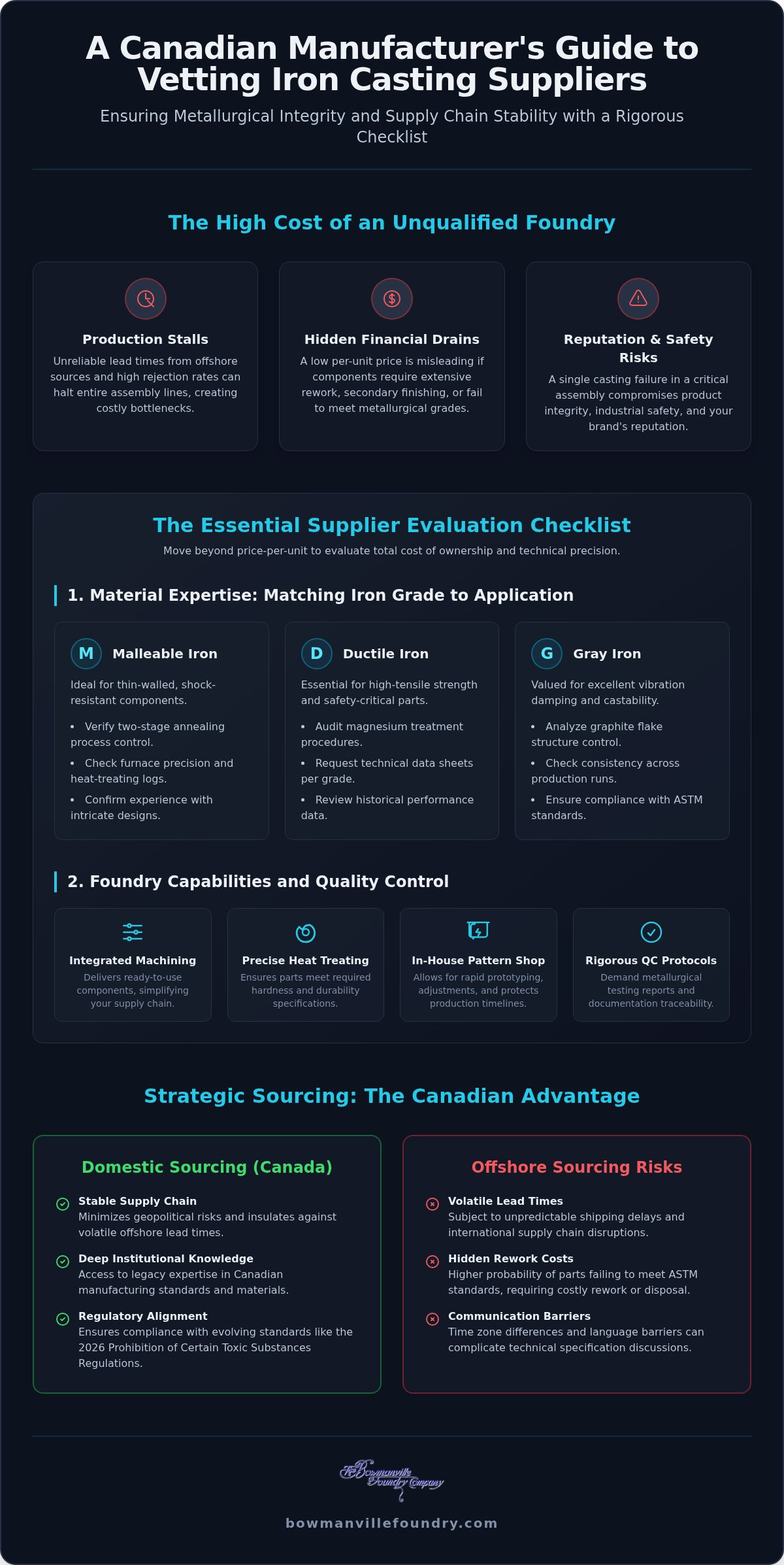
Choosing an unqualified foundry often leads to hidden expenses that far outweigh any initial savings on unit price. Unreliable lead times from offshore sources can stall entire assembly lines, while high rejection rates due to internal porosity or incorrect iron grades necessitate costly rework. Beyond the financial impact, poor material integrity poses a severe risk to industrial safety and your brand’s reputation. A thorough vetting process pays for itself during the very first production cycle by ensuring the foundry can deliver consistent quality that aligns with your engineering requirements and ASTM standards.
Evaluating Material Expertise: Malleable, Ductile, and Gray Iron
The core of any technical audit is verifying the foundry’s proficiency with the specific metallurgy your project demands. While generic metal checklists exist, a specialized iron casting supplier checklist must account for the unique thermal cycles and alloying requirements of ferrous materials. According to Canadian foundry industry statistics, the domestic sector remains a vital pillar for high-quality manufacturing, largely due to this specialized material knowledge. You need to ensure your supplier doesn’t just “pour iron” but understands the microstructure transformations necessary to meet specific ASTM iron casting standards. If a foundry cannot provide specific technical data sheets for each grade they offer, they likely lack the process control required for custom-engineered components.
Matching Iron Grades to Application Requirements
Selecting the correct grade is the first step in preventing field failures. Your vetting process should evaluate the foundry’s historical performance with these specific materials:
- Malleable Iron: This grade requires a rigorous two-stage annealing process to transform brittle white iron into a tough, shock-resistant material. Vetting a supplier involves checking their heat-treating furnace precision and their ability to cast intricate, thin-walled designs.
- Ductile Iron: Used extensively for safety-critical parts, ductile iron relies on nodular graphite to provide high tensile strength and elongation. Verify the foundry performs regular nodularity checks and ultrasonic testing to ensure structural integrity.
- Gray Iron: Known for its superior vibration damping and machinability, gray iron’s performance depends on flake graphite distribution. Ensure the supplier can consistently achieve the desired class through precise carbon equivalent control.
Technical Documentation and Material Traceability
A reliable partner provides transparent, data-driven documentation. Your checklist should include a mandatory requirement for Mill Test Reports (MTRs) and detailed chemical composition breakdowns for every heat poured. In 2026, material expertise is often demonstrated through compliance with updated standards, such as ISO 629:2026, which specifies spectrophotometric methods for determining manganese content. Suppliers must also demonstrate how they manage raw material purity, specifically the quality of scrap metal and pig iron, to prevent tramp elements from compromising the casting’s mechanical properties. Material traceability is a fundamental necessity for any component subjected to high-stress industrial environments. To assist in your evaluation, you might consult a Free Casting Buyer’s Guide to better understand these metallurgical benchmarks.
Assessing Foundry Capabilities and Quality Control Standards
A physical tour or a virtual audit of a foundry facility reveals much about its operational health. When you’re using an iron casting supplier checklist, don’t just look for new machinery; prioritize evidence of rigorous maintenance. A legacy foundry knows that even the most advanced induction furnaces or molding lines require documented maintenance logs to prevent unplanned downtime. You should ask to see these logs and inquire about the frequency of calibration for thermal sensors. Mold consistency and pouring temperature control are the two most critical factors in preventing defects like shrinkage or cold shuts. If a supplier can’t demonstrate how they stabilize these variables, they can’t guarantee a consistent product.
Another vital checklist item is the management of tooling. Determine if the foundry offers in-house pattern development or if they outsource tooling to a third party. In-house capabilities often lead to better design-for-manufacturability feedback and significantly faster revisions. This control over the pattern shop ensures that the tooling is built specifically for the foundry’s equipment, reducing the risk of mold mismatch or premature tool wear. Finally, vet their quality management system for alignment with ISO standards. A robust system doesn’t just check the final part; it audits every step of the process to catch deviations before they become scrap.
Production Capacity and Lead Time Management
Evaluating a supplier’s shop load is essential for ensuring they can scale alongside your business. Ask for their current capacity utilization and how they prioritize production runs during peak demand. A reliable partner manages custom iron casting production by balancing automated lines with manual expertise to maintain steady throughput. They should provide a clear project timeline that accounts for pattern creation, sample approval, and final production. Understanding how they handle unexpected surges in volume will help you identify if they’re a long-term partner or a short-term fix.
Testing and Inspection Protocols
Your iron casting supplier checklist must include a section on non-destructive testing (NDT) and dimensional verification. In 2026, standard visual inspections aren’t enough for safety-critical industrial components. Verify that the foundry offers advanced NDT options such as magnetic particle inspection for surface defects, ultrasonic testing for internal porosity, or X-ray for complex geometries. For dimensional accuracy, inquire about their Coordinate Measuring Machine (CMM) capabilities. These tools ensure that every part adheres to the tight tolerances required for secondary machining. Ask how often they perform quality audits during a single run; frequent, documented checks are the only way to maintain low rejection rates over time.
Post-Processing and Finishing: Ensuring Ready-to-Use Components
Procurement professionals often view casting as a two-stage process: pouring the metal and then finding a machine shop. This fragmented approach introduces significant risk and increases total lead times. A strategic iron casting supplier checklist should prioritize foundries that offer integrated post-processing services. By sourcing ready-to-use components, you eliminate the logistical burden of moving heavy parts between facilities and ensure a single point of accountability for final tolerances. If a part fails inspection after machining, a foundry with integrated services cannot deflect blame to a third-party shop; they own the quality of the finished part.
Precision Machining and Secondary Operations
When evaluating a supplier’s machining capabilities, you must verify their ability to meet critical tolerances on cast surfaces. Iron’s unique properties, particularly the graphite structures in gray and ductile iron, require specific tooling and speeds to avoid surface tearing or tool chatter. Ask if the machining is performed in-house or through a dedicated partner. In-house operations provide a tighter chain of custody and better feedback loops between the machine shop and the pattern shop. This collaboration allows for design-for-manufacturability adjustments that can reduce machining time and cost. For a deeper look at these efficiencies, review our resource on integrated iron casting and machining Canada.
Heat Treating and Surface Integrity
The mechanical properties of iron aren’t finalized until the part has undergone the necessary thermal cycles. Your checklist needs to specify when annealing, stress relieving, or tempering is required. Annealing is essential for malleable iron to achieve its characteristic ductility, while stress relieving is vital for complex gray iron castings to prevent warping during final assembly. Beyond the internal structure, surface integrity dictates how well a part performs in the field. You should assess the foundry’s surface coating options for long-term durability. Whether your application requires basic painting, specialized plating, or advanced rust prevention, the coating must adhere to a properly cleaned surface. In corrosive industrial environments, the durability of the finish is just as important as the strength of the iron itself. To ensure your components arrive ready for immediate installation, you can download our Free Casting Buyer’s Guide for detailed post-processing specifications.
Strategic Sourcing: The Benefits of a Canadian Iron Foundry Partnership
A technical iron casting supplier checklist must eventually weigh the geographical location of the foundry against long-term project stability. While offshore sourcing might offer a lower initial unit price, the complexity of international logistics often introduces hidden risks that a domestic partnership avoids. For Canadian manufacturers, sourcing within the country eliminates customs delays and the volatility of international shipping lanes. This stability is bolstered by government initiatives, such as the 50% freight rate discount for interprovincial steel and industrial shipments on CN and CPKC railways that began in Spring 2026. This makes national sourcing a clear logistical advantage that directly impacts your bottom line.
Beyond logistics, a partnership with a Canadian foundry provides access to legacy expertise that is difficult to replicate. When a facility has operated since 1902, it possesses institutional knowledge that spans generations of metallurgical advancements. This experience is vital when troubleshooting complex geometries or selecting the ideal iron grade for a new application. Your checklist should prioritize the ease of communication and technical support accessibility. The ability to speak directly with an engineer who understands your specific ASTM requirements, without the hurdle of time zone differences or language barriers, ensures that project adjustments happen in hours rather than weeks.
Logistical Advantages and Lead Time Reliability
Choosing a domestic partner allows for a more transparent vetting process. You can conduct on-site facility audits and witness pouring processes without the expense of international travel. This proximity simplifies the “chain of custody” for your components, especially when integrating post-processing services like machining or heat treating. Furthermore, Canadian foundries operate under strict environmental and ethical labour standards. For instance, the “Prohibition of Certain Toxic Substances Regulations, 2025,” which became effective on June 30, 2026, ensures that Canadian-made components comply with the latest restrictions on PFAS and other hazardous materials. This alignment reduces your corporate liability and supports the national industrial economy.
The Final Selection: Beyond the Unit Price
The final stage of your procurement process should focus on the “Total Cost of Ownership” (TCO) rather than the invoice price of a raw casting. A reliable partner reduces long-term engineering and administrative labour by delivering consistent, high-quality parts that don’t require constant re-inspection or rework. When you account for the expiration of certain steel tariff remissions in early 2026, the value of a predictable, domestic supply chain becomes even more apparent. We recommend using our technical resource on how to choose iron casting grade to finalize your material specifications. By combining a rigorous checklist with a strategic Canadian partnership, you secure a supply chain that is built on technical mastery and operational integrity.
Securing Technical Certainty in Your 2026 Supply Chain
Securing a reliable supply chain requires moving beyond simple price comparisons to focus on metallurgical precision and operational integrity. By implementing a rigorous iron casting supplier checklist, you can effectively vet a foundry’s material expertise across malleable, ductile, and gray iron grades while ensuring they meet the latest ASTM standards. We’ve seen that the most successful partnerships prioritize integrated post-processing and finishing services, which allow you to receive ready-to-use components that reduce internal overhead and eliminate logistical bottlenecks. This strategic approach ensures that your components are ready for immediate assembly upon arrival.
Since 1902, Bowmanville Foundry has served the Canadian industry as a legacy institution with deep institutional knowledge. We specialize in custom-engineered iron castings and provide comprehensive in-house machining and heat treating to guarantee the integrity of every part. Our goal is to act as a steady hand, guiding you through complex procurement landscapes to ensure your project’s long-term success.
Download our Free Casting Buyer’s Guide for a complete selection framework to start optimizing your sourcing strategy today. We look forward to helping you build a more resilient and technically sound production line.
Frequently Asked Questions
What are the most important certifications for an iron casting supplier?
ISO 9001:2015 is the baseline certification for any industrial quality management system. For iron-specific work, you must also verify compliance with specific ASTM standards, such as A47 for malleable iron or A536 for ductile iron. These certifications ensure the foundry maintains standardized processes and rigorous documentation across every production run. A technical audit should also confirm adherence to environmental regulations like the Prohibition of Certain Toxic Substances Regulations.
How do I determine if a foundry is capable of casting malleable iron?
Malleable iron requires a specialized two-stage annealing cycle that often lasts several days. You should ask to see their furnace capacity and thermal control records to verify they can manage these long heat-treatment cycles. If a foundry only pours gray or ductile iron, they likely lack the specific heat-treatment infrastructure and metallurgical expertise needed to transform white iron into its tough, shock-resistant malleable state.
What information should I include in an iron casting quote request?
Provide a detailed 2D drawing and a 3D CAD model if available. You must specify the exact iron grade, part weight, and annual volume requirements. It is also vital to clarify if you require secondary machining, heat treating, or surface finishing. Clear specifications prevent quoting errors and ensure the foundry understands your technical requirements from the outset, leading to a more accurate total cost of ownership.
Why should I prioritize a supplier with in-house post-processing services?
In-house services ensure a single point of accountability for the finished part. When post-processing is integrated, the foundry provides immediate feedback on design-for-manufacturability, which reduces total project lead times. This capability is a vital item on any iron casting supplier checklist because it eliminates the risks associated with moving heavy components between multiple third-party vendors and ensures that critical tolerances are met before the part leaves the facility.
What are the typical lead times for custom iron casting in Canada?
Lead times vary based on pattern complexity and current shop load. Generally, the process begins with pattern development and sample approval, which can take several weeks. Once the pattern is finalized, production runs depend on the moulding line schedule. Canadian foundries often provide more reliable timelines than offshore sources by eliminating international shipping and customs delays, which have become increasingly volatile in the current global trade environment.
How can I verify the metallurgical integrity of a delivered casting?
Request a Mill Test Report (MTR) for each heat poured. This document provides a chemical composition breakdown and mechanical property test results. For safety-critical parts, you should also specify non-destructive testing (NDT), such as ultrasonic or magnetic particle inspection. These protocols verify that the internal structure is free of porosity or inclusions, ensuring the component can withstand the stresses of its intended industrial application.
What is the difference between raw casting tolerances and machined tolerances?
Raw casting tolerances are dictated by the moulding process and usually have a wider range due to sand expansion and cooling contraction. Machined tolerances are much tighter, achieved through precision CNC equipment. Understanding this gap is a key part of an iron casting supplier checklist, as it determines which features require secondary operations to meet your assembly requirements and helps you avoid unnecessary costs for over-engineered features.
Can a foundry help me choose the right iron grade for my application?
Yes, foundries with deep institutional knowledge act as technical mentors. They analyze your component’s operational stresses and environmental exposure to suggest the most cost-effective iron grade. Whether you need the damping of gray iron or the shock resistance of malleable iron, an experienced foundry provides the metallurgical expertise to ensure your design is both functional and manufacturable. This guidance is especially valuable during the early design phases of a project.
