
What if the most dangerous threat to your precision-engineered component is completely invisible to the naked eye? You’ve likely felt the frustration of a casting that meets every specification on the foundry floor, only to warp unpredictably once it hits the machining centre. This distortion isn’t a fluke; it’s the result of internal residual stresses locked within the metal during the cooling process. For high-precision applications, stress relief heat treatment for iron castings acts as a critical insurance policy to neutralize these forces before they compromise your project.
We recognize that meeting tight dimensional tolerances is a constant challenge in heavy manufacturing. You need components that remain stable under pressure, not parts that fail prematurely in high-stress environments. This guide explains how professional stress relief ensures the long-term precision and service life of your industrial iron components. We’ll examine the specific thermal cycle requirements for gray, ductile, and malleable iron, providing you with the technical clarity needed to produce stable, ready-to-machine castings every time.
Key Takeaways
- Understand how residual stress, created by uneven cooling rates, compromises the dimensional stability of industrial iron components during machining.
- Discover why stress relief heat treatment for iron castings utilizes sub-critical temperatures to preserve material hardness while neutralizing internal tension.
- Identify the unique thermal cycle requirements for gray, ductile, and malleable iron to ensure reliable performance across different metallurgical grades.
- Learn the “Rough Machine First” rule to optimize your manufacturing workflow and achieve the tightest possible dimensional tolerances.
- Explore the advantages of an integrated “ready-to-use” service model that combines expert casting with in-house post-processing and engineering support.
The Hidden Danger of Residual Stress in Iron Castings
Residual stress is a mechanical tension that becomes “locked” into the metallic lattice during the transition from liquid to solid state. While a casting may appear inert after it reaches room temperature, it often contains significant internal forces. If these forces aren’t addressed through stress-relieving heat treatment, they can lead to catastrophic failure during service or unpredictable movement during machining. These stresses are not merely a surface issue; they exist throughout the cross-section of the component, waiting to be released by external triggers like heat or material removal.
Thermal Gradients and Solidification
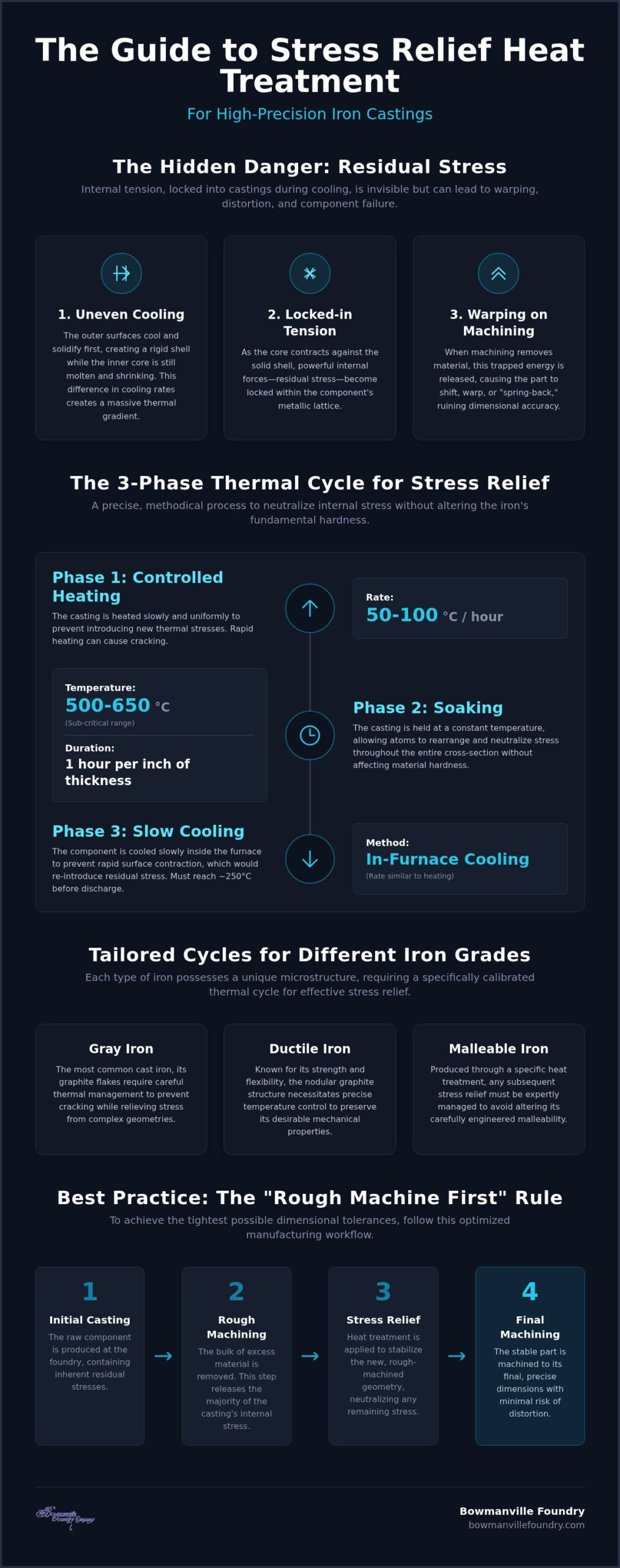
As molten iron enters the mould, the outer surfaces in contact with the sand cool and solidify first, forming a rigid shell. The interior core remains liquid and continues to shrink as it loses heat. In components with radical changes in cross-sectional area, such as a thin flange connected to a heavy hub, these uneven cooling rates create a massive thermal gradient. Thermal contraction in ferrous metallurgy is the physical reduction in volume that occurs as the material cools, and when this contraction is restrained by already-solidified sections, internal stress is the inevitable result. Complex geometries often act as stress concentrators, where the internal tension is highest and most likely to cause cracking or warping over time.
The Consequences for Machining Precision
One of the most frustrating scenarios for an engineer is a part that passes inspection at the foundry but fails to meet tolerances at the machine shop. This happens because machining removes specific layers of the casting, which physically releases the internal tension. This phenomenon, known as the “spring-back” effect, causes the part to shift or distort as the metal seeks a new equilibrium. Without stress relief heat treatment for iron castings, the precision of your final component is essentially at the mercy of these hidden forces.
Utilizing integrated iron casting and machining Canada ensures that these post-processing requirements are managed under one roof, preventing dimensional instability before the first tool ever touches the part. Skipping this step often results in scrapped parts, broken tools, or premature component failure in high-load industrial environments. By stabilizing the material before machining, you ensure that the dimensions recorded in the shop are the dimensions that will remain during the component’s entire service life.
The Thermal Cycle: How Stress Relief Heat Treatment Works
Executing a successful stress relief heat treatment for iron castings is a methodical exercise in thermal management. It is not enough to simply “heat the part.” The process requires a calibrated furnace environment where the atmosphere is carefully managed to prevent excessive scaling or surface oxidation. The objective is to reach a state of mechanical equilibrium where internal tensions are neutralized without triggering phase changes in the iron’s microstructure. This requires precise control over three distinct phases: heating, soaking, and cooling.
The Standard Stress Relief Process Flow
The cycle begins with controlled heating. If a casting is heated too quickly, the exterior expands at a significantly faster rate than the core, which can actually introduce new stresses or cause cracking. A typical industrial heating rate ranges between 50°C and 100°C per hour, depending on the complexity and section thickness of the component.
Once the target temperature is reached, the “soak” phase begins. For most gray and ductile iron components, this temperature sits between 500°C and 650°C. This is a sub-critical range, meaning it is high enough to allow the atoms to rearrange and relax their “locked” positions, but low enough to avoid changing the material’s fundamental hardness. A standard rule of thumb is to maintain this temperature for one hour per inch of the thickest cross-section to ensure the entire mass reaches equilibrium.
The final phase is slow, controlled cooling. This is often where the most critical errors occur. If a part is pulled from the furnace and exposed to ambient air too soon, the rapid surface contraction will re-introduce residual stress. Parts must remain in the furnace, cooling at a rate similar to the heating phase, until they reach approximately 250°C before being discharged.
Temperature Control and Metallurgical Integrity
It’s vital to differentiate stress relief from other heat treatments like annealing or normalizing. While annealing involves heating the metal above its critical transformation point to soften it, stress relief focuses solely on relaxing the grain structure. This allows you to maintain the specific mechanical properties, such as tensile strength and wear resistance, that were designed into the original iron grade.
Quality assurance in this process relies on furnace calibration and digital logging. Every batch should have a recorded thermal profile to prove that the “soak” was consistent and the cooling was gradual. Professionals seeking to refine their procurement process can find more technical details in our Free Casting Buyer’s Guide, which outlines how these thermal cycles impact the final quality of industrial components.
Comparing Stress Relief Requirements Across Iron Grades
Selecting the correct thermal profile depends entirely on the metallurgical structure of the component. While the general mechanics of the furnace cycle remain consistent, the specific parameters of stress relief heat treatment for iron castings must be tailored to the specific iron grade. As outlined in our iron grade selection guide, the distribution of carbon and the morphology of graphite significantly influence how a material absorbs and dissipates thermal energy.
Graphite morphology plays a decisive role in heat distribution. In gray iron, graphite exists as interconnected flakes, which provide excellent thermal conductivity but also create internal “notches” where stress can concentrate. Ductile iron, conversely, contains graphite in spherical nodules. These nodules improve the material’s toughness but change its thermal response, requiring a more precise soaking period to ensure uniform stress relaxation without compromising the matrix.
Stress Relief for Gray Iron Castings
Gray iron is prized for its vibration-damping capacity, a property directly linked to its flake graphite structure. However, this same structure makes the material susceptible to pearlite decomposition if heat treatment temperatures exceed 620°C. If the pearlite breaks down into ferrite and graphite, the casting loses significant tensile strength and wear resistance. For precision components like engine blocks or machine tool bases, the thermal cycle typically targets a range between 540°C and 620°C. This window is high enough to relax the grain structure but low enough to preserve the pearlite matrix, ensuring the casting remains stable during final grinding or honing operations.
Heat Treating Ductile and Malleable Irons
Ductile and malleable irons present a different set of challenges. Ductile iron requires a carefully managed cooling rate to prevent the formation of brittle phases that could lead to sudden failure in high-load environments. Malleable iron is even more specialized; because its properties are achieved through an extensive initial annealing process, any subsequent stress relief must be handled with extreme care.
The goal with malleable iron is to preserve its unique ductility while removing the tensions introduced during casting or rough machining. While ductile iron is often ready for use after a standard cycle, malleable components may require tighter temperature tolerances to avoid altering the ferritic or pearlitic structure established during its first heat treatment. Choosing between these materials often involves weighing the cost of post-processing against the required mechanical performance, a decision where engineering support becomes invaluable.
Best Practices for Specifying Post-Casting Heat Treatments
Integrating post-processing into the design phase is essential for long-term project success. When planning custom iron casting production, engineers must decide early if a component should be delivered as-cast or in a heat-treated state. While many parts perform well as-cast, those requiring tight tolerances or complex machining benefit from a formalized stress relief heat treatment for iron castings. Working closely with your foundry partner allows you to determine if the added step is a necessary investment based on the final application of the part.
The Ideal Workflow for Precision Components
A common mistake in industrial procurement is performing stress relief before any material is removed. The “Rough Machine First” rule suggests that you should remove the bulk of the waste material before the final thermal cycle. This process releases the most aggressive residual stresses early in the manufacturing sequence. By leaving approximately 1.5 mm to 3.0 mm of “meat” on critical surfaces, you provide enough material for a final finish pass after the metal has stabilized.
Consider a high-tolerance bracket for heavy mining machinery. If finished to final dimensions immediately after casting, the part might warp by several thousandths of an inch over the following weeks as internal tensions settle. By rough machining, stress relieving, and then performing the final finishing, the component maintains its dimensional integrity throughout its service life. This sequence ensures that the “memory” of the metal is cleared before the final, high-precision cuts are made.
ASTM Standards and Documentation
Contractual clarity is the best defence against component failure. When specifying your requirements, reference recognized standards such as ASTM A48 for gray iron or ASTM A536 for ductile iron. These documents provide a framework for chemical and mechanical properties, but you should explicitly add stress relief as a mandatory post-processing step if your application demands high stability.
Always request heat treatment charts and certificates of compliance to verify the process. A digital furnace log provides a literal map of the thermal cycle, proving the part reached the correct soaking temperature and cooled at a rate that prevented the re-introduction of stress. This documentation ensures full traceability from the initial pour to the final thermal cycle, providing the technical certainty required for critical industrial assemblies. If you’re unsure which standard applies to your specific design, contact our engineering team to discuss the metallurgical requirements of your project.
Comprehensive Iron Casting and Finishing at Bowmanville Foundry
Managing a complex industrial project requires a partner who understands the relationship between metallurgical integrity and final dimensional precision. Since 1902, Bowmanville Foundry has provided high-quality malleable, ductile, and gray iron production for critical Canadian industrial infrastructure. By acting as a single-source supplier for both casting and post-processing, we eliminate the logistical risks associated with moving components between multiple vendors. This integrated approach ensures that every specification, from the initial chemical composition to the final thermal cycle, is managed under one roof.
Integrated Post-Processing Services
Our capabilities extend far beyond the initial pour. We provide a full suite of post-processing services, including machining, surface coating, and assembly, to deliver components that are ready for immediate installation. Stress relief heat treatment for iron castings is a core component of this integrated workflow. By keeping these secondary operations in-house, we significantly minimize lead times and maintain absolute control over the quality of the finished part.
When a component undergoes stress relief heat treatment for iron castings at our facility, it moves seamlessly from the furnace to our finishing department. This eliminates the potential for environmental contamination or handling damage that can occur during transit to third-party heat treaters. Whether your project requires a simple gray iron base or a complex malleable iron bracket, our process ensures the material is stabilized and finished to your exact tolerances before it leaves our floor.
Partnering for Engineering Success
Success in heavy manufacturing is rooted in technical certainty. Our engineering team acts as a patient mentor, providing access to extensive technical data and application guides to help you make informed decisions. We don’t just take orders; we evaluate your project’s requirements to determine if heat treatment is a necessary investment for your specific application. This “no-nonsense” approach is built on transparency and technical mastery, ensuring that you receive the most cost-effective and reliable solution for your needs.
Our commitment to institutional knowledge means we’re always available to answer detailed inquiries regarding material properties or thermal cycle requirements. We value the success of your project as much as you do, and we’re dedicated to sharing our expertise to ensure your industrial components perform as intended for their entire service life. Consult with our engineers for your next iron casting project to learn how our integrated casting and finishing services can streamline your procurement process.
Securing Long-Term Precision in Industrial Castings
Residual stress is more than a metallurgical theory; it is a significant manufacturing risk that can compromise your tightest tolerances. By implementing a methodical stress relief heat treatment for iron castings, you ensure that your components remain dimensionally stable throughout their entire service life. This process neutralizes internal tension established during cooling, which allows for predictable machining and prevents premature component failure in high-stress environments.
Since 1902, Bowmanville Foundry has specialized in the production of high-precision malleable, ductile, and gray iron. Our comprehensive in-house finishing and heat treatment capabilities allow us to manage every stage of the manufacturing cycle, ensuring your components are delivered ready for immediate installation. We provide the technical clarity and engineering support required to reduce complexity in your procurement process. Please Request a Quote for Custom Iron Castings and Post-Processing to see how our expertise can support your specific project requirements. We look forward to helping you achieve the technical certainty your industrial applications demand.
Frequently Asked Questions
What is the primary purpose of stress relief heat treatment for iron castings?
The primary goal is to ensure dimensional stability by neutralizing internal tensions that develop during the cooling process. Without this treatment, those locked-in forces can cause the metal to warp or distort as soon as it is machined or exposed to operational heat. By stabilizing the grain structure, stress relief heat treatment for iron castings provides a reliable foundation for high-precision components that must maintain their shape throughout a long service life.
Can I perform stress relief in a standard industrial oven?
Standard industrial ovens typically lack the sophisticated thermal controls required for this metallurgical process. Effective stress relief necessitates a specialized furnace capable of managing precise heating and cooling ramps, often between 50°C and 100°C per hour. A standard oven cannot usually provide the uniform atmosphere control or the slow, linear cooling rates needed to prevent the re-introduction of thermal stresses during the final stage of the cycle.
Does stress relief heat treatment change the hardness of the iron?
When performed correctly within sub-critical temperature ranges, this process does not alter the material’s hardness or tensile strength. Because the furnace temperature remains below the transformation point, the pearlite and ferrite ratios established during the initial pour are preserved. This allows the internal grain structure to relax and shed its mechanical “memory” without compromising the specific wear resistance or mechanical properties designed into the original iron grade.
How much time does the stress relief process typically add to production?
The entire cycle generally adds 24 to 48 hours to the production timeline. This duration includes the time required for a controlled temperature ramp-up, a soaking period of approximately one hour per inch of the thickest cross-section, and a critical furnace-cooling phase. Rushing any of these steps can lead to inconsistent results, so the methodical pace is a necessary requirement for ensuring the metallurgical integrity of the finished industrial component.
Is stress relief necessary for all gray iron castings?
While not every simple casting requires it, the process is essential for gray iron components with complex geometries or varying wall thicknesses. Parts like engine blocks, precision machine bases, and pressure-containing components often mandate this treatment to prevent unpredictable distortion. If your component must meet tight tolerances or operate in a high-stress environment, skipping this step increases the risk of premature failure and costly machining errors.
What is the difference between stress relieving and annealing in metallurgy?
The distinction lies in the target temperature and the intended effect on the microstructure. Stress relieving is a sub-critical process that relaxes internal tension without changing the metal’s hardness. Annealing, however, involves heating the iron above its critical transformation temperature to intentionally soften the material or alter its grain structure. While both involve heat, stress relief preserves the as-cast mechanical properties whereas annealing fundamentally transforms them.
Should I machine my iron castings before or after heat treatment?
The most effective workflow involves rough machining the casting before the final stress relief cycle. This “Rough Machine First” approach allows the most aggressive internal stresses to be released as the bulk of the waste material is removed. Following this with stress relief heat treatment for iron castings stabilizes the remaining metal. This ensures that the final precision finishing cuts are made on a neutralized part that will not “spring” out of tolerance.
How do I know if my casting has high residual stress?
The most common indicator of high residual stress is unpredictable movement or “spring-back” during machining operations. If a part meets its dimensional specifications on the first cut but shifts out of tolerance after subsequent material removal, internal tensions are likely present. In some cases, high stress manifests as visible cracking or warping immediately after the casting is removed from the mould, particularly in designs with radical changes in cross-sectional thickness.
