
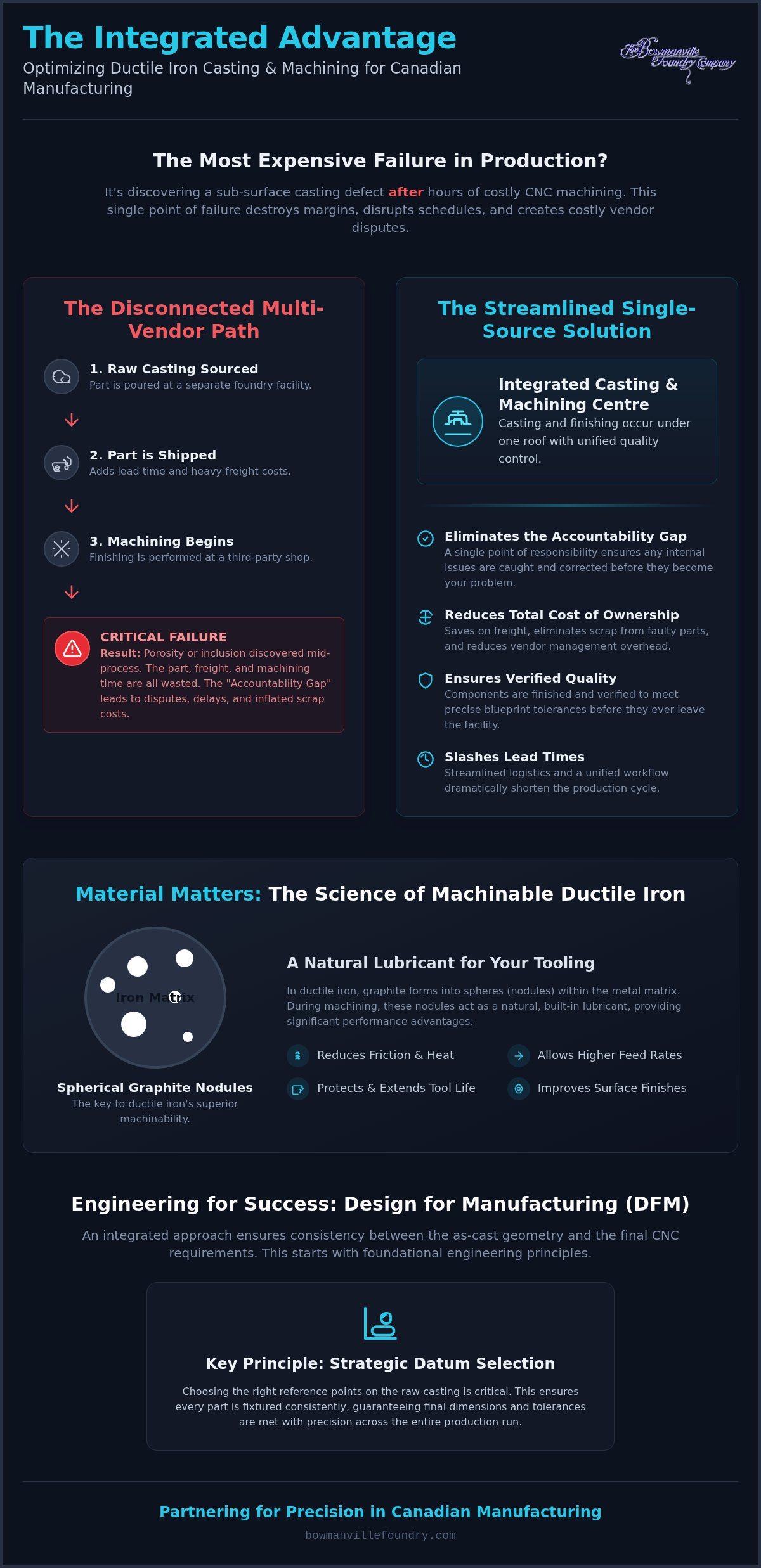
The most expensive failure in your production cycle isn’t a high material cost; it’s discovering a sub-surface casting defect only after your CNC tools have already spent hours on the bench. When machining ductile iron castings, the discovery of late-stage porosity or inclusions doesn’t just waste time; it destroys your margins and disrupts your assembly schedule. You’ve likely felt the frustration of logistical delays and the accountability gap that occurs when a foundry blames the machine shop for a failed part. It’s a common pain point in Canadian manufacturing that complicates supply chains and inflates scrap costs.
By integrating casting and machining at a single source, you can eliminate these disputes and significantly reduce your total cost of ownership. This article explores how a single-source strategy optimizes metallurgical performance, protects your tool life, and slashes lead times through unified quality control. We’ll examine why a direct manufacturer approach provides a strategic advantage that brokers can’t match, ensuring your components meet precise tolerances before they ever leave the shop floor.
Key Takeaways
- Consolidating casting and finishing at a single Canadian source eliminates the accountability gap and ensures parts meet final tolerances without vendor disputes.
- Understand how the metallurgical properties of graphite nodules act as a natural lubricant to optimize tool life and performance during machining ductile iron castings.
- Learn to reduce total cost of ownership by eliminating heavy freight movements and identifying scrap risks before they impact your assembly schedule.
- Discover how Design for Manufacturing (DFM) principles, such as strategic datum selection, ensure consistency between the as-cast geometry and final CNC requirements.
Beyond the Pour: The Role of Machining in Modern Foundry Services
Integrated machining is the practice of finishing a raw casting to its final, blueprint-specified tolerances within the same facility where the metal was originally poured. For decades, the standard industrial workflow involved sourcing a raw “as-cast” part from a foundry and then shipping it to a secondary machine shop for finishing. However, modern Canadian industrial projects increasingly require “ready-to-use” components. This shift is driven by the need to streamline supply chains and reduce the logistical friction inherent in managing multiple vendors for a single part.
When you consolidate these services, you eliminate the common “accountability gap” that occurs when a machine shop discovers a casting defect halfway through a production run. By performing the finishing work at the source, the foundry can identify internal issues like sub-surface porosity or inclusions immediately. This reduces waste and ensures that only verified, high-quality components reach your assembly line. Understanding the metallurgy of ductile iron is essential here, as the material’s internal structure directly dictates how it responds to cutting tools.
Defining Machining Capabilities for Ferrous Alloys
Precision machining for iron requires a specific set of operations, including milling, drilling, tapping, and precision boring. There’s a critical distinction between rough machining and high-precision finishing. Roughing is often used to remove the “casting skin” or surface scale, while finishing achieves the exact dimensional accuracy required for mechanical interfaces. When machining ductile iron castings, specialized tooling is necessary to manage the material’s varying surface hardness. Using the wrong tool geometry can lead to rapid wear or poor surface finishes; therefore, the foundry’s technical expertise in ferrous metallurgy is a significant asset during the setup phase.
The Evolution of Canadian Iron Foundries
The Canadian manufacturing landscape has evolved significantly since the early 20th century. Foundries have transitioned from traditional “pour-and-ship” houses into high-tech integrated manufacturing centres. At Bowmanville Foundry, a legacy of craftsmanship dating back to 1902 informs our modern CNC post-processing workflows. This combination of institutional knowledge and advanced technology is vital for maintaining national infrastructure. Reliable domestic technical support ensures that Canadian engineers can get direct answers about tolerances and material properties without the delays associated with international brokers or offshore suppliers.
Material Matters: How Ductile Iron Metallurgy Influences Machining Performance
The performance of any component begins long before it reaches the CNC spindle. Machinability isn’t just a secondary consideration; it’s a core property determined by the iron’s micro-structure, specifically the distribution and shape of graphite within the metal matrix. In ductile iron, graphite is present as spheres or nodules. These nodules act as a natural lubricant for cutting tools, reducing friction and heat at the tool-workpiece interface. This inherent lubrication is one of the primary machinability advantages of ductile iron, allowing for higher feed rates and improved surface finishes compared to many steel alloys.
Foundry control is paramount during the cooling stage. If the cooling rate is too rapid, or if the chemistry is slightly off, the iron can develop “hard spots” or primary carbides. These brittle structures are significantly harder than the surrounding matrix and can cause catastrophic tool failure or rapid edge wear. Integrated facilities manage this risk by monitoring the inoculation process and cooling cycles, ensuring that every batch is consistent and free from these machining hazards. Balancing mechanical strength with the ease of final machining requires a deep understanding of how pearlite and ferrite ratios affect the final product.
Ductile vs. Malleable Iron: Machining Comparisons
While ductile iron is famous for its strength, malleable iron offers distinct benefits for specific applications. The annealing process used in malleable iron production creates a unique micro-structure that allows for exceptionally tight tolerances on smaller, complex parts. It’s often preferred for thin-walled components where impact resistance is critical. Conversely, when machining ductile iron castings, engineers often find superior depth-to-diameter drilling ratios. This makes ductile iron a more efficient choice for heavy-duty components requiring deep, precise bores. For a deeper look at these metallurgical differences, consult The Comprehensive Guide to Malleable Iron Casting in Canada.
Optimizing Tool Life with Gray and Ductile Iron
Gray iron contains graphite in flake form rather than nodules. These flakes provide even more internal lubrication, making gray iron one of the easiest ferrous metals to machine at high speeds. However, this comes at the cost of ductility and tensile strength. Selecting the correct grade is a strategic decision that impacts both the part’s longevity and your shop’s spindle speeds. If you’re unsure which material fits your project, you can learn how to choose the ideal iron casting grade to maximize your machining efficiency. Our technical team can help you review your specifications to ensure the material properties align with your production goals.
Single-Source vs. Multi-Vendor Procurement: Evaluating Total Cost of Ownership
Selecting a vendor based solely on the lowest per-unit quote for a raw casting often leads to unforeseen expenses downstream. For Canadian procurement professionals, the true value of a component is measured by its Total Cost of Ownership (TCO). This includes not just the purchase price, but the costs associated with logistics, quality inspections, and the “accountability gap.” This gap occurs when a machine shop identifies a defect in a casting and the foundry refuses to accept responsibility, claiming the issue was caused by improper tool pressure or fixturing. When machining ductile iron castings at the source, this friction disappears. The foundry takes full ownership of the finished dimensions, ensuring that the internal solidification behaviour of the metal supports the final machining requirements.
Quality control becomes a unified process rather than a fragmented one. Instead of managing separate inspection reports for the raw pour and the final finish, you receive a single, comprehensive document verifying that the completed part meets all specifications. This level of transparency is essential for high-stakes projects in the mining, agriculture, and transportation sectors. It provides a steady, knowledgeable hand that guides the component from the furnace to the final CNC station without the risk of finger-pointing between vendors.
The Hidden Costs of Split-Source Procurement
Splitting production between two facilities introduces several logistical burdens that are often omitted from initial budget estimates. Consider these factors:
- Freight and Handling: Shipping heavy iron components between a foundry and a machine shop adds significant transport costs and increases the carbon footprint of your project.
- Redundant Inspections: Your team must manage incoming inspections at both the machine shop and your own assembly plant, doubling the administrative labour.
- Material Degradation: Raw iron is susceptible to surface oxidation. Moving parts between facilities increases exposure to moisture and the risk of transit damage, which can complicate the finishing process.
Streamlining the Canadian Supply Chain
Efficiency in modern manufacturing relies on simplicity. Managing one purchase order and one invoice for a “ready-to-install” part is far more productive than balancing multiple vendor schedules. By using a partner that offers Integrated Iron Casting and Machining in Canada, you benefit from synchronized production. The foundry can adjust the casting schedule based on real-time capacity in the machine shop, effectively shortening overall lead times. This integrated approach allows for immediate technical adjustments, ensuring that the machining ductile iron castings process is optimized for the specific metallurgical properties of each batch.
Engineering for Success: DFM in Iron Castings
Design for Manufacturability (DFM) represents the critical transition from a raw metallurgical pour to a precision-engineered component. While a design might be functional on paper, it must be optimized for the physical realities of the foundry and the machine shop. When machining ductile iron castings, the most significant cost drivers are often setup time and tool engagement. By addressing these factors during the initial engineering phase, you can reduce labour-intensive fixturing and ensure that the part’s geometry supports efficient material removal.
One of the most overlooked aspects of DFM is datum selection. A datum is a reference point used for measurement and machining. It’s essential that the “as-cast” datums align perfectly with the “machined” datums. If these points shift between the foundry’s inspection and the CNC setup, the finished part may fail to meet dimensional accuracy even if the raw casting was within spec. Managing material allowances is equally vital. The Required Machining Allowance (RMA) grades, as defined by international standards like ISO 8062-3:2023, provide a framework for determining how much extra metal is necessary. You must provide enough stock to ensure the tool can penetrate below the casting skin to reach the cleaner metal beneath, but excessive allowance leads to wasted cycle time and increased tool wear.
Optimizing Geometry for CNC Tooling
High-speed milling requires rigid clamping to prevent vibration and chatter. Integrating temporary machining lugs into the casting design provides stable points for hydraulic or manual clamps. These lugs are removed during the final operation, but they allow for much more aggressive feed rates in the interim. Additionally, engineers should aim to minimize deep-hole drilling in complex iron castings. It’s often more efficient to use sand cores to create internal passages, leaving only a small amount of material for a final precision boring operation. Draft angles must also be carefully planned; they should never interfere with critical faces that require a perpendicular finish.
Pattern Development and Technical Data
Dimensional accuracy starts with the pattern. Modern pattern development relies on sophisticated metallurgical data to predict how the iron will shrink as it cools. This coordination between the pattern shop and the CNC programmers ensures that thermal expansion is accounted for before the first mould is ever made. CAD/CAM integration at the foundry level allows for a seamless flow of data, reducing the risk of manual translation errors. For a detailed breakdown of these technical requirements, you can refer to our guide on Optimizing Custom Iron Casting Production. Our engineering team is available to help you review your technical drawings to ensure your parts are optimized for both the pour and the finish.
Partnering for Precision: The Bowmanville Foundry Integrated Advantage
Selecting a partner for machining ductile iron castings is a decision that impacts the entire lifecycle of your project. It’s not merely about finding a vendor with a CNC machine; it’s about securing a partner who understands the relationship between the furnace and the finished part. At Bowmanville Foundry, we’ve spent over 120 years refining the synergy between metallurgy and mechanical finishing. This long-standing expertise allows us to act as a steady, knowledgeable hand, guiding your components through the complexities of industrial procurement without the risks inherent in offshore or broker-based supply chains.
Transitioning from a traditional “raw-casting-only” source to a fully integrated manufacturing partnership provides a significant strategic advantage. When the same team that pours the metal also handles the final tolerances, the accountability gap disappears. We take full responsibility for the integrity of the component, ensuring that every ready-to-use part meets your exact specifications. This commitment to delivering custom-engineered iron components nationally ensures that Canadian infrastructure projects remain reliable, durable, and on schedule.
A Legacy of Canadian Craftsmanship
Since 1902, our facility has provided direct manufacturer accountability for high-stress industrial applications. We specialize in malleable, ductile, and gray iron, allowing us to meet a diverse range of engineering needs across sectors like mining, agriculture, and transportation. Working with a domestic partner who understands the Canadian industrial landscape means you don’t have to worry about international shipping delays or misaligned technical standards. Our legacy isn’t just about age; it’s about the institutional knowledge we apply to every project, ensuring that the machining ductile iron castings process is as efficient and precise as possible.
Taking the Next Step in Procurement
The path to a more efficient supply chain begins with informed decision-making. We encourage you to utilize our free Casting Buyer’s Guide to better understand the nuances of material selection and process optimization. This resource is designed to help you make technical choices that reduce total cost of ownership and improve part performance. When you’re ready to move forward, our team can provide a comprehensive quote for integrated casting and machining services tailored to your specific requirements. We’re here to provide the technical certainty you need for your next project. Contact Bowmanville Foundry today to discuss your custom engineered iron requirements and experience the benefit of a century of Canadian manufacturing excellence.
Optimizing Your Production with Integrated Iron Solutions
Consolidating your supply chain is a strategic move to protect your margins and ensure component reliability. By integrating the pour and the finish, you eliminate the accountability gap and ensure that the metallurgical properties of your parts fully support the final tolerances. We’ve explored how graphite nodules provide natural lubrication and how proactive DFM reduces labour-intensive CNC setups. When machining ductile iron castings at the source, you gain a level of technical certainty that split-source procurement simply can’t offer.
Since 1902, Bowmanville Foundry has served the Canadian industry with specialized expertise in Malleable, Ductile, and Gray iron. Our facility provides integrated post-processing and finishing to deliver ready-to-use components across the country. We invite you to request a quote for your machined iron components today to see how our legacy of craftsmanship can support your next project. We’re ready to help you simplify your logistics and achieve superior precision with a partner you can trust.
Frequently Asked Questions
What are the benefits of using a foundry with in-house machining capabilities?
Using a foundry with in-house capabilities eliminates the accountability gap between the metal pour and the final finish. When you consolidate these services, the foundry takes full responsibility for the finished part’s dimensions. This integration allows for immediate detection of sub-surface defects, preventing you from wasting resources on a part that would otherwise be scrapped at a secondary machine shop. It simplifies your procurement by providing a single point of technical contact.
How does machining ductile iron compare to machining steel?
Ductile iron generally offers superior machinability compared to many carbon steels. The primary reason lies in the graphite nodules within the iron’s micro-structure, which act as a natural lubricant for cutting tools. This reduces friction and heat during machining ductile iron castings, often allowing for higher spindle speeds and longer tool life. While steel is often chosen for its weldability, ductile iron provides a more efficient path to complex, high-strength finished parts.
Does machining at the foundry reduce the total lead time of a project?
Yes, integrating these services significantly shortens project lead times by removing the logistical delays of multi-vendor procurement. You don’t have to wait for heavy freight movements between a foundry and a separate machine shop. Production scheduling is synchronized internally, meaning the machining process can begin as soon as the castings are cleaned and inspected. This streamlined workflow ensures that your ready-to-use components arrive at your facility much faster than split-sourced alternatives.
Is it more cost-effective to have the foundry perform the machining?
While the initial quote for an integrated part might look higher than a raw casting, it’s more cost-effective when evaluating the Total Cost of Ownership. You eliminate secondary freight charges, redundant incoming inspections, and the administrative labour of managing multiple suppliers. Most importantly, you avoid the high cost of machining a defective casting, as the foundry identifies and replaces non-conforming parts before they are ever shipped to your facility for assembly.
What types of iron are best suited for high-precision CNC machining?
Gray iron is often considered the best for high-speed operations because its graphite flakes provide excellent internal lubrication. However, for components requiring a balance of strength and precision, ductile iron is the industry standard. Malleable iron is particularly well-suited for high-precision CNC work on smaller, complex parts where tight tolerances are critical. Each material has unique properties that our team can help you align with your specific mechanical requirements and production goals.
What technical information is required for an accurate machined casting quote?
To provide an accurate quote for machining ductile iron castings, we require detailed 3D CAD models and 2D technical drawings that clearly define your required tolerances. You should also specify the iron grade, annual production volumes, and any critical datums for fixturing. Providing information about the final application helps our engineers suggest Design for Manufacturability (DFM) improvements that can lower your production costs while maintaining the structural integrity of the finished component.
How does Bowmanville Foundry manage quality control for integrated services?
We utilize a unified quality management system that monitors every stage of production, from the initial melt chemistry to the final CNC inspection. Our team leverages over 120 years of institutional knowledge to control cooling cycles and prevent the formation of primary carbides or hard spots. This ensures that every component is metallurgically sound before it reaches our machining centre, resulting in consistent part quality and reliable performance for high-stress industrial applications.
Are other post-processing services like heat treating available?
Yes, we provide a comprehensive range of post-processing services beyond machining. Our capabilities include heat treating to achieve specific mechanical properties, as well as various surface coating options to protect against oxidation and wear. By offering these finishing services in-house, we provide a complete manufacturing solution for custom-engineered iron components. This allows Canadian project managers to receive ready-to-install parts from a single, dependable domestic source without managing multiple secondary vendors.
