
Did you know that the price of zinc on the London Metal Exchange has surged by 55% since its mid-2025 low? This volatility means the process of galvanizing iron castings is no longer just a routine finishing step; it’s a high-stakes engineering decision that directly impacts your bottom line. You’ve likely dealt with the headache of premature component failure or the high maintenance costs that come with using the wrong protection in corrosive Canadian environments. It’s often confusing to determine which specific coating adheres best to grey iron versus ductile or malleable grades, especially with the July 2024 updates to the ASTM A123/A123M-24 standard.
This technical guide will help you select and apply the most effective industrial coatings to protect your iron components from oxidation and wear. You’ll learn how to identify finishes that meet current regulatory standards, including the upcoming December 2026 RoHS lead exemption deadlines. We’ll also explore how to streamline your production by integrating casting and finishing services, ensuring your parts arrive ready for long-term outdoor or industrial use. By the end of this resource, you’ll have the technical certainty needed to improve durability and reduce the total cost of ownership for every casting you produce.
Key Takeaways
- Learn how graphite morphology and surface porosity dictate the oxidation rates of grey and ductile iron to better anticipate environmental degradation.
- Discover why hot-dip galvanizing iron castings remains the premier industrial standard for ensuring long-term durability in harsh Canadian climates.
- Identify the specific coating technologies, from electroplating to high-impact finishes, that offer the best adhesion for malleable and ductile iron grades.
- Understand the importance of adhering to updated ASTM specifications and rigorous quality control to ensure your finished components meet strict industrial safety standards.
- Explore the benefits of integrated post-processing to simplify your procurement process and receive ready-to-use iron components directly from the foundry.
Understanding Corrosion Mechanisms in Ferrous Castings
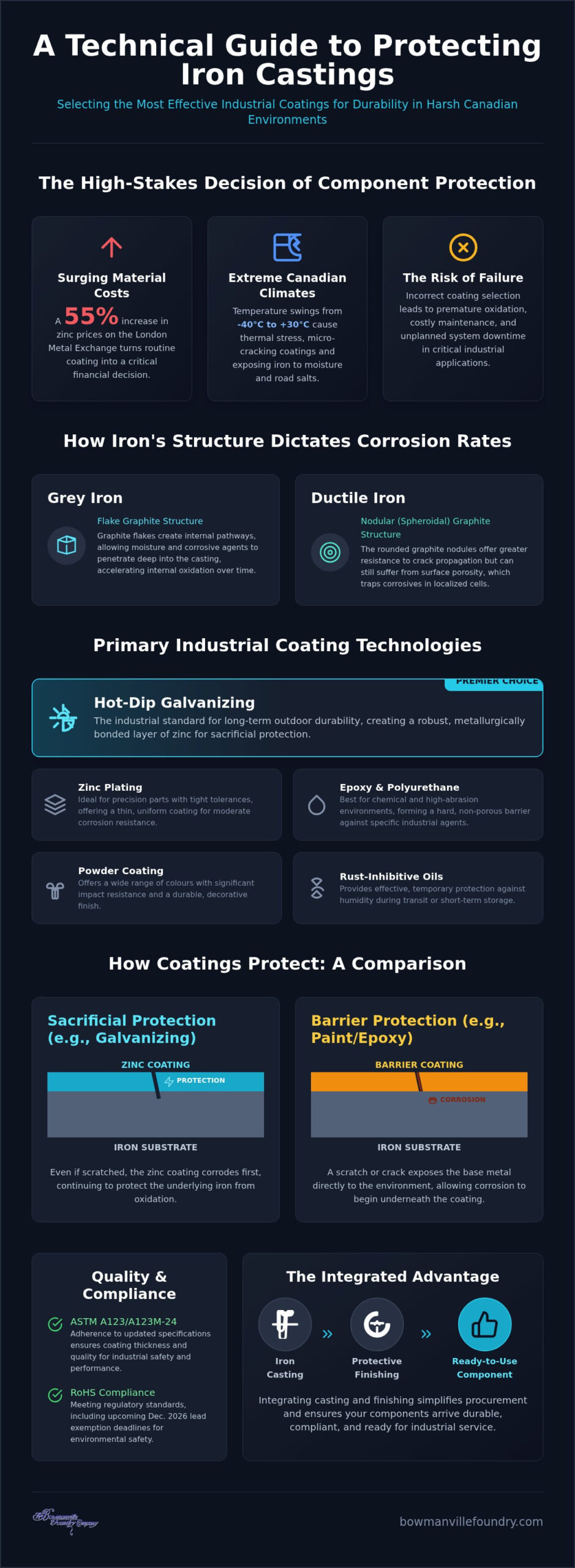
Iron corrosion is an electrochemical process that varies significantly depending on the metallurgical composition of the casting. When engineers evaluate the necessity of Galvanization, they must first understand how the internal structure of the metal interacts with external corrosive agents. In grey iron, graphite exists in flakes. These flakes create internal pathways that can allow oxidation to penetrate deeper into the component over time. Ductile iron, with its nodular graphite structure, behaves differently, yet both are susceptible to surface porosity. Small pits or voids inherent in the casting process can trap moisture, road salts, or industrial chemicals. These create localized corrosion cells that accelerate material loss long before the damage is visible on the surface.
Metallurgical Factors in Iron Oxidation
The specific grade of iron dictates its oxidation profile. Grey iron often forms a relatively stable oxide skin, but this layer is porous and lacks the mechanical bond required for high-stress environments. In contrast, the higher silicon content found in many modern castings influences the thickness and adherence of the initial oxide layer. To ensure a successful finish when galvanizing iron castings, the surface must be free of sand inclusions and casting skin. A clean, consistent surface finish is not just a cosmetic preference; it’s a technical requirement for the zinc to form a metallurgical bond with the iron substrate. Without proper surface preparation, even the most advanced coatings will fail to adhere correctly to the underlying metal.
Environmental Stressors for Industrial Components
Canada’s climate presents unique challenges for ferrous components. In provinces where temperatures swing from -40°C in winter to +30°C in summer, the thermal expansion and contraction of the metal can stress protective coatings. If a coating is too brittle, it may micro-crack, allowing moisture to reach the iron. Additionally, industrial processing plants often expose components to fluctuating pH levels or airborne particulates. For components in immersion service, such as those used in water treatment or heavy industrial vats, the corrosion rate is significantly higher than in simple atmospheric exposure.
Ignoring these factors leads to premature component failure, which translates to high maintenance costs and avoidable system downtime. Selecting the right protection during the design phase is a pragmatic financial decision. When you synchronize the choice of iron grade with the appropriate finishing process, you preserve the mechanical integrity of the component for its entire service life. This integrated approach is essential for galvanizing iron castings that must survive decades of exposure to harsh Canadian environments.
Primary Industrial Coating Technologies for Iron
Selecting the right protective layer requires a balance between environmental exposure and the mechanical requirements of the component. The most common industrial technologies include:
- Hot-dip galvanizing: The industry standard for long-term outdoor durability.
- Zinc plating: Ideal for precision parts with tight tolerances.
- Epoxy and polyurethane: Best for chemical and high-abrasion environments.
- Powder coating: Offers a wide range of colours with significant impact resistance.
- Rust-inhibitive oils: Effective for temporary protection during transit or storage.
Hot-dip galvanizing remains the premier choice for heavy-duty outdoor applications. This process creates a metallurgical bond between the zinc and the substrate, providing a robust layer that resists chipping and peeling. For those seeking deep technical insights, the American Galvanizers Association provides a technical guide to galvanizing castings that details how silicon and phosphorus levels in the iron influence the final coating thickness. While organic coatings provide a barrier, zinc-based methods offer sacrificial protection that continues to work even if the surface is slightly damaged.
Metallic vs. Non-Metallic Protective Layers
Protective strategies generally fall into two categories: sacrificial and barrier protection. Zinc-based methods, such as galvanizing iron castings, provide sacrificial protection. If the coating is scratched, the zinc corrodes in place of the underlying iron. Barrier coatings, like powder coating or specialized paints, rely on an impermeable shield to keep moisture out. Powder coating is particularly popular when a specific aesthetic colour is needed alongside functional durability. Choosing the right thickness is a matter of calculating the expected service life against the cost of application.
Advanced Surface Finishing Processes
Achieving long-term adhesion requires meticulous surface preparation. Grit blasting removes casting sand and oxidation, creating the profile necessary for coatings to grip effectively. Phosphate conversion coatings are often used as a pretreatment to improve the bond between the iron and a subsequent paint or powder layer. For high-wear industrial applications, electroless nickel plating provides a hard, uniform surface that resists both corrosion and mechanical friction. Integrating these post-processing services during the manufacturing stage ensures that every component arrives at the job site ready for immediate installation.
Selecting the Right Coating for Your Iron Grade
Success in corrosion protection depends on matching the specific chemistry of the metal to the application method. While many treat all ferrous metals as a single category, the internal structure of the iron dictates how well a coating will bond and perform. For instance, the ideal pairing for high-stress components is malleable iron treated with hot-dip galvanizing to ensure a permanent metallurgical bond. Understanding these nuances prevents premature delamination and ensures the component meets its design life.
Grade-Specific Coating Compatibility
Malleable iron is particularly well-suited for hot-dip galvanizing. Because malleable iron undergoes an intensive annealing process during production, it’s already accustomed to high temperatures. It handles the 450°C molten zinc bath with minimal risk of thermal distortion or embrittlement. If you’re unsure which material fits your project, consult our guide on how to choose iron casting grade to see how mechanical properties align with finishing needs.
Ductile iron offers superior strength and impact resistance, but these features must be matched with a coating that doesn’t mask critical engineering details. Thick coatings can sometimes obscure identifying marks or interfere with tight-fitting assemblies. When galvanizing iron castings made of ductile iron, it’s vital to reference Galvanizing Technical Standards to ensure the zinc layer thickness remains within acceptable tolerances. Grey iron, meanwhile, requires careful surface preparation because the graphite flakes can occasionally interfere with the uniformity of the zinc-iron alloy layers.
Application-Driven Selection Framework
The choice between galvanizing iron castings or using a polymer barrier often comes down to the final environment. Electrical fittings usually require thinner, more precise coatings like zinc plating to maintain thread integrity. Construction hardware, however, demands the heavy-duty protection of hot-dip galvanizing to withstand decades of exposure. You must also consider any post-processing machining. If a component is machined after it’s been galvanized, the exposed iron will require a secondary touch-up with zinc-rich paint to restore the sacrificial protection. Balancing these dimensional tolerances with the need for corrosion resistance is a pragmatic step in the procurement process.
Implementation: Quality Standards and Best Practices
Precision in the finishing stage is what separates a reliable industrial component from one prone to premature failure. When galvanizing iron castings, engineers must prioritize adherence to established benchmarks to ensure consistent performance across the extreme temperature cycles and high humidity characteristic of Canadian industrial sites. This process begins with a clear understanding of the regulatory framework that governs industrial coatings and the logistical challenges of applying them to complex geometries.
ASTM Standards and Compliance
ASTM A153/A153M is the primary specification for zinc coatings on iron and steel hardware. It defines the minimum coating weights required based on the material thickness and the intended service environment. While salt spray testing under ASTM B117 provides a baseline for durability, it’s merely one part of a comprehensive quality control program. For government or large-scale industrial contracts, you’ll need detailed documentation that verifies both the chemical composition of the melt and the final thickness of the protective layer. This level of transparency ensures that the finished part meets the safety and longevity requirements of the project without the risk of hidden defects.
Precision and Finishing Logistics
Heavy industrial coatings can significantly impact the final dimensions of a part. When you’re galvanizing iron castings, the zinc layer typically adds between 50 to 100 micrometres of thickness. This requires careful management of thread fit and tolerances. Oversizing internal threads or using specialized masking techniques for critical machined surfaces prevents assembly issues later. Complex internal geometries also require specific venting and drainage holes to ensure uniform coverage and avoid trapped gases or excess zinc buildup. Proper planning during the design phase ensures that these finishing requirements don’t compromise the mechanical function of the component.
To avoid confusion during procurement, specify your coating requirements clearly in the initial RFQ. Include the specific ASTM standard, any areas that require masking, and the expected environmental exposure. Once in the field, coated iron requires periodic inspection for mechanical damage. While zinc is sacrificial, deep gouges that penetrate the alloy layers should be cleaned and repaired with a zinc-rich compound to maintain the integrity of the barrier. If you’re ready to simplify your supply chain, you can request a quote for integrated casting and finishing to ensure your components meet these rigorous standards from day one.
Integrated Casting and Finishing with Bowmanville Foundry
Bowmanville Foundry has provided custom metallurgical engineering since 1902. By managing the full lifecycle of a component, from the initial melt to the final surface treatment, we eliminate the friction typically found in industrial procurement. This integrated approach is particularly valuable for projects requiring the precision of galvanizing iron castings, where the metallurgical bond must be carefully managed alongside the casting’s geometry to ensure long-term durability in the field.
Streamlining the Supply Chain
Sourcing ready-to-use components from a single Canadian partner significantly reduces logistical complexity. When you separate the foundry from the finishing vendor, you introduce risks related to transit damage, secondary handling costs, and fragmented quality accountability. Our facility provides integrated iron casting and machining Canada, ensuring that post-processing requirements are baked into the initial design. This single-source model shortens lead times by days or even weeks; parts move seamlessly from the cooling floor to the finishing line without ever leaving our control.
Get Started with Your Custom Project
Selecting the right iron grade and coating is an engineering challenge that benefits from early collaboration. Our team acts as a mentor, guiding you through the selection process for malleable, ductile, or grey iron to ensure the finish adheres perfectly to the substrate. To help you prepare for your next project, download our free Casting Buyer’s Guide, which outlines the critical factors in choosing materials and finishes. Whether you need specialized coatings for high-wear industrial environments or the standard protection of galvanizing iron castings for outdoor infrastructure, our engineers are available for consultation. Requesting a quote early in the design phase allows us to optimize the casting process for your specific coating needs, delivering a ready-to-use component that meets every performance benchmark.
Securing Long-Term Performance for Industrial Components
Selecting the right protective finish is just as critical as the initial metallurgical design. You’ve seen how graphite morphology and surface porosity influence oxidation, and why matching specific iron grades to their ideal coatings prevents premature failure. By integrating the process of galvanizing iron castings with the initial pour, you ensure that every part meets rigorous ASTM standards while streamlining your procurement logistics. This methodical approach reduces maintenance costs and protects your components against the harsh realities of industrial environments.
Bowmanville Foundry has been manufacturing custom iron components since 1902, providing the technical expertise needed to navigate complex coating specifications. Our team offers full-service post-processing and finishing alongside expert engineering support to help you select the ideal material grade and protection strategy. When you’re ready to improve your supply chain efficiency and ensure the durability of your components, Request an Accurate Iron Casting Quote from Bowmanville Foundry. We look forward to helping you achieve technical certainty and long-term success with your next project.
Frequently Asked Questions
What is the best corrosion resistant coating for grey iron?
Hot-dip galvanizing provides the most robust protection for grey iron in outdoor environments due to its sacrificial properties. For components exposed to harsh chemicals, epoxy or polyurethane coatings act as superior barriers. Because grey iron has a flake graphite structure, the surface must be thoroughly cleaned of all casting sand to ensure the coating adheres properly. Selecting the right finish depends on whether you prioritize atmospheric durability or chemical resistance.
Can malleable iron castings be hot-dip galvanized without losing strength?
Malleable iron castings are exceptionally well-suited for hot-dip galvanizing and don’t lose their mechanical integrity during the process. Since malleable iron is already annealed at high temperatures, it remains stable when submerged in a 450°C molten zinc bath. This makes it an ideal choice for electrical fittings and pipe components that require both high ductility and long-term corrosion resistance in demanding industrial applications.
How long do anti-corrosion coatings typically last on industrial castings?
The service life of anti-corrosion coatings varies based on the environmental category of the installation site. In typical Canadian industrial environments, galvanizing iron castings can provide protection for 50 years or more. In high-salinity coastal areas or processing plants with heavy chemical exposure, the lifespan may reduce to 20 to 30 years. Regular inspections help identify mechanical damage that might compromise the protective barrier prematurely.
Do coatings affect the dimensional tolerances of custom iron parts?
Protective coatings definitely impact the final dimensions of custom iron components. Hot-dip galvanizing typically adds between 50 and 100 micrometres of thickness to the surface. To maintain functionality, engineers often oversize internal threads or specify masking for critical machined surfaces before the coating is applied. Managing these tolerances during the design phase ensures that parts fit correctly during assembly without requiring secondary machining that could strip the protection.
What is the difference between zinc plating and galvanizing for iron?
Zinc plating involves electrodeposition, resulting in a thin, smooth finish ideal for precision hardware with tight tolerances. The process of galvanizing iron castings through the hot-dip method creates a much thicker metallurgical bond that is far more durable for outdoor use. While plating is excellent for indoor or decorative applications, hot-dip galvanizing is the preferred choice for heavy-duty infrastructure where sacrificial protection and impact resistance are paramount.
Are there eco-friendly coating options for iron castings in Canada?
Zinc is a naturally occurring element and is 100% recyclable, making it a sustainable choice for industrial coatings. Many Canadian facilities now use closed-loop systems to minimize hazardous waste and emissions. Additionally, adhering to the December 2026 RoHS lead exemption deadlines ensures that galvanized components meet modern environmental safety standards. Choosing a single-source foundry that manages both pouring and finishing also reduces the carbon footprint associated with component transport.
How should I prepare a casting surface before applying a coating?
Proper surface preparation is the most critical step in ensuring a coating’s long-term success. Castings must undergo grit blasting or chemical pickling to remove oxidation, casting sand, and surface impurities. This creates the necessary profile for the coating to form a secure bond with the iron substrate. Skipping this step often leads to delamination or localized corrosion, especially in components with complex geometries or internal cavities that trap moisture.
What ASTM standards apply to coatings for ductile iron components?
Several ASTM standards govern the quality of coatings on ductile iron. ASTM A153/A153M is the standard specification for zinc coatings on iron and steel hardware. For larger components, ASTM A123/A123M provides the requirements for zinc coatings on general iron products. Adhering to these standards, along with ASTM B117 salt spray testing, ensures that your ductile iron components possess the necessary durability and thickness to withstand their intended service environment.
