
Choosing the wrong iron grade doesn’t just lead to component failure; it can compromise the safety and integrity of an entire industrial system. You likely understand the frustration of seeing standard gray iron components fracture under impact or the budget strain caused by high-cost steel forgings. This guide clarifies the technical confusion surrounding sg cast iron, also known as ductile or nodular iron, to help you make informed procurement decisions based on metallurgical reality and physical craftsmanship.
By reading this professional guide, you’ll gain a clear understanding of how the unique micro-structure of spheroidal graphite iron offers superior ductility and tensile strength for high-performance components. We’ll explore the latest technical specifications, including the ASTM A536-26a standard and ISO 1083:2018 classifications, while comparing various grades to ensure your components meet rigorous stress requirements. We’ll also examine how to identify a dependable Canadian manufacturer capable of providing the post-processing services your project demands to ensure every part is ready for immediate use. Our goal is to provide the technical certainty you need to move from initial research to a finalized engineering solution.
Key Takeaways
- Understand how the nodularization process creates sg cast iron, a material that offers the structural integrity of steel with the design flexibility of cast iron.
- Learn to interpret the ASTM A536 grading system to ensure your custom components meet specific tensile strength, yield strength, and elongation requirements.
- Gain a clear framework for choosing between SG, gray, and malleable iron based on section thickness, vibration damping, and mechanical stress.
- Discover how integrated post-processing services like machining and heat treating can streamline your procurement by delivering finished, ready-to-use industrial parts.
What is SG Cast Iron? The Spheroidal Graphite Advantage
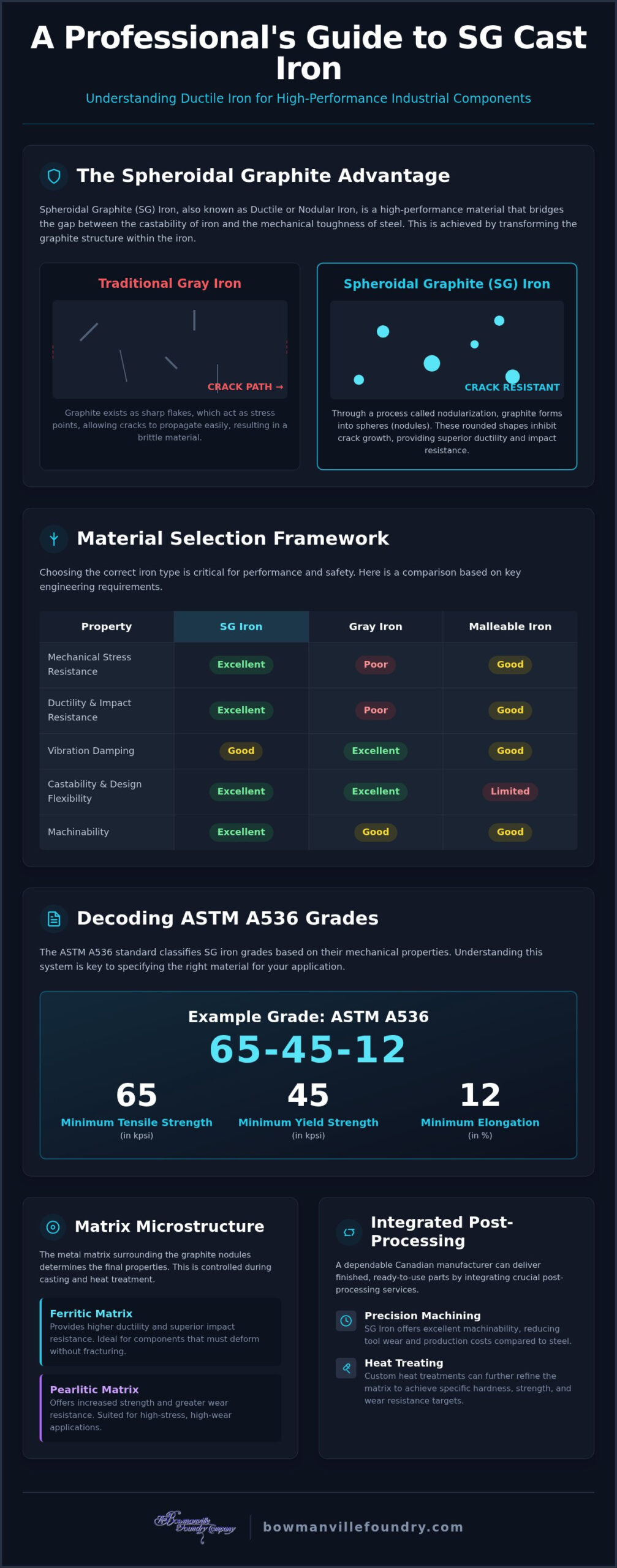
Spheroidal Graphite iron, commonly referred to as sg cast iron, represents a significant metallurgical advancement over traditional gray iron. While gray iron contains graphite in the form of sharp flakes, SG iron features graphite in a spherical or “nodular” shape. This change in geometry is achieved through a precise nodularization process where magnesium is added to the molten metal shortly before casting. Historically, this innovation allowed foundries to produce components that combined the castability of iron with the mechanical toughness of steel, effectively bridging a critical gap in industrial material selection.
The primary advantage of the spherical shape is its impact on crack propagation. In gray iron, the sharp tips of graphite flakes act as internal stress raisers, allowing cracks to travel easily through the material. In contrast, the rounded nodules in Spheroidal Graphite Iron inhibit crack growth, providing the material with its characteristic ductility. This ability to deform without immediate fracture makes it an ideal choice for high-stress applications where impact resistance is a strict requirement. It’s a material that doesn’t sacrifice ease of manufacturing for structural reliability.
The Microstructure of Strength
The mechanical properties of a casting are largely determined by its matrix, which is typically ferritic, pearlitic, or a combination of both. A ferritic matrix provides higher ductility and impact resistance, while a pearlitic matrix offers increased strength and wear resistance. To ensure consistent quality, foundries use specialized equipment to measure the degree to which the graphite has successfully formed into spheres rather than elongated shapes. Nodularity is the percentage of graphite present in spherical form. High nodularity is critical because any deviation toward flake-like structures significantly reduces the material’s fatigue life and tensile strength. By controlling the cooling rate and chemical composition, a foundry can tailor the matrix to specific engineering needs, ensuring the final part performs reliably in its intended environment.
Terminology: SG Iron vs. Ductile Iron vs. Nodular Iron
Engineers often encounter three different names for the same material: SG iron, ductile iron, and nodular iron. These terms are technically interchangeable and refer to the same metallurgical family. In North America, “ductile iron” is the standard convention used by organizations like ASTM. Conversely, sg cast iron is the preferred terminology in British and International (ISO) contexts. Global trade documents often use the SG designation when referencing parts destined for European or Asian markets. This can sometimes cause confusion during the procurement of international projects, but the metallurgical requirements remain consistent across these naming variations. Understanding these synonyms ensures that procurement professionals can accurately source materials regardless of the regional origin of the engineering specifications.
Mechanical Properties: Why Engineers Prioritize SG Iron for Stress
Engineers often face a difficult choice between the cost-efficiency of cast iron and the structural integrity of carbon steel. For components subject to significant mechanical stress, sg cast iron provides a pragmatic middle ground. Its tensile and yield strength often rival those of medium carbon steels, with high-strength grades reaching tensile strengths above 700 MPa. This material doesn’t just hold up under weight; it resists the fatigue that typically compromises brittle metals. By selecting the appropriate grade, you can realize a component that withstands high-pressure environments without the expense of complex steel forgings.
Beyond raw strength, the vibration damping qualities of this material are a critical advantage in heavy machinery. While steel tends to ring or transmit vibrations, the graphite structure within SG iron absorbs energy, reducing noise and protecting adjacent components from wear. This damping capacity, combined with excellent machinability, makes it a preferred choice for housing units and engine parts. It’s easier on cutting tools than steel, which helps lower your total cost of production. If you’re looking to optimize your designs, reviewing a free casting buyer’s guide can help clarify which material properties best suit your specific application.
Strength and Elongation Ratios
The defining characteristic of SG iron is its ductility. Unlike gray iron, which snaps under sudden load, SG iron can elongate significantly before failure. Typical elongation percentages can reach 18% or higher in ferritic grades, providing a safety margin for parts that might experience unexpected impact. The automotive industry relies on these properties, utilizing approximately 28% of global ductile iron production for critical parts like axle housings and suspension components. Organizations like the Ductile Iron Society provide extensive research on how these ratios impact long-term durability. We can further customize these properties through precise heat treatment processes, such as annealing or normalizing, to achieve the exact balance of hardness and flexibility required. For a deeper look at these specifications, consult our Ductile Iron Material Pillar for comprehensive technical data.
Wear and Corrosion Resistance
The graphite nodules within sg cast iron do more than just stop cracks; they act as a form of internal lubrication. This reduces friction in metal-on-metal contact, significantly extending the life of moving parts. Additionally, the material shows impressive atmospheric corrosion resistance. It forms a protective oxide layer that performs better than gray iron in many industrial environments, including high-temperature applications where thermal growth must be controlled. These properties ensure that your components remain functional even in harsh conditions, reducing the frequency of maintenance and replacement cycles.
SG Iron vs. Gray and Malleable Iron: Selection Framework
Selecting the right material requires an objective look at the mechanical environment. While sg cast iron is often the superior choice for high-stress applications, gray and malleable irons still hold specific industrial niches. A successful procurement strategy balances the cost of raw materials with the long-term performance and failure risks of the final component. It’s not just about choosing the strongest metal; it’s about matching material properties to the specific constraints of your design.
SG Iron vs. Gray Iron: The Brittleness Factor
Gray iron is prized for its excellent vibration damping and low production cost. However, its graphite flake structure creates inherent brittleness. If a component faces sudden impact or high tensile loads, gray iron can fail catastrophically. In these scenarios, switching to sg cast iron allows for significant weight savings. Because SG iron is stronger, you can often design thinner sections that maintain the same structural integrity as a bulkier gray iron part. For applications where vibration damping is the primary concern rather than shock resistance, our Gray Iron Pillar provides detailed use cases. Data from the Ductile Iron Pipe Research Association confirms how this strength translates to decades of reliability in pressurized infrastructure where gray iron might otherwise crack.
SG Iron vs. Malleable Iron: Thickness and Complexity
The choice between SG and malleable iron often comes down to the physical dimensions of the part. Malleable iron is produced by heat-treating white iron, a process that works exceptionally well for small, thin-walled components requiring high toughness. However, the heat-treatment cycle is limited by section thickness. Once a part exceeds a certain size, the process becomes impractical and inconsistent. This is where SG iron excels. It provides similar ductility and strength in much larger, heavier castings without the thickness limitations of the malleabilizing process. You can find more on these technical differences in our Malleable Iron Pillar.
To evaluate failure risk, engineers should map out the peak stress points and potential impact zones. If the design requires a safety factor that accounts for unpredictable loads, the ductility of SG iron is the most dependable insurance. While gray iron might save on initial costs, the risk of brittle fracture in a high-stress environment often makes it the more expensive choice over the component’s lifecycle. We help our clients navigate these decisions by analyzing the specific geometry and stress requirements of each custom-engineered part to ensure the most cost-effective, reliable result.
Design Standards and ASTM Specifications for SG Iron Castings
In North America, the primary specification for sg cast iron is ASTM A536. This standard provides a clear framework for engineers to communicate mechanical requirements to the foundry. The grade numbering system follows a logical three-part format: the first number represents minimum tensile strength in ksi, the second is minimum yield strength in ksi, and the third is the percentage of elongation. For example, a common grade like 65-45-12 indicates a tensile strength of 65,000 psi, a yield strength of 45,000 psi, and a 12% elongation. Selecting the correct grade ensures that the component performs under load while remaining cost-effective to manufacture.
Choosing a grade that is stronger than necessary is a common pitfall. Over-specifying can lead to increased manufacturing difficulty and higher costs without providing a functional benefit. High-strength grades often have lower ductility, making them more susceptible to brittle failure if the part experiences unexpected impact. It’s essential to balance the required yield strength with the necessary elongation to ensure long-term durability in the field. Using the latest standard, ASTM A536-26a, ensures your specifications align with current metallurgical benchmarks.
Understanding ASTM A536 Grades
Foundries typically work with several standard grades of sg cast iron, each tailored to specific mechanical environments. Grade 60-40-18 is the most ductile option, featuring a ferritic matrix that provides maximum impact resistance and excellent low-temperature performance. For applications requiring a balance of strength and toughness, Grade 80-55-06 is a standard choice for gears and crankshafts. When extreme strength is the priority, Grade 120-90-02 offers properties that rival many alloy steels, though it often requires specialized heat treatment like quenching and tempering to achieve its final state. These variations allow for precise engineering, but they require careful coordination between the designer and the foundry.
Design Considerations for Casting Integrity
The geometry of a part significantly influences the final properties of the metal. Section thickness is a critical factor; heavier sections cool more slowly, which can affect the nodule count and the overall matrix structure. Engineers should also incorporate generous draft angles and radii to ensure the molten iron flows smoothly and the casting can be removed from the mold without defects. Sharp corners act as stress raisers and can lead to cracks during cooling or while in service. For a detailed breakdown of these variables, we recommend consulting our How to Choose Iron Casting Grade Guide. If you’re currently developing a new component, our technical team at Bowmanville Foundry can help you optimize your design for both performance and manufacturability.
Custom SG Iron Production and Post-Processing in Canada
Modern industrial procurement requires more than a simple material supplier; it demands a partner capable of guiding a project from the initial pattern development to the final machining stage. When you source sg cast iron from a Canadian foundry, you eliminate the risks associated with long-distance logistics and varying international quality standards. Local production ensures that the metallurgical integrity discussed in previous sections is maintained through direct oversight and immediate technical feedback. This collaborative approach allows for the optimization of casting designs, reducing weight and material waste before the first pour occurs. It’s about ensuring that every custom component is engineered for its specific environment rather than being a generic solution.
Integrated Finishing and Machining
A raw casting is rarely the final step in the manufacturing process. Most high-performance components require precise secondary operations to meet the rigorous tolerances of modern machinery. By utilizing integrated Post-Processing Services, you ensure that machining, heat treating, and surface finishing are handled by the same experts who cast the part. This continuity reduces the likelihood of errors that often occur when parts are shipped between multiple vendors; it’s a method that simplifies your supply chain. Additionally, specialized surface coatings can be applied to provide enhanced corrosion protection, ensuring the component’s longevity in harsh industrial or atmospheric environments. These finished parts arrive ready for immediate assembly, saving your team valuable time on the shop floor.
Working with an Authority in Iron Casting
Working with an established institution provides a level of reassurance that is difficult to find in the global commodity market. Since 1902, Bowmanville Foundry has served as a steady hand for Canadian manufacturers, providing custom-engineered solutions for complex mechanical challenges. Our approach involves a deep technical consultation at the pattern development stage to ensure the final product aligns with your stress requirements and design standards. We encourage procurement professionals to utilize our free casting buyer’s guide to streamline the selection and ordering process. This resource provides a comprehensive path from initial curiosity to technical certainty, helping you avoid common pitfalls in material specification. If you’re ready to discuss the specific needs of your next project, our team is available to provide the technical mastery and institutional knowledge required for your success.
Optimizing Component Performance with SG Cast Iron
Selecting sg cast iron for your industrial applications ensures that your components possess the necessary ductility to withstand mechanical stress without the brittle failure risks associated with standard gray iron. By adhering to current ASTM A536 standards and understanding the specific matrix requirements of your project, you can achieve a balance of strength and machinability that carbon steels rarely match at the same cost efficiency. This material provides a dependable solution for high-stress environments where structural integrity and vibration damping are equally critical.
With over 120 years of Canadian manufacturing expertise, Bowmanville Foundry specializes in custom-engineered SG and malleable iron components tailored to your exact engineering specifications. Our comprehensive post-processing and finishing services deliver ready-to-use parts that streamline your assembly process and reduce supply chain complexity. We invite you to Request a Technical Consultation for Your SG Iron Project to leverage our institutional knowledge for your next engineering challenge. We look forward to helping you realize a more durable and efficient manufacturing solution that stands the test of time.
Frequently Asked Questions
What is the difference between SG iron and ductile iron?
There is no metallurgical difference between the two; they refer to the same material family. SG iron is the standard term in British and International (ISO) contexts, while ductile iron is the preferred convention in North America. Both terms describe an iron where graphite exists in spherical nodules rather than flakes. This terminology often depends on whether a project follows ISO 1083:2018 or ASTM A536-26a specifications for industrial procurement.
Is SG cast iron as strong as steel?
High-strength grades of sg cast iron can rival the tensile and yield strength of many carbon steels. While standard grades offer excellent ductility, specialized versions like ASTM Grade 120-90-02 reach tensile strengths above 800 MPa. This makes it a viable, cost-effective alternative to steel forgings for components that require high structural integrity and impact resistance. It provides the strength of steel with the superior castability and vibration damping of iron.
Can SG iron be welded for industrial repairs?
Can SG iron be welded for industrial repairs?
Welding is possible but requires specialized procedures and careful thermal management to be successful. Because of the high carbon content, rapid cooling can lead to the formation of brittle martensite, which increases the risk of cracking. Engineers typically use nickel-based filler metals and strict pre-heating and post-heating cycles to maintain the material’s ductility. In many cases, it’s more reliable to replace the component rather than relying on structural welds for critical repairs. For those who require precision maintenance for heavy machinery, Bore Repair Systems, Inc. – Bore Repair Made Easy with our USA made Lineboring and Boreweld solutions offers professional-grade tools designed for these specific industrial challenges.
The Canadian market primarily utilizes ASTM A536 specifications for industrial components. Grades such as 65-45-12 and 80-55-06 are frequently specified for their balanced mechanical properties in heavy machinery. For municipal applications like water distribution and sewer systems, products often follow certifications provided by the Bureau de normalisation du Québec (BNQ). These standards ensure that castings meet the physical and dimensional requirements necessary for national infrastructure projects and specialized manufacturing.
How does the cost of SG iron compare to gray iron?
Production costs are generally higher than gray iron due to the additional magnesium treatment and stricter raw material requirements. The nodularization process and the need for higher-purity pig iron increase the melting expenses for the foundry. However, the higher strength-to-weight ratio often allows for thinner, lighter designs that can offset the initial material cost. When you consider the reduced risk of brittle failure, it’s often the more economical choice for high-stress applications.
Why is magnesium added during the production of SG cast iron?
Magnesium acts as a nodularizing agent that changes the shape of graphite from flakes to spheres. During the sg cast iron production process, magnesium is added to the molten metal just before pouring. This chemical reaction forces the graphite to precipitate as nodules, which prevents the internal stress concentrations found in gray iron. This simple metallurgical change is what gives the material its characteristic ductility and prevents cracks from propagating through the final casting.
What industries typically use spheroidal graphite iron components?
The construction sector is the largest consumer, accounting for approximately 35% of the market for water and wastewater infrastructure. The automotive industry utilizes about 28% of production for high-stress parts like crankshafts and axle housings. Other major users include the agricultural sector for tractor components and the heavy machinery industry for brackets and frames. Its ability to absorb vibration while maintaining high tensile strength makes it indispensable across diverse industrial landscapes.
Can SG iron castings be heat treated for better performance?
Heat treatment is a standard method for customizing the mechanical properties of a casting for specific industrial roles. Processes such as annealing can maximize ductility and impact resistance by creating a fully ferritic matrix. Conversely, normalizing or quenching and tempering can significantly increase hardness and tensile strength for wear-intensive applications. These secondary operations allow a foundry to fine-tune the material to meet the exact yield and elongation requirements specified in your documentation.
