
Valve integrity is not just about material strength; it’s about matching nodular graphite morphology to the specific pressure-cycle stresses of your application. You likely recognize that selecting the right material is a delicate balance between long-term reliability and the reality of production costs. When components fail under high-pressure cycles or machining expenses spiral due to inconsistent material quality, the impact on your bottom line is immediate. This guide explores how ductile iron casting for valve components provides a superior solution by enhancing durability and machinability while meeting rigorous Canadian standards such as ASTM A536-24 and the National Plumbing Code 2025.
By understanding the metallurgical properties that define this material, you can realize significant improvements in pressure resistance and component longevity. We’ll examine the technical advantages of nodular iron, strategies to reduce secondary finishing costs through integrated casting processes, and the logistical benefits of securing a reliable Canadian manufacturing partner. From the latest MSS SP-156-2026 requirements to optimizing your pattern development, this resource provides the technical certainty needed to make informed procurement decisions.
Key Takeaways
- Understand how magnesium treatment creates graphite nodules that effectively prevent crack propagation and enhance long-term valve durability.
- Compare the specific mechanical properties of ASTM A536 grades to identify the ideal balance of tensile strength and elongation for pressure-rated applications.
- Learn to apply Design for Manufacturability (DFM) principles that ensure uniform wall thickness and minimize internal shrinkage defects during the casting process.
- Realize the logistical advantages of sourcing ductile iron casting for valve components from a domestic partner to reduce lead times and secondary machining costs.
- Identify how specialized engineering and pattern development translate into operational savings by optimizing component performance in fluctuating temperature environments.
The Fundamentals of Ductile Iron in Modern Valve Manufacturing
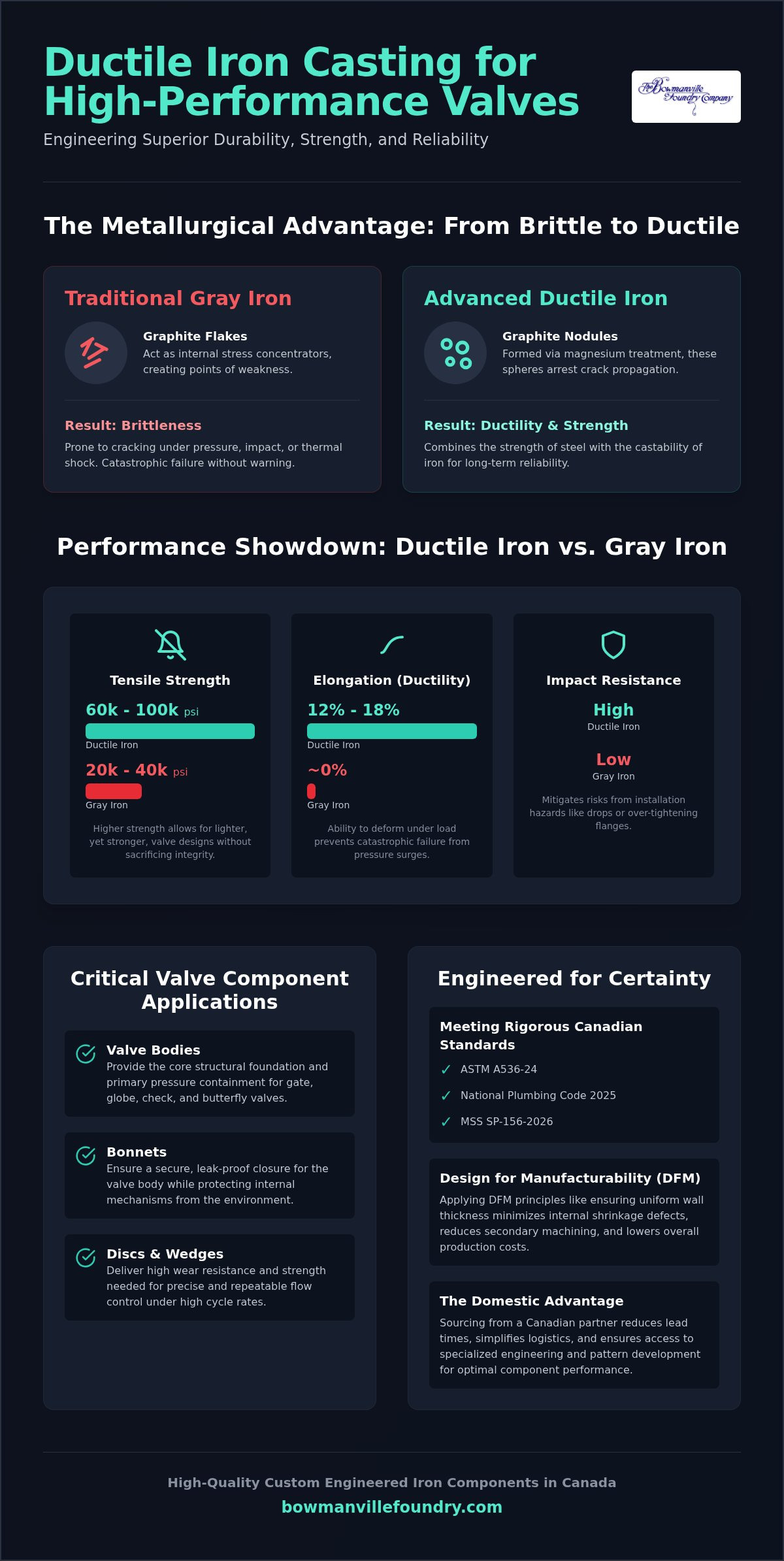
Ductile iron, also known as nodular or spheroidal graphite iron, represents a significant metallurgical advancement over traditional gray iron. While gray iron contains graphite in flake form, which acts as internal stress concentrators and leads to brittleness, Ductile Iron is treated with magnesium during the melting process. This treatment causes the graphite to form into distinct spheres or nodules. These nodules effectively arrest cracks rather than facilitating them, creating a material that combines the best properties of iron and steel.
For engineers, this transition from flakes to nodules translates into a material that mimics the strength of steel while retaining the superior castability of iron. Specifying a ductile iron casting for valve components is a strategic choice because it offers high tensile strength, exceptional elongation, and high impact resistance. It’s the primary reason why critical parts like valve bodies, bonnets, discs, and wedges are now standard in high-pressure industrial systems.
The Role of Nodular Graphite in Pressure Retention
The spherical shape of the graphite is the primary reason this material excels in pressure-rated applications. Producing a ductile iron casting for valve components requires precise metallurgical control to ensure these nodules form correctly. In gray iron, flakes create sharp notches that focus stress; in contrast, nodules distribute stress evenly across the metallic matrix. This microstructural consistency ensures that the material can deform slightly under load without fracturing. This ductility is vital for preventing catastrophic failure during sudden pressure surges. It provides a safety margin that brittle materials simply don’t offer, ensuring a longer and more predictable life cycle for the valve assembly.
Common Valve Types Utilizing Ductile Iron Castings
Different valve designs leverage specific properties of this specialized alloy. Gate valves and globe valves benefit from the high strength-to-weight ratio, which allows for lighter designs that don’t sacrifice structural integrity or safety. In check valves and butterfly valves, the focus shifts to fatigue resistance. These components undergo frequent cycling, where the material’s ability to withstand repeated stress without cracking is paramount. For high-performance applications in oil, gas, and petrochemicals, OG VALVES LTD. offers specialized industrial valve solutions designed to meet these exact technical requirements. Ductile iron is the industry standard for pressure-rated ferrous components in 2026.
- Valve Bodies: Provides the structural foundation and pressure containment.
- Bonnets: Ensures secure closure and protects internal mechanisms.
- Discs and Wedges: Offers the wear resistance and strength needed for flow control.
Performance Comparison: Why Ductile Iron Outperforms Gray Iron in Valve Bodies
Gray iron is often selected for its low initial cost, but its lack of ductility creates significant risks in pressure-rated systems. While gray iron has a tensile strength typically limited to 20,000 to 40,000 psi, ductile iron grades easily reach 60,000 to 100,000 psi. More importantly, gray iron exhibits nearly zero elongation; it simply snaps when overloaded. Ductile iron provides a measurable yield point and elongation, often ranging from 12% to 18%, which allows the valve to withstand thermal shock and physical impact without sudden fracture. This mechanical resilience is a primary reason why engineers specify a ductile iron casting for valve components in environments with fluctuating temperatures.
Brittleness isn’t just a service risk; it’s an installation hazard. Dropping a gray iron valve or over-tightening a flange can cause hairline cracks that lead to catastrophic leaks later. Ductile iron’s impact resistance mitigates these “hidden” costs, providing peace of mind during field assembly. For smaller, thin-walled hardware such as handles or specialized brackets, malleable iron castings serve as an excellent alternative. It offers similar ductility to its nodular cousin but excels in sections too thin for reliable ductile iron production, ensuring that even the smallest valve accessories don’t fail under stress.
Strength-to-Weight Advantages for Industrial Piping
Because of its higher strength, a ductile iron casting for valve components can often be designed with thinner walls while maintaining the same pressure rating as a bulkier gray iron equivalent. This reduction in material volume leads to lighter components, which directly lowers shipping costs and simplifies onsite installation for field crews. Understanding how to choose the ideal iron casting grade is essential for engineers looking to optimize these weight savings without compromising safety standards.
Corrosion Resistance and Material Longevity
Ductile iron demonstrates excellent longevity in water, oil, and gas applications. Its surface forms a protective oxide layer that slows further corrosion, and it bonds exceptionally well with modern epoxy or bitumen coatings. This synergy makes it the preferred choice for buried valve infrastructure, where components must survive decades of soil exposure and fluctuating groundwater levels. By choosing a material that resists both physical fatigue and chemical degradation, procurement professionals can realize a much higher return on investment over the valve’s total life cycle.
Engineering Specifications and ASTM Standards for Pressure-Rated Castings
ASTM A536-24 is the primary benchmark for North American foundries. When you’re reviewing a material spec sheet for a ductile iron casting for valve components, the three-number designation system provides the essential data for your engineering calculations. These numbers represent minimum tensile strength (ksi), minimum yield strength (ksi), and elongation percentage. For instance, Grade 60-40-18 indicates a tensile strength of 60,000 psi, a yield strength of 40,000 psi, and 18% elongation. These metrics aren’t just theoretical; they’re the variables that determine your safety factors and pressure-retaining capabilities.
Navigating ASTM A536 Grades for Valves
Grade 60-40-18 is the standard “workhorse” for pressure containment. Its predominantly ferritic matrix provides the highest ductility and impact resistance in the series. This makes it ideal for valves operating in cold Canadian environments where brittle failure is a significant risk. If your application demands higher yield strength for heavy-duty valve bodies, Grade 80-55-06 might be more appropriate. This grade utilizes a pearlitic matrix to provide superior wear resistance and strength, though it offers less elongation than ferritic grades.
Achieving these specific mechanical properties requires meticulous control over the cooling process and magnesium residuals. In many cases, heat treatment is necessary to refine the microstructure. Annealing, for example, is often used to transform pearlite into ferrite, ensuring a ductile iron casting for valve components meets the high elongation requirements of Grade 60-40-18. This process removes internal stresses and ensures consistent machinability across the entire production run.
Standard Compliance in the Canadian Market
In Canada, adherence to the National Plumbing Code (NPC) 2025 and relevant CSA standards is mandatory for municipal and industrial piping. These regulations often reference ASTM A536 as the foundational material specification. For critical infrastructure, foundry certifications and material traceability are non-negotiable. You need to know that the iron poured yesterday matches the chemical and physical properties required for a 50-year service life. This level of documentation protects the engineer of record and ensures the long-term safety of the installation. Selecting the correct ASTM grade is the first step in preventing casting failure.
- Grade 60-40-18: Best for low-temperature impact and maximum ductility.
- Grade 65-45-12: A versatile, general-purpose grade for standard pressure ratings.
- Grade 80-55-06: High strength for components subject to heavy mechanical loads.
Optimizing Valve Component Design for Casting and Machinability
Designing a high-performance valve requires more than just picking a material; it requires a deep understanding of how that material behaves during solidification. Design for Manufacturability (DFM) is the process of tailoring a component’s geometry to suit the specific strengths and limitations of the foundry process. When you specify a ductile iron casting for valve components, applying DFM principles early in the design phase can prevent costly defects and reduce the need for extensive secondary work. This collaborative approach between the engineer and the foundry ensures the final product is both structurally sound and economical to produce.
Maintaining uniform wall thickness is the most critical rule in valve design. When sections vary significantly in thickness, the thinner areas cool and solidify faster than the thicker regions. This uneven cooling creates “hot spots” where internal shrinkage or porosity can develop, compromising the pressure-retaining integrity of the valve body. Engineers must realize that even small adjustments to wall transitions can significantly improve the internal soundness of the casting. By partnering with a foundry that offers integrated Post-Processing Services, you can ensure your valve components arrive ready for immediate assembly with minimal internal defects.
Design Strategies to Reduce Casting Defects
Sharp corners are the enemy of a clean pour. Using generous radii and fillets is essential to improve metal flow during the casting process. Smooth transitions allow molten iron to enter the mould without creating turbulence or eroding the sand face. Additionally, avoiding abrupt changes in cross-section minimizes stress concentrations that could lead to cracking during the cooling phase. Precise pattern development is the foundation of this process; an accurately engineered pattern accounts for the specific contraction rates of ductile iron, ensuring the final valve body meets tight dimensional tolerances.
Enhancing Machinability and Surface Finish
Ductile iron is often described as a “free-machining” material due to its unique metallurgical structure. The graphite nodules act as a built-in lubricant, which reduces friction at the tool tip and allows for higher cutting speeds than cast steel. This results in a superior surface finish and extended tool life for your machining centre. Sourcing these parts domestically allows for a more organized supply chain, as integrated iron casting and machining in Canada reduces total lead times by eliminating the need to ship heavy components between multiple vendors. For valves exposed to corrosive media, the smooth surface of a well-machined ductile iron part provides an ideal substrate for protective epoxy or bitumen coatings.
- Generous Fillets: Reduces turbulence and improves mould longevity.
- Integrated Machining: Lowers logistics costs and shortens production cycles.
- Uniform Walls: Prevents shrinkage and ensures pressure-tight performance.
Sourcing High-Quality Custom Engineered Iron Components in Canada
Partnering with a domestic foundry offers more than just a physical product; it provides access to a specialized engineering partnership. When you source a ductile iron casting for valve components from a Canadian manufacturer, you eliminate the communication barriers and logistical delays inherent in international procurement. This proximity allows for real-time technical support, where foundry experts can review your specifications to ensure they align with the latest metallurgical standards. This collaborative environment ensures that the transition from a conceptual drawing to a finished part is seamless and technically sound.
Experience matters when dealing with the high-stress requirements of pressure-rated systems. Bowmanville Foundry has operated since 1902, accumulating over a century of institutional knowledge regarding complex valve geometries and iron grades. This legacy allows us to identify potential failure points in a design before the first pour occurs. While custom engineering fees might seem like an upfront expense, they translate into significant long-term savings by optimizing component performance and reducing the risk of field failures. A well-engineered casting reduces the need for expensive rework and ensures the valve performs reliably throughout its intended service life.
The Collaborative Engineering Process
The transition from an initial CAD design to a finalized pattern requires precise data and metallurgical insight. Our technical team works alongside your engineers to refine designs for better castability and performance. This collaboration ensures that every ductile iron casting for valve components meets the exact mechanical properties required for your specific application. It’s a methodical process that prioritizes technical certainty over speed. To help navigate these procurement decisions, we encourage you to download our Free Casting Buyer’s Guide, which provides a structured framework for evaluating material options and foundry capabilities.
Securing Your Supply Chain with a Canadian Partner
Supply chain reliability is a critical concern for large-scale industrial projects. By sourcing custom iron casting production domestically, you significantly reduce the risks associated with international shipping and volatile material surcharges. A local partner provides a steady, no-nonsense point of contact, ensuring that lead times are managed with transparency and precision. This professional approach simplifies the procurement of complex assemblies, allowing your team to focus on the broader engineering challenges of the project.
- Direct access to metallurgical experts for design verification and material selection.
- Reduced transit times and simplified logistics for heavy iron components.
- Full compliance with Canadian national standards and rigorous traceability requirements.
Ready to optimize your next project? Request a quote for your custom valve components to begin a partnership built on technical mastery and dependable results.
Advancing Valve Reliability through Technical Mastery
Selecting the correct iron grade and prioritizing metallurgical consistency are the essential foundations of industrial safety. The transition to nodular graphite structures provides the impact resistance and pressure retention required for modern piping systems. Specifying a ductile iron casting for valve components is a strategic investment in the long-term integrity of your infrastructure; it’s especially effective when paired with Design for Manufacturability principles that reduce internal defects.
Since 1902, Bowmanville Foundry has acted as a technical mentor to the industry, specializing in malleable, ductile, and gray iron. Our modern Canadian facility provides integrated post-processing and comprehensive technical data to help you navigate complex engineering challenges with confidence. By choosing a partner that values precision and transparency, you can reduce lead times and realize significant operational savings across your entire supply chain.
Download our Free Casting Buyer’s Guide to select the right iron grade for your project. We look forward to supporting your next engineering success with the technical certainty your project demands.
Frequently Asked Questions
Is ductile iron or gray iron better for high-pressure valve bodies?
Ductile iron is superior for high-pressure applications due to its higher tensile strength and yield point. Unlike gray iron, which is brittle and prone to fracture under sudden stress, ductile iron offers significant elongation. This allows the valve body to withstand pressure surges and thermal shock without catastrophic failure. For most modern pressure-rated systems, this material is the industry standard for ensuring long-term structural integrity.
What are the standard ASTM grades for ductile iron valve components?
The most common specification is ASTM A536. Within this standard, Grade 60-40-18 is widely used for a ductile iron casting for valve components because of its high elongation and impact resistance. Other frequently specified grades include 65-45-12 for general purposes and 80-55-06 for applications requiring higher yield strength. Selecting the correct grade depends on the specific pressure and temperature requirements of your industrial system.
Can ductile iron valves be used in low-temperature environments?
Yes, specifically ferritic grades like ASTM A536 60-40-18 are well-suited for low-temperature service. These grades maintain excellent impact resistance and ductility even in cold climates, which is a critical requirement for Canadian industrial infrastructure. Selecting a grade with high elongation ensures the material won’t become brittle and fail during winter temperature fluctuations. This makes it a reliable choice for outdoor and exposed piping networks across the country.
How does the machinability of ductile iron compare to cast steel?
Ductile iron generally offers superior machinability compared to cast steel. The spherical graphite nodules act as a natural lubricant during the cutting process, which reduces tool wear and allows for faster machining speeds. This results in a better surface finish on critical valve sealing surfaces and helps reduce the total cost of secondary finishing operations. It’s an efficient material choice for components requiring complex internal geometries and tight tolerances.
What post-processing services are typically required for valve castings?
Most valve castings require precision machining to achieve tight tolerances on flange faces and internal bores. Additionally, heat treating is often used to normalize the microstructure and meet specific ASTM grade requirements. Surface coatings, such as epoxy or bitumen, are also applied to enhance corrosion resistance for buried or submerged applications. Consolidating these services with a single partner helps ensure consistent quality and reduces overall production timelines.
Why is nodular graphite important for valve durability?
Nodular graphite is essential because its spherical shape prevents crack propagation. In gray iron, graphite flakes act as stress concentrators where cracks can easily start and travel. In a ductile iron casting for valve components, the nodules distribute stress evenly through the metallic matrix. This allows the material to deform under load rather than snapping, which significantly increases the valve’s durability and safety margin in high-stress environments.
How can I reduce the lead time for custom engineered iron components in Canada?
Partnering with a domestic foundry that offers integrated casting and post-processing services is the most effective way to shorten lead times. By consolidating pattern development, pouring, and machining under one roof, you eliminate the delays associated with shipping heavy parts between multiple vendors. A local Canadian partner also ensures faster technical communication and simpler logistics, which is vital for maintaining the schedule of large-scale industrial projects.
Does ductile iron require special surface coatings for corrosion resistance?
While ductile iron has inherent corrosion resistance similar to gray iron, specific environments demand additional protection. For waterworks or buried infrastructure, coatings like fusion-bonded epoxy are standard. The material’s surface provides an excellent bond for these coatings, ensuring the component remains protected against chemical degradation and soil-based corrosion over a long service life. It’s a standard practice for ensuring the longevity of critical valve infrastructure in harsh conditions.
