
Canadian domestic iron foundry capacity spans specialized jobbing and automated production, providing stable supply chains across industrial sectors. You can secure typical production lead times of four to eight weeks by matching alloy specifications directly with operational facilities. Sourcing locally minimizes international shipping friction while giving you access to high-quality Gray Iron, Malleable Iron, and Austempered Ductile Iron.
Key Takeaways: Canada foundry capacity supports small-to-medium iron production with typical four-to-eight-week lead times for Gray, Ductile, and Malleable iron castings across certified domestic facilities.
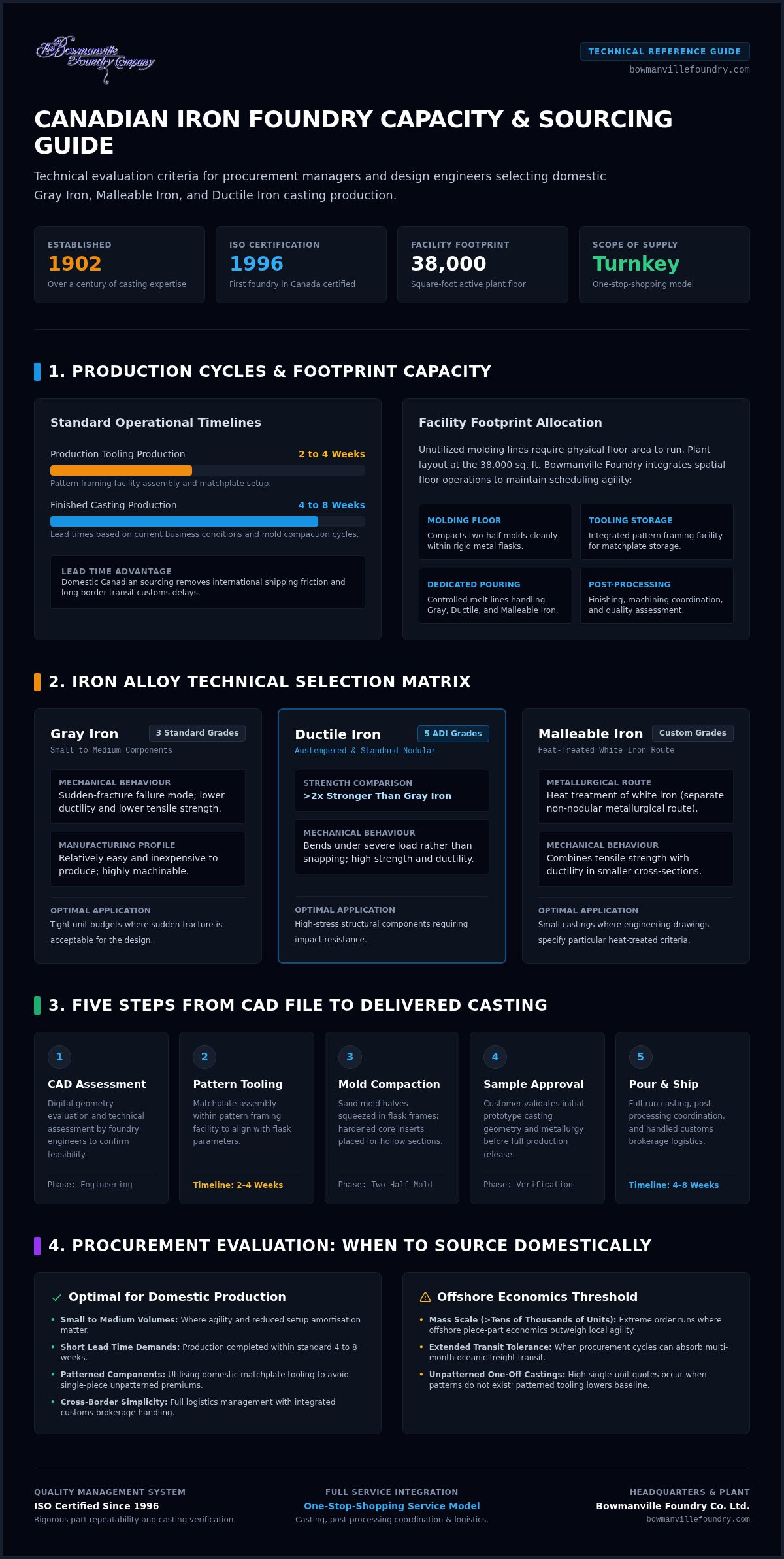
- Production volumes are physically limited by facility footprints, such as the 38,000-square-foot plant at Bowmanville Foundry.
- Except when orders exceed tens of thousands of units, where offshore piece-part economics outweigh domestic agility.
- Select Ductile Iron for high-strength applications requiring bending rather than the sudden fracture risk of Gray Iron.
- The 2023 Statistics Canada analysis confirms manufacturing capacity fluctuates based on supply chain inputs and floor space.
Sourcing Canadian Iron Castings: Quick Decision Guide
Selecting an iron casting supplier (supplier foundry) means matching your technical specifications to plant capability. The decisions that shape your outcome are which alloy grade meets the load case, whether domestic capacity can hold your volume, and when offshore piece-part economics beat local agility.
Typical situations you will face:
- Low-volume or unpatterned parts: quotes climb when each piece carries full setup cost; use established domestic pattern facilities and standard iron grades to bring the baseline down.
- Parts that must bend rather than snap: specify Ductile Iron (nodular iron), which delivers high strength with ductility and is more than twice as strong as Gray Iron while remaining machinable.
- Simpler small-to-medium components on a tighter unit budget: Gray Iron’s three grades remain relatively easy and inexpensive to produce when sudden-fracture behavior is acceptable for the design.
Evaluating foundry capabilities is close to sizing a precision machine tool: capacity has to match design complexity. Bowmanville Foundry runs complete production from sand mold halves (two-half mold) preparation through post-processing. A one-stop-shop (one-stop-shopping service model) fits procurement managers who want streamlined cross-border logistics.
Verify certifications carefully. Quality management systems support part repeatability. Typical tooling production takes two to four weeks, with complete casting lead times running four to eight weeks based on current business conditions. Send your CAD files for a technical assessment, or contact the engineering team to schedule a facility visit.
Audit Floor Space Before You Trust Stated Capacity
Canadian metal casters process thousands of metric tonnes of iron annually, offering predictable floor space and shift availability for commercial buyers.
Finding an available casting supplier means auditing physical plant footprints rather than relying on total theoretical output metrics. Facility layout dictates actual throughput, because unutilized molding lines cannot run without dedicated floor space. According to Statistics Canada’s 2023 analysis, manufacturing production capacity fluctuates based on supply chain inputs, making physical space verification essential. The plant at Bowmanville Foundry covers 38,000 square feet and holds scheduled capacity across multiple metal grades. Walking the spatial layout gives you a realistic view of volume handling.
During high-volume runs, floor space has to absorb raw sand mold halves and finished components at the same time. Prioritize facilities that offer integrated tooling storage beside dedicated pouring lines. Reviewing the iron grades technical data ties metallurgical choices to the production space you inspected. Domestic production removes international shipping risk from the schedule. More on this: Iron Grades Technical Data.
Tip: Verify a plant’s physical footprint and tooling storage before committing to high-volume multi-year casting contracts.
One user posted in the practicalmachinist.com forum topic titled "Custom Cast Iron castings, any rec’s? | Page 2":
"I got a quote a couple years ago to send that CAD file to a foundry that specialized in doing this kind of low volume, no pattern casting, and the quote was approx. $1500.00 per casting." (source)
Situation: a low-volume job with no existing pattern, so the foundry priced full custom setup into each piece. Response path: shift toward established domestic pattern facilities and standard iron grades instead of unpatterned one-offs. Result signal: the forum figure shows how quickly unit cost rises when setup is not amortized; patterned domestic work is how purchasing managers pull that baseline back down.
Match Alloy Grade to Strength, Ductility and Flask Limits
Canadian foundries produce Ductile Iron, Gray Iron, and Malleable Iron to meet precise engineering specifications for structural components. Choosing the right casting supplier means reviewing pouring limits and alloy specifications when you produce small or medium components.
Align flask dimensions directly with matchplate patterns so sand mold halves compact cleanly and mold defects stay out of the run.
| Iron Alloy Type | Standard Grades Offered | Primary Casting Capabilities |
|---|---|---|
| Gray Iron | 3 Grades | Small to medium components |
| Austempered Ductile Iron | 5 Grades | High strength applications |
| Malleable Iron | Custom Grades | Heat-treated parts to specification |
Gray Iron was the original cast iron: relatively easy and inexpensive to make, with lower tensile strength and lower ductility than the newer engineered irons, and a failure mode of sudden fracture rather than bending. Ductile Iron belongs to the nodular irons; you specify it where both high strength and ductility are required. Malleable Iron is a separate metallurgical route (heat treatment of white iron), not a nodular grade, and you call it up when the drawing names its particular property set.
For detailed material selection, use the metal grades guide to align mechanical requirements with production specs. The same 38,000-square-foot operation is set up for consistent quality across these grades. Ask the facility for a technical assessment and a custom quote on your alloy and flask combination.
Where Iron Castings Support Canadian Tech Infrastructure
Heavy industrial foundries and advanced semiconductor facilities serve distinct, complementary roles within Canada’s manufacturing supply chain. Heavy industrial sites cast iron components; high-tech facilities deliver micro-scale hardware such as optical sensors.
Pattern framing work in a foundry shows why physical equipment enclosures need structural castings long before microchips are mounted inside. Heavy iron casting uses different thermal management than silicon fabrication. Physical infrastructure often relies on gray iron for damping, while optical platforms rely on micro-chips for light routing.
You can use the casting buyers guide to evaluate structural iron needs beside high-tech hardware. Heavy foundries supply the physical backbone for industrial automation; the two supply chains meet at the enclosure and machine-base level.
When Domestic Sourcing Is the Wrong Choice for You
Offshore production fits high-volume commodity parts where low labour rates outweigh long lead times and international freight risks.
High-volume orders exceeding tens of thousands of identical units often justify offshore logistics. Overseas foundries can reduce basic unit expenses when piece-part economics override local supply chain agility, though ocean freight stretches the calendar by months.
If you choose offshore suppliers, you take on complex customs clearance, extended ocean transit, and inventory buffer costs. When part designs need frequent engineering revisions or rapid sample approval, foreign supply chains often cannot deliver the flexibility you need.
For specialized Gray Iron and Ductile Iron components, domestic typical production lead times remain four to eight weeks, with tooling in two to four weeks inside a 38,000 square foot plant. Reach out to engineering specialists for a custom price estimate tailored to your iron casting project.
Five Steps From CAD File to Delivered Casting
Procuring iron castings from a Canadian casting supplier requires structured communication across engineering and production teams, because each procurement choice locks part of the project timeline.
- Engineering review: Your CAD files undergo a technical assessment to optimize part design and determine necessary core placements.
- Tooling creation: A dedicated pattern framing facility builds the physical tooling or matchplate required for production.
- Molding and pouring: Sand mold halves are compacted inside a flask, followed by liquid iron pouring.
- Sample approval: The foundry delivers prototype castings for inspection, ensuring adherence to your quality management system.
- Final delivery: Completed orders move through post-processing suppliers, with the facility handling cross-border customs brokerage for direct shipment.
Arranging a comprehensive one-stop-shop that integrates logistics cuts post-processing delays between facilities. Pattern creation still forces an early choice: how much tooling design your own engineering capacity will carry.
A commenter in the practicalmachinist.com thread "Custom Cast Iron castings, any rec’s? | Page 2":
"In the past my dealings with foundries lead me to leave all the pattern building and modification to them, but stuff like this it isn’t really financially feasible to do that, so you either need to work closely with the foundry or know your stuff enough to do it all yourself without their help." (source)
Situation: pattern build-and-modify work priced by the foundry was no longer financially feasible on that job. Action: decide up front whether tooling design stays in-house or moves to the facility’s technical experts, and stay close to the foundry if you split the work. Outcome: you avoid mid-project rework when responsibility for pattern changes is clear before metal is poured.
ISO Certification and How to Read Market Rates
Industrial procurement managers need verified standards and clear pricing criteria when selecting a casting supplier. In 1996, The Bowmanville Foundry was the first foundry in Canada to achieve ISO certification. Working directly with an established partner reduces the chance of hidden production defects.
A certified quality management system supports green sand castings that meet exact design parameters. Current market price expectations reflect varying alloy compositions and technical requirements. If you need finished parts, a one-stop-shop consolidates post-processing and cross-border logistics so you compare total delivered value rather than melt price alone. Request a personalized quote and schedule a technical assessment or facility visit against your drawings. Longstanding manufacturing relationships rest on verified consistency.
According to market listings, Joe (5★) wrote:
"100 plus years outstanding quality from a family run business. I would highly recommend them. "
Decades of certified operation show how rigorous quality standards support long-term reliability on custom casting programs.
Protect Lead Times With Early Logistics Coordination
Typical lead times for production run from four to eight weeks, depending on current business conditions. Tooling requires an additional two to four weeks for manufacturing in a pattern framing facility (a workshop area where patterns are assembled).
Coordinating with post-processing suppliers (companies that perform finishing operations after casting) early protects project schedules. If those external finishing operations are not booked in parallel, completed castings sit idle while they wait for final processing.
Customs brokerage handling simplifies cross-border shipping for U.S. buyers. Select a casting supplier that manages integrated shipping and logistics service so transit delays shrink. A full one-stop-shop keeps single-source accountability from raw melt to delivered part. Contact the technical team when you are ready for a quote or a plant visit.
Tip: Engage post-processing suppliers early during sample approval to prevent bottlenecking final delivery schedules.
Frequently asked questions
What is the pouring capacity for gray iron?
Canada foundry capacity for gray iron depends on plant tooling, flask size, and the specific mold compaction equipment installed in the facility. Modern operations use specialized casting supplier techniques across three distinct material grades so strength targets stay consistent with the drawing.
What is the pouring capacity for ductile iron?
Ductile iron pouring limits are governed by furnace size and the specific weight requirements of medium to large iron components. Purchasing managers often select nodular alloys when the part needs high strength alongside ductility in demanding industrial applications.
How long do Canadian iron casting lead times usually run?
Under typical business conditions you should plan four to eight weeks for production castings, plus two to four weeks if new tooling must be built in a pattern framing facility. Confirm both windows against current shop load before you freeze the project schedule.
When should you choose Ductile Iron over Gray Iron?
Choose Ductile Iron when the part must combine high strength with ductility and should bend or stretch rather than fracture suddenly. Gray Iron remains appropriate for many small to medium components where lower tensile strength, lower ductility, and a lower unit cost fit the design risk profile.
When does offshore casting beat domestic Canadian supply?
Offshore production tends to fit high-volume commodity runs (tens of thousands of identical units) where piece-part labour savings outweigh freight time, customs complexity, and inventory buffers. If you expect frequent engineering revisions or fast sample approval, domestic four-to-eight-week lead times and local pattern support usually serve you better.
Assessing Canada Foundry Capacity in 2026
Evaluating domestic Canada foundry capacity brings you back to the same decisions you started with: which alloy grade matches the load case, whether the plant’s floor space and certifications can hold your volume, and when local lead times beat offshore piece-part maths. For more than a century, Bowmanville Foundry has produced high-quality small-to-medium iron components inside a modern 38,000 square foot plant, with Canadian ISO certification in place since 1996 as a benchmark for its quality management system.
The technical assessment team reviews complex CAD files and material grades to optimize your production workflow. Download the casting buyers guide or schedule a site visit to evaluate your component requirements and request pricing.
