
The cast iron manufacturing process relies on controlled thermal and metallurgical steps to transform raw iron ore and scrap into precise industrial components. Modern foundries systematically melt, mold, pour, cool, and finish iron alloys to achieve strict mechanical standards across varied production volumes. This specific sequence gives design engineers and procurement managers the predictable metallurgical properties needed for complex applications. Your core decision is which iron grade and process route will meet tensile, ductility, and volume targets without forcing late redesigns or cost overruns.
Key Takeaways: The cast iron manufacturing process transforms raw scrap and pig iron into components through melting, sand molding, and finishing to achieve specific mechanical properties.
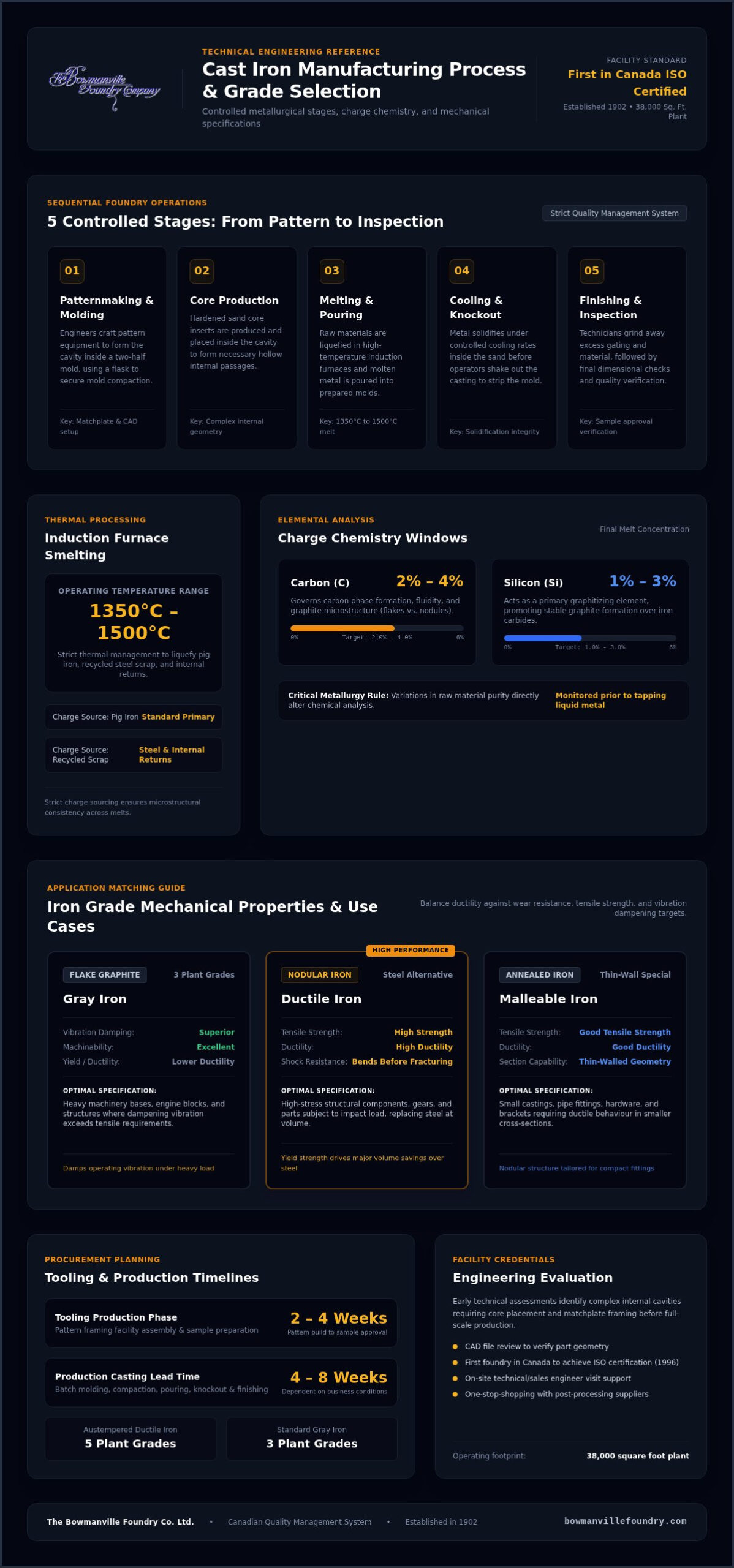
- Induction furnaces melt raw charges at 1350°C to 1500°C to reach 2% to 4% carbon content.
- Unless your application requires low density or extreme impact toughness, ductile iron often replaces steel at lower costs.
- Specify Gray Iron for vibration damping or Ductile Iron for high-stress structural parts to optimize performance.
Match geometry, strength, and volume to the right cast iron process
Your part geometry, tensile strength needs, and planned production volumes determine which casting process you should choose. Clients often balance ductility against wear resistance for specific service conditions. Three situations come up repeatedly:
- High-stress structural parts that must bend rather than fracture: specify Ductile Iron for toughness under load.
- Heavy machinery bases where vibration damping matters more than peak tensile strength: specify Gray Iron.
- Small, thin-walled fittings that still need strength and ductility: specify Malleable Iron grades.
Selecting Ductile Iron yields superior toughness for high-stress components, whereas Gray Iron provides excellent vibration damping for heavy machinery bases. Design engineers can review core requirements and mold compaction methods through iron grade options to optimize structural performance. Evaluating CAD files early helps identify complex internal cavities that require precise pattern framing facility setup. More on this: The Bowmanville Foundry.
Our engineering team provides a technical assessment to ensure your design aligns with efficient foundry practices. Contact the facility to request a technical/sales engineer visit for your upcoming project.
Hold charge chemistry tight before you melt
Smelting high-quality cast iron requires precise metallic charge ratios and strict thermal control during melting. Induction furnaces typically run at temperatures between 1350°C and 1500°C to liquidize pig iron, recycled steel scrap, and internal returns. The raw material mix must yield a final carbon content of 2% to 4% alongside 1% to 3% silicon. You can review detailed specs via Iron Grades Technical Data, The Bowmanville Foundry and Arabic Wikipedia cast iron technical entry (2026) to verify exact elemental composition. Modern facilities carefully monitor these chemical inputs before tapping the liquid metal. Buyers seeking exact material standards should request a technical assessment or visit the modern, clean foundry.
A commenter in the homemodelenginemachinist.com thread "Metal casting at home":
"So you can end up getting mixed/bad advice from folks on foundry forums, and other places, just because you may be using different materials or equipment." (source)
Variations in raw material purity or furnace equipment across facilities directly alter the final chemical analysis of the melt. Strict quality management systems and precise charge sourcing are therefore critical to consistent iron casting properties.
Run five controlled stages from pattern to inspection
Iron casting transforms raw metal into precise components through controlled heating, molding, and finishing operations.
- Patternmaking and molding: Engineers create pattern equipment to form the cavity inside a two-half mold, using a flask to secure the mold compaction.
- Core production: Workers place a core inside the cavity to form necessary hollow passages within the design.
- Melting and pouring: Technicians melt selected raw materials in high-temperature furnaces and fill the mold with liquid metal.
- Cooling and knockout: The metal solidifies inside the sand, after which operators shake out the casting to remove the sand.
- Finishing and inspection: Technicians grind away excess material and execute final quality checks.
Picking the right material class during initial design stages avoids expensive engineering revisions down the road. Reviewing the Iron Grades Application Guide, The Bowmanville Foundry helps design engineers match specific metallurgical properties to mechanical demands.
Process control at each stage protects internal integrity. Choose a supplier that controls every step directly: Bowmanville Foundry provides modern facilities to handle your complete production cycle. Ask the team for a quote or schedule a facility visit.
Weigh mechanical properties against iron grade cost
To pick the right cast iron grade, you must weigh application demands against material cost, high strength, and ductility. From client work, choosing Ductile Iron over steel drastically reduces overall component expenses while maintaining structural integrity. Yield strength drives this financial advantage during volume production. Microstructural carbon variations dictate the mechanical performance of distinct iron alloys; you can confirm grade targets against the technical data already linked above.
| Iron Grade | Key Properties | Typical Application |
|---|---|---|
| Gray Iron | Excellent machinability, vibration damping | Engine blocks, machine bases |
| Ductile Iron | High strength, high ductility | Structural components, gears |
| Malleable Iron | Good tensile strength, ductility | Small castings, pipe fittings |
Gray Iron suits designs needing damping capacity, whereas Malleable Iron works best for thin-walled components. Review the casting buyers guide to evaluate engineering trade-offs. Design engineers can reach the facility for a focused technical assessment.
Plan finishing lead times and surface quality early
Custom iron casting orders require precise scheduling, starting with pattern production that takes two to four weeks. In the pattern framing facility, engineers prepare tooling to ensure high-quality surface finishes. Typical casting lead times run four to eight weeks, depending on overall business conditions.
Post-processing suppliers are managed directly to streamline your supply chain. The one-stop-shopping approach handles secondary operations along with complete customs brokerage handling for US-based shipments. For facilities integrating high-volume cleaning and degreasing into their post-cast finishing workflow, equipment specialists such as The Global One Group provide heavy-duty industrial washing systems designed for continuous manufacturing throughput.
A commenter in the practicalmachinist.com thread "Custom Cast Iron castings, any rec’s? | Page 2":
"I got a quote a couple years ago to send that CAD file to a foundry that specialized in doing this kind of low volume, no pattern casting, and the quote was approx. $1500.00 per casting." (source)
Situation: a low-volume prototype with no existing pattern. Action: a specialized patternless route was quoted instead of standard tooling. Result: about C$1500.00 per casting, a clear premium over production tooling. Securing early sample approval with standard tooling helps optimize long-term production costs once volumes rise.
Request a technical assessment or arrange an on-site technical/sales engineer visit to discuss your casting requirements.
Know when cast iron is the wrong specification
Avoid specifying gray or ductile iron when component designs require low density, high thermal shock resistance, or extreme impact toughness in severe low-temperature environments. While iron alloys deliver compressive strength, welded fabrications or forged steel fit lightweight structural applications better.
Microscopic sharp internal radii in CAD files often act as stress risers, causing premature cracking in brittle metal parts. Selecting a material is like picking a hull material for a boat: steel flexes under heavy dynamic shocks, whereas iron remains rigid until its fracture point. Evaluate yield requirements before you lock the material callout.
The technical assessment team guides component selection. Discuss your custom casting requirements or request an on-site technical engineer visit.
Verify Canadian plant quality and ISO practice
Evaluating Canadian plant quality standards requires reviewing documented production practices alongside third-party environmental compliance. The Bowmanville Foundry was the first foundry in Canada to achieve ISO certification in 1996. Maintaining a strict quality management system helps control emissions and energy consumption during melting operations. Standardized procedures reduce material scrap during the green sand casting process, lowering overall resource use. Modern electric induction melting minimizes greenhouse gas output while maintaining precise heat control. Strict process audits ensure trace elements are contained effectively. Certified facilities give you verified environmental oversight. Prospective buyers can visit the plant to review operational standards. Overseas pattern suppliers often share their perspectives on structural quality expectations.
Tip: Always request formal documentation on quality management systems prior to issuing tooling contracts.
Among the plant’s Google reviews, Kalpajeet (5★) wrote:
"We are pattern Makers from India with 34+ years of experience. Do let us know about your pattern requirements.
Regards,
Kalpajeet Baidya
Kalpataru Patterns"
Decades of specialized tooling experience show how global patternmakers rely on standardized foundry quality management systems to ensure precise mold integration.
Frequently asked questions
What is cast iron?
Cast iron is an iron alloy with high carbon content melted and poured into molds to form solid components. It provides high strength and wear resistance for industrial applications.
What raw materials are used to make cast iron?
Foundries melt pig iron, scrap steel, and recycled iron along with specific alloying elements to produce grades like Ductile Iron, Gray Iron, and Malleable Iron. The exact furnace charge relies on the targeted chemical composition and required mechanical properties.
How are cast-iron components formed from molten iron?
Molten metal is filled directly into a prepared mold cavity where it cools and solidifies into the final shape. The process allows precise creation of complex geometries that are difficult to machine from solid stock.
What finishing techniques are applied after casting?
Post-processing suppliers perform necessary finishing operations including shot blasting, grinding, heat treating, machining, and surface coating. Verified quality management system controls cover manufacturing and finishing steps under the plant’s ISO certification framework established in 1996.
What is sand molding?
Sand molding uses compacted sand around a pattern within a metal flask to create the cavity for liquid metal. This method supports versatile production of small and medium-sized iron castings.
Close the loop on grade, process, and plant fit
Your opening questions still stand: which iron grade matches the load case, which process route fits the geometry and volume, and which plant can prove control from charge to finish. Exact mold compaction prevents dimensional shifting during filling. Proper core placement creates precise internal cavities for complex component geometries.
The Bowmanville Foundry team operates a 38,000 square foot plant with ISO certification to maintain strict quality management system standards. In 1996, the facility became the first foundry in Canada to achieve ISO certification. Design engineers and procurement managers can request a detailed technical assessment or schedule a plant visit to evaluate specific alloy requirements. Explore the material specification guide for detailed material specifications, or contact engineering staff directly for a tailored project quote.
