
Market prices for low-volume custom engineered iron components in Ductile Iron typically range from C$120 to C$299 per unit, with a median around C$177 based on recent industry benchmarks. Precise custom quotes reflect tooling, grade selection, and order volume, so industrial buyers can contact the team directly for a full technical assessment and custom quotation.
Key Takeaways:
- Bowmanville Foundry was Canada’s first foundry to earn ISO certification in 1996.
- Austempered Ductile Iron delivers substantially higher strength than standard Gray Iron while retaining ductility.
- Three distinct grades of Gray Iron are produced to balance strength and machinability.
- Post-approval deliveries ship as fast as one week for critical customer needs.
Match iron grade to load so you avoid overpaying for strength you will not use
You are choosing an alloy so the part survives real stress without padding the bill for properties you never load. Three common situations make the trade-off concrete: a stationary equipment base that mainly needs damping points you toward Gray Iron; a structural frame under mixed tension and shock points you toward Ductile Iron; a high-load gear that must hold strength and still bend rather than snap points you toward Austempered Ductile Iron (ADI). Mechanical stress still dictates material choice across production environments, and published market listings for comparable low-volume Ductile Iron units sit in the C$120-C$299 band (median C$177).
When you face severe dynamic loads, standard Ductile Iron provides superior fatigue resistance compared with traditional Gray Iron grades. High-strength alloys withstand extreme friction in heavy machinery. Bowmanville Foundry produces 3 grades of Gray Iron, each exhibiting varying degrees of machinability and strength. Gray Iron offers excellent damping capacity for stationary equipment bases. Modern Ductile Iron variants deliver far stronger mechanical consistency than the brittle ferrous materials engineers once accepted for secondary structures. Choosing Gray Iron suits lower-stress housings; higher-strength alloys fit demanding drivetrain parts.
Complex geometries often need internal channels. A hardened sand insert used to create hollow sections (core) forms those passages in the mould. Settling the grade before pattern work prevents early component failure and wasted machine time.
Tip: Evaluate structural load requirements early; selecting one of the 3 grades of Gray Iron can reduce machining overhead if high tensile strength is unnecessary.
A commenter in the homemodelenginemachinist.com thread "Metal casting at home":
"So you can end up getting mixed/bad advice from folks on foundry forums, and other places, just because you may be using different materials or equipment." (source)
Forum threads often blur grade distinctions, so purchasers carry the wrong assumptions into a drawing package. Precise technical data stops that misallocation before metal is poured.
How grade choice shifts wear life, damping, and your unit cost
Pick the grade first and you lock in mechanical performance, wear resistance, and most of the production expense before anyone cuts a pattern. Ductile Iron combines high strength with ductility for medium to large components. Gray Iron remains the economical route when you need vibration damping and high thermal conductivity. ADI adds a further step up in mechanical performance: it is described here as twice as strong as regular Ductile Iron while still retaining excellent ductility, and it sits well above standard Gray Iron in strength without giving up that ductile failure mode. Compare the numbers on Iron Grades Technical Data, The Bowmanville Foundry before you freeze the print.
| Material Grade | Tensile Strength | Primary Advantage |
|---|---|---|
| Gray Iron | Baseline | Superior vibration damping |
| Ductile Iron | Moderate to High | High strength with ductility |
| ADI | Maximum | Twice the strength of regular Ductile Iron, far above Gray Iron |
Density versus yield strength is why ADI behaves like a lightweight muscle athlete: steel-like toughness at a lower total casting weight. Use ADI for high-load gears, Ductile Iron for structural frames, and Gray Iron where damping and thermal conductivity matter more than peak tensile figures. Grade choice is the cost driver you feel on every piece after the pattern is paid for. Ask Bowmanville Foundry for a personalized quote when you need pricing tied to your geometry and volume.
What drives landed cost: volume, patterns, and core complexity
Unit price alone does not explain what you pay. Tooling scope, expected volume, and how early you integrate the design into pattern work set the real curve. Scalable matchplate tooling pays off when volume rises; short runs often favour patternless techniques even when the per-piece price looks steep. Pattern framing and facility preparation control initial lead times, so design integration at the start shortens the calendar.
Amortizing tooling over a long run cuts unit expense sharply versus a short custom batch. Part designs arrive as wood, epoxy, or metal models, paper drawings, or electronic CAD files. Specifying the grade with the Iron Grades Application Guide, The Bowmanville Foundry avoids over-engineering. Tooling fabrication typically takes two to four weeks; overall lead times commonly run four to eight weeks.
Hollow sections (core) need specialized sand inserts and change the initial cost structure on complex parts. Modern facilities cover both prototype and scalable work. Contact the foundry or schedule a visit when you want help sequencing tooling and first articles.
Tip: Supplying electronic CAD files directly simplifies initial pattern framing and shortens estimation cycles.
A contributor to the practicalmachinist.com discussion "Custom Cast Iron castings, any rec’s? | Page 2" stated:
"I got a quote a couple years ago to send that CAD file to a foundry that specialized in doing this kind of low volume, no pattern casting, and the quote was approx. $1500.00 per casting." (source)
Situation: a buyer needed a low-volume iron part without a durable pattern. Approach: send CAD to a shop set up for patternless work. Result: about C$1,500 per casting on that quote, the kind of premium that makes shared matchplate tooling economical once volume climbs.
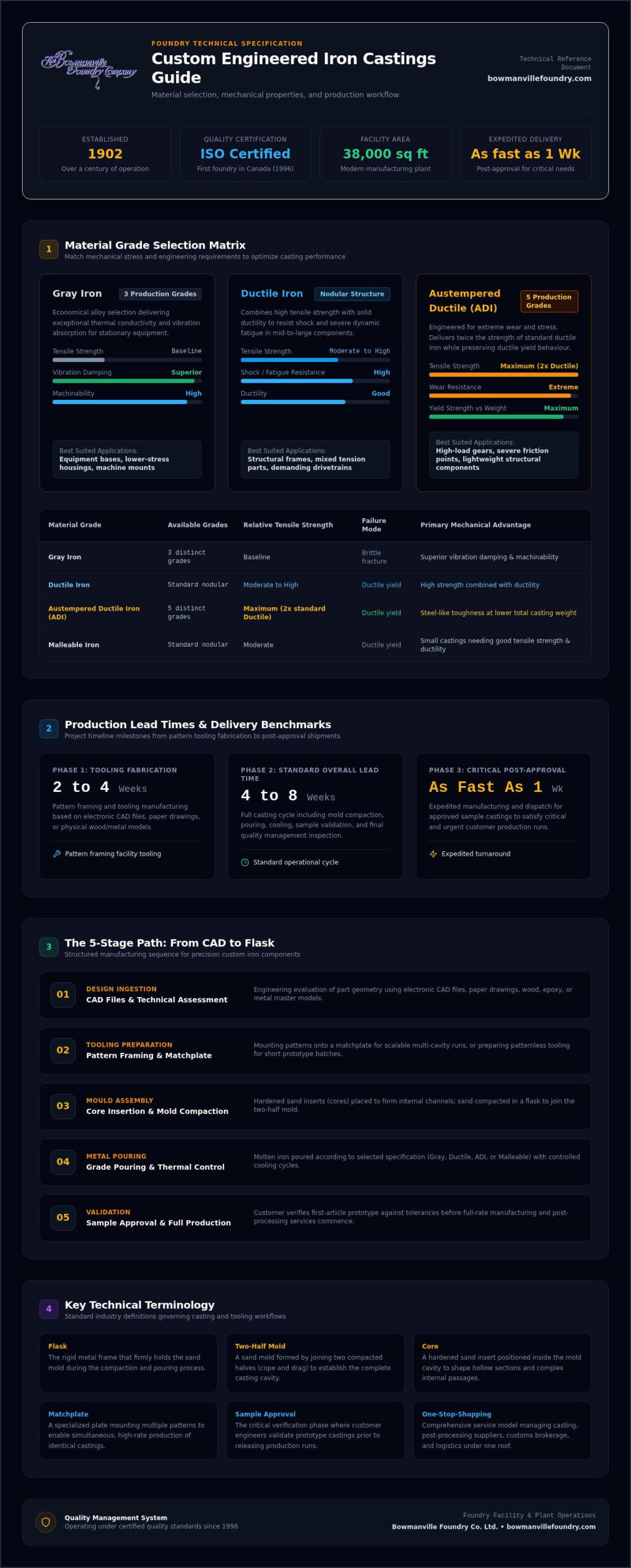
From CAD to flask: the five-stage path to an approved casting
Custom iron casting follows a fixed engineering sequence so a drawing becomes a repeatable part rather than a one-off experiment. Published market listings place many low-volume Ductile Iron pieces in the same broad unit-price band already noted above; your quote still hinges on tooling, cores, and grade.
Every project moves through five stages:
- CAD files submission and technical assessment: Engineers evaluate digital geometry for draft angles and wall thicknesses.
- Tooling fabrication: Specialized pattern equipment builds tooling in two to four weeks.
- Mold compaction and core assembly: Sand forms the two-half mould; internal sand structures create hollow sections (core).
- Sample approval: You validate initial prototypes before full-scale manufacturing.
- Volume production and delivery: Full manufacturing starts once the sample is signed off.
After sample approval, castings can ship as quickly as one week later; typical lead times remain four to eight weeks. Working with a US Customers, The Bowmanville Foundry team keeps customs brokerage straightforward on cross-border orders.
Heavy mechanical components demand disciplined quality systems (Enterprise Europe Network 2026). Early technical collaboration avoids late redesigns. You are welcome to visit the facility and walk the process before you commit the pattern budget.
Among Google reviews, Kalpajeet (5★) wrote:
"We are pattern Makers from India with 34+ years of experience. Do let us know about your pattern requirements.
Regards,
Kalpajeet Baidya
Kalpataru Patterns"
External pattern specialists feed high-precision tooling into the foundry supply chain when that route fits the job.
A commenter in the practicalmachinist.com thread "Custom Cast Iron castings, any rec’s? | Page 2":
"In the past my dealings with foundries lead me to leave all the pattern building and modification to them, but stuff like this it isn’t really financially feasible to do that, so you either need to work closely with the foundry or know your stuff enough to do it all yourself without their help." (source)
Situation: pattern cost threatened the economics of a custom job. Approach: either partner tightly with the foundry on pattern decisions or bring in-house pattern skill. Result: procurement cost stays under control because tooling choices are made before metal is poured, not after a failed sample.
When sand-cast iron is the wrong process for your part
Custom sand-cast iron is a poor fit for high-volume thin-walled sheet parts and for structures where mass itself is the enemy.
If you need thousands of uniform sheet geometries per hour, sheet-metal stamping is the right process: stamping lines run flat parts at high speed, while sand moulds need dedicated cooling time in the flask. Where weight reduction dominates the specification, aluminum die casting usually wins; iron alloys bring high tensile strength, yet dense ferrous sections add mass lightweight assemblies cannot carry.
Sand casting earns its place on thick-walled, wear-resistant parts that need internal hollow sections (core). Short-run pattern equipment can raise unit expense versus cutting a standard stock shape, so run the volume math before you commission tooling.
For those seeking custom metalwork for residential or commercial interiors rather than industrial machinery, you can discover Chris’s Custom Creations for handcrafted furniture frames and bespoke shelving.
In 1996, Bowmanville Foundry became the first foundry in Canada to achieve ISO certification. That quality management system is how each batch is held to the print. Submit your CAD files when you want an engineer to pressure-test the process choice before you spend on patterns.
Frequently asked questions
What materials can you cast?
The facility produces custom engineered iron components in several alloy grades aimed at defined performance targets. You can specify 3 grades of Gray Iron for different balances of strength and machinability, plus Malleable Iron and 5 grades of Austempered Ductile Iron (ADI). ADI is positioned here as twice as strong as regular Ductile Iron, well above Gray Iron in strength, and still ductile in failure rather than brittle.
How do market unit prices relate to a formal foundry quote?
Public listings for low-volume Ductile Iron pieces often fall between C$120 and C$299 per unit (median about C$177), but that band is a benchmark, not your order. Tooling scope, grade, cores, and volume move the number. A formal quotation from the foundry ties price to your geometry, pattern plan, and release quantity after engineering review.
Do you use 3‑D design software?
Designs arrive through several channels so tooling can start from whatever you already have. You may send wood, epoxy, or metal models, paper drawings, or electronic CAD files. Engineering reviews geometry and core needs in the digital files before moulding. Contact the foundry to arrange an on-site technical assessment when a new casting is still on the board.
What lead times should you plan for tooling and first production?
Plan two to four weeks for production tooling once geometry is clear, then four to eight weeks typical lead time for castings depending on shop load. After you approve the sample, emergency needs can ship in as little as one week. Matchplate mounting supports dimensional repeatability when you move from sample to larger releases inside the 38,000 square foot plant.
What are the advantages of custom cast iron components?
Custom iron castings let you place metal only where stress paths demand it and open internal cavities with sand cores so you shed mass without losing section where it counts. Hollow sections (core) cut unnecessary bulk while wear surfaces and bosses stay thick. ISO certification since 1996 anchors batch traceability, and cast sections give vibration damping and wear resistance that fabricated steel stacks often lack.
Custom Engineered Iron Components Technical Planning
Structural demand and tooling strategy decide whether your custom engineered iron components hold value over the life of the machine. Benchmark unit pricing for comparable work still clusters in the C$120-C$299 range on public listings, yet your landed cost follows pattern amortization, cores, and grade.
Plan for stress paths and core geometry together. Ductile Iron supplies the yield strength many duty cycles need; internal hollow sections (core) trim weight without hollowing out integrity. ISO-certified process control keeps each release on specification.
Buyers who want one accountable path from print to dock can use the design-to-delivery model (one-stop shopping service model) for logistics as well as metal. Reach the technical sales engineering staff for a formal quotation or an on-site facility assessment when you are ready to lock grade and tooling.
