
Why would a design engineer specify a material that prematurely wears out expensive cutting tools and risks brittle failure in low temperature environments? It’s a frustrating reality for many procurement managers when as-cast iron components arrive with high internal stresses that cause dimensional instability or excessive hardness. When your machining costs climb because of inconsistent material properties, the efficiency of your entire production line suffers. Professional cast iron annealing services offer a technical solution to these common manufacturing hurdles by precisely altering the metallurgical structure of the metal.
You likely recognize that the as-cast state is not always the optimal state for final application or high-speed finishing. This guide will show you how professional annealing services transform the mechanical properties of cast iron to ensure superior machinability and long-term structural reliability. We will examine the specific heat treatment cycles for Ductile Iron and Malleable Iron that improve ductility and impact resistance. You will also learn how these processes help your parts maintain compliance with ASTM standards, which helps you achieve better material consistency and predictable performance across every production run.
Key Takeaways
- Professional cast iron annealing services provide a controlled thermal process that softens material and relieves internal stresses to prevent part warping during finishing.
- Understand how transforming pearlite into ferrite significantly improves machinability, allowing you to extend tool life and reduce production cycle times.
- Learn to specify the correct ASTM standards for Ductile Iron and Malleable Iron to ensure your components perform reliably in low temperature environments.
- Discover why providing CAD files for a technical assessment early in the design phase is critical for achieving dimensional stability in high strength applications.
- See how partnering with an ISO-certified Canadian foundry with over a century of expertise ensures your heat-treated castings meet rigorous quality management system requirements.
What are Cast Iron Annealing Services?
Annealing is a fundamental thermal process used to modify the mechanical and physical properties of a metal. Within the foundry environment, cast iron annealing services involve heating a casting to a specific temperature, holding it for a predetermined duration, and then cooling it at a controlled rate. This methodology follows established annealing heat treatment principles to reduce dislocations in the crystal structure and restore a more uniform grain pattern. It’s a reliable method for ensuring consistency across high-volume production runs.
The primary goal of this service is to soften the material, which makes it significantly easier to machine. It also serves to relieve internal stresses and improve ductility. Custom engineered iron components often face rigorous service conditions in high-stress machinery. Without proper annealing, these parts may contain residual stresses from the uneven cooling that occurs during the initial casting process. In high-strength applications, these stresses can lead to sudden failure or dimensional warping during the finishing stages. Full annealing is often used to convert the iron’s pearlite matrix into ferrite and graphite. This lowers the hardness of the metal. Process annealing is a more targeted alternative. It’s often used to relieve stress without drastically altering the overall metallurgical structure of the part.
The Role of Heat Treatment in Foundry Operations
Annealing is a critical step in the transition from an as-cast state to a final engineered component. It’s an essential part of the post-processing and finishing phase. At our facility, which operates under a stringent quality management system, we ensure that every temperature cycle is monitored with precision. This consistency is vital. If the cooling rate is too fast or the heating temperature is uneven, the casting won’t meet the required specifications. Foundries that offer one-stop-shopping handle these complex thermal cycles in-house. This streamlines the path from sample approval to full-scale production. It also reduces the risks associated with moving heavy castings between multiple vendors.
Targeted Iron Grades for Annealing
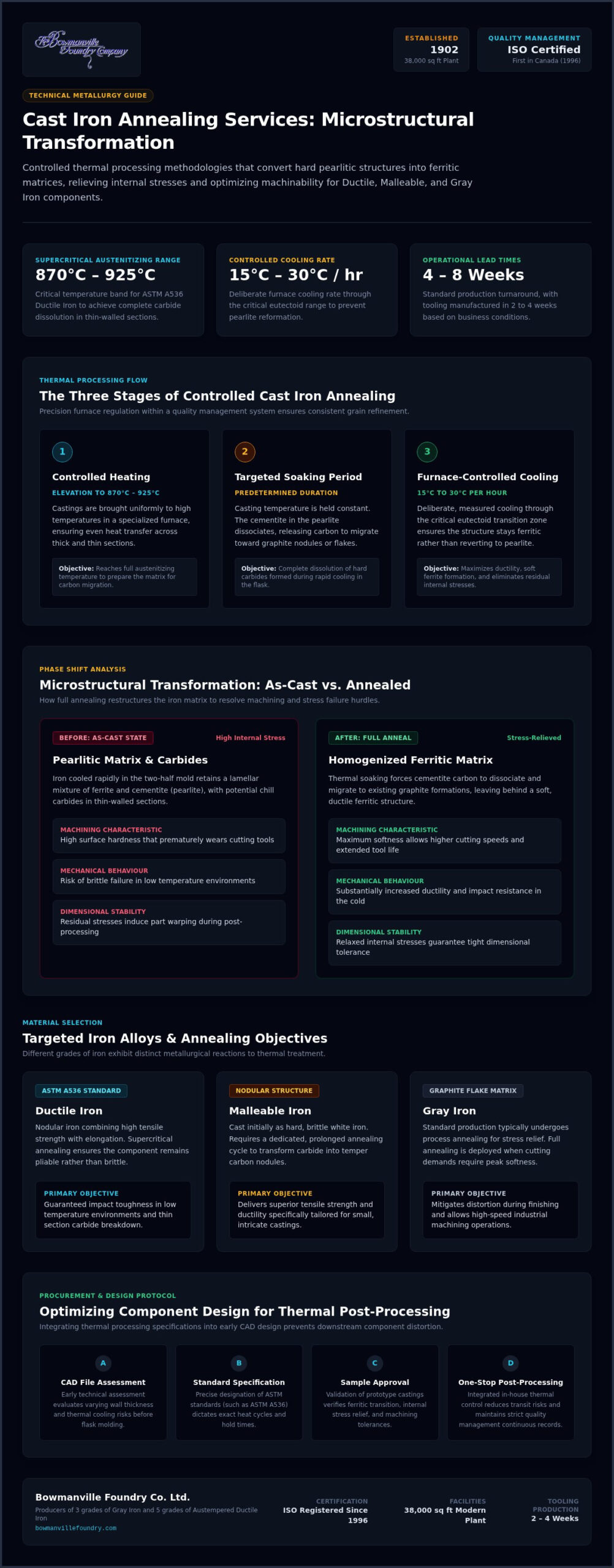
Different grades of iron respond uniquely to thermal treatment. Malleable Iron requires a specific, prolonged annealing cycle to transform its initial white iron structure into a nodular carbon structure. This gives it the necessary toughness for small, intricate parts. For Ductile Iron, annealing is often performed to guarantee performance in low temperature environments. This process ensures the material remains pliable rather than brittle when exposed to extreme cold. Gray Iron typically requires stress relieving to prevent distortion during machining. However, full annealing is used when maximum softness is required for high-speed cutting operations.
The Metallurgical Process: Transforming Iron Microstructure
At the heart of professional cast iron annealing services is the manipulation of the metal’s matrix structure. In the as-cast state, iron often contains pearlite, which is a lamellar mixture of ferrite and cementite that contributes to high hardness. During a full anneal, the casting is heated to a temperature where the pearlite transforms. The carbon within the cementite dissociates and migrates to existing graphite nodules or flakes. This leaves behind a soft, ferritic matrix. This shift provides the superior machinability and impact resistance required for high-performance industrial components.
Precision is vital when managing critical temperature ranges. For parts following the ASTM A536 specification for ductile iron, full supercritical annealing typically requires heating the material to between 870°C and 925°C. This range ensures the iron is fully austenitized. Holding the material at these temperatures allows for the complete dissolution of carbides. This is especially important for thin-walled sections that may have cooled too quickly in the flask during the initial pour.
The cooling phase is just as important as the heating cycle. To achieve proper grain refinement, the foundry must employ slow furnace cooling through the critical eutectoid range, usually at a rate of 15°C to 30°C per hour. This deliberate pace prevents the reformation of pearlite and ensures a uniform, homogenized structure across varying section thicknesses. Sub-critical annealing, an essential part of professional cast iron annealing services, involves heating the iron to just below the transformation temperature, specifically between 700°C and 760°C, to relieve internal stresses without changing the underlying crystal structure.
Achieving Ductility in Malleable Iron
Converting white iron into a usable product requires a specialized two-stage annealing cycle that can last dozens of hours. During the first stage, free cementite dissociates into irregular aggregate nodules known as temper carbon. The second stage involves extremely slow cooling to create a ferritic matrix. This process is essential for achieving the toughness found in our detailed guide to Malleable Iron casting in Canada.
Grain Refinement and Homogenization
Controlled heating helps eliminate dendritic segregation, which is the uneven distribution of alloying elements that occurs during solidification. The effectiveness of this treatment is often influenced by the initial mold compaction and the cooling rates achieved in the two‑half mold. To determine the most effective cycle for your specific geometry, our team can perform a detailed technical assessment of your design requirements. This proactive step ensures that the final part meets all mechanical specifications while remaining cost-effective to machine.
Key Benefits of Professional Annealing Services
Implementing professional cast iron annealing services provides immediate advantages to the manufacturing workflow by normalizing the material state. While previous sections detailed the internal transformation of pearlite to ferrite, the practical result is a significant reduction in hard spots. These localized areas of high hardness often cause premature tool wear or chipping. By eliminating these defects, manufacturers can extend tool life and decrease cycle times, leading to a more efficient production floor. It’s a pragmatic approach to ensuring that every casting behaves predictably during the cutting process.
Beyond machining, annealing is critical for the long-term structural reliability of custom components. The process removes residual stresses that accumulate during the cooling of the casting in the flask. It also enhances ductility, which is the material’s ability to deform under stress without experiencing a brittle fracture. This is a vital safety requirement for high-strength machinery. Additionally, the improved impact resistance gained through this thermal cycle is essential for parts operating in low temperature environments across Canada, where brittle failure can occur if the microstructure remains in a pearlitic or chilled state.
Reducing Post-Processing Costs
Procurement managers must consider the total cost of acquisition rather than just the initial pour. While heat treatment involves a post-processing step, it simplifies all subsequent secondary operations. According to this industrial annealing process guide, reducing material hardness directly optimizes the cutting process. This results in significant long-term savings by reducing machine downtime and the frequency of tool replacements. You can find more details on these efficiencies in our guide on integrated iron casting and machining in Canada.
Ensuring Dimensional Stability
Dimensional integrity is often compromised when internal stresses are released during metal removal. Stress-relieved castings are far more likely to maintain tight tolerances throughout the life of the component. This is particularly important for complex geometries and thin-walled sections where warping is a constant risk during high-speed machining. The sample approval process serves as a final validation step. It confirms that the heat treatment has achieved the desired material properties without compromising the physical dimensions defined in the original design files. By stabilizing the iron before it reaches the CNC machine, you ensure that the final product remains within specification for its entire service life.
Specifying Annealing in Your Engineering Requirements
Engaging with professional cast iron annealing services requires precise documentation to ensure the final mechanical properties align with your design intent. Engineers shouldn’t just make generic requests for material softening. Instead, it’s vital to define specific metallurgical outcomes within procurement documents. This process starts with identifying the correct ASTM standards for the application. For instance, a ferritizing anneal is mandatory to meet the 18% elongation requirements of ASTM A536 Grade 60-40-18. Providing detailed CAD files early in the process allows the foundry to perform a technical assessment of the part geometry to determine if specific section thicknesses require adjusted cycle times.
Defining hardness ranges using the Brinell scale (HB) is another critical requirement. While pearlitic as-cast structures often range between 220 and 280 HB, a successful annealing cycle typically targets a range of 130 to 170 HB. Stating these limits clearly helps the foundry verify the success of the heat treatment during the sample approval stage. A technical/sales engineer plays a vital role here by auditing your project requirements to identify potential conflicts between specified strength and desired machinability. They can even visit your facility to assess how the material interacts with your specific CNC equipment.
Navigating Material Standards
Selecting the right specification is the foundation of a successful project. Whether you are working with Gray Iron, Malleable Iron, or Ductile Iron, each material has distinct thermal requirements. You can learn more about these differences in our guide on how to choose the ideal iron casting grade. By adopting a one-stop-shopping model, you ensure that the foundry maintains compliance with these standards from the initial pour in the flask through to the final heat treatment and logistics handling.
Managing Lead Times and Logistics
Integrating heat treatment into the production schedule affects the overall project timeline. Typical lead times for castings range from four to eight weeks, depending on current business conditions. This duration accounts for the time needed for molding, pouring, and the extended cooling cycles required for annealing. Working with a foundry that has an integrated quality management system reduces the complexity of coordinating with external post-processing suppliers. This centralized oversight minimizes transit risks and ensures that dimensional stability is maintained throughout the logistics chain. If you need help refining your specifications, you can contact our team to arrange a technical assessment.
The Bowmanville Foundry Advantage for Heat Treated Castings
Bowmanville Foundry has maintained a position of industrial authority since its establishment in 1902. With over a century of experience, we provide a level of expertise in ferrous metallurgy that ensures your components are engineered for success. A major milestone in our history occurred in 1996, when we became the first foundry in Canada to achieve ISO certification. This established a rigorous quality management system that governs our cast iron annealing services today. Our operations are housed in a modern, 38,000 square foot plant designed for clean, efficient production. This facility allows us to maintain total control over the thermal cycles required to transform as-cast iron into high-performance engineered parts.
We believe that successful procurement starts with active engineering collaboration. Rather than just following a drawing, our technical/sales engineers are available to visit your facility to assess your specific application and machining requirements. This on-site assessment helps us identify the ideal iron grade and heat treat cycle before production begins, reducing the likelihood of tool wear or part failure. For those seeking deeper technical data on material optimization, we invite you to download our free casting buyer’s guide. This resource provides the specifications needed to make informed decisions during the design phase.
Commitment to Quality and Precision
Our commitment to consistent quality is reflected in our use of matchplate and two‑half mold techniques. These processes ensure that the initial casting is physically sound and ready for thermal processing. Within our pattern framing facility, we prepare patterns to ensure that the final component achieves an optimal response to the annealing furnace. By conducting a detailed technical assessment early in the project, we minimize the risk of internal stresses that can lead to dimensional instability. This proactive oversight ensures that every part meets the high strength and ductility standards required for your most demanding applications.
National Service and Logistics
We operate as a one‑stop‑shopping provider for industrial manufacturers across Canada and for U.S. buyers purchasing iron castings. Our integrated service model eliminates the need for external post‑processing suppliers, which simplifies your supply chain and maintains the integrity of the material from the flask to the finished state. We manage all aspects of shipping and logistics, including customs brokerage handling for international orders, to ensure your parts arrive on time and within specification. If you are looking to improve the reliability of your components, you can contact Bowmanville Foundry for a technical assessment of your casting needs to discuss your next production run.
Achieving Long-Term Reliability through Precision Annealing
Selecting professional cast iron annealing services is a strategic decision that determines the final quality and cost-effectiveness of your industrial components. By transforming the underlying microstructure, you ensure that every casting is optimized for high-speed machining and resilient enough for service in low temperature environments. This process eliminates the internal stresses that lead to dimensional instability, providing you with a predictable and high-performing product. Since our founding in 1902, we’ve focused on delivering this level of technical mastery to our partners across Canada and the United States.
As the first foundry in Canada to achieve ISO certification in 1996, we maintain a strict quality management system within our modern 38,000 square foot facility. Our team is ready to help you navigate the complexities of material standards and thermal cycles to ensure your project’s success. We invite you to Request a Technical Assessment for Your Iron Castings to see how our expertise can streamline your production. We look forward to supporting your manufacturing goals with precision and integrity.
Frequently Asked Questions
What is the difference between annealing and normalizing for cast iron?
Annealing involves slow furnace cooling to maximize softness and ductility by transforming pearlite into ferrite. Normalizing uses air cooling to achieve a finer grain structure and higher strength than annealed parts. While annealing prioritizes maximum machinability, normalizing produces a uniform pearlitic structure that offers a balance of strength and wear resistance. The choice depends on the specific mechanical requirements of the engineered component.
Does every Ductile Iron casting require annealing services?
No, not every casting requires these treatments. Many components perform excellently in their as-cast state when the required grade is achieved through chemistry and inoculants in the flask. However, professional cast iron annealing services are necessary when a ferritic matrix is mandatory for high ductility. It’s also required when the part must meet specific ASTM A536 elongation requirements that the as-cast cooling rate cannot guarantee.
How does annealing affect the hardness of Gray Iron?
Annealing reduces the hardness of Gray Iron by breaking down iron carbides and transforming the pearlite matrix into ferrite and flake graphite. This process typically drops the Brinell hardness from as-cast levels near 220 HB down to a range of 130 to 170 HB. Lowering the hardness in this way is essential for reducing tool wear during high-speed machining operations and ensuring material consistency across large production volumes.
Can annealing help prevent casting failure in low temperature environments?
Yes, it’s a critical process for improving impact toughness in extreme cold. By creating a fully ferritic microstructure, annealing ensures the iron remains ductile rather than becoming brittle when exposed to sub-zero service conditions. This transformation prevents brittle cleavage fractures. It’s a standard requirement for heavy machinery and infrastructure components operating in the harsh Canadian winter or other low temperature environments where safety is paramount.
What technical data should I provide when requesting an annealing quote?
You should provide detailed CAD files and your specific ASTM material grade requirements. It’s also vital to specify the desired Brinell hardness range and any critical dimensions that require high stability. Our technical/sales engineer can use this data to perform a technical assessment of your part geometry. This information helps determine the ideal heating and cooling cycles needed to achieve your mechanical property targets without risking dimensional distortion.
How much time does annealing add to the standard casting lead time?
Annealing is a post-processing step that typically fits within the standard lead time of four to eight weeks. The specific thermal cycle, which includes controlled heating and slow furnace cooling, adds several days to the manufacturing process. This timeline can vary based on current business conditions and the complexity of the batch. We coordinate these cycles internally to maintain the shortest possible path to final delivery for our customers.
Is stress relieving the same as a full anneal for iron components?
No, they are distinct processes with different metallurgical goals. Stress relieving is a sub-critical treatment performed at lower temperatures to remove residual internal stresses without changing the underlying crystal structure. A full anneal involves heating the iron above the transformation temperature to completely alter the microstructure, resulting in maximum softness. While both improve dimensional stability, only full annealing significantly increases the material’s ductility and reduces its overall hardness during cast iron annealing services.
Why is Bowmanville Foundry’s ISO certification relevant to heat treating?
Our ISO certification, which we first achieved in 1996, ensures that every heat treat cycle follows a documented and audited quality management system. This provides you with technical certainty that temperature ramps and cooling rates are precisely controlled and recorded. For procurement managers, this certification serves as a trust signal that the final castings will meet all specified mechanical properties and ASTM standards consistently across every production run we manage.
