
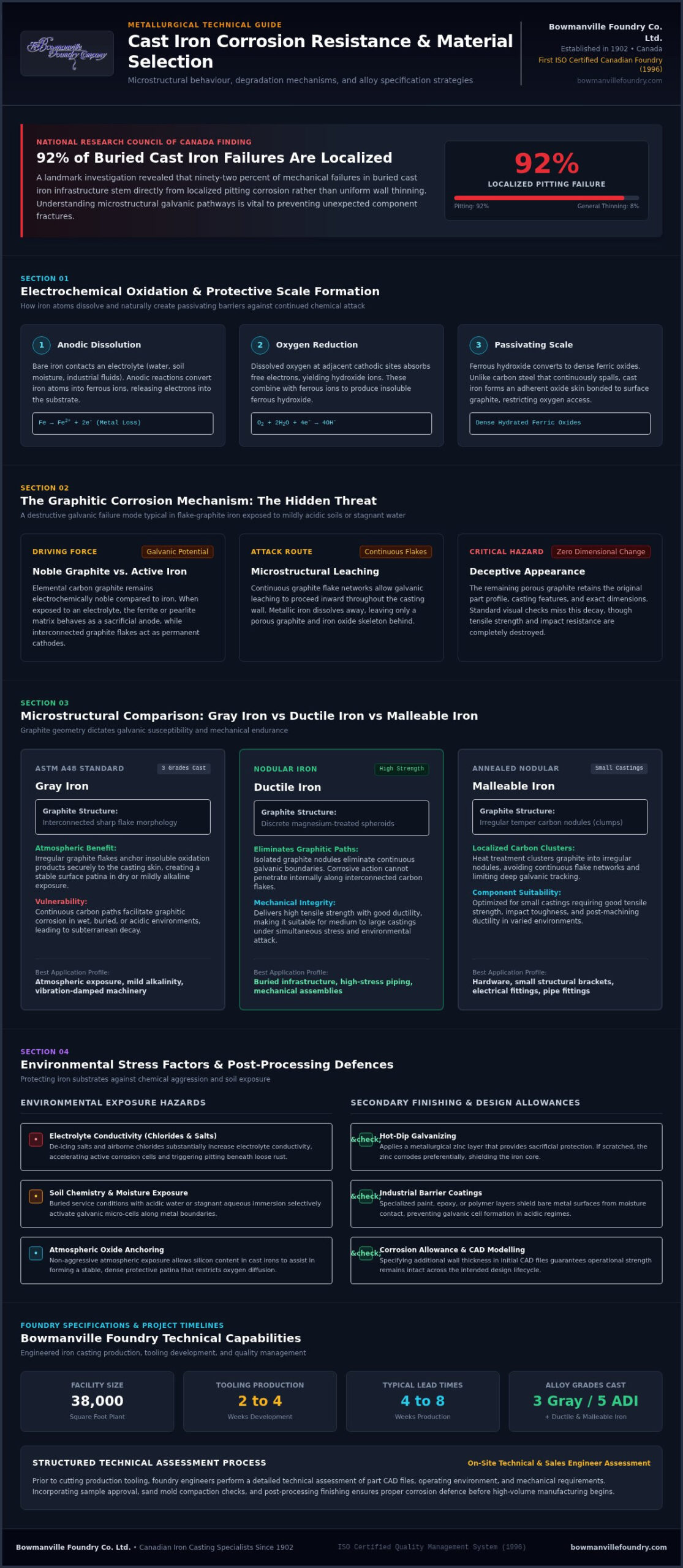
A study conducted by the National Research Council of Canada revealed that 92 percent of mechanical failures in buried cast iron infrastructure were caused by localized pitting corrosion rather than general thinning. For design engineers and procurement teams, unexpected degradation and graphitic decay can halt critical operations without warning. This cast iron corrosion resistance guide provides the metallurgical clarity needed to prevent premature field failure across demanding operating environments.
Deciding whether to modify base alloy chemistry or rely on secondary barrier coatings is a familiar dilemma when matching ASTM iron grades to severe chemical, soil, or moisture exposure. You will discover how iron microstructure, environmental factors, and post-processing treatments dictate cast iron corrosion performance in practical service. The following sections evaluate the corrosion behaviours of Gray Iron, Ductile Iron, and Malleable Iron while establishing a dependable technical assessment framework to evaluate your components before cutting tooling.
Key Takeaways
- Understand how electrochemical oxidation produces adherent surface layers that naturally passivate iron castings against continuous chemical attack.
- Learn why nodular graphite in Ductile Iron and Malleable Iron eliminates the internal galvanic pathways that accelerate graphitic corrosion in Gray Iron.
- Use this cast iron corrosion resistance guide to evaluate harsh atmospheric, chemical, and soil operating conditions prior to specifying ASTM grades.
- Identify suitable post-processing finishing treatments, such as hot-dip galvanizing and industrial barrier coatings, that provide sacrificial defence.
- Establish a structured technical assessment framework to incorporate precise corrosion allowances before committing to production tooling.
Understanding Cast Iron Corrosion Mechanisms and Oxidation Behaviour
Cast iron degradation begins as an electrochemical reaction when bare metal contacts an electrolyte like water, soil moisture, or industrial chemicals. Anodic reactions dissolve iron atoms into ferrous ions, releasing electrons that reduce oxygen at cathodic sites. Unlike plain carbon steel, which flakes continuously until cross-sections collapse, cast irons generate complex corrosion scales. Insoluble oxidation products, such as hydrated ferric oxides, bond with the casting skin and surface graphite. This barrier restricts oxygen diffusion to the underlying substrate, slowing steady-state degradation rates over extended service periods.
A central tenet of this cast iron corrosion resistance guide is recognizing how internal microstructure governs environmental endurance. Operating equipment fails prematurely when engineers evaluate cast irons as uniform materials rather than heterogeneous metal-graphite composites.
The Chemistry of Ferrous Oxidation and Rust Scale
When clean cast iron surfaces encounter atmospheric moisture and dissolved oxygen, active galvanic micro-cells form across the casting face. The initial corrosion byproduct consists of ferrous hydroxide, which oxidizes rapidly into dense ferric compounds. In non-aggressive environments, this surface scale densifies, acting as a partial physical shield against ongoing oxidation. Electrolytes compromise this shield. De-icing salts, chlorides, and industrial airborne acids increase electrolyte conductivity, accelerating active corrosion cells and initiating localized pitting beneath loose rust deposits.
Graphitic Corrosion in Aqueous and Buried Service
Graphitic corrosion represents a specific, destructive failure mode seen predominantly in flake-graphite Gray Iron components placed in mildly acidic soils, mine waters, or stagnant aqueous systems. The mechanism depends on the electrochemical potential difference between the iron matrix and embedded graphite:
- Galvanic Driving Force: Elemental carbon graphite is chemically noble relative to iron. In an active electrolyte, the ferrite or pearlite matrix becomes an sacrificial anode, while the graphite network serves as the permanent cathode.
- Microstructural Leaching: The continuous graphite flake network allows galvanic dissolution to penetrate deep within the part wall, selectively leaching metallic iron.
- Deceptive Physical Appearance: The remaining graphite framework and insoluble oxidation debris retain the original dimensions, casting details, and surface profile of the part.
Because dimensions remain unchanged, standard visual inspections often fail to detect graphitic decay. The component loses tensile strength, impact resistance, and structural integrity, causing catastrophic fracture under normal operational loads. Preventing this hidden deterioration requires matching your alloy microstructure to operating conditions, which this cast iron corrosion resistance guide explores next.
Comparing Corrosion Resistance in Gray, Ductile, and Malleable Iron
Graphite geometry dictates how oxidation advances into an iron casting. While all unalloyed cast irons share similar base iron chemistries, the shape and distribution of their carbon phase define their mechanical and chemical endurance. Any dependable cast iron corrosion resistance guide must evaluate these microstructural differences so specifiers avoid mismatched material selections in aggressive operating conditions.
Gray Iron Flake Morphology and Oxide Anchoring
Gray iron contains an interconnected network of sharp graphite flakes. In moderate atmospheric conditions, this structure offers an unexpected benefit: the irregular flake network anchors insoluble oxidation products to the casting skin. This mechanical interlock helps retain a dense oxide scale that slows ongoing atmospheric attack. Silicon content in standard ASTM A48 gray iron also aids in developing this surface patina. Reviewing industrial gray iron casting applications shows that while gray iron performs well in dry or mildly alkaline settings, continuous flake networks make it vulnerable to graphitic leaching in wet, acidic environments.
Ductile Iron Spheroids and Uniform Corrosion Performance
Ductile Iron incorporates magnesium during treatment, transforming graphite flakes into discrete spheroids. This nodular morphology interrupts continuous internal boundaries. Without interconnected carbon paths, galvanic penetration cannot travel inward through the section thickness. Corrosion proceeds uniformly across the exterior profile at rates comparable to or slower than carbon steel. Design engineers selecting materials from our guide to ductile iron gain high strength and structural elongation without exposing parts to subterranean structural leaching.
Malleable Iron Temper Carbon for Resilient Small Castings
Many material surveys overlook malleable iron, yet its distinct microstructural configuration provides remarkable durability in demanding field service. Produced by annealing white iron castings, Malleable Iron precipitates carbon into irregular clusters called temper carbon embedded in a ferritic matrix. This configuration provides several operational advantages:
- Discontinuous Carbon Structure: Similar to Ductile Iron, temper carbon nodules do not form continuous paths, preventing internal graphitic tunneling.
- Uniform Surface Passivation: Ferritic malleable iron grades develop steady, uniform oxidation layers under atmospheric exposure.
- Mechanical Toughness: The material retains high impact resistance in low temperature environments where cyclic moisture and freezing stress brittle components.
Reviewing our malleable iron guide helps clarify how this alloy suits pipe fittings, brackets, and hardware exposed to weather. For engineering teams evaluating alloy trade-offs across complex geometries, reviewing casting designs with an experienced technical specialist at Bowmanville Foundry helps confirm that your chosen grade provides lasting field durability.
Environmental Exposure Factors Affecting Cast Iron Degradation
Operating environment chemistry dictates casting life expectancy far more than baseline mechanical loads. Ambient moisture, electrolyte conductivity, and chemical exposure determine whether an iron component forms a stable passivation film or suffers progressive cross-sectional thinning. Evaluating these external variables within this cast iron corrosion resistance guide allows engineering teams to anticipate degradation pathways long before parts enter field operation.
Atmospheric and Marine Environmental Exposure
Atmospheric degradation accelerates sharply once relative humidity exceeds fifty percent, creating a persistent liquid film across the metal face. In moderate outdoor environments, unalloyed irons degrade at manageable rates of 22 to 27 µm per year as stable surface oxides form. Surrounding airborne contaminants alter this balance:
- Industrial Atmospheres: Airborne sulphur dioxide reacts with moisture films to yield sulphurous acids, pushing general atmospheric degradation up to 130 µm per year.
- Marine Environments: Marine coastal zones carry airborne chloride salts that deposit directly on metal surfaces. These hygroscopic salts draw moisture below typical condensation thresholds and drive corrosion rates up to 343 to 536 µm per year in harsh splash zones.
Soil Resistivity and Buried Infrastructure Concerns
Buried iron castings face complex electrochemical and microbial challenges. Research confirms that surrounding soil chemistry and backfill moisture account for 65 percent of external subterranean attack, with stray electric currents causing the remaining 35 percent. Dense, poorly aerated clays exhibit low electrical resistivity and frequently harbour anaerobic sulphate-reducing bacteria. These microbes strip polarized hydrogen from cathodic sites, initiating rapid localized pitting. Conversely, dry, granular soils with high electrical resistivity create minimal galvanic activity, permitting castings to maintain structural service for decades when paired with clean backfill.
Chemical, Acidic, and Alkaline Fluid Handling
Standard iron castings perform dependably in alkaline process streams and neutral fluids between pH 6 and pH 12, where insoluble ferric hydroxide layers remain stable. Concentrated sulphuric acid (above 65 percent concentration) also allows successful handling at ambient temperatures because it passivates the casting with a dense iron sulphate barrier film. In contrast, dilute mineral acids like hydrochloric or nitric acid rapidly dissolve ferrous matrix phases. Applying this cast iron corrosion resistance guide helps process engineers determine when aggressive chemical exposure demands specialized post-processing surface barriers.
Protective Coatings and Post-Processing Finishing Treatments
Selecting the right casting alloy solves only part of the durability equation. When components operate in aggressive media, high humidity, or coastal atmospheres, secondary surface treatments supply the necessary physical barrier. Applying this cast iron corrosion resistance guide helps procurement managers coordinate surface finishing operations early in the production cycle, protecting iron substrates before environmental attack begins.
Surface Preparation and Foundry Blast Cleaning
Protective coatings depend entirely on mechanical adhesion to the substrate. Foundry blast cleaning uses abrasive media to strip residual molding sand, annealing scale, and surface contaminants from raw castings. This process establishes an angular surface profile, creating mechanical anchor teeth that bond primers and heavy barrier coatings directly to the iron matrix. Without proper blast profiling, thermal cycling and moisture undermine paint films, triggering premature blistering and delamination. Review our integrated casting and machining guide to see how early surface preparation integrates with post-cast operations.
Galvanizing, Painting, and Specialized Plating Options
Matching the finishing process to operational stress factors prevents premature component replacement in severe working environments:
- Hot-Dip Galvanizing: In accordance with ASTM A153/A153M, dipping iron castings into molten zinc creates a series of metallurgical zinc-iron alloy layers. This treatment delivers sacrificial cathodic protection for exterior brackets and fittings exposed to cyclic weather.
- Thermal Spray Zinc Metallizing: Applying arc-sprayed zinc at 200 g/m² under ISO 8179-1 standards, sealed with an organic topcoat, cuts maximum pitting penetration rates by approximately 50 percent in aggressively corrosive service beds.
- Electroplated Zinc: Zinc electroplating provides uniform, micro-thin sacrificial coverage on precision-machined threads and close-tolerance mounting faces without clogging fine features.
- High-Build Epoxies and Polyurethanes: Multi-layer epoxy systems resist continuous immersion in chemicals, wastewater, and dilute processing streams inside valve bodies and pump housings. For specialized assemblies or facilities needing comprehensive surface protection, teams can explore Industrial Painting and advanced coating solutions to ensure long-term barrier performance.
Coordinating casting, heat treatment, machining, and coating through separate vendors often leads to scheduling delays and transit oxidation. Managing these requirements through vetted post-processing suppliers under a unified quality management system ensures parts arrive finished and production-ready. Contact Bowmanville Foundry to schedule an engineering review for your custom casting and surface finishing requirements.
Material Specification Strategy for Long-Term Corrosion Defence
Designing durable components requires balancing base metallurgy, structural geometry, and protective barriers before cutting metal for pattern tooling. Over-dimensioning walls adds dead weight and increases material usage, while under-designing leads to structural failure in harsh environments. Establishing a proactive material specification strategy through this cast iron corrosion resistance guide ensures that each casting delivers predictable mechanical performance over its intended operating lifespan.
Design Geometry and Corrosion Allowance Engineering
Component geometry directly influences corrosion rates by determining how liquids interact with the casting surface. Recessed pockets, sharp internal corners, and flat horizontal ledges collect moisture, chemicals, and abrasive debris. Incorporating generous fillet radii and deliberate drainage slopes allows corrosive electrolytes to shed freely. Evaluating 3D CAD files prior to production helps engineers establish uniform section thicknesses, which ensures balanced cooling during pouring and eliminates internal shrinkage stress.
Engineers should incorporate a calculated corrosion allowance rather than arbitrarily thickening parts. Adding a predetermined sacrificial thickness based on empirical environmental degradation rates ensures the part maintains its structural load capacity throughout its design life. Reviewing our iron casting grade selection guide helps align mechanical requirements like yield strength and fatigue limits with practical corrosion allowances.
Collaborating with Bowmanville Foundry for Reliable Production
Operating continuously since 1902, Bowmanville Foundry combines over a century of iron manufacturing heritage with modern manufacturing controls. In 1996, we became the first foundry in Canada to achieve ISO certification, maintaining a quality management system that ensures strict dimensional accuracy and metallurgical consistency across our 38,000 square foot facility.
We deliver an integrated one-stop-shopping approach that reduces supply chain friction:
- In-House Pattern Framing: Our dedicated pattern framing facility prepares matchplate tooling and core boxes designed for efficient two-half mold compaction inside the flask.
- Design Feasibility: We conduct a thorough technical assessment of your CAD files to optimize parting lines, draft angles, and wall transitions before building tooling.
- Prototyping and Validation: Rigorous sample approval ensures test castings meet mechanical and dimensional criteria prior to full production runs.
- Finished Component Delivery: We coordinate heat treatment and surface coatings through vetted post-processing suppliers, delivering parts ready for final assembly.
Whether you require standard Gray Iron, high-ductility Malleable Iron, or high-strength Ductile Iron, our engineering team is ready to assist. We will gladly send a technical/sales engineer to your facility to assess your operating conditions and determine the optimal casting specification for long-term corrosion defence.
Securing Reliable Field Performance for Industrial Castings
Preventing premature component degradation requires aligning graphite structure with specific operating exposures. Spheroidal and temper carbon nodules protect against subsurface leaching, while adherent oxide patinas and secondary metallic or organic coatings defend surfaces against weathering and aggressive chemical streams. Applying the engineering principles outlined in this cast iron corrosion resistance guide allows procurement teams to balance alloy selection with proper geometric allowances before releasing tooling for manufacture.
Operating continuously since 1902, Bowmanville Foundry brings over a century of metallurgical expertise to custom industrial iron casting production. As Canada’s first foundry to earn ISO certification in 1996, our modern 38,000 square foot manufacturing facility delivers dependable one-stop-shopping from initial design review through casting, heat treating, machining, and surface finishing. Request an on-site technical assessment to evaluate your component designs with our experienced engineering personnel, ensuring your castings achieve optimal durability in harsh industrial service.
Frequently Asked Questions
Does cast iron have better corrosion resistance than structural carbon steel?
Cast iron typically demonstrates superior atmospheric and soil corrosion resistance compared to structural carbon steel. While unalloyed steel sheds flaky rust continuously, cast iron forms a dense, adherent surface scale anchored by carbon and silicon. This protective oxide barrier retards oxygen diffusion to the underlying substrate. In standard atmospheric conditions, this mechanism significantly reduces long-term cross-sectional loss compared to unalloyed structural steel.
Can ductile iron components be hot-dip galvanized for outdoor exposure?
Yes, ductile iron components readily accept hot-dip galvanizing under ASTM A153/A153M specifications. Molten zinc reacts with the iron substrate to form distinct metallurgical iron-zinc alloy layers beneath a pure zinc exterior. This coating provides sacrificial cathodic defence alongside physical isolation. Proper abrasive blast cleaning is required before dipping to remove casting scale and guarantee uniform metallurgical bonding across all cast faces.
What is graphitic corrosion and which iron grades are most vulnerable?
Graphitic corrosion is a selective leaching process where metallic iron dissolves, leaving a soft matrix of noble graphite and corrosion byproducts. Flake-graphite Gray Iron is the most vulnerable grade because its interconnected carbon network provides a continuous electrical cathode throughout the wall thickness. As documented in this cast iron corrosion resistance guide, Ductile Iron and Malleable Iron resist this deterioration because isolated carbon nodules eliminate internal galvanic circuits.
How does graphite shape affect oxidation progression through the metal?
Graphite geometry governs whether corrosion advances uniformly across the surface or penetrates deeply into the casting. Continuous flakes in gray iron create interconnected channels that permit subsurface electrolytic attack under acidic conditions. Conversely, discrete spheroids in ductile iron and compact temper carbon clusters in malleable iron break these pathways. This nodular morphology confines oxidation to the outer boundary, producing steady, predictable surface corrosion rather than internal structural decay.
Is a protective surface coating required for all cast iron components?
Not every application requires a secondary protective barrier. Cast iron components operating in dry indoor machinery or submerged in neutral petroleum fluids maintain integrity through their natural oxide skin. However, secondary treatments like thermal zinc spray, liquid epoxies, or galvanizing become necessary when castings face de-icing chemicals, severe coastal marine spray, or acidic soil moisture. Specifying coatings depends directly on the surrounding electrolyte severity.
What environmental factors cause the highest corrosion rates in cast iron?
Coastal splash zones, de-icing salts, and acidic soils induce the highest degradation rates. Marine splash zones expose iron to wet-dry cycling and high chloride concentrations, accelerating attack up to 536 µm per year. Likewise, poorly aerated, waterlogged clays foster anaerobic sulphate-reducing bacteria that strip protective polarization layers. Consulting our cast iron corrosion resistance guide helps engineers evaluate local environmental chemistry before settling on final part geometries.
How does Bowmanville Foundry ensure quality control across corrosion-resistant castings?
Operating continuously since 1902, Bowmanville Foundry became Canada’s first foundry to achieve ISO certification in 1996. We maintain a quality management system that monitors chemical composition, sand mold compaction, and thermal treatment. Our technical team evaluates customer CAD files to verify uniform wall thickness and provides rigorous sample approval prior to production. We also manage post-processing suppliers to deliver verified finishes meeting precise industrial standards.
