
Does defaulting to cast steel always guarantee superior usable strength for demanding structural components? When evaluating cast iron vs cast steel strength, design engineers and procurement teams often treat cast steel as the default choice to avoid premature component cracking under dynamic loads. It is easy to understand why, given steel’s reputation for high ultimate tensile ratings and impact toughness. Yet relying solely on nominal tensile figures can be misleading when assessing how parts actually perform under working stress.
Design uncertainty between yield strength and ultimate tensile strength frequently results in over-specified geometries and excessive machining difficulty. This engineering guide directly compares tensile, yield, and impact metrics across both metal families to help you select the optimal alloy for your structural components. We examine verified ASTM specifications, graphite microstructures, and vibration damping characteristics to show exactly where modern irons match or exceed cast steel in demanding mechanical environments.
Key Takeaways
- Evaluating cast iron vs cast steel strength shows that yield strength, rather than ultimate tensile figures, governs structural deflection and component service life.
- Nodular graphite microstructures arrest crack propagation effectively, allowing high strength Ductile Iron to match the usable yield capacity of many cast steel grades.
- Operating in low temperature environments requires reviewing Charpy impact toughness to safeguard structural parts against sudden brittle fractures.
- Free graphite provides natural lubrication and up to ten times the vibration damping of steel, extending tool life during post-processing and reducing mechanical resonance.
- Superior molten fluidity allows iron alloys to fill complex two-half mold geometries with intricate cores that are often impractical or uneconomical to cast in steel.
Defining Cast Iron vs Cast Steel Strength: Tensile, Yield, and Compression Metrics
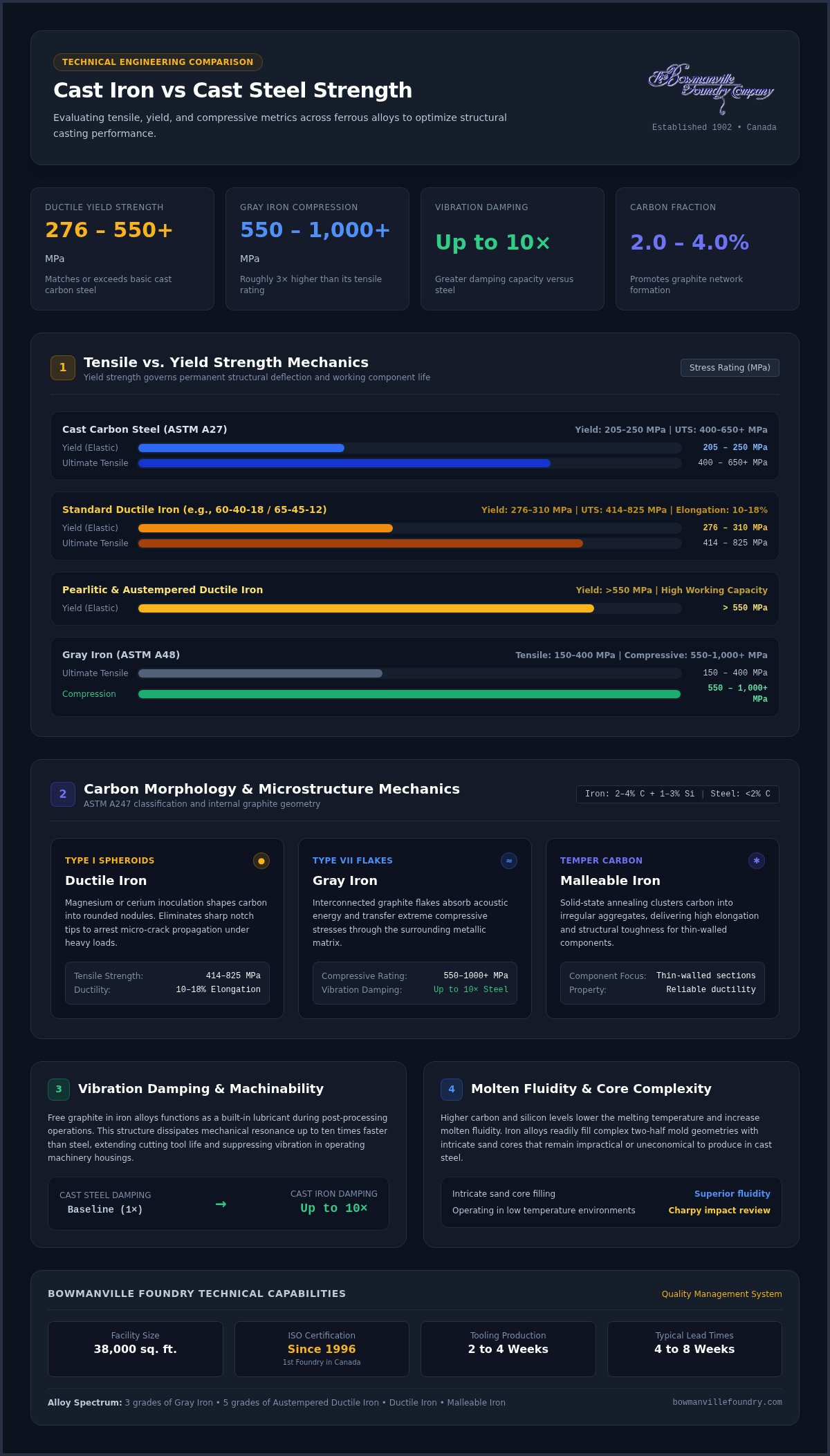
Many material specifications default to cast steel under the assumption that it is universally stronger under load. Evaluating real-world cast iron vs cast steel strength, however, requires looking past single-point tensile figures. While structural carbon steel delivers ultimate tensile strength (UTS) values ranging from 400 MPa to well over 650 MPa, Gray Iron typically ranges between 150 and 400 MPa under ASTM A48 classifications. Yet this metric alone does not dictate engineering success, because high-strength Ductile Iron directly challenges this divide by offering tensile capabilities between 414 MPa and 825 MPa.
Tensile Strength Versus Yield Strength in Ferrous Alloys
Machinery components rarely fail because an alloy reaches its ultimate tensile ceiling; failure happens when a part permanently bends. Yield strength marks this elastic limit, making it the decisive parameter for structural design. Basic cast carbon steels (such as ASTM A27) provide yield strengths between 205 and 250 MPa (30 to 36 ksi). By comparison, standard Ductile Iron grades like 60-40-18 or 65-45-12 deliver minimum yield ratings of 276 to 310 MPa, with pearlitic and austempered grades exceeding 550 MPa. Designing to yield prevents mechanical brackets and housings from taking a permanent set under dynamic stresses, while still maintaining 10 to 18 percent elongation to resist sudden fracture.
Compressive Strength and Deformation Behaviour
While cast steel holds an advantage in pure tension, cast irons outperform steel under compression. Standard Gray Iron withstands compressive forces roughly three times greater than its tensile rating, routinely supporting loads from 550 to over 1,000 MPa. Foundational documentation on Cast Iron Properties details how carbon forms an internal graphite network within the metal matrix. Under compressive clamping and heavy mechanical mounting, these graphite structures resist deformation by transferring loads through the surrounding matrix without buckling.
Design teams can consult our selection guide to evaluate compressive performance alongside tensile parameters, ensuring structural castings handle heavy machinery loads without unnecessary bulk.
Metallurgical Differences: Carbon Content and Microstructure Mechanics
At a chemical level, the divide between steel and iron rests on a clear threshold: cast steel contains under two percent carbon, whereas cast irons contain two to four percent. Silicon additions between one and three percent promote graphite precipitation during cooling in iron. This compositional contrast fundamentally alters how both metals solidify, dictating crystalline mechanics and explaining the practical divergence in cast iron vs cast steel strength.
Carbon Fractions and Graphite Morphology in Cast Iron
Under ASTM A247-24 standards, the shape and distribution of elemental carbon govern how cast iron responds to mechanical stress:
- Gray Iron (Type VII Flakes): Sharp graphite flakes create internal stress concentrations that initiate micro-fractures under tension, explaining its lower tensile threshold despite high compressive resistance.
- Ductile Iron (Type I Spheroids): Magnesium or cerium inoculation forces carbon into rounded nodules. These spheroids lack sharp notch tips, arresting micro-crack propagation and delivering high yield limits.
- Malleable Iron: Solid-state annealing of white iron clusters carbon into irregular temper carbon nodules. This structure provides thin-walled castings with reliable elongation and structural toughness.
Review our malleable iron guide for thin-section ductility parameters and specialized alloy behaviours.
Ferrite-Pearlite Crystal Lattice in Cast Steel
Cast steel solidifies into an isotropic ferrite-pearlite lattice devoid of free graphite. Carbon remains completely dissolved within the metallic matrix, yielding uniform tensile resistance in every mechanical axis. However, this metallurgical purity introduces distinct manufacturing hurdles.
Lower carbon content raises the liquidus temperature, requiring furnace pouring temperatures near 1,550 to 1,650 degrees Celsius compared to roughly 1,150 to 1,250 degrees Celsius for gray and ductile irons. Additionally, steel exhibits volumetric solidification shrinkage between four and six percent, roughly double that of iron. Feeding these shrinking zones requires elaborate gating and massive feeder risers, increasing production tooling complexity and post-cast cleaning operations.
Design teams looking to simplify part geometry while preserving structural integrity can coordinate a technical assessment with our foundry engineering staff to evaluate nodular iron conversions.
Impact Toughness, Fatigue Resistance, and Operating Temperatures
Shock loading and temperature swings quickly reveal the practical boundaries of cast iron vs cast steel strength. While yield metrics indicate how much static load an alloy holds before bending, impact toughness governs whether a component fractures catastrophically under sudden kinetic shock. Selecting the right alloy requires balancing energy absorption against cyclic fatigue thresholds.
Dynamic Shock Loading and Charpy V-Notch Performance
Cast carbon steel exhibits superior raw impact toughness because its uniform metallic matrix plastically deforms before rupture. In standard Charpy V-notch testing at room temperature (20 degrees Celsius), cast structural steels absorb between 30 and 60 Joules, with specialized low-alloy grades exceeding 100 Joules.
Standard Gray Iron provides virtually no plastic deformation under impact, absorbing under 5 Joules. However, modern nodular irons bridge this gap significantly:
- Ferritic Ductile Iron (ASTM A536 60-40-18): Delivers 14 to 20 Joules of impact energy at ambient temperatures, providing adequate resilience for suspension arms and driveline brackets.
- Austempered Ductile Iron (ADI): Retains 8 to 14 Joules while delivering tensile thresholds up to 1,600 MPa, outperforming many quenched-and-tempered cast steels in combined wear-fatigue service.
- Severe Impact Boundaries: Applications involving violent, unbuffered point-impacts, such as excavator bucket teeth or heavy rock-crushing jaws, remain the strict domain of cast steel.
Ductile-to-Brittle Transition in Low Temperature Environments
Exposing mechanical assemblies to low temperature environments drastically shifts ferrous crystal mechanics. As ambient temperatures drop below freezing, body-centred cubic metals experience a ductile-to-brittle transition temperature (DBTT), where impact absorption drops sharply.
Standard structural cast steels often maintain ductile behaviour down to -20 degrees Celsius, but unalloyed ductile irons may turn brittle between 0 and -10 degrees Celsius. To overcome cold-weather fracture risks common in Canadian winter duty, specialized ferritic Ductile Iron grades rely on tightly controlled chemistry. Limiting silicon below 2.2 percent and keeping phosphorus under 0.02 percent lowers the DBTT below -40 degrees Celsius.
Charpy impact verification at sub-zero temperatures confirms that properly formulated irons survive rigorous cold-weather shock loading, allowing engineers to replace steel without compromising winter reliability.
Wear Resistance, Vibration Damping, and Machinability Trade-Offs
Evaluating real-world performance requires looking beyond static yield numbers. When analyzing cast iron vs cast steel strength, dynamic operational wear and harmonic resonance often determine the actual service life of an engineered component. Mechanical assemblies operating under continuous sliding contact or variable rotational speeds frequently fail from surface fretting and vibration fatigue rather than gross structural yielding.
Harmonic Absorption and Surface Wear Characteristics
Internal friction gives cast iron a distinct mechanical advantage over cast steel. The graphite dispersed throughout the iron matrix absorbs vibrational energy directly, converting kinetic energy into minute amounts of heat. Standard Gray Iron provides five to ten times the vibration damping capacity of structural cast steel, rapidly suppressing resonance that would otherwise loosen fasteners or accelerate bearing wear. Ductile Iron also exhibits roughly double the damping capacity of steel, preserving component alignment under fluctuating cyclic forces.
Free graphite also acts as a solid lubricant during sliding contact. Machined surfaces expose microscopic graphite pockets that retain lubricating oil films during boundary friction events, preventing galling and surface scuffing. Review our analysis of industrial iron applications to see how these wear mechanisms support heavy machine frames, hydraulic bodies, and pump housings.
Tool Wear and Efficiency in Secondary Machining
Secondary machining reveals major operational trade-offs between these alloy families. Cast steel forms tough, continuous chips that generate significant friction and heat against cutting tool inserts. This thermal load accelerates crater wear, forcing machinists to run lower surface speeds and conservative feed rates.
In contrast, graphite inclusions in iron act as natural chip-breakers and dry lubricants. Flake and nodular irons produce discontinuous chips that clear cutting edges cleanly, reducing cutting forces and lowering tool temperatures. Machine shops transitioning from cast steel to Ductile Iron often achieve cutting speed increases of 20 to 40 percent without sacrificing surface finish or dimensional tolerances. That efficiency reduces machine downtime and extends tool life across long production schedules.
Coordinating finish work through integrated casting and machining services streamlines production while eliminating multi-vendor handling. If you want to refine component geometry or improve cycle times, contact our foundry team to arrange a technical review of your design files.
Engineering Selection Framework: When High-Strength Iron Replaces Cast Steel
Selecting the proper ferrous material requires a systematic audit of operating loads, structural geometry, and production steps. When assessing cast iron vs cast steel strength for a specific application, design teams should follow a structured evaluation framework:
- Audit Working Stresses: Define whether primary operational loads are tensile, compressive, or cyclical. If working stress remains within elastic bounds and compressive or torsional forces dominate, high-grade iron delivers equal or superior performance.
- Analyze Operating Environment: Review working temperatures, thermal cycles, and chemical exposure. For severe low temperature environments, verify impact energy ratings to prevent cold-embrittlement failures.
- Assess Geometry and Fluidity: Identify intricate details such as thin ribs, cross-sectional changes, or complex internal passages requiring sand cores. Iron fills intricate tooling cavities far more readily than molten steel.
Evaluating High-Stress Structural Components in Industrial Design
Ductile Iron frequently replaces multi-piece welded steel fabrications. Welded assemblies contain heat-affected zones prone to fatigue cracking under cyclic loading. Converting these multi-part weldments into a single high-strength Ductile Iron casting eliminates continuous welding operations, reduces dimensional distortion, and distributes mechanical stresses across fluid radii.
The superior casting fluidity of molten iron allows foundries to pour thin-walled geometries that reduce total component mass while maintaining structural rigidity. Consult our engineering team for custom casting optimization before finalizing production tooling, ensuring pattern designs take full advantage of iron’s tight solidification parameters.
Collaborating with a Canadian Quality-Certified Foundry
Establishing production certainty starts with an experienced manufacturing partner. Operating from a modern 38,000 square foot facility, Bowmanville Foundry was the first foundry in Canada to achieve ISO certification in 1996. Our technical staff evaluates CAD files, mold compaction parameters, and alloy selections under a rigorous quality management system established over more than a century of continuous operation.
We are happy to send a technical/sales engineer to your facility to assess your operating conditions, review structural stress calculations, and audit casting feasibility. You can also download our Free Casting Buyer’s Guide to compare alloy classifications or contact our facility directly to begin your engineering review.
Optimizing Structural Performance Across Ferrous Alloys
Making an informed choice between ferrous materials comes down to operational reality. When evaluating cast iron vs cast steel strength, designing to true yield limits and dynamic damping requirements frequently favours nodular iron over fabricated steel. While cast steel remains necessary for unbuffered kinetic shock, high-strength ductile and malleable irons deliver matched yield capacity, superior compressive resistance, and cleaner machining behaviour across complex geometries.
Selecting the right alloy ensures structural components survive demanding mechanical service without over-complicating production. Producing high-integrity iron castings continuously since 1902, Bowmanville Foundry was the first foundry in Canada to achieve ISO certification in 1996. Our 38,000 square foot facility pairs meticulous metallurgical control with direct engineering assistance. We are always ready to send a technical/sales engineer to your facility to evaluate stress requirements, inspect CAD files, and confirm casting feasibility. Download our Free Casting Buyer’s Guide or request a technical assessment with Bowmanville Foundry to start refining your component specifications today.
Frequently Asked Questions
Can Ductile Iron achieve the same yield strength as structural cast steel?
Yes, Ductile Iron often matches or exceeds the yield strength of standard structural cast steel. While basic cast steel delivers yield ratings around 205 to 250 MPa, standard Ductile Iron grades like 65-45-12 reach 310 MPa, and it’s common for austempered grades to exceed 500 MPa. In a direct cast iron vs cast steel strength evaluation, modern nodular irons provide equivalent resistance to permanent deformation under functional mechanical loads.
Why is cast iron better than cast steel for machinery bases and housings?
Cast iron excels in machine bases due to its superior compressive strength and vibration damping. Gray Iron absorbs dynamic vibrations up to ten times faster than steel, preventing harmonic resonance that misaligns spindles or loosens mountings. Its compressive capacity withstands massive clamping stresses without flexing. Iron’s high molten fluidity also enables casting thick base sections with complex internal ribbing and oil passages that are impractical in steel.
How does temperature affect the impact strength of cast iron compared to cast steel?
Both metals lose impact resistance in low temperature environments, but cast steel generally retains higher toughness below zero. Standard cast steels remain ductile down to -20 degrees Celsius. In contrast, standard ductile irons experience a ductile-to-brittle transition closer to 0 degrees Celsius. However, foundries adjust iron chemistry by reducing silicon and phosphorus, lowering the transition temperature below -40 degrees Celsius for dependable Canadian winter performance.
What makes cast steel harder to machine than cast iron grades?
Cast steel forms tough, continuous chips that generate high friction against cutting tools. This creates excessive cutting temperatures, accelerating tool flank wear and forcing machinists to run lower spindle speeds. Cast irons contain free graphite particles that act as internal chip-breakers and solid lubricants. These graphite pockets allow tooling to cut cleanly with lower cutting forces, extending cutter life and reducing cycle times during post-processing.
When is cast steel strictly required over high strength iron alloys?
Cast steel is strictly required when components face severe, unbuffered shock loading or require extensive field welding. Applications like heavy mining excavator teeth, massive crusher hammers, and high-pressure steam vessels benefit from steel’s superior plastic deformation and fracture toughness. If a failure mode involves violent tensile impact or if on-site structural welding is unavoidable, cast steel remains the appropriate material choice over iron alloys. In demanding sectors such as mining, power generation, and chemical processing, engineering teams frequently rely on specialized partners like Pro-Mech Engineering Solutions Pty. Ltd. to evaluate alloy performance and specify the right cast materials for critical flow hardware and pressure systems.
Cast iron achieves tighter dimensional tolerances and finer surface details than cast steel. Steel shrinks between four and six percent during cooling, creating severe thermal contraction stresses and necessitating massive risers. Iron doesn’t shrink as severely during solidification, often staying near one to two percent. This stability allows foundries using two-half mold systems to hold tighter casting tolerances, reducing excess stock and cutting secondary machining allowances.
Can Malleable Iron withstand high shock loads in small mechanical assemblies?
Yes, Malleable Iron offers remarkable shock absorption and toughness for small, thin-walled mechanical components. Its microstructure consists of temper carbon nodules within a ductile ferrite matrix, formed through controlled multi-day annealing. This unique matrix stops crack propagation under dynamic impact and torsional loading. When analyzing cast iron vs cast steel strength for small brackets, pipe fittings, and hardware, malleable iron matches steel toughness while offering superior casting detail.
