
A flawed casting specification costs far more in downstream machining scrap and unpredicted field failures than any initial material savings could ever justify. If you’ve faced cracked housings during stress testing, internal porosity that destroys cutting tools, or months of offshore supply delays, you already know how easily misaligned expectations can derail a production schedule. This iron casting buyer’s guide provides the technical framework engineering and procurement teams need to eliminate component failure and secure a dependable supply line.
You’ll learn how to evaluate specific iron grades for tensile strength, machinability, and impact resistance; assess pattern tooling fabrication and realistic production schedules; and select an accredited Canadian casting partner. We will examine the distinct metallurgical behaviours of Gray Iron, Ductile Iron, and Malleable Iron, detail exact tooling development steps from CAD files to sample approval, and outline the quality management system standards required to keep your critical industrial assemblies moving without interruption.
Key Takeaways
- Match your mechanical stress profiles directly with specific grades of Gray Iron, Ductile Iron, or Malleable Iron to prevent in-service failures and excessive machining scrap.
- Engage foundry engineers during early CAD file development to correct draft angles and shrinkage allowances before tooling fabrication begins.
- Establish dependable production schedules by planning for two to four weeks of tooling development alongside typical casting run cycles of four to eight weeks.
- Apply this iron casting buyer’s guide to audit foundry quality management system standards and molten metal spectrometry testing before any metal is poured.
- Mitigate cross-border supply chain risks and logistics bottlenecks by partnering with an accredited Canadian foundry offering integrated post-processing services.
Iron Casting Metallurgy: Selecting the Proper Ferrous Alloy Grade
Engineering industrial components as cast parts delivers damping capacity, internal wear resistance, and cycle-time machinability that welded fabrications cannot replicate. Selecting the wrong metallurgical grade, however, risks sudden mechanical fracture under heavy dynamic loads. Understanding what is cast iron at the microstructural level reveals that graphite morphology dictates performance. Flake graphite dissipates vibrational energy but concentrates stress, whereas rounded spheroidal nodules allow the metal to deform elastically without propagating cracks. Any thorough iron casting buyer’s guide prioritizes identifying these mechanical trade-offs during initial component design. To avoid premature field issues, engineering teams should evaluate how to choose the ideal iron casting grade before finalizing part geometry.
Gray Iron and Malleable Iron Applications
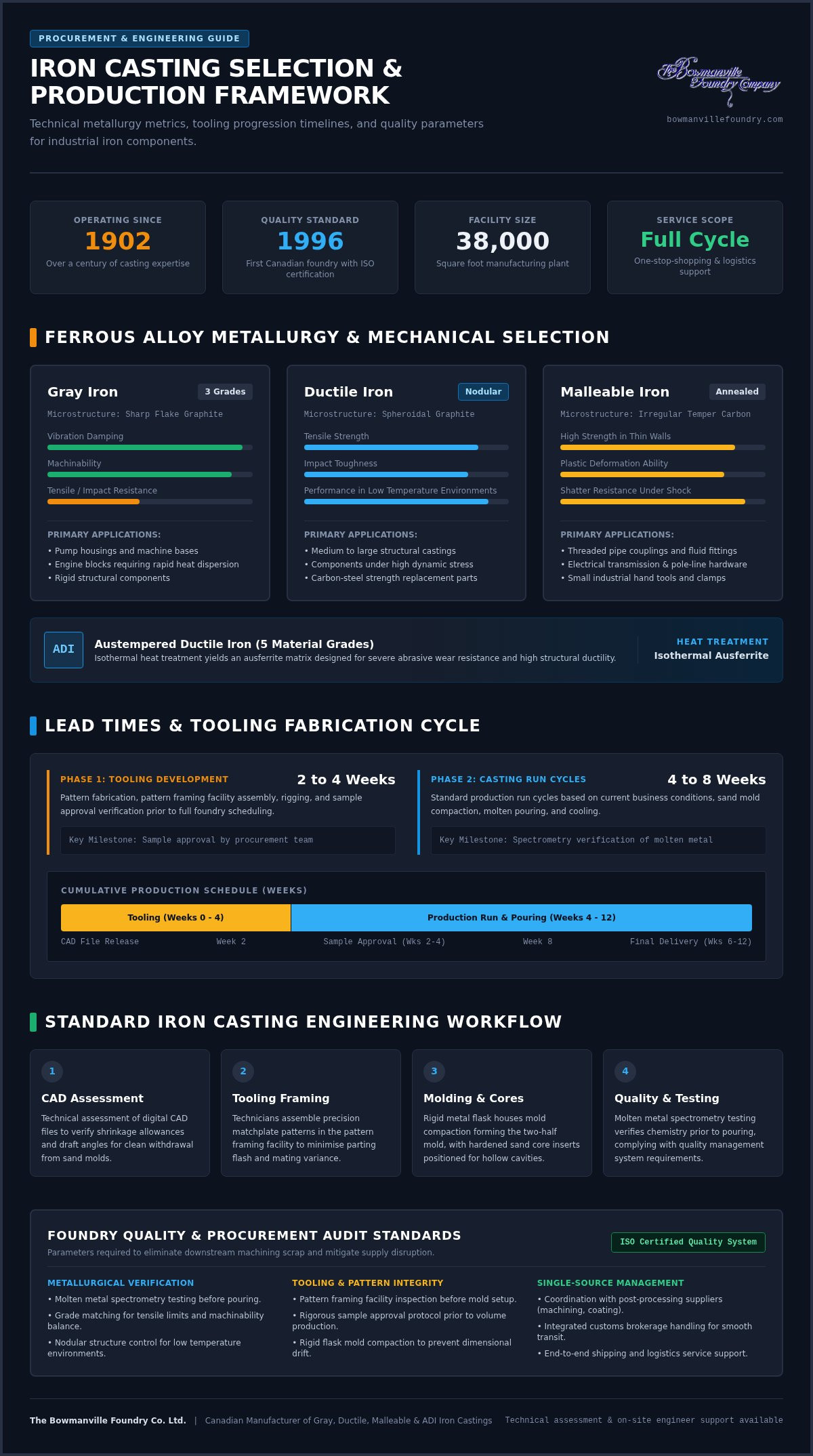
Gray Iron remains the industry benchmark for rigid structural components. Its microstructure contains sharp graphite flakes that disperse heat quickly and suppress operational resonance, making it ideal for pump housings, engine blocks, and machine bases. Foundries produce this alloy across three primary industrial classes to balance tensile limits against tool wear during turning and milling.
Malleable Iron offers a distinct mechanical alternative for small, thin-walled castings requiring high strength alongside plastic deformation capability. Produced by heat-treating white iron to precipitate irregular carbon aggregates known as temper carbon, it resists shattering under sudden impacts. Manufacturers rely on Malleable Iron for:
- Threaded pipe couplings and high-pressure fluid fittings
- Electrical transmission and pole-line hardware
- Industrial hand tools, brackets, and structural pipe clamps
Ductile Iron and Austempered Ductile Iron Performance
Ductile Iron incorporates trace amounts of magnesium or cerium to force graphite into spheres during solidification. This nodular structure yields tensile strength and elongation metrics comparable to carbon steel, without sacrificing casting complexity. These spheroidal graphite formations also maintain critical impact toughness in low temperature environments where other ferrous metals become brittle.
For extreme service duties, Austempered Ductile Iron (ADI) undergoes an isothermal heat treatment to create an ausferrite matrix. Foundries formulate ADI across five distinct high-strength material grades to resist severe abrasive wear while retaining structural ductility. As you consult this iron casting buyer’s guide, review malleable iron casting properties to determine whether small-batch annealed parts or nodular castings best meet your mechanical yield targets.
Pattern Tooling and Molding: Preparing Engineering Files for Production
Tooling quality directly governs dimensional repeatability, parting lines, and surface finish across every production cycle. When moving from raw concepts to production tooling, early foundry involvement prevents expensive tooling modifications later on. A thorough iron casting buyer’s guide emphasizes the importance of a dedicated pattern framing facility, where technicians inspect, rig, and frame patterns before pouring molten metal. Setting up tooling properly from the start protects dimensional stability across thousands of molding cycles.
CAD Files, Parting Lines, and Draft Angles
Engineering teams must supply complete CAD files that clearly define finished component geometry alongside realistic machining allowances. Casting engineers evaluate these digital models during a technical assessment to integrate proper draft angles. Adequate draft allows the pattern to withdraw cleanly from sand molds without tearing cavity walls. At the same time, carefully planned parting lines minimize parting flash, which drastically reduces secondary grinding labour and prevents dimensional variation across mating faces.
Matchplate Tooling and Mold Compaction Techniques
High-volume commercial production relies on precision matchplate tooling mounted inside a rigid metal flask. A matchplate mounts opposing pattern halves on either side of a single plate, streamlining automated two-half mold preparation. Automated mold compaction squeezes sand uniformly around the pattern geometry, eliminating soft spots that cause swelling, sand inclusion defects, and dimensional distortion. Where internal passages or undercut chambers are specified, technicians place hardened sand core assemblies into the mold cavity before closing the flask halves.
Validating these tooling parameters early ensures smooth sample approval before entering high-rate casting runs. If you need engineering feedback on new designs or want to evaluate an existing pattern, you can connect directly with Bowmanville Foundry to review your CAD files and mold tooling requirements.
Quality Assurance: Auditing Foundry Standards and Testing Procedures
Industrial procurement demands strict adherence to formal quality management system protocols to prevent structural failures in field service. Auditing a supplier’s internal quality controls reveals whether they can consistently produce castings that match exact mechanical specifications. A dependable foundry verifies raw melt chemistry before pouring each ladle, uses non-destructive testing to detect hidden sub-surface porosity, and tracks physical properties across every batch. Evaluating these technical controls is a central step in this iron casting buyer’s guide, helping buyers avoid suppliers whose inspection methods cannot guarantee reliable components.
ISO Certification and Metallurgical Verification
Decades-long ISO registration records indicate deeply established quality controls rather than surface-level procedural compliance. Bowmanville Foundry became the first foundry in Canada to achieve ISO certification in 1996, establishing a benchmark for documented traceability from furnace charges to finished products. Rigorous metallurgical testing within an accredited quality management system relies on specific verification procedures:
- Optical emission spectrometry: Technicians analyze chemical samples drawn directly from the furnace to confirm carbon equivalent, silicon, and alloy elements before tapping.
- Brinell hardness testing: Verifying hardness profiles on raw castings ensures consistent machinability and prevents uneven tool wear during secondary CNC operations.
- Microstructural analysis: Metallurgists examine polished samples under magnification to confirm nodularity percentages in Ductile Iron or flake distribution in Gray Iron.
Sample Approval and First Article Inspection
Authorizing high-volume production requires rigorous sample approval protocols. Coordinate measuring machines (CMM) and 3D scanning verify first-article castings against the critical tolerances, wall thicknesses, and datums specified in your engineering drawings. Non-destructive examination, including magnetic particle inspection and liquid penetrant testing, checks critical stress areas for surface tears or inclusions before machining begins. Procurement teams seeking detailed validation checklists should review our operational guide on custom iron casting production to align dimensional acceptance criteria before launching full production runs.
Production Lead Times, Tooling Fabrication, and Post-Processing Operations
Accurate production schedules rely on separating initial pattern manufacturing from ongoing pouring schedules. Raw castings rarely leave the foundry shakeout deck straight to the assembly floor; they require organized planning across machining, heat treating, and surface preparation. A practical iron casting buyer’s guide establishes firm delivery milestones so procurement teams can avoid costly production shutdowns.
The Four-Step Casting Procurement Timeline
Foundry manufacturing schedules follow a structured progression to ensure part integrity before volume production begins:
- Technical assessment: Foundry engineers evaluate CAD files to resolve parting lines, draft angles, and wall thicknesses for optimal castability.
- Pattern construction: Patternmakers build matchplates and core boxes. Tooling can be produced in two to four weeks depending on pattern complexity.
- Sample approval: The foundry casts prototype units to verify dimensions via coordinate measuring machines and obtain customer sign-off.
- Production casting: Full production runs begin. Typical lead times are four to eight weeks depending on current business conditions.
Integrated Secondary Machining, Heat Treating, and Coating
Raw iron components often require secondary operations to achieve finished engineering tolerances. Partnering with established post-processing suppliers ensures precision CNC turning, boring, and milling operations match your critical print tolerances without inducing part distortion. Additionally, specialized heat treatment, such as annealing for stress relief or austempering to maximize tensile strength, refines internal crystalline matrices to meet severe operating loads.
Applying protective primers, powder coatings, or plating prevents oxidation during long-term storage and damp operating conditions. Exploring integrated iron casting and machining enables manufacturers to consolidate these finishing steps under a single purchase order. This one-stop-shopping approach reduces handling damage, eliminates fragmented supply chains, and simplifies warranty administration. When you are ready to evaluate schedules for an upcoming production run, request a quote from Bowmanville Foundry to review your component specifications with an experienced technical sales engineer.
Selecting an Established Canadian Foundry: The Bowmanville Foundry Standard
Sourcing ferrous castings domestically protects manufacturing operations from unpredictable overseas shipping delays, rising border duties, and fractured communication lines. While third-party brokers connect buyers with disconnected contract shops, working directly with an operating domestic foundry establishes direct technical accountability. Buyers gain immediate access to experienced metallurgical teams who review tooling, inspect active production molds, and solve manufacturing bottlenecks before components reach your assembly floor. Applying this iron casting buyer’s guide helps industrial procurement managers select manufacturing partners with proven domestic production records.
Century-Old Heritage and Proven Technical Mastery
Operating continuously since 1902, Bowmanville Foundry provides long-standing ferrous casting expertise from a modern, clean 38,000 square foot manufacturing facility. As the first foundry in Canada to achieve ISO certification in 1996, the plant maintains rigorous quality documentation across all core operations. The facility formulates three standard grades of Gray Iron alongside five distinct grades of Austempered Ductile Iron to satisfy strict tensile and impact requirements. For procurement teams evaluating functional performance in heavy equipment, reviewing grey iron casting applications illustrates how proper material selection ensures component longevity across national infrastructure projects.
On-Site Engineering Assessments and Technical Sourcing Support
Direct technical collaboration eliminates design discrepancies that cause tooling delays or scrap parts. Bowmanville Foundry provides direct engineering support to assist your staff during pattern development, core placement planning, and secondary finishing:
- On-site technical assessments: We will be happy to send a technical/sales engineer to your facility to assess your needs, evaluate operating stresses, and review component requirements.
- Fabrication conversions: Foundry engineers work alongside your design team to convert complex multi-piece welded assemblies into single-piece castings, eliminating weld joints and reducing machining cycles.
- Logistics and supply chain control: Complete domestic production guarantees transparent material heat records, reliable delivery tracking, and simplified customs brokerage handling for continental freight.
Consolidating pattern fabrication, casting production, and post-processing services under one roof provides true one-stop-shopping for your procurement team. To evaluate material grades for your upcoming projects or review tooling lead times with our engineering staff, request our free casting buyer’s guide or contact our technical team to schedule an on-site facility consultation.
Streamline Your Ferrous Sourcing with Proven Foundry Engineering
Matching graphite metallurgy to operational stress profiles and qualifying tooling early prevents costly machining scrap and unexpected component fractures. As detailed throughout this iron casting buyer’s guide, disciplined procurement depends on technical collaboration, documented spectrometer controls, and realistic tooling schedules.
Bowmanville Foundry delivers that dependability through continuous manufacturing operations established in 1902. Operating from a modern 38,000 square foot casting and pattern framing facility, we became the first foundry in Canada to achieve ISO certification in 1996. Our production capabilities span Gray Iron, Ductile Iron, Austempered Ductile Iron, and Malleable Iron castings, providing your team with complete domestic accountability and integrated secondary processing under one roof.
Take the uncertainty out of your component supply line. Request a technical consultation or download our free casting buyer’s guide today to evaluate your engineering files and production schedules directly with an experienced foundry engineer.
Frequently Asked Questions
How do I choose between Gray Iron and Ductile Iron for custom components?
Base your choice on mechanical loading and damping requirements. Gray Iron features flake graphite, providing superior vibration damping and machinability for static housings and machinery bases. If a component doesn’t experience sudden shock, it’s the ideal selection. Ductile Iron contains nodular graphite, delivering high tensile strength and elongation for structural brackets and suspension components. This iron casting buyer’s guide helps engineers match operating stress profiles to exact ASTM material grades.
What design information is required to begin pattern tooling development?
Foundries require 3D CAD files alongside 2D engineering drawings showing critical dimensions and allowable tolerances. Your files must clearly indicate machining stock, datum locations, parting lines, and draft angles. Specifying operating temperatures, annual production volumes, and required alloy grades helps engineers construct appropriate matchplates and core boxes. Conducting an early technical assessment identifies wall thickness transitions and shrinkage risks before patternmakers begin cutting tooling.
What are typical production lead times for custom iron castings?
New pattern tooling can typically be produced in two to four weeks, followed immediately by first-article inspection. Once sample approval confirms dimensional compliance, production casting lead times generally range from four to eight weeks depending on current business conditions. These timelines don’t include the lengthy ocean transit delays common with offshore suppliers, making domestic production far more predictable for scheduling assembly lines.
Can an existing welded assembly be converted into a single iron casting?
Yes, converting multi-piece welded fabrications into a single cast part is a standard engineering process. Casting unifies separate plates, tubes, and brackets into one continuous shape, eliminating failure-prone weld seams and structural stress risers. This conversion reduces manual fabrication labour, eliminates weld inspection costs, and optimizes section thickness where mechanical loads demand extra reinforcement. Foundry engineers work directly with your design team to remodel fabrications for castability.
How does Bowmanville Foundry ensure metallurgical quality and structural integrity?
Quality assurance begins with strict molten metal verification using optical emission spectrometry before pouring each heat. As the first foundry in Canada to achieve ISO certification in 1996, the facility maintains a structured quality management system across every department. Technicians perform Brinell hardness testing, microstructural nodularity checks, and coordinate measuring machine audits on sample castings. Documented melt logs ensure full traceability from raw charges to finished industrial components.
What secondary post-processing operations can be completed before delivery?
Why should industrial manufacturers source iron castings from a domestic Canadian foundry?
Domestic sourcing protects supply lines from unpredictable ocean freight delays, port congestion, and fluctuating cross-border tariff structures. Working directly with an established Canadian manufacturer ensures transparent communication, on-site technical visits, and reliable delivery schedules. Consulting an iron casting buyer’s guide helps procurement teams identify accredited domestic foundries capable of managing pattern framing, automated molding, and post-processing in one location to maintain consistent product quality.
