
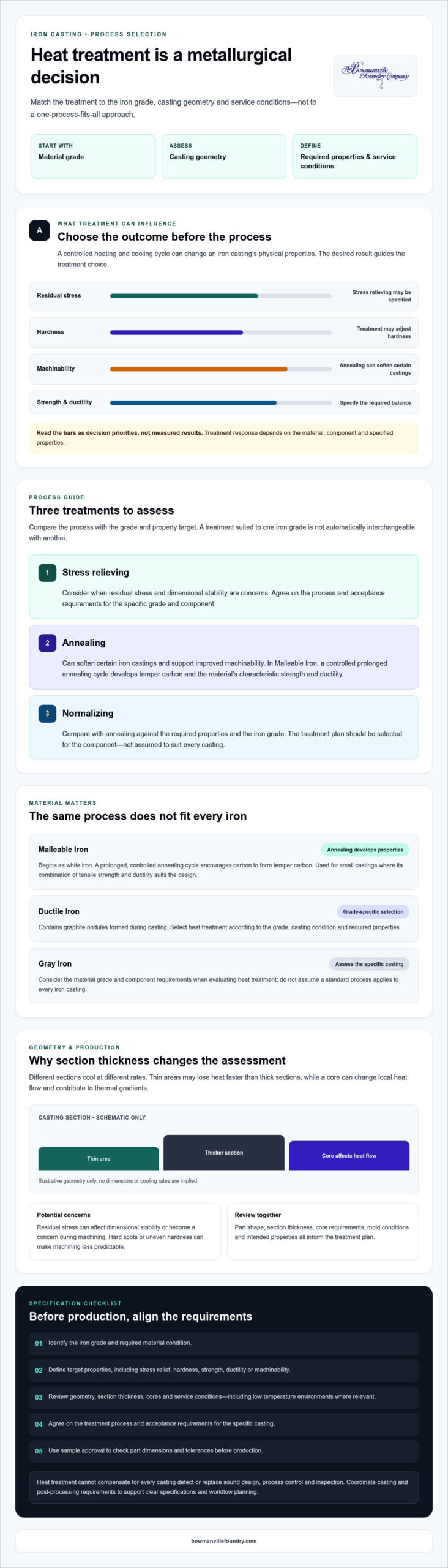
Heat treatment is not a finishing touch; it’s a metallurgical decision that can determine whether an iron casting meets its design requirements. Choosing heat treating for iron castings means balancing the material grade, casting geometry and service conditions, rather than applying one process to every part. Buyers and engineers are right to consider how internal stresses, strength and machinability affect performance and long-term reliability.
This article explains how heat treatment can influence Ductile Iron, Malleable Iron and Gray Iron components, and what to consider when selecting a process for a specific application. You’ll learn how annealing, normalizing and stress relieving can support different mechanical property goals, including improved machinability, and why the appropriate treatment depends on the casting’s material and required properties.
We’ll also outline how to connect ASTM grade requirements with casting performance, assess concerns about residual stress and consider reliability in low temperature environments. With a clear understanding of the metallurgical choices, you can discuss specifications more effectively with your foundry and post-processing suppliers.
Key Takeaways
- Understand how heat treating for iron castings can address different goals, including stress relief, hardness and ductility.
- Compare annealing and normalizing to identify which process may align with the required properties of Malleable Iron or Ductile Iron.
- Account for section thickness when assessing how consistently a casting can respond to heat treatment.
- Use sample approval to check part dimensions and tolerances before moving into production.
- Consider how coordinating post-processing with casting production may simplify supplier communication and workflow planning.
Why Heat Treating is Essential for Custom Engineered Iron Components
Heat treating is a controlled cycle of heating and cooling that changes an iron casting’s physical properties. Depending on the iron grade and required outcome, a treatment may relieve residual stress, increase hardness or strength, or improve ductility and machinability. The process must be selected for the material and component, not applied as a standard finishing step to every casting.
Heat treating for iron castings also needs to be considered alongside part design and production. Mold compaction, the placement of each core and the pouring conditions affect how the casting cools and solidifies. Those conditions influence the structure and stresses present before post-processing begins. As background on iron types, Cast iron includes malleable iron, whose properties are developed through heat treatment.
In components exposed to repeated or high mechanical loads, residual stress or inconsistent material properties can contribute to dimensional movement or premature failure. A suitable treatment can help manage these risks, but it cannot compensate for every casting defect or replace sound design, process control and inspection. The required properties and service conditions should guide the treatment plan.
Addressing Internal Stresses in the Two-Half Mold
During solidification, different sections of a casting cool at different rates. Thin areas may lose heat faster than thicker sections, while a core can change local heat flow and create additional thermal gradients. Uneven cooling may leave residual stresses that affect dimensional stability or become a concern during machining. A technical assessment before the first pour gives the foundry an opportunity to review the part geometry, core requirements and intended properties together.
The flask and mold affect heat transfer, but rapid cooling alone does not explain every source of stress. Section thickness, casting shape and the surrounding mold conditions also matter. Where stress relief is specified, the process and acceptance requirements should be agreed upon for the particular grade and component.
Improving Machinability and Tool Life
Hard spots or uneven hardness can make machining less predictable and may increase tool wear. For a grade and casting condition suited to it, heat treatment can adjust hardness and improve consistency through the section. Annealing, for example, is used to soften certain iron castings, but treatment response depends on composition and prior processing. It should not be assumed to create an identical grain structure or hardness throughout every part.
For high-volume production, more consistent machinability can support steadier machining cycles and reduce interruptions for tool changes. The practical benefit depends on the casting, machining operation and specified properties. Engineers should define the required material condition before production, then confirm that the treatment and post-processing plan meet those requirements.
Primary Heat Treatment Processes for Ductile and Malleable Iron
Heat treatment must match the iron grade and the properties required of the component. Malleable Iron and Ductile Iron develop different graphite structures through different processes. Malleable Iron is a type of nodular iron used for small castings that need good tensile strength and ductility; its properties are developed by heat treating white iron. Ductile Iron contains graphite nodules formed during casting. For metallurgical background, see NIST’s Heat treatment and properties of iron and steel.
The Annealing Cycle for Malleable Iron
Malleable Iron begins as white iron. A prolonged annealing cycle encourages carbon to form temper carbon within the iron matrix, developing the material’s characteristic combination of strength and ductility. The cycle must be controlled for the casting’s composition and section size. Malleable Iron is used for small castings where this balance of tensile strength and ductility suits the part’s design.
For engineers selecting a grade, required mechanical properties and part geometry should guide the specification. Heat treating for iron castings is grade-specific; annealing intended to develop Malleable Iron properties is not interchangeable with treatment for Ductile Iron.
Quenching and Tempering for Wear Resistance
Hardening followed by tempering may be specified for certain iron grades and applications. Quenching cools a heated casting rapidly, but the cooling medium and cycle require careful selection because uneven thermal change can increase the risk of distortion or cracking. Tempering reheats the hardened component to reduce brittleness and adjust the balance between hardness and toughness. The target properties depend on the material and component, so this route requires a defined specification rather than a general recipe.
For heavy industrial machinery, a design may need wear resistance at working surfaces without sacrificing the toughness needed to withstand service loads. The heat-treatment plan should account for the entire component, not just surface hardness.
Normalizing is another possible treatment for Ductile Iron. Heating followed by controlled cooling can alter the matrix and may increase tensile strength or hardness, depending on the grade and starting structure. It isn’t an automatic improvement for every casting; confirm the required properties against the material specification and validate the treatment for the part.
Austempering follows a different route from conventional quenching and tempering. It develops an ausferritic matrix in Ductile Iron, supporting combinations of high strength, ductility and wear resistance for demanding applications. Bowmanville Foundry produces five grades of Austempered Ductile Iron. To discuss material selection and casting requirements, review Bowmanville Foundry’s iron casting capabilities.
Comparing Stress Relieving, Annealing, and Normalizing
These treatments address different engineering needs, so selecting one requires more than naming a desired property. Stress relieving primarily targets residual stress and dimensional stability. Annealing softens a suitable iron grade to support greater formability or easier machining. Normalizing uses heating followed by air cooling to develop a different matrix condition, often balancing strength and toughness. The result depends on the iron grade, casting geometry and treatment cycle.
Use the specified ASTM grade and required mechanical properties as the starting point for heat treating for iron castings. For example, ASTM A536 covers Ductile Iron, ASTM A47/A47M covers ferritic Malleable Iron, and ASTM A48/A48M covers Gray Iron. These designations help identify material requirements; they don’t, by themselves, establish a universal heat treatment cycle. Confirm the treatment and verification criteria with the foundry based on the component’s application.
When to Prioritize Dimensional Stability
Stress relieving may be considered for castings with residual stresses that could cause movement during machining or service. This is relevant to intricate geometries, where uneven sections and constrained features can make distortion especially disruptive to dimensional control. The treatment uses controlled, relatively low-temperature heating and cooling to reduce residual stress while limiting changes to the material structure.
CAD files help the foundry review section changes, junctions and other features that may affect cooling. They are one input to a technical assessment, not a guarantee of stress locations or final dimensions. Discuss machining datums and tolerance requirements before production so the casting and post-processing plan can account for them.
Selecting the Right Grade for High Strength
Normalizing can change the balance of ferrite and pearlite in the matrix of a suitable iron, influencing hardness and strength. The direction and extent of that change depend on composition, section thickness and cooling conditions. For brackets or housings, define the required tensile properties and toughness first; don’t assume normalizing will produce a particular result without confirming it for the selected grade and casting.
A practical selection sequence is:
- Dimensional stability: assess whether residual stress could affect machining or service, then discuss stress relieving.
- Softness or machinability: confirm whether annealing is suitable for the specified iron grade and property targets.
- Strength and toughness: evaluate normalizing only against the grade’s requirements and the part’s section geometry.
For more guidance on matching material properties to component requirements, see How to Choose the Ideal Iron Casting Grade: A Comprehensive Selection Guide.
Technical Considerations for Designing Heat-Treated Castings
Heat treatment can affect dimensions as well as mechanical properties. Section thickness matters because thin and heavy areas heat and cool at different rates, so a casting may not respond uniformly throughout. Geometry, iron grade and the specified treatment all influence the result. For that reason, define critical dimensions and material requirements before production rather than relying on a generic tolerance allowance for every part.
Provide post-processing suppliers with current CAD files and clear manufacturing requirements. Identify machining datums, finished dimensions, critical interfaces and any surfaces that must remain as-cast. Where the component will operate in low temperature environments, state the service conditions and required material properties so the foundry can assess the grade and verification needs. Heat treating for iron castings should be planned alongside these requirements, not after dimensions and performance targets are fixed.
Collaborating with a Technical/Sales Engineer
An on-site technical assessment can help engineers and foundry staff review part geometry, tolerances and production requirements together. Discuss whether the pattern framing facility workflow and matchplate layout can produce consistent castings for the intended treatment. A matchplate supports repeatable pattern placement, but it does not by itself ensure uniform heating during heat treatment. Casting section design and the treatment plan still require review.
Sample approval provides a practical checkpoint before full production. Use the approved sample to assess the casting against agreed dimensions and machining requirements, and clarify how heat treatment affects those acceptance criteria. Bowmanville Foundry can arrange an on-site technical/sales engineer visit to assess your requirements; request an on-site engineering assessment.
Quality Management Systems and ISO Certification
Bowmanville Foundry has held ISO certification since 1996 and was the first foundry in Canada to achieve ISO certification. Certification supports confidence in a documented quality management system, but it doesn’t replace the need to define part-specific acceptance criteria. For safety-critical components, specify the material grade, required properties, inspection expectations and documentation needed for approval.
Agree on traceability expectations for heat-treated batches with the foundry and any post-processing suppliers. The records needed will depend on the purchase specification and application; identify them before production rather than assuming a particular format. Keep the approved sample and its inspection requirements linked to the production documentation.
Integrity also begins before heat treatment. The flask contains the sand mold, while mold compaction forms the cavity around the pattern. These steps help establish the casting’s shape and repeatability. Review mold and core requirements with the foundry alongside the treatment plan, especially where section changes or tight tolerances could affect machining and final fit.
Integrated Post-Processing: The Benefits of Foundry-Managed Heat Treating
Heat treatment affects more than material properties. It can influence machining sequence, dimensional checks and delivery planning, so its requirements should be discussed alongside the casting specification. A one‑stop‑shopping approach brings casting and post-processing coordination into the same supplier relationship. This can reduce hand-offs and help keep part requirements consistent, although the scope of heat treatment and other operations should be confirmed for each project.
Bowmanville Foundry provides integrated post-processing services for Malleable, Ductile and Gray iron castings. Coordinating casting and finishing requirements with one foundry can give buyers a clearer point of contact for specifications and production questions. It doesn’t remove the need to define acceptance criteria or confirm who is responsible for each operation. Ask how the proposed workflow addresses heat-treatment documentation, inspection and any required machining.
Streamlining Your Supply Chain
Typical lead times are four to eight weeks, depending on current business conditions. The schedule for a specific project depends on its requirements, so confirm timing with the foundry and identify any dependencies between casting, heat treatment and finishing. Bowmanville Foundry operates a 38,000 square foot plant. For an overview of coordinating castings and finishing operations, read Integrated Iron Casting and Machining in Canada: A Guide to Post-Processing.
For projects involving customers or suppliers across borders, clarify who is responsible for transportation arrangements and customs brokerage rather than assuming these are included in the casting order. Agree on documentation, delivery points and hand-off responsibilities before production begins.
Preparing for a Technical Assessment
To help assess a project, provide the foundry with current CAD files, the specified iron grade, annual or batch requirements, critical dimensions, machining needs and service conditions. Include the target properties and applicable material specification, as well as any inspection or traceability requirements. This information helps the foundry review feasibility and identify questions before production planning advances.
For new projects, ask separately how production tooling requirements affect the project scope and schedule. Tooling can be produced in two to four weeks; confirm timing for the specific design and current business conditions. Bowmanville Foundry also welcomes customers who wish to visit its modern facility. Arrange a foundry visit or discuss your casting requirements with the team.
Plan Heat Treatment With Your Casting Requirements
The right treatment depends on the iron grade, part design and properties required in service. Stress relieving, annealing and normalizing serve different purposes, so define dimensional, strength and machinability targets before production. For dependable results, include heat treatment in the casting plan and align it with sample approval, inspection and post-processing requirements.
Bowmanville Foundry has served Canadian industry since 1902 and has held ISO certification since 1996. A technical/sales engineer can assess your part design and discuss material and production requirements, including service in low temperature environments. This early coordination helps your team make informed decisions about Ductile, Malleable or Gray Iron castings and the steps needed to meet the specification.
Start a conversation about your component, drawings and required properties. Request a technical assessment for your iron castings and work with an experienced foundry team to plan the next steps with confidence.
Frequently Asked Questions
What is the primary difference between annealing and normalizing for iron?
Annealing generally uses controlled heating and cooling to soften a suitable iron grade, which can support ductility or machinability. Normalizing involves heating followed by air cooling, changing the matrix and potentially increasing strength or hardness. The response depends on the grade, composition, section thickness and treatment cycle. Neither process is suitable for every iron casting, so select one according to the required properties and material specification.
Can all grades of Gray Iron be heat treated for higher strength?
No. Heat treatment may change hardness or other properties in Gray Iron, but it won’t make every grade achieve a higher strength requirement. Results depend on composition, graphite structure, casting geometry and the treatment used. Start with the applicable grade specification and required mechanical properties, then ask the foundry whether a proposed treatment is suitable. Confirm how the result will be verified before setting production requirements.
How does heat treating affect the lead times for custom iron castings?
Heat treatment can add process steps, scheduling requirements and inspection to a casting order, so its effect on delivery timing depends on the part and production plan. Bowmanville Foundry’s typical lead times are four to eight weeks, depending on current business conditions. Ask for a project-specific schedule that accounts for casting, heat treatment, post-processing and sample approval. Don’t assume the treatment fits within the standard production sequence without confirmation.
Is heat treating necessary for castings used in low temperature environments?
Not automatically. Suitability for low temperature environments depends on the iron grade, required properties, component design and service conditions. Heat treatment may change the material’s properties, but it doesn’t by itself establish low-temperature suitability. Specify the expected operating conditions and relevant mechanical property requirements, then confirm the grade and any required testing with the foundry. The decision should be based on the application and material specification.
Will heat treating my iron casting change its final dimensions?
It can. Heating and cooling may cause dimensional movement or distortion, particularly where a casting has uneven sections, complex geometry or residual stress. The amount and direction of change depend on the casting and treatment cycle, so avoid assuming a universal machining allowance. Identify critical dimensions and datums in the CAD files, and agree on inspection and machining sequence. Sample approval can help verify dimensions before full production.
What are the benefits of Austempered Ductile Iron (ADI) over standard grades?
Austempered Ductile Iron develops an ausferritic matrix through a specialized heat-treatment process. Depending on the grade, it can provide a useful combination of high strength, ductility and wear resistance compared with conventional Ductile Iron grades. Selection still depends on the component’s design, service conditions and required properties. Bowmanville Foundry produces five grades of Austempered Ductile Iron; confirm the applicable grade requirements with its technical team.
Can I machine my casting before it undergoes heat treatment?
Sometimes, but the sequence depends on the treatment, casting geometry and final tolerances. Rough machining before heat treatment can remove material while leaving stock for finish machining if the process causes dimensional movement. In other cases, the specified treatment or machining plan may call for a different sequence. Provide the foundry with the required dimensions, datums and machining requirements before production so the sequence can be assessed for the part.
How does Bowmanville Foundry ensure quality during the heat treating process?
Bowmanville Foundry has held ISO certification since 1996 and was the first foundry in Canada to achieve ISO certification. That certification is a quality-system trust signal, but part-specific heat-treatment controls and acceptance criteria should still be confirmed for each order. Ask how the proposed treatment will be documented and how specified properties will be verified. A technical/sales engineer visit can support discussion of the casting design and requirements.
