
For buyers searching “automotive casting supplier Canada,” a capable foundry may still be the wrong source if its material grades, casting processes or quality controls do not match the part’s requirements. Comparing suppliers can be difficult when quotations leave technical questions unanswered or quality claims lack supporting evidence. Clear specifications and early technical discussions help prevent avoidable delays in assessment and production planning.
This guide explains what to compare across Gray Iron, Ductile Iron and Malleable Iron, which process details to clarify, and what quality documentation, validation steps and post-processing capabilities to discuss. It also covers how to prepare CAD files and component requirements for a technical assessment, and how sample approval fits into the path to production. Use it to shortlist suppliers based on verifiable capability and project support, not broad claims. Bowmanville Foundry’s iron grades and post-processing services can be considered against your requirements, without assuming automotive approvals or qualifications that need to be confirmed.
Key Takeaways
- Assess an automotive casting supplier in Canada against your component drawing and program requirements, not broad capability statements alone.
- Ask for quality evidence that applies to the specific process, material grade and part under review.
- Compare Gray Iron, Ductile Iron and Malleable Iron against the design requirements, then confirm suitability through engineering assessment.
- Prepare CAD files, drawings, material requirements, quantities, tolerances and operating conditions for a clear initial technical discussion.
- Review how sample approval and post-processing fit your project, and verify any supplier certification and its scope before qualification.
Automotive Casting Supplier Canada: What Should Buyers Expect?
An automotive casting supplier is a manufacturing partner whose suitability must be assessed against the component drawing, material specification and program requirements. The label alone does not confirm that a foundry can make a particular part or meet its acceptance criteria. Verify the relevant material grades, casting process, production controls and quality records for the component under consideration. While commercial distributors such as ELart, UAB can supply standard automotive spare parts and accessories off the shelf, custom automotive castings demand a much more involved manufacturing and qualification process.
Assessing a custom casting differs from buying a standard catalogue component. A custom part is developed around defined geometry and requirements, which may call for a review of the pattern, mold design, cores and finishing needs. A catalogue component is already specified for general use and may not match a program’s interfaces or acceptance criteria. For an overview of metal casting processes, review the basic terminology, then ask the foundry which processes and controls apply to your part.
What does supplier qualification mean for a cast component?
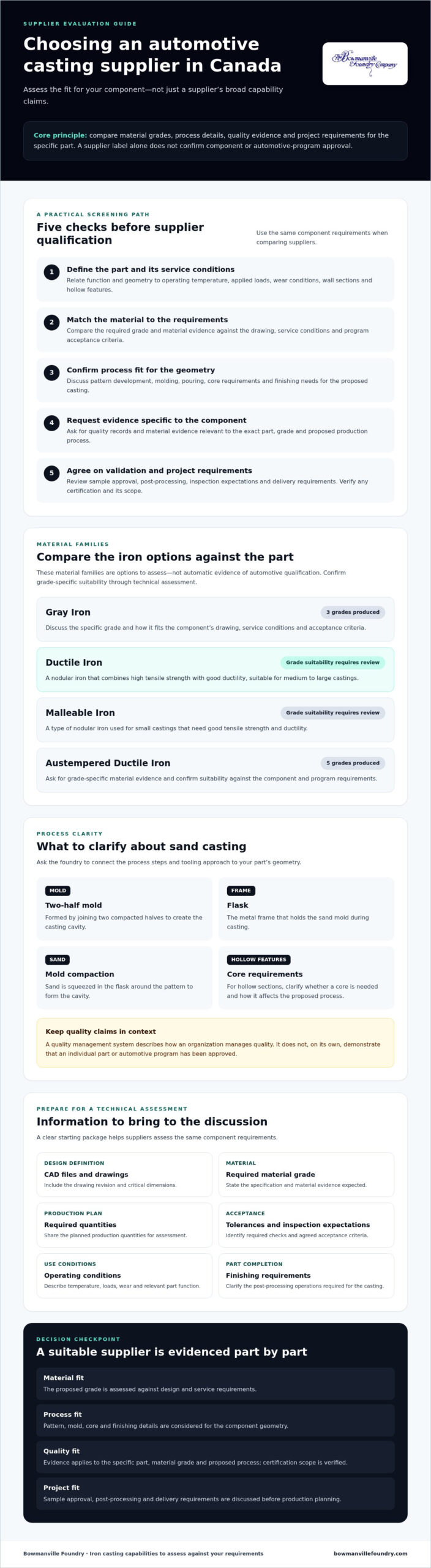
Supplier qualification is the documented assessment of a foundry’s ability to produce a specified component to agreed material, process, quality and delivery requirements. Start by relating the part’s function and service conditions to its geometry and production needs. Operating temperature, applied loads, wear conditions, wall sections and hollow features can all affect material selection and casting feasibility. Before requesting quotations, have engineering and procurement agree on acceptance criteria so suppliers are responding to the same requirements.
Specify the required material grade, drawing revision, critical dimensions, inspection expectations and finishing operations. Confirm which records the supplier can provide for the casting and whether its proposed process can meet the drawing. A quality management system describes how an organization manages quality. It does not, on its own, demonstrate that an individual part or automotive program has been approved.
Which iron casting processes and materials should buyers investigate?
Bowmanville Foundry produces Gray Iron, Ductile Iron, Malleable Iron and Austempered Ductile Iron. These are material families to assess against a part’s requirements, not automatic evidence of automotive qualification. Ductile Iron is a nodular iron that combines high tensile strength with good ductility, and is suitable for medium to large castings. Malleable Iron is a type of nodular iron used for small castings that need good tensile strength and ductility. Gray Iron and Austempered Ductile Iron are also available, with the foundry producing three grades of Gray Iron and five grades of Austempered Ductile Iron.
Ask for grade-specific material evidence and confirm how the proposed casting process suits your geometry and production needs. The iron casting grade selection guide can help frame an initial comparison. Final selection requires a technical assessment against the drawing, service conditions and program acceptance criteria. This helps determine whether an automotive casting supplier you are considering is a suitable match.
How to Evaluate an Automotive Casting Supplier’s Process and Quality Evidence
Request evidence tied to the exact component, material grade and proposed production process. A general capability statement or quality certificate can start a discussion, but it does not establish that a specific casting meets your drawing or program requirements. The Canadian Automotive Industry Overview provides sector context. Supplier qualification still depends on project-specific technical and quality evidence.
What production details should a buyer confirm?
Ask the foundry to explain how pattern development, molding, pouring and any core requirements relate to the part’s geometry. In sand casting, the two-half mold is formed by joining two compacted halves to create the casting cavity. The flask is the metal frame that holds the sand mold, while mold compaction squeezes sand in the flask around the pattern to form the cavity. If the design has hollow sections, clarify whether a core is required and how it affects the proposed process.
Ask for answers specific to your part and production plan:
- Which process steps and pattern arrangements apply to the drawing?
- How will the foundry assess whether the geometry is feasible to mold and pour?
- What production capacity is available for the required quantities and schedule?
- How will the supplier demonstrate repeatability for the specified component?
- Which inspection records and other documents can be provided, and at what production stage?
Look for clear, documented responses rather than assumptions based on a supplier’s broad industry label. A potential automotive casting supplier should explain what evidence it can provide for your project and identify requirements that need further engineering review.
How should buyers assess quality systems and sample approval?
A quality management system describes an organization’s procedures for managing quality. It is not, by itself, proof that a particular part has passed inspection or that a supplier is approved for a specific automotive program. Request current certification details, including the applicable standard, certificate status and scope. Verify that the information is current and relevant to your requirements. Agree on inspection criteria, required records and approval responsibilities before production begins.
A certification is relevant to a project only when its current scope matches the buyer’s requirements. Confirm this directly rather than inferring coverage from the certificate or a supplier’s general claims.
Sample approval is the process in which a customer validates a prototype casting before full production begins. Before samples are made, document what will be reviewed, which drawing revision and material grade apply, and how deviations will be handled. Clear approval criteria help both parties understand what must be accepted before production proceeds. To discuss how these checks may apply to an iron casting project, contact Bowmanville Foundry.
Can an Iron Casting Supplier Meet Automotive Component Requirements?
Potentially, but an iron casting supplier’s capability must be confirmed against the buyer’s drawing and program requirements. A material family or broad industry label does not establish that a particular grade and process will meet the component’s functional, dimensional or validation needs. Treat “automotive casting supplier Canada” as the start of a qualification process, not proof of automotive approvals or experience.
How do iron material options differ at a screening stage?
Use material families to structure an initial engineering discussion, then verify mechanical properties and acceptance criteria against the required grade specification. Bowmanville Foundry produces three grades of Gray Iron and five grades of Austempered Ductile Iron. These options, alongside Malleable Iron and Ductile Iron, require component-specific review before selection.
| Material family | Screening considerations | Confirm with engineering |
|---|---|---|
| Malleable Iron | Consider part size, geometry and the specified grade. | Do the grade’s documented properties and acceptance criteria match the component requirements? |
| Ductile Iron | Review the drawing, section geometry and required grade. | Does the selected grade meet the specified mechanical requirements? |
| Gray Iron | Check geometry and the component’s function in service. | Which available grade and supporting evidence align with the drawing and program criteria? |
| Austempered Ductile Iron | Identify the required grade and the component’s design conditions. | Can the supplier document the grade’s properties and confirm process fit? |
For material-specific context, consult the Malleable Iron casting guide. Use it to inform questions, not to replace review of the required grade specification.
Which automotive requirements need supplier confirmation?
Give the supplier the information needed to assess the part: geometry and drawing revision, loading conditions, low-temperature environments, tolerances, validation requirements and required documentation. Identify applicable program criteria and ask which requirements the supplier can support with evidence. Confirm relevant automotive experience and compliance evidence directly. Do not assume either from a general capability statement.
Ask engineering to review whether the proposed material grade and casting approach suit the component. Clarify how the supplier will address any open requirements, and record acceptance criteria and approval steps before proceeding. For more detail on design and production considerations, see the custom iron casting production guide. Final suitability depends on documented confirmation for the specific component, not a material name alone.
What Information Should You Send to a Canadian Casting Supplier?
A useful initial inquiry gives the foundry the information it needs to review the part’s design, material requirements and intended production sequence. Send the latest controlled information available and identify items that are still under discussion. This helps a supplier assess the request without treating assumptions as confirmed requirements.
Which design and specification documents help a foundry assess feasibility?
Gather the current design package before requesting a technical assessment. If documents differ, identify the controlling revision and explain the discrepancy instead of leaving the foundry to choose.
- Part definition: Attach current CAD files and dimensioned drawings. Include revision status and identify the controlling drawing.
- Material requirements: State the required iron family and grade specification, if selected. Mark material selection as open if engineering review is still needed.
- Quantity and timing: Provide expected order quantities, production volume and requested schedule so the supplier can assess the proposed production sequence.
- Dimensional requirements: List critical tolerances and identify surfaces that require machining or other finishing operations.
- Design features: Flag cores, hollow sections, restricted geometry and any areas that may affect pattern or mold planning.
- Service conditions: Describe operating conditions, including loading and exposure to low-temperature environments, where relevant.
- Quality and validation: Specify inspection, documentation and sample approval requirements, or list these as questions requiring agreement.
Incomplete or conflicting inputs can prevent a dependable feasibility assessment. Separate confirmed requirements from open questions. For example, distinguish a specified material grade from a preferred option that engineering has not approved. This gives the foundry a clear basis for identifying what it can assess and what needs clarification.
How can buyers plan the technical review and production sequence?
Discuss the sequence early: technical assessment, pattern planning, sample production, sample approval, full production and any requested post-processing. Confirm when the customer will review the sample, what criteria govern acceptance, and whether finishing requirements apply to the sample or production castings. Raise post-processing needs with the initial design package, since they can affect the required condition and inspection of the finished casting.
Bowmanville Foundry’s typical lead times are four to eight weeks, depending on current business conditions, and tooling can be produced in two to four weeks. Confirm the current schedule and timing for your project directly. Tooling, sample review and post-processing requirements may form part of the discussion.
To discuss drawings, material requirements and project sequence, contact Bowmanville Foundry for a technical discussion.
How to Start a Casting Supplier Discussion with Bowmanville Foundry
Bowmanville Foundry has produced custom Malleable Iron, Ductile Iron and Gray Iron castings since 1902. Its 38,000-square-foot plant is a verified facility fact, not a measure of available capacity for a particular project. The foundry also offers post-processing and technical support. These capabilities are starting points for a project discussion, not evidence of automotive approvals or program qualification. Buyers should confirm project requirements and supporting evidence directly.
What can buyers discuss with the foundry’s technical team?
Bring the component drawing and CAD files to a technical assessment. The discussion can cover geometry, iron material options, process feasibility and sample approval criteria. Explain the component’s operating conditions and identify design features that may affect casting or finishing. A foundry engineer can assess feasibility against the information provided and clarify questions that need engineering review.
Describe the finished-component specification, including any required machining, heat treating or surface coating. Bowmanville Foundry offers post-processing, but buyers should confirm which operations are within the foundry’s scope and which, if any, require other arrangements. The iron casting post-processing guide provides further context for planning finishing requirements alongside the casting.
Buyers can also discuss an on-site technical or sales engineer visit to their facility to review needs and requirements. For early-stage sourcing, the free Casting Buyer’s Guide can help procurement and engineering prepare questions and organize project information before contacting suppliers.
What are the next steps for a potential casting project?
Prepare the current drawing package, CAD files, material specifications, quantities, tolerances and known production requirements. Mark unresolved details clearly. Ask the foundry whether the proposed material and process can be assessed against the component requirements, what documentation is available, and how sample approval would be handled.
Before treating a supplier as qualified for an automotive program, verify relevant experience and program-specific evidence directly. Request current certification details, including scope and status, and confirm they match your requirements. Discuss project timing with the foundry as well, since schedules depend on the component, tooling and current business conditions.
For a project-specific discussion, contact the foundry to discuss your casting requirements.
Make Your Next Casting Decision with Clear Requirements
Choosing an automotive casting supplier in Canada requires more than matching a material name to a component. Confirm the supplier’s process capability, grade-specific evidence, inspection documentation and sample approval support against your drawing and program requirements. Clear CAD files, tolerances, operating conditions and finishing needs help the technical team assess feasibility and identify open questions early.
Bowmanville Foundry has produced iron castings since 1902. It was the first foundry in Canada to achieve ISO certification in 1996. Verify its current certification status and scope directly, along with project-specific capabilities and any automotive requirements. A long production history provides useful context, but each component still needs its own technical assessment.
Bring your requirements to the foundry’s technical team to discuss material options, process feasibility and post-processing. Contact the foundry to discuss your casting requirements and take the next step with a clear basis for review.
Frequently Asked Questions
How do I choose an automotive casting supplier in Canada?
Check a supplier’s capability against your component drawing, material grade and program requirements. Ask how the proposed casting process fits the part’s geometry, what quality documentation is available, and how inspection and sample approval will be handled. Verify current certification details and scope, and confirm any automotive-specific experience or requirements directly. A supplier on your shortlist should provide clear, project-specific answers rather than rely on broad capability claims.
What should I send to a casting supplier for a quote?
Send current CAD files and drawings with revision status, required material grade or specification, quantities, tolerances and requested timing. Include operating conditions, critical dimensions, machined surfaces, core requirements and finishing needs. Identify inspection, documentation and sample approval requirements. Separate confirmed specifications from open questions, such as a material choice that still needs engineering review. Complete, consistent inputs help the foundry assess feasibility and prepare a relevant response.
Can iron castings be used for automotive components?
Iron castings may be considered for a component, but suitability depends on the specific drawing, material grade, service conditions and program acceptance criteria. Have engineering assess loads, geometry, temperature conditions, tolerances and validation needs. Ask the foundry to confirm the proposed process and provide relevant evidence for the part. Do not assume that a supplier’s iron casting capability or general manufacturing experience means it has automotive approval or meets a particular program’s requirements.
What is the difference between Gray Iron, Ductile Iron, and Malleable Iron?
They are distinct iron material families, and suitability depends on the required grade and component requirements. Ductile Iron combines high tensile strength with good ductility and is suitable for medium to large castings. Malleable Iron is a type of nodular iron used for small castings that need good tensile strength and ductility. Gray Iron has its own grade-specific properties. Compare documented mechanical properties and acceptance criteria against the applicable grade specification, then confirm selection with engineering.
How long does a custom iron casting project take?
Timing depends on project requirements and current business conditions. Bowmanville Foundry’s typical lead times are four to eight weeks, and tooling can be produced in two to four weeks. Confirm current timing directly with the foundry for your project. The sequence may include technical assessment, tooling or pattern planning, sample production, sample approval and production. Provide drawings, quantities and requested dates early so the supplier can review the schedule and identify timing questions.
Can a foundry machine or finish cast automotive components?
Some foundries offer post-processing services, but buyers should confirm which operations are available for the project and whether they meet the finished-component specification. Identify machined surfaces, required tolerances and any specified heat treating or surface coating in the initial inquiry. Ask how these requirements affect inspection and sample approval. Bowmanville Foundry offers post-processing services. Confirm the specific operations and project scope with its technical team rather than assuming every finishing requirement is included.
What quality certifications should I check with a casting supplier?
Ask for the supplier’s current certification details, including certificate status, applicable standard and scope, then verify that they match your project requirements. Certification can describe a quality management system, but it does not by itself prove that a specific casting or automotive program is approved. Bowmanville Foundry was the first foundry in Canada to achieve ISO certification in 1996. Confirm its current certification and scope directly, along with part-specific inspection and validation evidence.
