
A casting can leave the mould hard and brittle, then gain the ductility needed for service through a separate heat-treatment stage. That transformation is the purpose of malleablizing: a suitable white iron casting is annealed so its structure and mechanical properties change. Understanding the distinction between casting the part and treating it afterwards is essential when specifying Malleable Iron components.
If you’re unsure how the heat-treatment cycle connects to the properties on a casting specification, you’re not alone. The result depends on more than the material name: the casting’s chemistry, section thickness, and controlled heating and cooling all matter. Malleablizing changes iron carbides into temper carbon within a metal matrix, helping produce a casting with useful strength and ductility.
This article explains the main stages of the process, how ferritic and pearlitic structures differ, and which process controls influence the finished casting. It also outlines practical questions to discuss with a foundry, including required properties, casting geometry, and the applicable material specification. Bowmanville Foundry produces custom Malleable Iron castings and can help customers assess grade and process requirements.
Key Takeaways
- Malleablizing is a heat-treatment step applied after casting, not part of forming the casting itself.
- Controlled heating and cooling transform white iron’s structure and develop temper carbon.
- Connect the resulting microstructure to specified mechanical requirements. Don’t assume one grade fits every application.
- Prepare the component’s function, service conditions, geometry, drawings, CAD files, and acceptance criteria for a clearer foundry discussion.
- Use a technical assessment to review process requirements and casting feasibility with a foundry experienced in Malleable Iron castings.
What Is Malleablizing, and Why Does It Produce Malleable Iron?
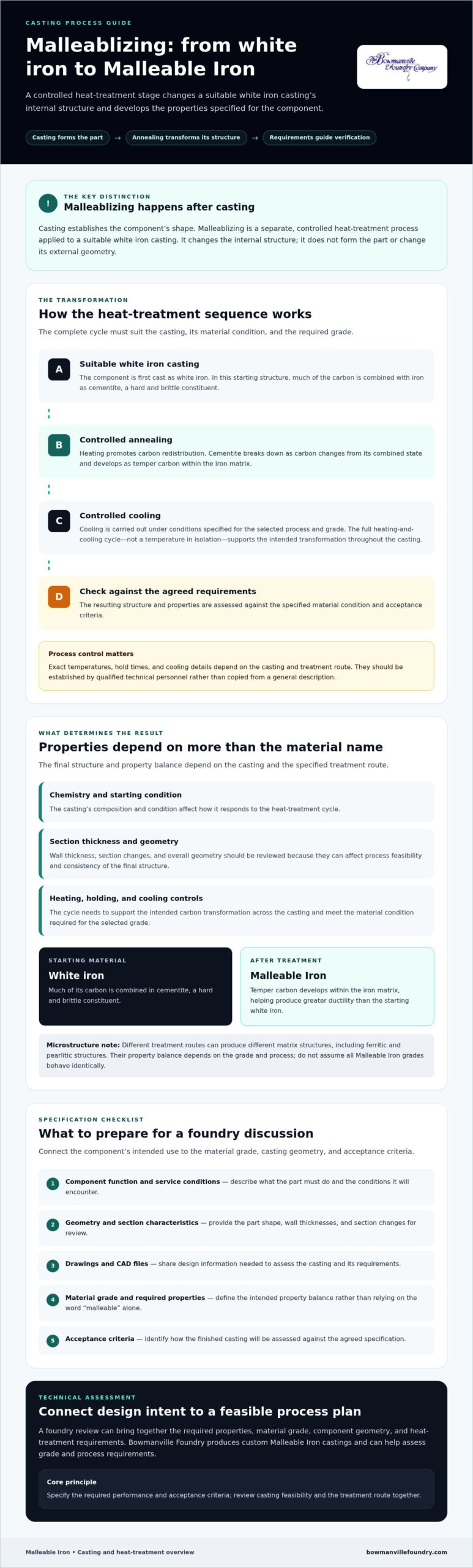
Malleablizing is the controlled heat treatment of a suitable white iron casting to transform its internal structure and produce Malleable Iron. In the starting casting, much of the carbon is combined with iron as cementite, a hard, brittle constituent. During annealing, the cementite breaks down and carbon develops as temper carbon within the iron matrix. The resulting structure can provide greater ductility than the starting white iron, but the outcome depends on the casting and the specified treatment route.
The term describes a metallurgical change, not a second method of shaping the component. As outlined in this Malleable iron overview, the material is first cast as white iron and then transformed through annealing. This distinction matters when assessing a part: casting design establishes its shape and section geometry, while heat treatment develops the intended structure and properties.
How does malleablizing differ from making the casting?
Casting forms the component. Molten iron fills a mould cavity and solidifies into the required shape; the resulting white iron casting is then prepared for its heat-treatment cycle. Malleablizing changes the casting’s internal structure rather than its external geometry. It isn’t a substitute for sound casting design, and it doesn’t correct every design limitation. Wall thickness, section changes, and the part’s function should be reviewed alongside treatment requirements because geometry can affect process feasibility and the consistency of the final structure.
What does Malleable Iron mean in this context?
Malleable Iron is a type of cast iron produced by heat-treating a suitable white iron casting. Its final microstructure and properties depend on the specified grade and controlled processing. Different treatment routes can produce different matrix structures, so buyers shouldn’t assume that all Malleable Iron grades respond identically or offer the same property balance.
For engineers and procurement teams, the practical point is to specify the required material grade and acceptance criteria, rather than relying on the word “malleable” alone. The intended service, loading, and part geometry inform whether the material and treatment route are suitable. A foundry’s technical assessment can help connect those design requirements to a feasible casting and heat-treatment plan before production details are finalized.
How Malleablizing Changes White Iron: The Heat-Treatment Sequence
Malleablizing follows a controlled sequence, and each stage must suit the casting and the required material condition. The process begins with a suitable white iron casting, continues through a planned heating cycle and controlled cooling, and ends with verification against the agreed requirements. It isn’t a single heating step: the full cycle determines how the iron’s carbon changes form and how the final microstructure develops.
What happens to cementite during malleablizing?
In white iron, much of the carbon is chemically combined with iron in cementite, a hard and brittle iron-carbon phase. During annealing, heat promotes carbon redistribution and the formation of temper carbon. Put simply, the controlled transformation of cementite allows carbon to separate from the combined state and form temper-carbon particles within the iron matrix. The precise transformation path can vary with the selected process and material; the Malleablizing process overview describes the central aim of changing combined carbon into graphite.
This change in carbon form is the metallurgical basis for the treatment. Reaching a temperature in isolation isn’t enough: the casting must receive a cycle that supports the intended transformation throughout its sections. The required structure depends on the grade and specified properties, so one cycle shouldn’t be assumed suitable for every casting.
Why do heating and cooling controls matter?
Before treatment, the foundry must consider the casting’s condition, composition, geometry, and section characteristics. These factors affect how the part responds to heating and cooling. The cycle is then controlled to meet the intended material condition, with cooling carried out under the conditions specified for that process and grade. Exact temperatures, hold times, and cooling details should be established by qualified technical personnel, not copied from a general description.
After cooling, the result needs to be checked against the agreed material and acceptance requirements. Verification may address whether the specified properties and structure have been achieved, using criteria established for the order. Buyers should confirm with the foundry engineer:
- Which grade and treatment route are intended for the casting.
- Which composition and section details affect the thermal cycle.
- What cooling conditions and acceptance criteria apply.
- How the finished casting will be verified against the specification.
Discussing these points early helps align component design with process requirements. For a technical assessment of Malleable Iron casting requirements, discuss your casting needs with Bowmanville Foundry.
Malleablizing Outcomes: Microstructure, Properties, and Process Limits
The outcome of malleablizing is a change in microstructure, not a new casting made by melting the original part again. White iron is annealed as a solid casting; the controlled treatment transforms the starting structure and develops temper carbon in an iron matrix. The result is assessed against the material grade and the component’s specified requirements.
Which properties can the treatment influence?
The balance of tensile strength and ductility is central to selecting Malleable Iron for a component. A part that must carry load while accommodating some deformation has different requirements from one selected primarily for another service condition. Microstructure contributes to this property balance, but malleablizing alone doesn’t establish a universal performance level. Composition, grade, casting geometry, and control of the treatment all affect the achievable result.
Use verified technical data for the specified grade and acceptance criteria rather than relying on general property descriptions. The appropriate outcome must be checked against both the grade and the component requirements.
What can malleablizing not correct by itself?
Heat treatment isn’t a remelting step, and it doesn’t automatically remove casting defects or resolve a design limitation. Soundness, section geometry, and the component’s loading and service environment still matter. A defect or stress concentration may require a change to casting design or production controls, not simply a different annealing cycle. For related guidance, see the casting failure prevention guide.
Before approval, confirm the grade, required properties, and applicable inspection or acceptance criteria with the foundry. This keeps the material specification connected to the actual function of the part.
How Engineers and Buyers Should Specify Malleablizing Requirements
A useful casting specification connects the part’s job to measurable material requirements. For malleablizing, buyers should provide enough information for the foundry to assess the component, its intended material grade, and any treatment-related constraints. If requirements are still being developed, identify what is fixed and what can be reviewed with a foundry engineer.
What information should a casting buyer provide?
Share the current part drawing or CAD files, along with a concise description of how the component functions. Include its loading and service environment, such as exposure conditions that could affect material selection. Identify required mechanical properties and the applicable material specification or grade, if known. Broader material decisions can be considered alongside this iron casting grade selection guide.
Use this checklist to organize the request:
- Component function: What does the part do, and what loads will it carry?
- Service environment: What operating conditions could influence material performance?
- Geometry: Provide drawings or CAD files that show dimensions, wall sections, and relevant features.
- Material requirements: State the required grade and properties, or identify which items need engineering review.
- Acceptance needs: Specify required inspection, documentation, and sample approval expectations, where applicable.
Separate mandatory requirements from preferred design targets. For example, distinguish a required property tied to part function from a preferred value that may be open to discussion. This helps prevent assumptions from becoming embedded in the purchase specification and gives the foundry a clearer basis for reviewing feasibility.
When should a foundry engineer review the design?
Request a technical assessment before production planning if the material grade, geometry, acceptance criteria, or treatment requirements remain unsettled. Early review can identify questions about part feasibility and whether the proposed design and requirements align. It also gives the engineering team an opportunity to clarify missing information before production details are finalized. For additional design and process considerations, consult the custom iron casting production guide.
Bowmanville Foundry produces custom Malleable Iron castings. To discuss drawings, material requirements, or a technical assessment, contact Bowmanville Foundry about your casting requirements.
Working with a Foundry on Malleablizing and Malleable Iron Castings
A productive discussion with a foundry connects the requested material to the part’s actual function and acceptance requirements. Before specifying Malleable Iron, confirm the intended grade, component loads, service conditions, and criteria the finished casting must meet. Also ask how the component’s geometry may affect casting feasibility and planned heat-treatment requirements. These details help establish whether the proposed material and process suit the application; they don’t guarantee a particular outcome without technical review.
What should a technical discussion confirm?
Bring unresolved questions into the discussion rather than leaving them implicit in a drawing or purchase order. Confirm which material requirements are mandatory, which are preferred targets, and how compliance will be assessed. Ask what technical data can be provided for the specified grade, what inspection requirements apply, and whether sample approval is part of the project plan. Clarify how any changes to geometry or service conditions could affect the agreed requirements.
For a component with features such as varying wall sections or load-bearing transitions, share the relevant drawing details and explain how the part is used. The foundry can then review the relationship between geometry, casting requirements, and malleablizing needs. This discussion is also a chance to agree on the information that must accompany the order and the criteria that will be used to review the finished casting.
What is the next step for a Malleable Iron casting project?
Prepare current drawings or CAD files, the intended function and service conditions, and any material, inspection, or acceptance requirements already established. If the grade or criteria remain undecided, identify those points for review. A technical assessment can help clarify feasibility and process questions before production planning proceeds.
Bowmanville Foundry produces custom iron castings, including Malleable Iron castings. The fit of a particular casting still depends on its design and requirements. The company also provides technical data, application guides, and a free casting buyer’s guide to help customers assess material options.
To discuss your component, share its drawings and material requirements with Bowmanville Foundry and request a technical assessment.
Bring Material and Process Requirements Together
Malleablizing is a post-casting heat treatment that transforms suitable white iron, but the final result depends on the material grade, controlled processing, and component requirements. The casting’s geometry and intended service matter too. Treating these factors as one specification helps engineers and buyers ask clearer questions before production begins.
For a practical next step, gather current drawings or CAD files, describe the part’s function and service conditions, and identify required properties and acceptance criteria. A foundry discussion can help clarify how those requirements relate to casting feasibility and the treatment plan. Bowmanville Foundry manufactures custom iron castings and offers post-processing services for secondary operations such as machining, heat treating, and surface coating.
Contact Bowmanville Foundry to discuss your Malleable Iron casting requirements and request a technical assessment. With the design information and material needs in hand, you can move forward with a clearer basis for evaluating the project.
Frequently Asked Questions
What is malleablizing in iron casting?
Malleablizing is a heat treatment applied after casting to suitable white iron components to develop Malleable Iron. The casting operation forms the part’s shape; the later treatment changes its internal structure. During the controlled cycle, carbon changes from its combined form in the starting iron and temper carbon develops. The required grade and properties should be specified for the application, since the process and final result aren’t identical for every casting.
How does malleablizing turn white iron into Malleable Iron?
Malleablizing transforms suitable white iron through a controlled heating and cooling cycle. Heat promotes changes in the iron-carbon structure, including cementite transformation and temper-carbon formation. The part remains a solid casting; it isn’t remelted and recast. The precise cycle depends on the material, casting geometry, and target grade. After treatment, the finished casting should be assessed against the material requirements and acceptance criteria agreed for the project.
Is malleablizing the same as annealing?
Malleablizing is a specific annealing heat-treatment process, but annealing is a broader term for treatments that use controlled heating and cooling to change a material’s structure or properties. In malleablizing, the aim is to transform suitable white iron into Malleable Iron by developing temper carbon. The term “annealing” alone doesn’t define the required cycle or result, so a casting specification should identify the intended grade and applicable acceptance requirements.
Can every iron casting be malleablized?
No. The process is intended for suitable white iron castings, and the casting’s composition, geometry, and section characteristics affect whether the required treatment and outcome are feasible. Heat treatment also doesn’t automatically correct casting defects or design limitations. Before specifying Malleable Iron, provide the foundry with part drawings or CAD files, intended service conditions, and required properties so the material and process can be reviewed for the component.
How do engineers specify a malleablizing process for a casting?
Engineers specify the required material grade, component function, loading, service conditions, and acceptance criteria, then review how the casting’s geometry affects process requirements. Provide drawings or CAD files, material requirements, and inspection needs where available. Identify which requirements are mandatory and which are preferred targets. A technical assessment with the foundry can clarify feasibility and help establish what technical data or sample approval steps are appropriate before production planning.
What properties does Malleable Iron offer after malleablizing?
Malleable Iron is a cast iron produced by heat-treating suitable white iron. Its balance of properties depends on the specified grade, composition, casting geometry, and controlled processing, so no universal strength or ductility value applies. Select the material using verified technical data for the grade and compare its requirements with the part’s loading and service conditions. Confirm acceptance criteria with the foundry before ordering.
