
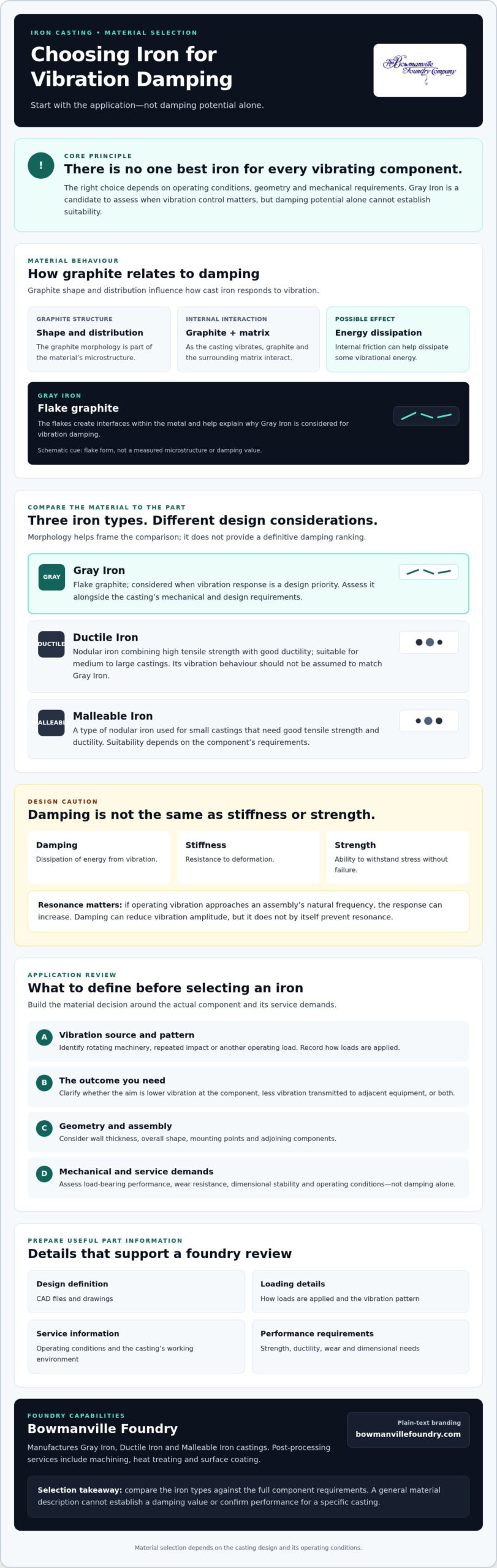
Gray Iron is often considered for vibration damping, but it isn’t automatically the right casting for every vibrating component. If you’re searching for the best iron for vibration damping, the graphite structure is a useful place to start: Gray Iron’s flakes create interfaces within the metal that help dissipate vibrational energy.
That potential advantage has to be weighed against the part’s strength, wear, geometry and operating conditions. A general material comparison can’t account for every load or service environment, and choosing for damping alone may create problems elsewhere in the design.
This article explains how graphite morphology relates to vibration damping and compares Gray Iron, Ductile Iron and Malleable Iron in the context of application requirements. You’ll learn what to consider when balancing damping with mechanical demands, and what part details and service information can help a foundry review a casting. Bowmanville Foundry manufactures iron castings and offers post-processing services, including machining, heat treating and surface coating.
Key Takeaways
- The best iron for vibration damping depends on the component’s operating conditions, geometry and mechanical requirements, not damping potential alone.
- Graphite morphology helps explain differences in vibration behaviour; Gray Iron’s flake graphite makes it a candidate to assess for damping needs.
- Compare Gray Iron, Ductile Iron and Malleable Iron against the part’s required strength, ductility and service conditions before selecting a material.
- Prepare CAD files, drawings, loading details and service information to support a useful foundry review.
- Bowmanville Foundry manufactures Gray Iron, Ductile Iron and Malleable Iron castings, and offers post-processing services.
Best Iron for Vibration Damping Starts with the Application
The best iron for vibration damping depends on what the component must do in service. Vibration damping is the reduction of vibration amplitude as energy is dissipated within a material or system. In cast iron, graphite structure can influence this response, which is why Gray Iron is often considered when vibration control is a design priority. It is one factor in material selection, not a guarantee of performance in every assembly.
What does vibration damping mean in an iron casting?
Damping describes how a material or system dissipates energy from vibration. It differs from stiffness, which describes resistance to deformation, and strength, which describes the ability to withstand stress without failure. Natural frequency is the frequency at which a component or assembly tends to vibrate. These properties affect vibration response in different ways.
Consider a motor mounted on a cast base. The base’s material and geometry affect its response, while the mounting points and connected equipment influence how vibration travels through the assembly. If an operating vibration approaches the system’s natural frequency, resonance can increase the response. Damping can reduce vibration amplitude, but it doesn’t by itself prevent resonance. Design and operating conditions matter too.
Why does the operating context change material selection?
Start with the source and pattern of vibration. Is the component exposed to a rotating machine, repeated impact or another operating load? Record how loads are applied and the service conditions the casting will face. These details help distinguish a damping concern from requirements for load-bearing performance, wear resistance or dimensional stability.
Geometry and assembly also matter. Wall thickness, overall shape, mounting points and adjoining components can all affect the behaviour of the installed part. Gray Iron’s flake graphite structure is associated with its excellent damping capacity, but that characteristic alone can’t determine whether a casting is suitable. The component still needs to meet its mechanical and design requirements.
Before choosing a material, define the outcome you need: lower vibration at the component, less transmitted vibration to adjacent equipment, or both. Then assess damping alongside stiffness, mass, geometry, mounting and service demands. This application-first approach provides a sound basis for comparing iron types without assuming there is one best material for every vibration-control requirement.
How Graphite Structure Affects Cast Iron Vibration Damping
Graphite is not simply an ingredient in cast iron. Its shape and distribution within the metallic matrix influence how the material responds to vibration. As the casting vibrates, graphite and the surrounding matrix interact, helping dissipate some vibrational energy through internal friction. The effect depends on the material’s microstructure and the conditions in which the component operates.
What role does graphite play in Gray Iron?
Gray Iron is characterized by graphite in flake form. These flakes create interfaces within the metal that can contribute to energy dissipation, which helps explain why Gray Iron is considered for components where vibration response matters. A U.S. Bureau of Mines research paper examines the relationship between graphite morphology and vibration damping in cast irons. Its findings provide technical context, but they don’t replace an assessment of the particular casting and its service conditions.
Graphite structure influences a casting’s damping potential, but the component’s performance depends on its material, design and operating conditions.
For an actual part, microstructure is only one consideration. Geometry, section thickness, loading and assembly affect how vibration moves through the component. Relevant material information and application data are needed to evaluate performance. A general description of Gray Iron cannot establish a damping value for a specific casting or grade.
How do Ductile Iron and Malleable Iron differ in the comparison?
Ductile Iron is a nodular iron that combines high tensile strength with good ductility, suitable for medium to large castings. Its graphite morphology differs from Gray Iron’s flakes, so its vibration behaviour shouldn’t be assumed to match Gray Iron’s. Malleable Iron is a type of nodular iron used for small castings that need good tensile strength and ductility. Its suitability likewise depends on the component’s requirements.
These structural differences help engineers frame the material comparison, but they don’t provide a definitive damping ranking. A valid comparison requires relevant, comparable test data and a clear account of the conditions being assessed. For information about available materials and casting capabilities, review Bowmanville Foundry’s iron casting capabilities.
Is Gray Iron Always the Best Iron for Vibration Damping?
No. Gray Iron is a common candidate when vibration damping is a priority, but it isn’t automatically suitable for every component. Its damping potential must be considered alongside the part’s loading, geometry, wear demands and service conditions. The best iron for vibration damping is the material that addresses the vibration concern while meeting the component’s full requirements.
| Iron type | Graphite structure | Damping relevance | Strength and ductility considerations | Design questions |
|---|---|---|---|---|
| Gray Iron | Flake graphite | Commonly assessed when damping matters; grade-specific damping values are not provided here. | Confirm the selected grade meets the component’s mechanical requirements. | Do geometry, loading, wear and service conditions suit the selected grade? |
| Ductile Iron | Nodular graphite | Do not assume a damping ranking without comparable test data. | Combines high tensile strength with good ductility. | Does the design require this combination of properties? |
| Malleable Iron | Nodular form, as described in the supplied material guidance | Comparative damping values are unavailable here. | Used for small castings requiring strength and ductility. | Does the part size and its mechanical requirements suit this material? |
Unavailable comparative values should remain unavailable. Results from different test methods, specimen geometries or operating conditions shouldn’t be treated as a direct ranking. If measured damping is a design requirement, define the test conditions and seek data relevant to the material and component. The ASTM E756 standard is a reference for measuring damping properties; confirm its suitability for the specific assessment.
When should engineers evaluate Gray Iron first?
Include Gray Iron on the shortlist when damping is important and the design can meet the selected grade’s requirements. Review loading, geometry, wear exposure and service conditions before deciding. For application examples, consult Grey Iron Casting Applications for Canadian Industry. For a broader grade-selection framework, refer to How to Choose the Ideal Iron Casting Grade.
When might another iron grade merit assessment?
Assess Ductile Iron if its combination of tensile strength and ductility suits the part. Consider Malleable Iron for a small casting when its stated strength and ductility characteristics fit the application. Review the material requirements alongside the part’s operating conditions, and use relevant data rather than assuming either iron type has a particular damping rank.
How to Specify and Validate an Iron Casting for Vibration Control
A useful casting specification describes the vibration concern and the component’s full service demands. This gives the foundry a basis to review the design and shortlist materials, rather than selecting an iron type from damping reputation alone. The process should also establish how the proposed casting will be reviewed before production proceeds.
- Define the vibration concern. Describe what is vibrating, where the effect is observed, and what needs to change. Distinguish vibration reduction from separate requirements such as strength, wear resistance or dimensional stability.
- Record service requirements. Document the vibration source, operating conditions, load cases and relevant interfaces with adjoining components. Include how the part is mounted and any service conditions that could affect its performance.
- Shortlist materials. Compare Gray Iron, Ductile Iron and Malleable Iron against the documented requirements, geometry and available material information. The best iron for vibration damping must also be suitable for the component’s mechanical and design demands.
- Review and validate the design. Discuss the candidate material and casting geometry with the foundry. Before full production begins, agree on how a sample casting will be reviewed and what requirements it must meet.
What information should a technical assessment include?
Give the foundry enough information to assess the part in context. Useful inputs include:
- CAD files and dimensioned drawings, including material, tolerance and finishing requirements where available.
- Part geometry, wall sections, mounting features and interfaces with adjoining components.
- Loading details, including the type and pattern of loads the casting experiences.
- The vibration source, operating conditions and service environment.
- A clear statement of the performance concern, with vibration control separated from strength, wear or other requirements.
Specific details help identify questions that a material name alone cannot answer. If drawings or requirements are still being developed, indicate what is confirmed and what remains open for review.
How can a proposed casting design be checked?
A foundry can review candidate material and geometry against the application information, then identify design points that need clarification. Design review and production planning should use the same agreed requirements so the intended component is clear through sample approval, the process where a customer validates a prototype casting before full production begins.
Set sample approval criteria before the prototype is reviewed. Specify which drawing details, material requirements and application needs the customer will validate. This keeps approval tied to the actual part specification without assuming a test method or acceptance threshold that hasn’t been established for the application.
For information about iron casting options and post-processing, contact Bowmanville Foundry.
Work with Bowmanville Foundry to Assess Iron for Vibration Damping
Material selection is strongest when it starts with the part’s requirements. Bowmanville Foundry manufactures Gray Iron, Ductile Iron and Malleable Iron castings. These material options provide a basis for discussing the application, but they don’t promise a particular damping result.
Bowmanville Foundry has produced iron castings since 1902. It also provides technical data and application guides to help customers select an iron grade.
What can a foundry review help clarify?
A discussion with the foundry can help review whether a proposed material, component geometry and stated requirements align. Share how vibration affects the part and the other demands it must meet, such as loading, wear or dimensional requirements. This helps frame material and design questions around the actual application.
The discussion can also identify items to resolve before production planning, including sample approval criteria and whether machining, heat treating or surface coating is required. Confirm the scope of any requested operation directly with the foundry. A review can guide material and design evaluation, but it doesn’t guarantee a specific damping result.
What should buyers prepare before contacting the foundry?
Drawings or CAD files give the foundry a practical starting point for reviewing geometry and features. Include available specifications for material, tolerances and finishing, along with information about expected operating conditions, loads, vibration sources and assembly interfaces. State the performance requirement clearly, separating vibration concerns from strength, wear or other needs.
Also identify expected production and post-processing requirements, and note any unresolved details. This allows the technical discussion to focus on what is known, what needs clarification and what may require validation through sample approval. Bowmanville Foundry’s technical data and application guides can also support grade selection.
If you’re evaluating the best iron for vibration damping, bring your part information to the discussion rather than relying on a general material ranking. Contact Bowmanville Foundry to discuss your iron casting requirements.
Move Forward with an Application-Based Material Choice
The best iron for vibration damping can’t be selected by graphite structure alone. Gray Iron is a common candidate, but the right choice must also satisfy the component’s geometry, loading, wear and service requirements. Ductile Iron and Malleable Iron may merit assessment when their mechanical characteristics better match the part.
Bring those requirements together with drawings or CAD files and clear information about operating conditions. A discussion with a foundry can help review material and design suitability, identify questions for sample approval, and clarify any required post-processing. It won’t guarantee a particular damping result, but it can help ground the decision in the actual application.
Bowmanville Foundry manufactures Gray Iron, Ductile Iron and Malleable Iron castings, with post-processing options that include machining, heat treating and surface coating. Its technical data and application guides can help customers consider suitable iron grades.
Contact Bowmanville Foundry to discuss your casting requirements and take a practical next step towards specifying a component that fits your application.
Frequently Asked Questions
Is Gray Iron the best material for vibration damping?
Gray Iron is commonly evaluated when vibration damping matters because its graphite-flake structure influences its vibration response. That doesn’t make it the best choice for every component. Engineers also need to consider loading, geometry, strength, wear, mounting and service conditions. Compare candidate materials using relevant, verified data for the application rather than relying on a general ranking. A material choice should satisfy the part’s full requirements, not damping needs alone.
How does graphite help cast iron damp vibration?
Graphite within cast iron affects how the material responds to vibration and dissipates energy. In Gray Iron, graphite commonly occurs as flakes, a structure associated with damping potential. The actual response depends on the grade, component design and operating conditions. A general material description can help explain why a material is being considered, but it can’t replace application-specific test data or an engineering review of the casting.
Can Ductile Iron be used for vibration damping?
Yes, Ductile Iron can be considered when evaluating an iron casting, but the decision should reflect the component’s full requirements. Its nodular graphite structure and combination of high tensile strength and good ductility are relevant material characteristics. They don’t establish a damping result for a specific part. Compare verified data under suitable conditions, and consult an engineer about the component’s design, loading and service requirements.
What is the difference between Gray Iron and Ductile Iron for damping?
Gray Iron has flake graphite, while Ductile Iron has nodular graphite. These structural differences inform material evaluation, but they don’t establish a universal performance ranking for every component. Compare relevant data alongside strength, ductility, geometry, loading and service conditions. If comparable data for the application aren’t available, treat material selection as an engineering question to assess, rather than assuming one iron type will perform better in every case.
How can engineers test vibration damping in an iron casting?
Start by defining the vibration concern, operating conditions, component geometry and assembly interfaces. Then establish suitable comparison or validation criteria with qualified engineering support. The appropriate test method and acceptance limits depend on the application, so don’t assume there is a universal protocol. Confirm any proposed method with the customer’s engineering team and foundry before using results to approve a casting or make a material comparison.
What information should I provide for an iron casting technical assessment?
Provide available drawings or CAD files, component geometry, expected loads, operating conditions and a clear description of the vibration concern. Include material, tolerance and finishing requirements where known. Explain how the casting connects to adjoining parts and which performance requirements need validation. This information gives a foundry a practical basis to discuss design feasibility, material considerations and possible sample approval steps without assuming a specific damping outcome.
Does vibration damping alone determine which iron grade to specify?
No. Damping is one selection criterion. A candidate material must also meet the component’s strength, ductility, wear, geometry and service requirements. Mounting and the behaviour of the assembled system can affect vibration response as well. Define the critical requirements before shortlisting grades, then review the choice against relevant material information and application-specific engineering input. This helps keep the specification focused on the complete part, not one property in isolation.
