
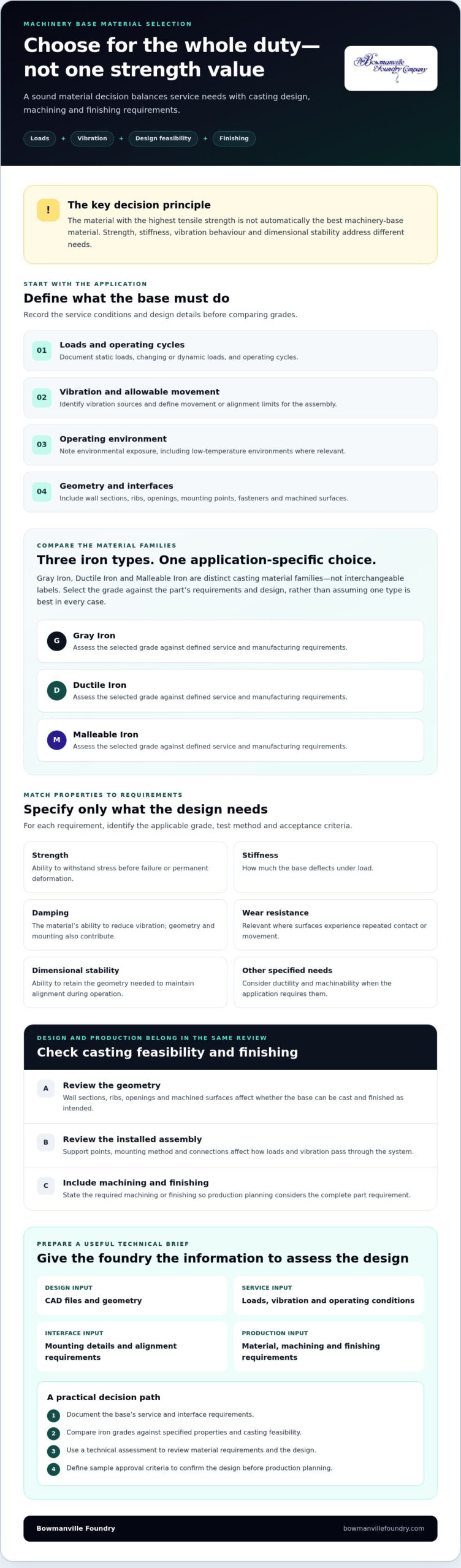
The material with the highest tensile strength isn’t automatically the best material for machinery bases. A base must suit its loads and operating conditions, including vibration, and its geometry must be practical to cast and machine. Choosing a grade based on one property alone can leave important service and manufacturing requirements unaddressed.
Before specifying a material, compare how each option fits the base’s intended use. Gray Iron, Ductile Iron and Malleable Iron have different characteristics, and the right choice depends on the application and design, not a single strength value.
This guide explains which performance requirements to define, how to compare the three iron types for a machinery base, and why casting feasibility and machining requirements belong in the decision. It also outlines what to include in a technical brief so a foundry can assess the design, material and production requirements together.
Key Takeaways
- Document the base’s loads, vibration, geometry, operating environment and interfaces before choosing a material.
- Compare Gray Iron, Ductile Iron and Malleable Iron against the part’s specified performance requirements, rather than relying on one property.
- The best material for machinery bases must suit both the casting design and any required machining or finishing.
- Provide CAD files and interface details so a foundry can review the geometry and raise design questions before production planning.
- Use a technical assessment to review material requirements and casting feasibility, then define how sample approval will confirm the design.
What Should the Best Material for a Machinery Base Do?
A machinery base supports and locates machine components. It must carry their loads while maintaining the relationships between mounting points, bearings, drives and other connected parts. The best material for machinery bases depends on how the assembly will perform in service and whether the base’s geometry and interfaces can be produced and finished as specified.
Several distinct properties matter. Strength describes the stresses a material can withstand before failure or permanent deformation. Stiffness relates to how much it deflects under load. Damping describes its ability to reduce vibration, while wear resistance matters where surfaces experience repeated contact or movement. Dimensional stability also matters because the base must retain the geometry needed to maintain alignment during operation.
These requirements can compete. A design may need to support substantial loads, limit movement at precision interfaces and manage vibration from the machine or surrounding equipment. Epoxy granite is another base material discussed for its vibration-damping characteristics. Epoxy granite provides an overview of its composition and manufacturing process. Any comparison of material options still needs to account for the specific design and service conditions.
Which service conditions should guide material selection?
Document the expected operating conditions before settling on a grade. Include static and changing or dynamic loads, vibration sources and operating cycles. Record environmental exposure, including low-temperature environments where relevant. Ask the design or application engineer to define allowable movement, alignment tolerances, and requirements for mounting faces, fasteners and other interfaces.
Why is strength alone not enough?
A base can meet a strength target yet deflect more than the assembly allows or transmit vibration in a way that affects machine operation. Strength and stiffness are related but distinct properties, and vibration behaviour is another consideration. Select a material by balancing the service requirements, including load capacity, stiffness, damping, wear resistance and dimensional stability, rather than relying on strength alone.
Geometry matters as well. Wall sections, ribs, openings and machined surfaces affect how a base carries loads and whether it can be cast and finished as intended. A material recommendation should follow a review of operating conditions and design details, not a general preference for one material family. These requirements provide a practical basis for comparing grades and discussing casting feasibility with a foundry.
How Do Iron Properties Affect Machinery Base Performance?
Iron grades respond differently to mechanical loads and vibration, so the material specification should connect each property to a design requirement. Gray Iron, Ductile Iron and Malleable Iron are distinct casting material families, not interchangeable labels. Performance depends on the selected grade and the casting’s design. Engineering references on the properties of cast iron discuss how characteristics such as vibration damping and wear resistance factor into material choice.
Material behaviour is only one part of the system. The base’s geometry, support points, mounting method and connection to the machine all affect how loads and vibration pass through the assembly. For example, changing a wall section or mounting arrangement can alter the base’s response even if the material grade stays the same. Evaluate the casting and the installed assembly together.
How can vibration behaviour affect a machine base?
Vibration can affect alignment, operating stability and the performance of connected components. Identify vibration sources and operating conditions in the design brief, alongside static and dynamic load requirements. Material damping matters, but it doesn’t determine the result on its own. Geometry, mounting and system conditions also contribute. Don’t assume a particular grade will deliver a specific damping outcome without evidence for that grade and design.
Which material properties belong in the specification?
Specify properties that correspond to defined service needs. Depending on the application, the design team may set requirements for tensile strength, stiffness, ductility, wear resistance, dimensional stability or machinability. Include vibration-related criteria where they can be evaluated for the intended design. Avoid adding property limits simply because they appear in a general material comparison.
For each requirement, engineering should identify the applicable grade, test method and acceptance criteria. Confirm these details against the relevant grade specification and approve them before they become procurement requirements. This gives the foundry a clear basis for assessing the casting, rather than asking it to rely on an assumed value or a material-family name alone.
Machinery base selection requires application-specific property data because grade performance, casting geometry and operating conditions together determine whether the part meets its service requirements. Share the load case, vibration expectations, wear conditions and machining needs with the foundry during a technical assessment. This discussion can clarify which properties need verification before the material is finalized.
Gray Iron, Ductile Iron, or Malleable Iron: Which Fits a Machinery Base?
No single iron grade suits every base. Assess Gray Iron and Ductile Iron against the part’s specified loads, vibration requirements and geometry. Malleable Iron is used for small castings that need good tensile strength and ductility, but that does not make it suitable for every machinery base. The best material for machinery bases is the grade that meets the application requirements and can be produced to the design.
| Material | Design considerations | Evidence to confirm |
|---|---|---|
| Gray Iron | Assess where the base design places emphasis on vibration behaviour, load support and cast geometry. | Applicable grade specification, relevant test results and foundry review of the casting design. |
| Ductile Iron | Assess where the specified requirements call for tensile strength and ductility, alongside the base’s other service needs. | Applicable grade specification, mechanical test results and confirmation that the geometry is feasible. |
| Malleable Iron | Consider for small castings requiring good tensile strength and ductility; confirm that the part’s size and service conditions fit. | Grade-specific information and foundry assessment of part geometry and production suitability. |
These are starting points, not guarantees about a grade. Performance depends on the selected grade and the actual casting. Base the comparison on verified specifications and relevant evidence, rather than general values assigned to an entire material family. Industry sources also discuss other base materials, including polymer composite machine bases, but this section focuses on the iron grades Bowmanville Foundry produces.
When should engineers assess Gray Iron or Ductile Iron?
Compare the grades against the defined loading, vibration and component design requirements. Check that the evidence applies to the specific grade under consideration, and review how the casting’s geometry and interfaces affect feasibility. For more application context, see this Gray Iron casting applications guide. A foundry technical assessment can help identify design questions before the material choice is finalized.
Where does Malleable Iron fit in the decision?
Malleable Iron is intended for small castings that require good tensile strength and ductility. Don’t assume it suits a base just because those properties seem useful. Confirm the part’s dimensions, loads, operating conditions and interfaces. Consult the Malleable Iron casting guide for grade-specific information.
For all three materials, confirm suitability against the design, service conditions and foundry capability. This review helps align the selected grade and casting process with the part’s requirements.
How Should You Prepare a Machinery Base for Casting?
Prepare the design information before finalizing the material or production plan. A foundry needs to understand what the base must do, how it connects to other components and which features require control. A technical assessment can identify questions about part geometry and casting feasibility while design changes are still under review.
Use this sequence to organize the handoff:
- Document service requirements. Record loads, vibration, operating conditions, material requirements and any applicable acceptance criteria.
- Provide design records. Supply current CAD files and drawings, including dimensions, tolerances and notes that clarify the intended geometry.
- Mark critical interfaces. Identify mounting points, machined surfaces, alignment features and other areas with specific requirements.
- Request a technical assessment. Review the material, geometry and proposed casting approach with the foundry before production planning proceeds.
- Plan sample approval. Define how the customer will inspect and validate a prototype casting before full production begins.
What design information should engineers provide?
CAD files help the foundry examine the base’s overall geometry, sections, openings and interfaces. Drawings add tolerances and other requirements that may not be clear from the model alone. Include operating conditions and the requested material grade. Distinguish surfaces that need machining from those that can remain as cast. For broader grade-selection context, review this iron casting grade selection guide.
How do casting and post-processing affect the design?
Part geometry must work with the proposed mold arrangement. In a sand-casting process, the pattern forms the cavity in a two-half mold, and the flask holds the mold during casting. Mold compaction shapes the sand around the pattern. Where the design includes a hollow section, a core may be needed to create it. Consider these features during design review because geometry and mold requirements affect whether the part can be produced as intended.
Identify machining or other post-processing needs early. Specify which faces, bores or mounting features need finishing, and communicate the related dimensions and tolerances. This allows the foundry to consider casting and finishing requirements together, rather than discovering interface concerns after the casting design is set.
Before production moves forward, agree on sample approval criteria and confirm which features will be checked. For help reviewing a machinery base design or material requirements, contact Bowmanville Foundry for technical assistance.
How Can a Foundry Help Confirm the Best Machinery Base Material?
A foundry can review material requirements alongside the casting design, production approach and finishing needs. This helps assess whether a proposed grade and geometry are feasible before production planning proceeds. The best material for machinery bases isn’t confirmed by a grade name alone. The decision needs to account for service requirements, the evidence required for acceptance and the foundry’s ability to produce the design.
A technical assessment can identify questions about sections, features, interfaces or specified machining that need to be resolved. Bowmanville Foundry produces custom Gray Iron, Ductile Iron and Malleable Iron castings, as well as post-processing services. Reviewing these requirements together can clarify the scope of the casting and any specified finishing.
What should buyers ask during a technical assessment?
Bring the drawings or CAD files, service conditions, requested grade and acceptance criteria. Ask how the proposed material aligns with the application and what information can confirm that alignment. Review casting and production details with the foundry, including:
- Pattern and molding considerations for the part geometry.
- Machining or other post-processing requirements, including controlled interfaces.
- Inspection criteria and the method for sample approval before full production.
For additional production-planning context, see the custom iron casting production guide.
What supplier evidence supports a sound decision?
Ask for relevant quality management system information and verify current certification details directly. Review the technical documentation available for the specified grade, the engineering support for design questions and whether the supplier’s post-processing capabilities match the drawing. Confirm that inspection and sample approval requirements are understood by both parties before production planning is finalized.
Bowmanville Foundry supports customers with technical information and technical or sales engineer assistance. Buyers can also request the free Casting Buyer’s Guide to help organize casting requirements and supplier questions. A clear brief makes it easier to assess material, geometry and finishing as connected parts of the decision.
Contact Bowmanville Foundry to discuss a machinery base requirement with its team.
Move from Material Comparison to a Foundry Assessment
The best material for machinery bases is the grade that meets the base’s actual service requirements and can be cast and finished to its design. Compare Gray Iron, Ductile Iron and Malleable Iron using verified grade information, then review loads, vibration, geometry, interfaces and machining needs together. A foundry technical assessment can help identify design questions before production planning moves ahead.
Established in 1902, Bowmanville Foundry produces custom Gray Iron, Ductile Iron and Malleable Iron castings, with post-processing services. The foundry was the first in Canada to achieve ISO certification in 1996. For current certification details, ask the foundry directly. Technical or sales engineer assistance is available to discuss your requirements.
Discuss your machinery base requirements with Bowmanville Foundry and take the next step towards a clear, application-based material specification.
Frequently Asked Questions
Is Gray Iron a good material for machinery bases?
Gray Iron may be a suitable candidate, but suitability depends on the base design, service conditions and specified material requirements. Assess loads, vibration behaviour, geometry, interfaces and machining needs. The best material for machinery bases isn’t the same for every machine. Compare verified data for the proposed grade with the application requirements, rather than relying on a general claim about Gray Iron or another iron grade.
Can Ductile Iron be used for a machinery base?
Ductile Iron may be considered if documented properties for the selected grade align with the part requirements. Evaluate loading, geometry, operating conditions and required tolerances together. A material name alone doesn’t confirm that a grade is suitable for a particular base. Ask a foundry to review the design and applicable grade information, then have the engineering team confirm the material specification before it’s finalized.
How do I choose between Gray Iron and Ductile Iron for a machine base?
Start with the base’s operating requirements, including loads, vibration, geometry and interfaces. Compare verified mechanical property data for specific candidate grades against those requirements. Include casting feasibility and machining needs in the review because the design must be producible and meet its finished dimensions. A foundry technical assessment can help identify design questions, but the engineering team should approve the final material specification.
Is Malleable Iron suitable for large machinery bases?
Don’t assume Malleable Iron is suitable for a large machinery base. Bowmanville Foundry describes it as a material used for small castings that need good tensile strength and ductility. Confirm the base’s dimensions, design, service conditions and applicable grade data with the engineering team and foundry before selecting a material. The intended use of a material family doesn’t establish suitability for every component size or application.
What information should I send a foundry to assess a machinery base?
Provide CAD files or drawings, operating conditions, loading requirements and details of the base’s interfaces. Include dimensional tolerances and identify surfaces or features requiring machining or other finishing. State the required material properties and acceptance criteria, too. This information helps the foundry review component geometry, casting feasibility and production requirements. A clear design brief can help resolve questions before the material and part specifications are finalized.
Does machinery base material selection depend on casting design?
Yes. Geometry, wall sections, internal features, cores and machined surfaces can affect casting feasibility and the finished component. Review the material alongside the casting design, rather than treating them as separate decisions. A technical assessment can identify questions about the design or production requirements before sample approval and production planning. Confirming these details early helps the engineering team and foundry work from a shared specification.
