
Specifying the hardest possible material for a casting might seem like the most logical path to durability, but without the right thermal post-processing, that same hardness often leads to brittle failure or excessive tool wear. Understanding the nuances of annealing vs normalizing iron castings is vital for any engineer looking to balance structural integrity with manufacturing efficiency. You likely recognize that unexpected failures due to internal stresses or inconsistent mechanical properties across batches can stall a project and inflate your total cost of ownership.
This technical comparison will help you determine which thermal cycle is necessary to eliminate those stresses and reach your specific performance targets. We’ll examine how these distinct heat treatment processes alter grain structures to optimize your components for either maximum ductility or superior tensile strength. By understanding these nuances, you can better organize your manufacturing workflow to ensure improved component longevity and realize significant savings through optimized machinability. Whether you’re working with gray, ductile, or malleable iron, selecting the correct thermal path is essential for engineering success.
Key Takeaways
- Learn how controlled thermal cycles mitigate internal stresses inherent in the cooling process within the mould.
- Understand how the annealing process produces a fully ferritic structure to achieve maximum softness and superior machinability.
- Evaluate the mechanical trade-offs of annealing vs normalizing iron castings to determine if furnace cooling or still-air cooling is required for your design.
- Discover how normalizing creates a finer grain structure, providing a uniform balance of hardness and tensile strength across different batches.
- Identify the post-processing path that minimizes tool wear and optimizes component longevity to reduce total manufacturing costs.
Understanding Heat Treatment in Ferrous Casting Production
Heat treatment is a fundamental metallurgical process involving the controlled heating and cooling of a material to intentionally alter its physical and mechanical characteristics. For ferrous materials like gray or ductile iron, these thermal modifications are often the final step in ensuring a component meets rigorous engineering specifications. Unlike generic metal advice that treats all alloys the same, iron requires a specific approach because of its unique carbon distribution. Precision matters here. It’s the careful management of these temperatures that allows engineers to tailor the material’s properties to the specific needs of the application.
The primary distinction in the debate of annealing vs normalizing iron castings lies in the cooling medium and the resulting microstructure. Annealing relies on a slow, insulated furnace-cooling cycle; conversely, normalizing utilizes ambient air cooling. These choices aren’t merely procedural. They determine the final grain refinement and microstructure of the metal. By selecting the appropriate thermal path, you can control whether the iron is optimized for extreme ductility or higher tensile strength.
The Role of Thermal Cycles in Metallurgy
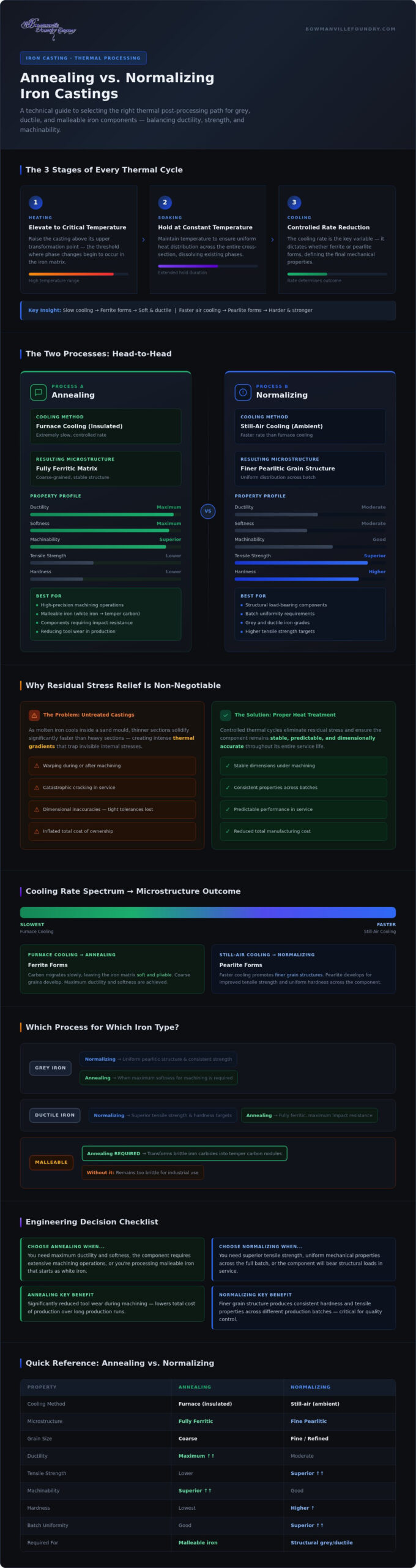
The thermal cycles used in annealing vs normalizing iron castings involve three distinct stages:
- Heating: Elevating the material to a specific critical temperature range, typically above the upper transformation point.
- Soaking: Holding the casting at a constant temperature to ensure heat distributes uniformly throughout the cross-section.
- Cooling: Reducing the temperature at a controlled rate to dictate the final microstructure.
This soaking stage is critical for dissolving existing phases and preparing the iron for a uniform transformation. The subsequent cooling rate is what dictates the final result. Slow cooling encourages the formation of ferrite, while faster air cooling promotes the development of pearlite. These microscopic changes are what ultimately define how the part performs under load.
Why Castings Require Stress Relief
As molten iron cools within a sand mould, it doesn’t do so uniformly. Thinner sections solidify and cool significantly faster than heavy sections, creating intense thermal gradients. These gradients trap internal stresses within the material that remain invisible to the naked eye. If left unaddressed, these residual stresses can manifest as warping or even catastrophic cracking when you begin the machining process or put the part into service. Implementing proper heat treatment is a cornerstone of optimizing custom iron casting production. It ensures the component remains stable and predictable, preventing the dimensional inaccuracies that often plague untreated castings. This stability is essential for high-precision components that must maintain tight tolerances over time.
The Annealing Process: Maximizing Ductility and Softness
Annealing represents a comprehensive thermal reset for iron components. By heating the casting above its upper critical temperature and allowing it to cool at an extremely slow rate inside the furnace, we encourage the development of a stable, coarse-grained microstructure. The primary metallurgical objective is to achieve a fully ferritic matrix. This structure provides the highest possible level of softness and ductility within the iron. It’s a critical differentiator when evaluating annealing vs normalizing iron castings for specific engineering needs. A ferritic structure is characterized by its ability to absorb energy and resist impact without fracturing. The slow cooling cycle allows carbon to migrate in a way that leaves the surrounding iron matrix soft and pliable. This makes annealed castings ideal for components that require high safety margins against brittle failure.
This process is particularly vital for malleable iron casting Canada projects. Unlike other iron grades that may be used in an as-cast state, malleable iron starts as white iron and requires a prolonged annealing cycle to transform brittle iron carbides into temper carbon nodules. Without this specific heat treatment, the material remains too brittle for industrial utility. If your project requires high-precision finishing, our post-processing services can help you determine the ideal hardness range for your specific tooling.
Full Annealing vs. Process Annealing
Full annealing involves heating the entire part above the transformation range to completely recrystallize the metal structure. It requires the most time and energy but offers the most uniform results. In contrast, process annealing, sometimes called sub-critical annealing, involves heating the part to a temperature just below the critical range. This is primarily used to relieve stress or restore some ductility between manufacturing steps without a full structural reset. Full annealing requires the furnace to cool slowly alongside the castings, often over several hours or days, to ensure the internal structure is consistent throughout. Process annealing is faster and less energy-intensive, making it a pragmatic choice for intermediate stress relief.
Impact on Machinability and Tool Life
Machining costs often represent a significant portion of a component’s total price. Annealing directly addresses this by reducing the hardness of the iron, which in turn lowers the cutting forces required. This leads to extended tool life and faster cycle times. However, engineers must account for a potential trade-off: extremely high ductility can lead to “gummy” machining behaviour, where chips don’t break cleanly. In certain grades, the resulting softness allows the material to flow rather than shear, which technicians must realize when setting feed rates. Annealing is the preferred thermal cycle when maximum elongation and minimum hardness are the primary design requirements.
Normalizing Iron Castings: Uniformity and Strength
Normalizing is a thermal process involving heating an iron casting above its transformation range followed by cooling in still, ambient air. This method differs fundamentally from the furnace-cooling cycle used in annealing. When evaluating the benefits of annealing vs normalizing iron castings, the primary advantage of the normalizing process is its ability to produce a finer, more uniform grain structure. This structural consistency is vital for industrial components that must perform reliably across large production runs, ensuring that each batch maintains the same mechanical characteristics.
The accelerated cooling rate associated with normalizing prevents the development of the coarse, soft grains typical of annealed iron. Instead, it results in a material with significantly higher tensile strength, yield strength, and impact resistance. This makes it an essential post-processing step for ductile iron foundry operations. By utilizing air cooling, we can provide engineers with robust components that withstand rigorous operational demands while maintaining a favourable strength-to-weight ratio.
Achieving a Pearlitic Microstructure
During the air-cooling phase of the normalizing cycle, the iron matrix typically transforms into pearlite. Pearlite consists of alternating lamellar layers of ferrite and cementite. This specific microscopic arrangement provides a higher baseline hardness and superior wear resistance compared to the fully ferritic structure achieved through annealing. While annealing maximizes softness, the refined grain size in normalized iron offers a more predictable response during subsequent surface hardening. This refinement is especially beneficial for parts that encounter abrasive environments, as the denser pearlitic structure resists surface degradation more effectively than coarser alternatives.
Enhancing Mechanical Properties for High-Stress
Castings destined for structural loads or heavy industrial machinery require the enhanced fatigue resistance that normalizing provides. By refining the internal grain structure, the process increases the material’s toughness, which is its ability to absorb energy and deform without catastrophic failure. It’s the standard specification for gears, crankshafts, and heavy-duty brackets that must endure cyclic loading. Engineers prioritize normalizing when the application demands a balance of toughness and strength, ensuring the component maintains its dimensional integrity under extreme stress. This thermal path is often the most pragmatic solution for optimizing the performance of annealing vs normalizing iron castings in high-stress environments.
Annealing vs. Normalizing: A Performance Comparison
Choosing between these two methods requires a clear understanding of the final application’s mechanical requirements. The fundamental difference in annealing vs normalizing iron castings remains the cooling rate. Annealing involves a slow, controlled furnace descent that can take days; conversely, normalizing utilizes the ambient air of the shop floor to cool the part in a fraction of that time. This difference in cycle time makes normalizing a more economical choice for high-volume production, as it reduces energy consumption and accelerates throughput.
The metallurgical results are equally distinct. Annealed iron typically exhibits lower Brinell hardness and higher elongation, which is vital for parts requiring extensive machining. Normalized iron, however, offers superior tensile strength and yield points. When you need to choose the ideal iron casting grade, these thermal results should be your primary guide. If you’re unsure which path fits your specific assembly, our team at Bowmanville Foundry provides expert consultation to align material properties with your design intent.
Side-by-Side Decision Matrix
Engineers should evaluate several key factors when finalizing their specification:
- Ductility: Annealing is superior for components requiring maximum elongation.
- Tensile Strength: Normalizing is the preferred choice for structural integrity.
- Processing Cost: Normalizing is generally lower due to reduced furnace dwell time.
- Grain Size: Normalizing produces finer, more uniform grains.
Dimensional stability also plays a role. While annealing provides the most thorough stress relief, the prolonged heat can occasionally lead to slight distortion in very thin-walled sections. Normalizing offers a pragmatic middle ground, providing sufficient stability for most industrial applications without the extended thermal exposure. This ensures your components maintain their intended geometry through subsequent finishing steps.
Grade-Specific Considerations: Gray, Ductile, and Malleable
Gray iron often performs well in its as-cast state due to the presence of graphite flakes, but complex geometries may still require a stress-relief anneal to prevent warping. For malleable iron, annealing isn’t optional; it’s the defining step that transforms brittle white iron into a usable, ductile material. Ductile iron is perhaps the most versatile. It can be annealed to reach a fully ferritic state for maximum impact resistance or normalized to a pearlitic state for better wear resistance in heavy-duty gears and shafts. We can help you organize your production schedule to include the most efficient thermal cycle for your specific material grade.
Selecting the Right Post-Processing for Your Components
The final decision between annealing vs normalizing iron castings shouldn’t be made in isolation. It requires a holistic view of the component’s lifecycle, from the initial pour to the final assembly. While metallurgical properties define the part’s performance, the choice of thermal cycle also dictates your manufacturing timeline and total cost. At Bowmanville Foundry, we specialize in helping engineers navigate these technical landscapes by providing integrated solutions that align material science with practical production goals. By consolidating these processes, you ensure that the specified hardness and grain structure are achieved consistently across every batch.
Choosing the right path depends heavily on your primary objective. If your design prioritizes maximum ductility and ease of high-speed machining, annealing is often the correct specification. However, if your application demands a robust component capable of withstanding significant structural loads and wear, normalizing provides the necessary strength. Sourcing integrated iron casting and machining Canada allows you to streamline this decision-making process, ensuring that the heat treatment is tailored specifically to the requirements of your finishing equipment.
Integrating Heat Treatment with Machining
We coordinate thermal cycles to ensure that every casting arrives at the machining centre with the optimal microstructure for your specific tooling. This integration eliminates the common friction between foundries and machine shops regarding material workability. To maintain these standards, we employ rigorous quality control measures, including Brinell hardness testing, to verify that the results of the annealing vs normalizing iron castings cycle meet your exact specifications. Utilizing a single-source supplier for both casting and finishing significantly reduces lead times and simplifies your supply chain, as it removes the need for transit between disparate service providers. This centralized approach ensures that any dimensional changes during cooling are managed within a controlled environment.
Technical Support and Consultation
Our team acts as a technical mentor, drawing on over a century of institutional knowledge to guide your project toward success. We encourage engineers to consult with our metallurgical experts during the design phase to determine which post-processing path offers the best value. This early collaboration helps prevent unexpected failures and ensures that your material choice is optimized for both performance and cost-efficiency. For those seeking deeper technical insights, our Free Casting Buyer’s Guide offers a comprehensive resource for understanding the nuances of iron metallurgy and procurement. When you’re ready to move forward, providing details on your end-use application and machining requirements will help us deliver a precise and actionable quote. Request a technical consultation for your custom iron casting project today to ensure your components are engineered for long-term reliability.
Optimizing Component Performance through Thermal Precision
Selecting the appropriate thermal cycle is a critical step in bridging the gap between a raw casting and a high-performance industrial component. The decision regarding annealing vs normalizing iron castings depends entirely on whether your application prioritizes extreme ductility for complex machining or uniform grain refinement for structural strength. By making an informed choice, you can significantly improve component longevity and reduce total manufacturing costs across your production run.
Bowmanville Foundry has been a trusted Canadian manufacturer since 1902, providing specialized expertise in malleable, ductile, and gray iron. Our full-service facility integrates in-house heat treating and machining to ensure your specifications are met with absolute precision. We’re committed to acting as your technical partner, helping you realize the full potential of your custom designs through proven metallurgical excellence. To gain deeper insights into material properties and industry standards, download our Free Casting Buyer’s Guide for detailed material specifications. We look forward to supporting your next engineering project with the reliability that only a century of experience can provide.
Frequently Asked Questions
What is the main difference between annealing and normalizing iron?
The primary difference lies in the cooling medium and the resulting microstructure. Annealing uses slow furnace cooling to create a soft, ferritic structure, whereas normalizing uses ambient air cooling to produce a harder, pearlitic structure with finer grains. This choice between annealing vs normalizing iron castings essentially dictates whether the final component prioritizes maximum machinability or higher tensile strength and yield points for demanding structural applications.
Can I machine an iron casting without annealing it first?
You can machine iron castings in their as-cast or normalized state, but it depends on the grade and hardness requirements. While gray iron often has good as-cast machinability, ductile or malleable iron may possess hard carbides that accelerate tool wear. Annealing is often specified when complex machining is required, as it reduces cutting forces and extends tool life by providing a consistently soft, ferritic matrix across the part.
Is normalizing cheaper than annealing for high-volume production?
Normalizing is generally more economical for high-volume production because the cycle times are significantly shorter. Since the castings cool in ambient air rather than inside a controlled furnace, the equipment is freed up much faster for the next batch. This reduces both energy consumption and labour costs per part. For many industrial projects, normalizing offers a pragmatic balance between enhanced mechanical properties and lower processing expenses without the long furnace dwell times.
Does normalizing make iron castings more brittle than annealing?
Normalizing increases hardness and strength, which results in lower elongation compared to annealed iron, but it does not make the part brittle in a negative sense. It actually improves toughness and impact resistance by refining the grain structure. While an annealed part will deform more before breaking, a normalized part can withstand higher loads before reaching its yield point. This makes it better suited for components facing cyclic stress or structural loads.
Which process is better for relieving internal stresses in complex geometries?
Annealing is the superior choice for relieving internal stresses in complex geometries because the slow, controlled cooling rate ensures the entire cross-section reaches ambient temperature uniformly. This prevents the thermal gradients that cause warping or cracking. While normalizing provides some stress relief, the faster air cooling can occasionally reintroduce minor stresses in parts with extreme thickness variations. This makes furnace cooling the safer choice for ensuring dimensional stability in high-precision components.
How does heat treatment affect the dimensional tolerances of my casting?
Heat treatment affects dimensional tolerances through thermal expansion and contraction during the cycle. Annealing, due to prolonged exposure at high temperatures, carries a slightly higher risk of sagging or distortion in very thin sections. However, both processes generally improve the overall dimensional stability of the final component. By removing residual stresses, heat treatment prevents the part from moving or warping during subsequent machining operations, ensuring your final tolerances remain within the required specifications.
Can all grades of cast iron be both annealed and normalized?
Most industrial grades of gray, ductile, and malleable iron can be either annealed or normalized, but the metallurgical goal varies. Malleable iron must be annealed to transform its structure from brittle white iron. Ductile iron is highly versatile and frequently undergoes either process to reach specific ASTM grades. When comparing annealing vs normalizing iron castings, gray iron is often used as-cast, but engineers may specify annealing for stress relief or normalizing for uniformity.
What happens if the cooling rate is too fast during normalizing?
If the cooling rate is too fast during the normalizing process, such as through forced air or thin sections cooling too rapidly, the iron may develop an excessively hard microstructure. This can lead to higher Brinell hardness and significantly reduced ductility, making the part difficult to machine and prone to tool breakage. Proper spacing of castings during ambient air cooling is essential to ensure a consistent pearlitic transformation across the entire production batch.
