
A casting quotation can look complete while leaving important production assumptions unstated. Two foundries may work from the same drawing but quote different iron grades, machining operations, inspection methods, or sample approval steps. A custom iron casting quote comparison is useful only when each quotation is assessed against the same part specification and production scope.
If it is difficult to tell whether quotations cover the same requirements, the concern is well founded. Differences in tooling, molding, post-processing, quality checks, and delivery assumptions can affect whether a proposed supply plan suits the part and is ready for production.
This article explains how to align quotations before comparing them. You’ll learn which details to standardize, how to identify exclusions and assumptions, and what to review in a foundry’s quality management system and validation process. It also covers tooling, machining, inspection, sample approval, and delivery planning, so you can assess each quotation on a consistent basis.
Key Takeaways
- Use one approved drawing revision and material specification as the basis for every custom iron casting quote comparison.
- Check that geometry, tolerances, cores, and machining requirements match the part’s intended production specification.
- Record whether tooling, heat treating, surface coating, inspection, and sample approval are included or excluded.
- Compare how each quotation documents quality controls and verifies the casting against the purchase specification.
- Resolve differences in delivery assumptions and production scope in writing before selecting a foundry.
What Should a Custom Iron Casting Quote Comparison Actually Compare?
A custom iron casting quote comparison should establish whether each foundry is proposing to supply the same component, material, production scope, and acceptance basis. A quotation is not directly comparable simply because it refers to the same part number. One may cover a finished, machined casting, while another describes a casting that requires additional work outside the quoted scope.
Quotable definition: Comparable quotations describe the same requirements and identify material assumptions. This gives procurement and engineering teams a shared basis for reviewing technical fit, production responsibilities, and what will count as an acceptable part.
What makes two casting quotations comparable?
Begin with the same revision-controlled drawing, CAD files, and written specification. Then check that each quotation identifies the requested iron grade, order quantity, tolerances, and required post-processing. The material designation matters because iron types and grades have different properties and intended applications. The Cast iron overview provides general background, while the purchase specification must define the material required for the component.
Compare the acceptance basis as well. The documents should make clear which requirements govern the finished part and identify assumptions, exclusions, and customer approvals. For example, if a drawing calls out machined surfaces, confirm whether machining is included or whether the casting is supplied unfinished. An omitted operation is a scope difference, not evidence that two offers cover equivalent production.
Why iron casting scope needs careful reading
The part specification defines what the component must be. The proposed foundry scope describes the work planned to produce and finish it. Pattern development, molding, and pouring are connected stages, but a quotation should state which work it covers rather than leave the buyer to infer it from a general process description.
Geometry and production requirements can affect the proposed mold arrangement. A part with an internal passage may require a core, while a matchplate may suit repeated production of similar castings. A two-half mold is formed by joining two mold halves, but the quotation should identify the proposed arrangement. These details matter because tooling and molding must correspond to the part design and planned production.
For each quotation, record whether it specifies:
- The drawing and specification revisions used to prepare the offer.
- The material grade and any stated assumptions about requirements.
- Included production stages, finishing operations, and exclusions.
- Inspection or approval requirements that define acceptance.
- Decisions or approvals needed from the customer before production.
This comparison separates a difference in manufacturing approach from a difference in what is being supplied. If a quotation leaves a requirement open, record it for written clarification before treating the offers as equivalent. The resulting comparison shows which proposals align with the component specification and which rely on unresolved assumptions.
Align Material, Part Design, and Production Assumptions Before Comparing Quotes
Once the quotation scope is understood, check that every offer addresses the same material and part requirements. A material name alone may not define the required properties or suitability for the part’s service conditions. For a useful custom iron casting quote comparison, treat the approved specification as the authority and record any proposed substitutions or interpretations separately for engineering review.
Check that every quotation addresses the same iron grade
Compare Malleable Iron, Ductile Iron, or Gray Iron quotations only against the material specified for the component. These names are not interchangeable. The choice must reflect the design’s stated mechanical requirements and intended service conditions. Confirm that each quotation identifies the requested grade and addresses the same applicable requirements. Bowmanville Foundry’s guides to Malleable Iron and Ductile Iron, along with its guide to choosing an iron casting grade, can help frame the material discussion.
Separate customer-defined requirements from foundry assumptions. The purchase specification may identify the grade and required properties, while the foundry may explain how it has interpreted an incomplete or conflicting detail. Record those interpretations rather than treating them as agreed requirements. If a quotation proposes a different grade or does not identify the grade clearly, resolve the point with engineering before comparing the offers as equivalent.
Compare geometry, tolerances, and design assumptions
Use one approved drawing revision and its matching CAD files as the reference for each quotation. Check that the documents describe the same geometry, dimensions, and specified tolerances. A revision change can alter a wall, feature, or machining allowance, so an offer based on an earlier file may not address the current component design.
A shared drawing revision improves quotation comparability because each foundry is responding to the same defined part geometry and dimensional requirements.
Review features that affect molding and finishing. An internal passage may require a core, while other part details can influence the mold arrangement. Check whether the quotation identifies these requirements and whether machining is included for specified surfaces. Do not assume a particular core, matchplate, or molding method is part of the proposal unless the quotation says so.
A practical review table can keep the technical basis visible:
- Material: Specified iron type and grade, plus mechanical or service requirements.
- Design reference: Drawing revision, matching CAD files, geometry, and dimensions.
- Dimensional requirements: Stated tolerances and surfaces requiring machining.
- Manufacturing assumptions: Cores or molding details identified in the proposed scope.
- Open points: Differences between the customer specification and foundry interpretation, assigned for technical review.
This record helps prevent an assumption from becoming an unintended acceptance criterion. Bowmanville Foundry can discuss part requirements through a technical assessment, giving design and procurement teams a direct way to clarify material, geometry, and production details before finalizing the quotation basis.
Compare Tooling, Post-Processing, Quality Controls, and Delivery Scope
After aligning material and part requirements, compare the production work each quotation includes. A casting can require pattern development, production tooling, machining, heat treating, or surface coating, but these operations are not automatically part of every quoted scope. Record each as included, excluded, or requiring clarification. This prevents a finished component in one quotation from being compared with an unfinished casting in another.
Identify tooling and post-processing scope
Check whether pattern development and required production tooling are described, and note any assumptions about the tooling arrangement. Review machining, heat treating, and surface coating as separate operations. For machining, identify the surfaces or features involved and compare the stated requirements with the purchase specification. If finishing is handled separately from casting, record where that hand-off occurs and which work remains outside the quoted scope.
Integrated casting and machining can simplify scope review when one supplier coordinates both stages. Bowmanville Foundry’s post-processing services include machining, heat treating, and surface coating, so these operations can be considered alongside pattern development, molding, and pouring. For related detail, see the foundry’s guide on integrated iron casting and machining. In your comparison, note whether the quotation treats casting and finishing as one coordinated scope or as distinct work packages.
Review quality and delivery assumptions
Compare each quotation’s inspection plan with the purchase specification. Look for the characteristics to be inspected, the documentation supplied, and the applicable acceptance criteria. Record how sample approval is handled: it is the customer’s validation of a prototype casting before full production begins. Clarify what approval covers and whether the production schedule depends on its completion.
Delivery schedules also need context. Separate the stated production schedule from assumptions about tooling completion, sample approval, and production readiness. Bowmanville Foundry’s typical lead times are four to eight weeks, depending on current business conditions, and tooling can be produced in two to four weeks. These are planning details for the foundry’s work, not universal guarantees or a substitute for clarifying the schedule for a specific project.
- Tooling: Identify pattern development and production tooling included in the quotation.
- Post-processing: List machining, heat treating, and surface coating separately, with their stated scope.
- Quality: Match inspection, documentation, sample approval, and acceptance criteria to the purchase specification.
- Delivery: Record schedule assumptions, including dependencies on tooling and customer approvals.
A clear custom iron casting quote comparison keeps technical acceptance and delivery planning connected. If your team is reviewing a finished-part requirement, Bowmanville Foundry can discuss iron casting and machining scope in relation to the part specification.
Use a Consistent Review Process to Resolve Differences Between Quotes
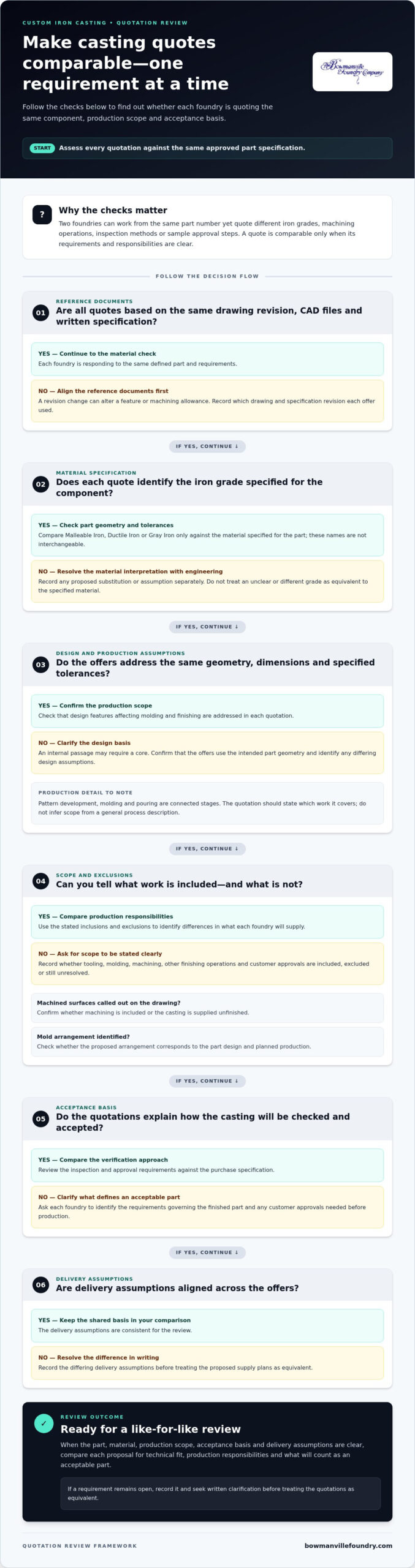
A structured review turns a set of quotations into a traceable technical decision. Apply the same sequence to each offer, record differences against the approved part specification, and keep unresolved items visible. This custom iron casting quote comparison should distinguish confirmed requirements from supplier assumptions, so clarifications and revisions do not get lost in an email thread.
A practical sequence for reviewing quotations
Follow the same review order for every quotation. Start with the document basis, then compare technical and production scope, and finish by recording open questions. This helps identify whether a difference reflects a manufacturing proposal or inconsistent information.
- Verify the document basis. Match the part number, drawing revision, written specification, and production quantity. If a quotation references an outdated drawing, mark it for revision before evaluating technical fit.
- Compare requirements and scope. Check iron grade, geometry, tolerances, tooling, and post-processing against the shared specification. Record differences, such as machining included in one offer but excluded in another.
- Log conditions and unresolved points. Capture exclusions, inspection and acceptance requirements, delivery assumptions, and customer approvals. Assign each open question to the relevant procurement or engineering contact and record what written response will resolve it.
Resolve technical differences before selecting a quotation
Use a comparison record with one line per requirement and one column per quotation. For each difference, state the specification, the foundry’s stated assumption, and the clarification needed. For example, if quotations describe different tolerances or inspection steps, compare each against the same requirement rather than relying on general statements. Keep each written clarification with the quotation it addresses.
Some questions need more than document review. An on-site technical assessment gives a foundry engineer and the customer an opportunity to discuss part geometry, molding considerations, machining needs, and production feasibility together. Bowmanville Foundry offers technical support that includes an on-site assessment. This can be useful when drawing details or manufacturing requirements need direct discussion. Record the resulting clarification in writing and tie it to the relevant drawing and quotation versions.
Maintain revision control throughout the review. Store the approved drawing, specification, each quotation version, written clarifications, and customer approvals together in procurement records. If a drawing changes, identify which offers were prepared against the prior revision and ensure the final comparison uses updated documentation. The guide to optimizing custom iron casting production can also help teams consider production requirements as they refine part information.
For support discussing part requirements and quotation scope, contact Bowmanville Foundry about your casting project.
How Bowmanville Foundry Supports a Clear Custom Iron Casting Quotation
A useful quotation connects the component specification to the work required to produce and finish the casting. Bowmanville Foundry manufactures Malleable Iron, Ductile Iron, and Gray Iron castings for industrial applications. Its production scope can include pattern development, molding, pouring, and post-processing such as machining, heat treating, and surface coating. Reviewing these stages together helps buyers distinguish the casting itself from the additional operations required for a finished component.
The foundry operates a 38,000-square-foot plant and has produced custom iron castings since 1902. It was the first foundry in Canada to achieve ISO certification, in 1996. This milestone is relevant context when discussing documented quality practices. Buyers should assess the quality requirements and records that apply to their purchase specification.
Technical support for quotation clarity
A technical or sales engineer can visit a customer’s facility to assess component requirements and discuss the application directly. Bring current drawings, matching CAD files, material and dimensional specifications, and defined acceptance requirements. With these documents available, the discussion can focus on how geometry, tooling, molding, machining, and other production needs relate to the proposed scope.
This technical assessment can also identify where design intent and manufacturing assumptions need clarification. For example, a drawing may define a machined feature, while the production plan must account for both casting and finishing. Discussing that requirement with an engineer helps procurement and design teams document what the quotation is expected to cover, rather than relying on a broad description of the finished part.
Discuss your iron casting requirements with Bowmanville Foundry
Before requesting or reviewing a quotation, organize the project details so the technical basis is clear. Include the required iron type and grade, part drawing and revision, production quantity, dimensional tolerances, and service requirements. Then identify the production and acceptance questions that affect the scope:
- Production: What pattern development, molding, and pouring work relates to the component?
- Tooling: What production tooling is required, and which assumptions should be recorded?
- Finishing: Are machining, heat treating, or surface coating required for the supplied part?
- Quality: What inspection, documentation, and customer approval requirements define acceptance?
These details give engineering and procurement teams a consistent basis for a custom iron casting quote comparison. They also help surface open points before a quotation is treated as a complete production proposal. Bowmanville Foundry’s experience in iron casting and its malleable, ductile, and gray iron capabilities provide a practical starting point for a project-specific technical discussion.
To review your drawings, specifications, and production scope with the foundry team, contact Bowmanville Foundry to discuss your casting requirements or arrange an on-site technical assessment.
Move Forward with a Defined Casting Specification
A sound supplier decision is one your engineering and procurement teams can support with a clear record of requirements, accepted assumptions, and outstanding approvals. Carry that discipline into the next project: establish the technical basis early, keep drawing revisions controlled, and make sure the selected quotation reflects the component your operation needs. A careful custom iron casting quote comparison helps turn supplier discussions into a production plan with responsibilities clearly understood.
If part geometry, material selection, finishing requirements, or acceptance criteria still need discussion, bring those questions to the foundry team before finalizing the purchase. A technical conversation can connect design intent to the proposed manufacturing scope and identify points that need written clarification.
Contact Bowmanville Foundry to discuss your casting requirements. With a defined specification and the right technical input, you can proceed with greater confidence toward a suitable casting solution.
Frequently Asked Questions
What information should I compare across custom iron casting quotes?
Compare the document identifiers and order assumptions that determine whether offers address the same work: part number, drawing issue, production quantity, requested delivery point, and stated order conditions. For repeat orders, note whether the quotation treats the work as a new production setup or refers to an established part record. A comparison table with one row per item helps expose mismatches before the team evaluates technical fit.
How can I compare foundry quotes when the scopes are different?
Restate each offer against the same purchase specification, with alternatives shown separately rather than blended into the base proposal. This makes it easier to see which requirements are accepted as written and which depend on a proposed change. Keep the original and revised versions together, and record who approved each clarification. That creates a clear decision trail for purchasing and repeat orders.
Should tooling be included in a custom iron casting quote?
The quotation should explicitly address tooling so the buyer can plan the production arrangement and future changes. In addition to whether tooling is part of the proposal, document its identification, revision status, and the process for authorizing modifications. If a part design changes later, these records help distinguish a component change from a change to its production tooling and reduce ambiguity when preparing the next order.
How do I compare quality requirements between casting quotations?
Translate the purchase specification into verifiable acceptance points, then check that the quotation’s quality documentation addresses them. For instance, if certain dimensions are critical to assembly, identify how those dimensions will be recorded and reviewed. Also define the records your organization needs at receipt, such as an inspection report when required by the purchase documents. Clear acceptance language helps receiving and engineering teams assess parts consistently.
How long does custom iron casting production take?
Use the project schedule to identify milestones, not just a single duration. Establish when the quoted schedule begins and how design release, tooling readiness, customer approvals, production, and shipment affect the planned completion date. Internal drawing approval and changes made after release can also affect the sequence. Bowmanville Foundry’s timing depends on current business conditions, so align the required date with the schedule stated for the specific order.
Can a foundry help assess a part design before production?
Yes. A foundry engineer can provide a technical assessment to discuss whether the part information is suitable for production planning. This can be useful before an RFQ is finalized, especially when the engineering team is deciding which features are essential and which may be adjusted. Bring design questions and the intended application to the discussion, then capture any resulting drawing changes through your normal engineering approval process.
What does post-processing mean in an iron casting quote?
Post-processing means work carried out on a casting after it has been produced. For buyers, the key question is the required condition of the component at delivery: whether it must be ready for assembly, further manufacturing, or another defined use. State the required finish and dimensional condition in the purchasing documents, and make sure receiving staff can distinguish an acceptable completed part from one requiring additional work.
