
The casting route can shape the machining work as much as the CNC program. After casting, CNC machining brings critical bores, faces, and connection features to their drawing dimensions. For custom iron casting for valve bodies, service conditions and part geometry guide material and process selection, while machining finishes features that require controlled dimensions.
Casting and machining are best considered as connected stages, not separate decisions. This article explains how operating conditions influence iron selection, how casting methods affect valve body geometry, and what to assess in a supplier’s capabilities and quality controls. It also explains where CNC machining fits into production, which features may need machining, and how clear drawings and specifications support the process.
Key Takeaways
- Match iron type to the valve body’s operating conditions and required material properties, then align the grade with the design requirements.
- Assess how Gray Iron, Ductile Iron, Austempered Ductile Iron, and Malleable Iron differ before selecting a material for an application.
- Choose a casting process around part geometry and production needs, and identify which features require CNC machining after casting.
- Use the Casting Buyers Guide and technical support to clarify specifications, material selection, and the steps from casting through post-processing.
Gray Iron Valve Body Castings
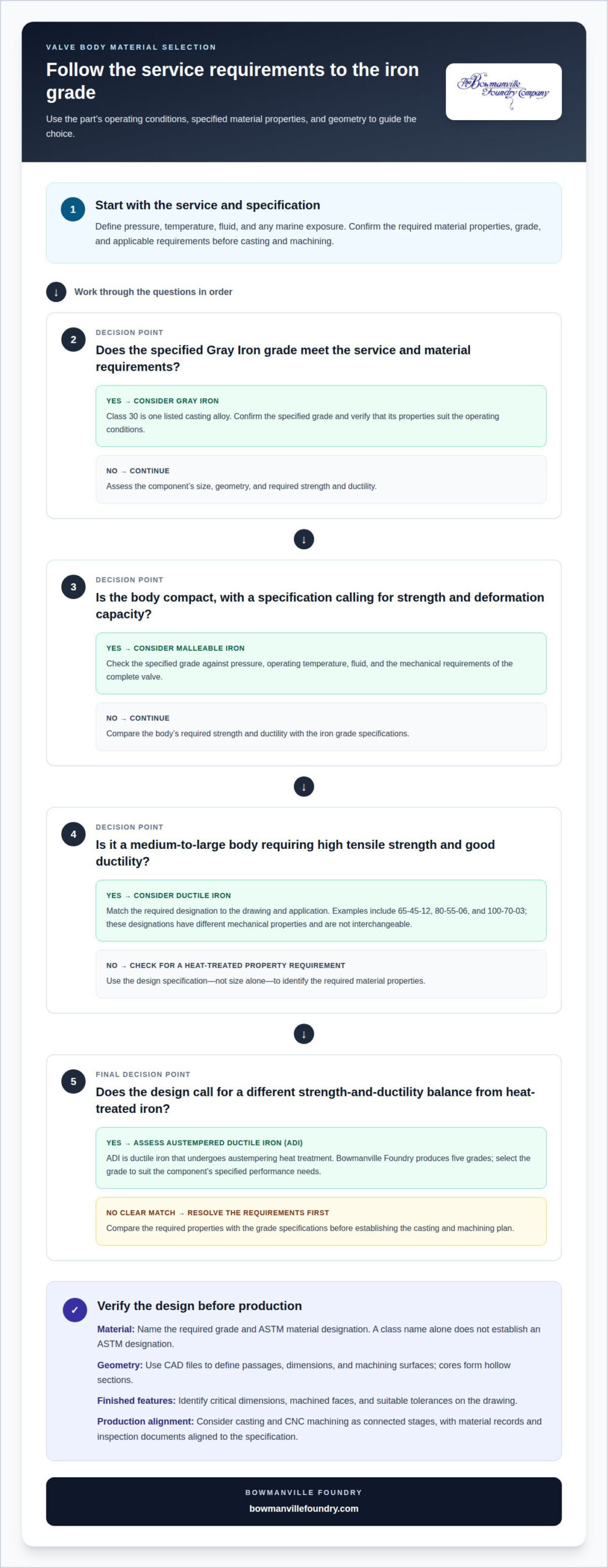
Gray Iron selection starts with service conditions, required material properties, and the valve body’s finished geometry. Confirm the specified grade and applicable requirements before casting and machining.
Valve Body Materials and Grades
This decision covers the iron grade and design details needed for the valve’s service. Class 30 Gray Iron is one listed casting alloy; its properties must match operating conditions, including pressure, temperature, fluid, and any marine exposure. Custom casting can form complex passages and internal chambers, while cores create hollow sections. CAD files should define the geometry, dimensions, and machining surfaces.
Material Verification and Certification
Material verification connects the delivered casting to the drawing and purchase specification. State the required grade and its ASTM material designation, then align material records and inspection documents with that requirement. A class name alone does not establish an ASTM designation. Drawings should identify critical dimensions, machined faces, and tolerances suited to the part’s function and production process.
Comparing Valve Body Materials and Construction
Gray Iron and Ductile Iron have different structures and mechanical properties, so the choice depends on required strength, ductility, and service conditions. Steel may suit applications with material requirements beyond those specified for iron, but it is a separate material choice. Casting can form complex flow paths in one body; fabrication joins separately made components, while machining from solid stock removes material to create the shape. Custom iron casting suits designs whose material requirements and geometry fit the selected iron grade.
Applicable Standards and Regulations
Requirements depend on the valve’s application and governing Canadian rules. According to Department of Justice Canada, for machinery-connected inlets or discharges, valves more than 76 mm in diameter must be made of steel, bronze, or other equally efficient material. The Department also prohibits cast iron valves on piping carrying LPG in the liquid phase and on LPG containers and their connections. These provisions affect material selection; an ASTM designation alone does not establish compliance. Define the intended service and applicable requirements in the specification before selecting a grade.
Ductile Iron and Austempered Ductile Iron Castings
Ductile Iron has a nodular graphite structure and combines high tensile strength with good ductility. These properties make it suitable for medium to large valve body castings where the design calls for strength and resistance to deformation. Grade selection should reflect the part’s specified mechanical requirements and service conditions, including pressure, temperature, and the fluid being handled. The casting geometry also matters: internal passages and wall sections must be suited to the selected material and manufacturing process.
Common ductile iron designations include 65-45-12, 80-55-06, and 100-70-03. The numbers distinguish grades with different mechanical properties, so they are not interchangeable specification labels. Match the required designation to the valve body drawing and the application’s material requirements. A specification that names the grade helps align casting production, inspection, and any post-casting machining with the intended part.
Austempered Ductile Iron (ADI) is ductile iron that undergoes austempering heat treatment. The treatment changes the material’s structure and provides a different strength and ductility balance from conventional ductile iron. Bowmanville Foundry produces five grades of ADI, giving design teams grade options to consider for valve body requirements. The selected grade should follow the component’s specified performance needs rather than the assumption that heat-treated material is automatically suitable for every service.
For a valve body, compare the specified grade, geometry, and operating conditions together. A Ductile Iron casting may suit a medium or large body requiring ductility and high tensile strength; ADI is an option when the design calls for a different heat-treated property balance. Drawings and material specifications help define the intended requirements. Explore the Ductile Iron Castings available for custom applications.
Malleable Iron Castings
Malleable iron may be considered for castings when its properties suit the component’s requirements and service conditions. For valve-body designs, those properties make it worth considering when the component is compact and the specification calls for both strength and deformation capacity. Material choice still depends on the body’s service conditions and the performance requirements set for the complete valve.
Start with the part’s function and geometry. For example, a small branch body may have closely spaced ports or internal passages that are difficult to create by machining alone. Casting forms the main shape, while the drawing identifies connection faces and other features that need machining. The design must also allow the required core to form hollow passages.
Suitability depends on more than size. Specified pressure, operating temperature, fluid, and mechanical properties all inform grade selection. Name the Malleable Iron grade in the material specification, and use the drawing to define critical dimensions and machined surfaces. This gives production and inspection a clear basis for assessing the casting against the design.
Malleable Iron is not the automatic choice for every valve body. Compare the required properties with the grade specification, then assess whether the casting geometry supports the valve’s flow path and connection layout. For bodies with different mechanical-property requirements, assess other iron grades against the same criteria. Clear CAD files and complete specifications help resolve design questions before establishing the casting pattern and machining plan. This review connects material selection to the finished component, rather than treating the casting as shape alone.
Casting Process Selection for Valve Bodies
Process selection starts with the valve body’s geometry, material, service conditions, and required machined features. Sand casting suits large or heavy industrial bodies; shell molding balances dimensional accuracy with production speed for medium-sized parts. Investment casting may suit smaller, intricate components that require precision and a smoother surface.
For iron valve bodies, sand casting forms the shape in a prepared mould, with cores creating internal passages and chambers. Shell molding uses a shell-shaped mould to produce more defined details. Investment casting forms complex shapes around a pattern. The appropriate route depends on the specified iron, part geometry, and production needs. Molding must also account for wall sections and features that affect solidification.
Material requirements also guide process selection. Ductile Iron, for example, has different mechanical properties from Gray Iron, so the grade must suit operating pressure, temperature, and sealing requirements. A design specifying carbon steel, alloy steel, or stainless steel has a different material requirement from an iron casting and needs a separate process assessment.
Production moves from design to finished component: review CAD files and material specifications; assess casting geometry and core requirements; prepare the pattern and mould; pour and cool the iron; then inspect the casting and machine specified faces, bores, and connections. Clear drawings identify critical dimensions and machining allowances, coordinating the as-cast shape with CNC operations. That is how custom iron casting for valve bodies reaches a machined finish: casting creates the near-net shape, and machining completes features that need tighter control.
Share your valve-body drawings and material requirements to discuss casting process options.
Bowmanville Foundry: Free Casting Buyers Guide and Technical Support
Bowmanville Foundry helps manufacturers assess iron casting requirements with its Free Casting Buyer’s Guide and technical support. The guide can help organize decisions about material, part geometry, and finishing before a valve body project moves into production. For an assessment, provide the intended application, material requirements, drawings, and machining needs.
Minimum order quantity depends on the design and production requirements, including pattern needs and the intended casting run. Typical lead times are four to eight weeks, depending on current business conditions; tooling can be produced in two to four weeks. These timelines help with planning, while the part specification and production conditions determine the schedule.
Bowmanville Foundry produces Gray Iron, Ductile Iron, and Malleable Iron castings, and offers post-processing services. These iron options address different material requirements. Post-processing can take a casting from its cast shape to a finished component, including machining of features identified in the drawing. Share CAD files and specifications to support assessment of the design and production requirements.
The Bowmanville Foundry was the first foundry in Canada to achieve ISO certification in 1996. For a project needing closer design review, a technical/sales engineer can visit your facility to assess the application and requirements. This is useful when drawings, samples, or production needs require discussion with an engineer before decisions are finalized.
Contact Bowmanville Foundry to discuss your valve-body drawings, iron requirements, and production needs.
Move Your Valve Body Design Forward
Before releasing a valve body project, align engineering, procurement, and quality teams on one approved specification. Record the material designation, inspection criteria, and drawing revision together so every team works from the same requirements. This gives custom iron casting for valve bodies a clear starting point and helps prevent conflicting expectations during production.
Use the project discussion to resolve open design decisions and identify who approves changes. A controlled specification keeps the next steps clear as the design moves from planning toward production.
Start a valve-body project discussion with Bowmanville Foundry. A well-defined specification is a practical foundation for moving your design ahead.
Frequently Asked Questions
Can CNC machining be supplied after casting?
Yes. For a finished valve body, the machining plan should identify datum surfaces, bore locations, thread details, fits, and required surface finishes. These details define how the part will be held and measured during machining. Include them in the drawing rather than relying on general notes, especially where connected components must align or a controlled interface is needed for sealing.
Can you help review porosity and leakage risks before production?
Yes. A design review can focus on pressure boundaries, sealing interfaces, and areas where inspection access may be limited. Mark these locations clearly on the drawing and state the intended service so the review can address relevant risks. This does not replace applicable acceptance criteria or a testing plan; establish those requirements for the specific valve application.
Which Casting Method Is Best for Valve Body Manufacturing?
The right method is the one that fits the part’s geometry and production requirements. Consider how internal features will be formed, which surfaces need machining, and how the design can be inspected after casting. A useful process review compares the drawing’s critical features with the tooling and inspection plan, rather than choosing a method based on one feature or a general preference.
Which materials can be reviewed for valve castings?
Bowmanville Foundry reviews iron material options for valve applications. To make the review useful, provide the fluid being handled, operating temperature and pressure, and any specified mechanical properties. These details help assess whether a proposed iron grade fits the component’s intended duty. Include the valve’s installation and service context in the technical documentation, since application restrictions matter.
What iron grades are commonly used for custom-cast valve bodies?
No single grade suits every valve body. Select the grade according to the component’s required mechanical properties and operating conditions, then record it explicitly in the purchase specification. Avoid relying on a broad material label alone. For a replacement valve, existing drawings and material records can help establish the grade and acceptance requirements for the new casting.
What quality tests and certifications are required for cast iron valve bodies?
Requirements depend on the valve’s application and purchasing specification. Distinguish certification of a foundry’s quality management system from inspection or testing of a specific casting: they demonstrate different things. State required records, acceptance criteria, and customer approval points in the order documents. This makes clear what evidence must accompany the component and how conformance will be assessed.
