
The highest tensile strength isn’t always the safest choice for your bottom line. Selecting the strongest alloy available might seem like a logical route to component durability, but in many industrial applications, over-specifying is a direct path to unnecessary costs and manufacturing delays. Understanding how to choose iron casting grade specifications requires a balance between metallurgical properties and the practical realities of post-processing. You likely recognize the pressure of navigating complex ASTM standards, such as the recently approved E351-25 methods, while trying to avoid casting failures in high-stress environments.
This guide provides a clear technical framework for selecting iron grades that align with your specific environmental requirements and budget. By mastering these criteria, you can ensure component longevity while effectively reducing your total cost of ownership. We will examine the essential metallurgical differences between gray, ductile, and malleable iron. You will also learn how to optimize your material choice for both high-stress durability and efficient machinability, moving from technical uncertainty to engineering confidence.
Key Takeaways
- Identify the risks of over-specifying materials to avoid unnecessary manufacturing costs without compromising component durability.
- Compare the distinct graphite structures and mechanical properties of gray, ductile, and malleable iron to match the right alloy to your application.
- Follow a methodical engineering framework on how to choose iron casting grade by prioritizing tensile strength, yield strength, and required elongation.
- Account for machinability and post-processing cycle times to ensure the lowest total cost of ownership for your finished parts.
- Discover how early collaboration with a Canadian foundry can help you finalize technical specifications and improve component longevity.
Defining Your Requirements: The Strategic Importance of Iron Grade Selection
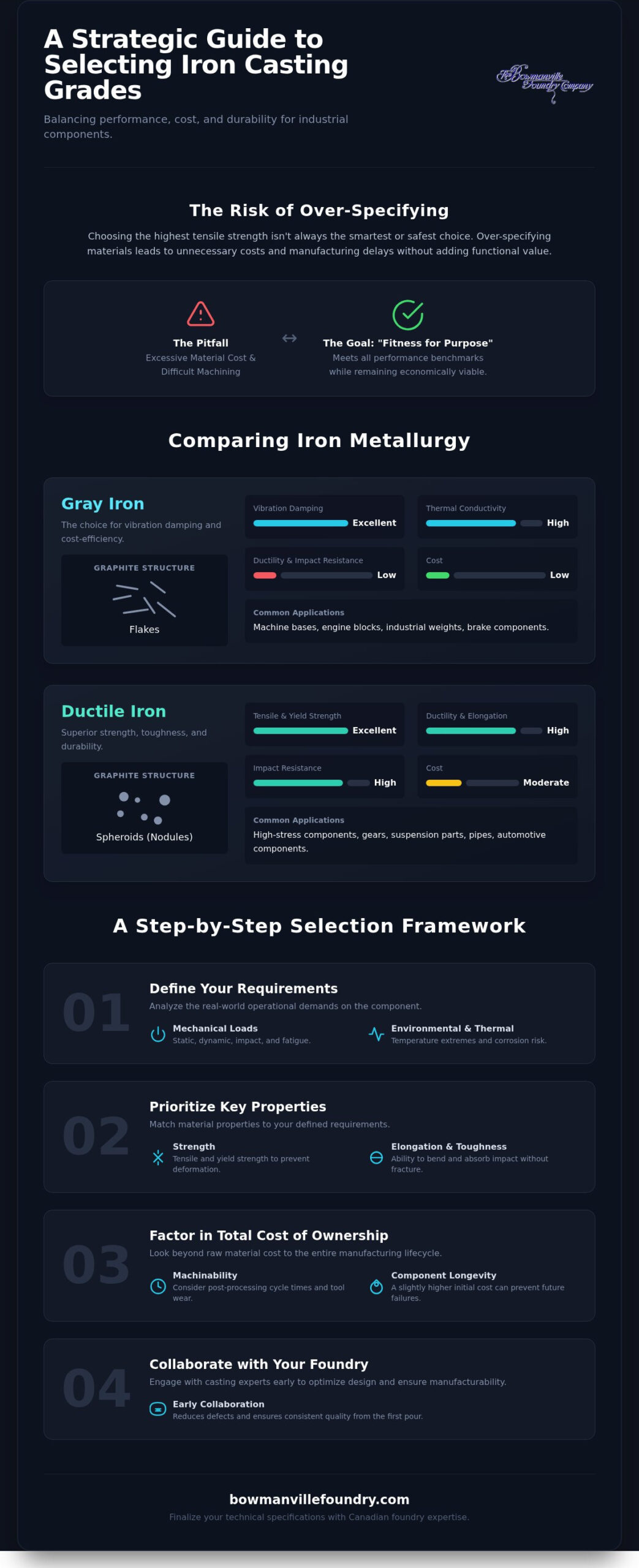
Material choice is the primary driver for an industrial component’s total lifecycle performance. In the context of heavy manufacturing, selecting the correct Cast iron grade is not merely a box to tick on a design sheet; it is a strategic decision that dictates everything from raw material costs to the complexity of post-processing. When engineers evaluate how to choose iron casting grade specifications, they must balance the risk of under-specifying, which leads to catastrophic mechanical failure, against the financial drain of over-specifying. Over-specifying often results in unnecessary material expenses and increased machining difficulty, which inflates the total cost of ownership without providing additional functional value.
In Canadian heavy industry, we rely on the principle of “fitness for purpose.” This means selecting a material that meets all safety and performance benchmarks while remaining economically viable for the specific application. This early decision also carries significant weight in the foundry. The specific grade of iron influences the cooling rate, shrinkage characteristics, and the overall complexity of the pattern design. By establishing these requirements early, you allow the foundry to optimize molding techniques and ensure internal integrity from the first pour. This collaborative approach reduces the likelihood of internal defects and ensures the final component can be manufactured consistently.
Identifying Primary Mechanical Loads
Mechanical stress is rarely uniform across a component. Static loads, such as those found in structural supports or base plates, require high yield strength to prevent permanent deformation. However, components in moving machinery often face dynamic or impact loads that demand superior toughness and elongation. Fatigue resistance is equally critical; repetitive stress cycles can cause microscopic cracks to propagate over time, eventually leading to failure. To simplify this, your design team should define a “fail-safe” requirement: “This component must withstand a peak impact of X kilo-Newtons without fracturing, while maintaining a fatigue life of Y cycles under standard operating vibration.”
Environmental and Thermal Considerations
External conditions significantly influence iron performance. In Canada, operating temperatures can drop well below freezing, which may increase the brittleness of certain alloys. Conversely, high-heat applications require grades with specific thermal conductivity to dissipate heat efficiently, as seen in engine blocks or brake components. You must also account for corrosion. While iron is naturally durable, chemical environments or outdoor exposure may necessitate specific alloying elements or post-casting coatings to prevent surface degradation. Mastering how to choose iron casting grade involves looking beyond the workshop floor to the actual environment where the part will live.
Comparing the Metallurgy: Gray, Ductile, and Malleable Iron Properties
Cast iron is not a single alloy; it’s a versatile family of materials defined by carbon content and specific microstructures. The primary differentiator between these types is the shape and distribution of graphite within the iron matrix. These structural variations, achieved through controlled cooling rates and specialized heat treatments, dictate how the material responds to mechanical stress. Understanding these metallurgical nuances is essential when learning how to choose iron casting grade specifications that meet your performance requirements without over-engineering the component. By selecting the right graphite structure, you can optimize for strength, weight, or cost-efficiency.
Gray Iron: The Choice for Vibration Damping and Cost
Gray iron is characterized by its flake-like graphite structure. These flakes interrupt the continuity of the matrix, providing excellent thermal conductivity and superior vibration damping. It’s the standard choice for machine bases, engine blocks, and industrial weights where noise reduction and heat dissipation are paramount. Most specifications follow ASTM A48 standards, with Class 30 and Class 40 being common industrial benchmarks. While it lacks high ductility and impact resistance, its ease of casting and lower production cost make it a staple for heavy, stationary components that aren’t subject to sudden shock loads.
Ductile Iron: High Strength and Impact Resistance
By adding magnesium to the molten metal, foundries cause the graphite to form into spherical nodules rather than flakes. This change significantly improves the material’s tensile strength and toughness, allowing it to bend rather than snap under pressure. Ductile iron, governed by ASTM A536, uses a three-number grading system to define its properties. For example, grade 65-45-12 denotes 65,000 psi tensile strength, 45,000 psi yield strength, and 12% elongation. This alloy is often used for crankshafts and pressurized fittings where impact resistance is vital. If your project requires the strength of steel with the castability of iron, you can consult with our technical team to find the optimal balance for your application.
Malleable Iron: Superior Toughness for Complex Parts
Malleable iron starts as white iron and undergoes a prolonged, multi-day annealing process. This heat treatment transforms the carbon into “tempered carbon” clusters. This unique structure provides exceptional toughness and machinability, particularly in thin-walled sections where ductile iron might struggle with consistency. It is highly resistant to shock and is frequently used for electrical hardware, pipe fittings, and hand tools. Mastering how to choose iron casting grade means recognizing that malleable iron offers a specific resilience and surface finish that flakes or nodules cannot always replicate in intricate, small-scale designs.
A Step-by-Step Selection Framework for Engineering Iron Components
Selecting a material requires more than just picking a high tensile strength from a data sheet. To ensure long-term reliability and cost-efficiency, engineers must follow a methodical logic flow that accounts for mechanical limits and manufacturability. This foundational logic for how to choose iron casting grade parameters ensures that the final component performs as intended under real-world stress. The following five-step framework provides a structured approach to making an informed material decision.
- Step 1: Determine Strength Requirements. Start by identifying the maximum tensile and yield strength the part will encounter. Yield strength is particularly critical, as it defines the point where the iron will permanently deform.
- Step 2: Assess Ductility Needs. Evaluate if the component needs to absorb energy or bend slightly before fracturing. If the application involves high impact or shock, grades with higher elongation percentages, such as specific ductile or malleable irons, are necessary to prevent catastrophic failure.
- Step 3: Evaluate Functional Environment. Consider if the part requires vibration damping to reduce noise or high thermal conductivity to manage heat. Gray iron often excels here, even if its tensile strength is lower than other alloys.
- Step 4: Cross-Reference ASTM Standards. Align your requirements with established industry specifications. This ensures that the material properties are verifiable and consistent across production batches.
- Step 5: Verify Castability. Consult with foundry engineers to confirm that your chosen grade can be poured effectively into your specific geometry. Some grades may be prone to internal defects in complex or extremely thin sections.
Navigating ASTM Standards and Specifications
Understanding the nomenclature of ASTM standards is vital for accurate procurement. For example, in ductile iron (ASTM A536), a grade like 65-45-12 explicitly lists the minimum tensile strength (65,000 psi), yield strength (45,000 psi), and elongation (12%). Specifying the exact standard in your Request for Quote (RFQ) eliminates ambiguity and ensures the foundry uses the correct metallurgical controls. Applying a standardized ASTM grade ensures that your calculated safety factors remain consistent with real-world material performance and regulatory requirements.
The Role of Section Thickness in Grade Performance
The cooling rate of molten iron dictates its final microstructure, a phenomenon known as the “mass effect.” Thick sections cool more slowly, often resulting in a softer matrix and lower hardness, while thin sections cool rapidly and may become brittle. When you refine the process of how to choose iron casting grade specifications, you must account for these variations. Foundries often adjust the chemical composition or use specialized inoculants to maintain property consistency across varying thicknesses. Designing for uniform section thickness whenever possible helps optimize the grade’s inherent properties and reduces the risk of internal casting stresses.
Factoring in Machinability, Post-Processing, and Total Cost
Material cost per pound is a deceptive metric in the world of heavy manufacturing. If an alloy is exceptionally difficult to machine, any initial savings on the raw casting will vanish during the finishing stage. When you evaluate how to choose iron casting grade parameters, you must look beyond the foundry floor to the machine shop. High-strength ductile iron might provide the tensile properties your design requires, but its increased hardness often leads to accelerated tool wear and extended machining cycle times. This relationship between metallurgy and manufacturing efficiency is the primary driver of a project’s financial success.
Post-processing requirements like heat treatment and surface coatings also vary significantly by grade. Some iron types achieve their target mechanical properties as-cast, while others require precise annealing or quenching to realize specific hardness levels. Similarly, the surface porosity of the iron dictates how well it accepts paints, powders, or galvanizing treatments. If your component requires a high-quality aesthetic finish or extreme corrosion resistance, the choice of grade will directly influence the complexity and cost of these final steps.
Machinability Ratings Across Iron Grades
Malleable iron is widely regarded as the gold standard for machinability in the iron family. Its unique tempered carbon structure allows for aggressive cutting speeds and provides a superior surface finish with minimal tool degradation. Gray iron is also highly machinable, though it presents a specific risk known as “chilled edges.” These are hard, white iron formations that occur when thin sections of the casting cool too rapidly. Chilled edges are notoriously abrasive and can easily shatter carbide inserts. By working with a foundry that maintains strict metallurgical consistency, you can reduce scrap rates and ensure that your finishing processes remain predictable and efficient.
Total Cost of Ownership (TCO) in Casting Procurement
True cost-efficiency is found by analyzing the “final part cost” rather than the “casting price.” This holistic approach, known as Total Cost of Ownership, accounts for every expense from the initial pour to the final assembly. For instance, a more expensive ductile iron grade might allow for thinner wall sections, reducing the total weight and shipping costs of the component. Sourcing ready-to-use components from a single partner also eliminates the logistical burden of managing multiple vendors for machining and coating. To reduce your internal overhead and ensure your materials are optimized for finishing, you can explore our integrated post-processing services. Mastering how to choose iron casting grade specifications is ultimately about finding the balance that yields the lowest total production cost.
Collaborating with a Canadian Foundry to Finalize Your Specification
Finalizing a technical specification is a collaborative process between your engineering team and the foundry. Early involvement allows for design-for-manufacturability (DFM) adjustments that can significantly lower production costs and prevent casting defects. At Bowmanville Foundry, we draw on a legacy of Canadian manufacturing expertise dating back to 1902 to help clients refine their material choices. By leveraging our institutional knowledge, you can move from a preliminary design concept to a production-ready iron grade with technical certainty. A domestic supply chain offers additional security, reducing the logistical risks associated with overseas procurement and ensuring just-in-time delivery for North American manufacturers. Recent global supply chain disruptions have highlighted the value of nearshoring to foundries that provide both engineering support and reliable logistical pipelines.
Mastering how to choose iron casting grade parameters is a major step toward a successful project, but the final validation happens on the foundry floor. Our engineers act as technical mentors, helping you interpret mechanical data and environmental stress factors to ensure your component’s longevity. This partnership ensures that the iron you select doesn’t just look good on a design sheet but performs reliably in high-stress industrial environments. We focus on transparency and precision to make sure you’re never over-specifying or under-specifying your components.
Utilizing Technical Data and Buyer’s Guides
We provide a range of technical resources to support data-driven decision-making. Providing a detailed Request for Quote (RFQ) that includes the service environment, peak load requirements, and post-processing needs allows us to provide a more accurate and competitive quote. This document should ideally specify relevant standards, such as the recently approved ASTM E351-25 for chemical analysis, to ensure total transparency. To assist in this process, we provide a Free Casting Buyer’s Guide that outlines the specific metallurgical properties and selection criteria discussed throughout this guide. Using these tools helps eliminate guesswork and aligns your procurement team with engineering realities.
Custom Engineering and Prototyping Services
Prototyping is a vital step to validate your grade selection before committing to mass production. It allows you to test the component’s performance under actual load conditions and assess its machinability firsthand. Our facility is unique in its ability to produce gray, ductile, and malleable iron in a single location, providing the flexibility to pivot between alloys if testing reveals a need for different mechanical properties. Our integrated post-processing services, including precision machining and specialized heat treating, ensure that your components arrive ready for assembly. To begin refining your material strategy, Contact Bowmanville Foundry for an Expert Consultation.
Optimizing Your Material Strategy for Long-Term Performance
Selecting the right iron grade is a precision engineering task that impacts your entire production cycle. You’ve learned how the graphite structure of gray, ductile, and malleable iron dictates mechanical limits and why a structured selection framework prevents costly over-specification. By focusing on the final part cost rather than the initial casting price, you’ll ensure that your components are both durable and economically viable. Mastering how to choose iron casting grade specifications allows you to bridge the gap between design theory and shop-floor reality.
As a trusted Canadian manufacturer since 1902, we provide the deep expertise in malleable, ductile, and gray iron metallurgy required for high-stress applications. Our full-service post-processing and finishing capabilities ensure your components arrive ready for immediate use. We’re committed to acting as your technical partner throughout the procurement journey. Download our Free Casting Buyer’s Guide to simplify your selection process. We look forward to helping you achieve technical certainty in your next project.
Frequently Asked Questions
What is the primary difference between ductile and gray iron for industrial use?
Ductile iron contains spherical graphite nodules that provide high tensile strength and superior impact resistance. Gray iron utilizes graphite flakes, which offer excellent vibration damping and thermal conductivity but lack the toughness of ductile alloys. When researching how to choose iron casting grade options for moving machinery, ductile is often preferred for load-bearing parts, while gray iron excels in stationary machine bases.
How do I know if malleable iron is better for my part than ductile iron?
Malleable iron is typically superior for thin-walled components that require extreme toughness and resistance to shock. While ductile iron is strong, malleable iron’s unique annealing process makes it more reliable in complex, small-scale designs where ductile iron might suffer from cooling inconsistencies. It also offers better machinability for high-volume finishing operations where tool life is a primary concern.
What are the most common ASTM standards for iron castings in Canada?
The most frequent standards include ASTM A48 for gray iron, ASTM A536 for ductile iron, and ASTM A47 for malleable iron. These standards provide a verified framework for mechanical properties like tensile and yield strength. Adhering to these specifications ensures that Canadian manufacturers receive consistent, high-quality materials that meet safety and performance benchmarks across the North American supply chain.
Can the iron grade affect the final cost of machining and finishing?
The material grade directly influences tool wear and machining cycle times. High-strength ductile iron is harder to cut than gray or malleable iron, which can increase the total cost of finishing. Choosing a grade with better machinability can reduce your total cost of ownership, even if the raw casting price is slightly higher, by decreasing labour and tooling expenses.
Why does section thickness matter when choosing an iron grade?
Section thickness dictates the cooling rate of the molten metal, which fundamentally changes the iron’s microstructure. Thick sections cool slowly and tend to be softer, whereas thin sections cool quickly and can become brittle or develop abrasive “chilled edges.” Understanding this “mass effect” is essential when learning how to choose iron casting grade specifications for parts with varying wall thicknesses to ensure uniform performance.
How does heat treating improve the mechanical properties of an iron casting?
Heat treating refines the iron’s grain structure and can significantly increase surface hardness or relieve internal stresses. Processes like annealing improve ductility and machinability, while quenching and tempering can boost wear resistance for high-friction applications. This post-processing step allows a single iron grade to meet a wider range of technical requirements without changing the base alloy chemistry.
Is it possible to switch iron grades without changing the casting pattern?
It is often possible, but you must account for different shrinkage rates between alloys. For example, ductile iron typically shrinks more than gray iron during the cooling process. If your design tolerances are tight, switching grades without modifying the pattern equipment may result in dimensional inaccuracies that require additional machining or design adjustments to correct.
What information should I include in an RFQ to help the foundry choose a grade?
A comprehensive RFQ should include the peak mechanical loads, operating temperature, and any specific corrosion or vibration damping needs. You should also specify the required production volume and any post-processing services like machining or coating. This detailed information allows foundry engineers to recommend the most cost-effective grade that meets all functional safety factors and manufacturing goals.
