
Choosing steel for high-stress industrial components often seems like the default engineering decision, yet the most resilient and cost-effective solutions frequently emerge from the specialized moulds of a ductile iron foundry in Ontario. You likely recognize the frustration of component failure in demanding environments or the logistical headaches caused by unpredictable overseas supply chains. It’s difficult to balance the need for high tensile strength with the practicalities of production costs and lead times, especially when confusing terminology around iron grades complicates the selection process.
This guide will clarify how ductile iron provides the mechanical properties of steel with the superior vibration damping and castability of iron. You’ll discover how a domestic partnership can stabilize your procurement process and ensure your components meet rigorous ASTM standards. We’ll examine the technical distinctions between iron grades, the benefits of local manufacturing, and the essential criteria for selecting a specialized foundry partner in Canada to ensure your long-term success.
Key Takeaways
- Learn why the nodular graphite structure of ductile iron provides the tensile strength of steel with the superior vibration damping of iron for heavy-duty machinery.
- Understand the strategic advantages of sourcing from a ductile iron foundry in Ontario to stabilize your supply chain and reduce the risks associated with overseas logistics.
- Discover the technical differences between ductile, malleable, and gray iron to help you realize significant cost savings while meeting specific mechanical requirements.
- Identify the rigorous ASTM A536 quality standards and in-house metallurgical testing protocols required to ensure reliability in high-stress industrial applications.
- Learn how to evaluate a casting partner’s engineering capabilities and post-processing services to streamline your component production from initial design to final delivery.
Understanding the Role of a Ductile Iron Foundry in Ontario’s Industrial Supply Chain
The stability of Canada’s industrial sector depends on more than just raw materials; it requires a reliable network of specialized manufacturers. A ductile iron foundry in Ontario serves as a critical link in this network, providing the high-strength components necessary for machinery that operates in the country’s most unforgiving environments. While many procurement professionals previously looked overseas to reduce initial costs, recent global disruptions have highlighted the strategic necessity of domestic production. Relying on local expertise eliminates the months of transit and potential customs delays that often cripple project timelines. It’s a matter of operational security and long-term predictability.
Modern manufacturing has shifted away from simple, mass-produced parts toward custom-engineered iron components. This evolution means that a foundry is no longer just a place where metal is melted and poured. Instead, it functions as a technical partner. By working with a ductile iron foundry in Ontario, manufacturers gain access to metallurgical specialists who understand how to manipulate material properties to meet specific stress requirements. This collaboration is essential for safety-critical applications where material failure isn’t an option. When you source locally, you aren’t just buying a part; you’re securing a relationship with a team that understands Canadian safety regulations and the specific demands of our climate.
The Backbone of Canadian Infrastructure
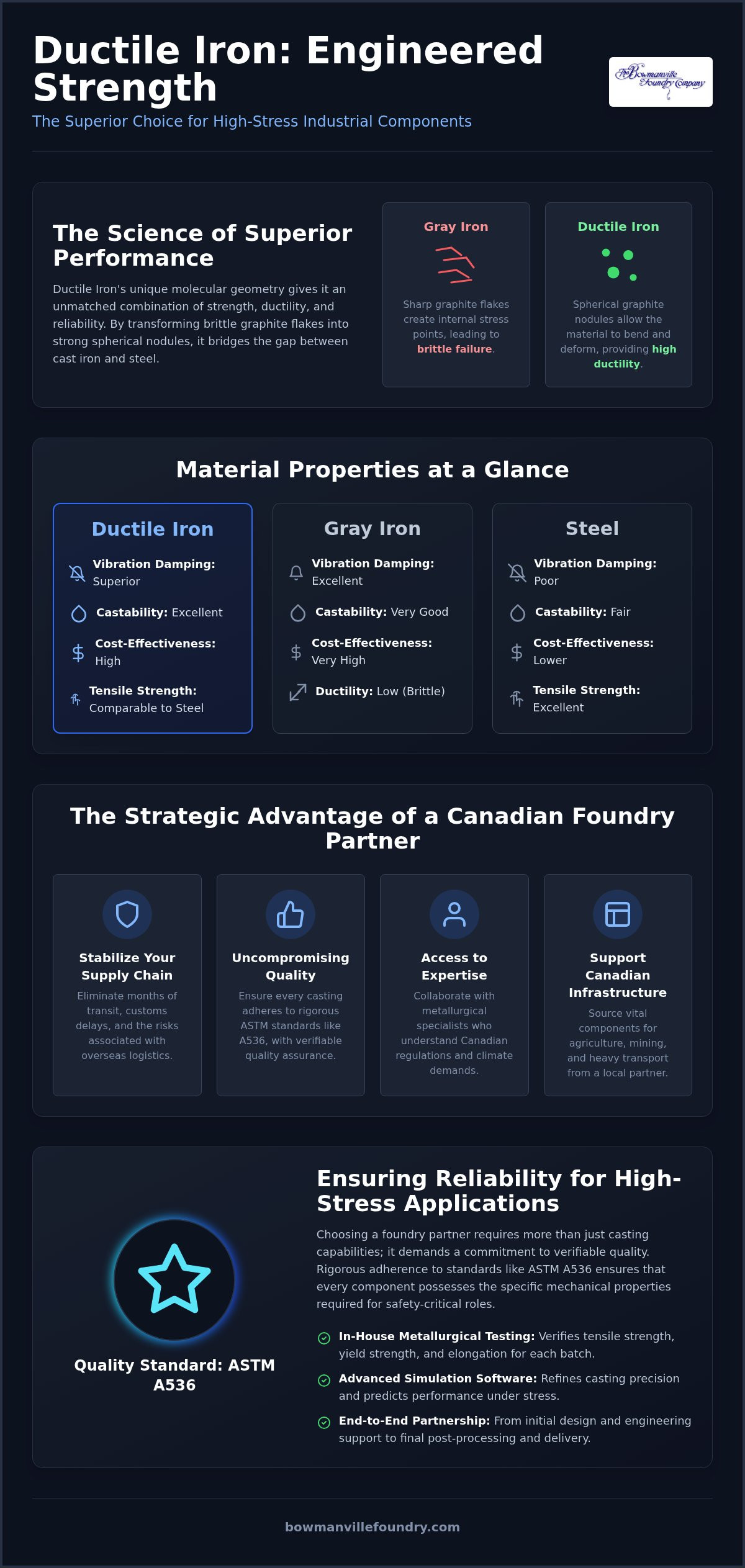
Canada’s primary industries, including agriculture, mining, and heavy transportation, require components that can withstand extreme thermal cycles and mechanical stress. Sourcing these parts from a facility with over a century of institutional knowledge ensures that every casting adheres to strict ASTM standards, such as ASTM A536. Domestic foundries provide a level of oversight and quality assurance that’s difficult to replicate with distant suppliers. This consistency is vital for maintaining the longevity of national infrastructure. It ensures that the equipment used in our mines and on our farms performs reliably year after year, reducing the total cost of ownership through durability.
Modernizing Traditional Craftsmanship
The casting process has undergone a significant transformation since 1902. While the core principles of metallurgy remain, the integration of modern simulation software and automated systems has refined the precision of every pour. By 2026, the industry has seen a greater focus on sustainable manufacturing and lightweighting to improve fuel efficiency in the automotive and transport sectors. These advancements allow specialized foundries to support Canadian innovation, helping engineers realize complex designs that were previously considered impossible to cast. This blend of legacy knowledge and modern technology ensures that Ontario remains a leader in the global casting market.
The Science of Strength: Why Ductile Iron is Engineered for Performance
The performance of heavy-duty industrial components is a direct result of their molecular geometry. Understanding the mechanical superiority of ductile iron requires a look at how its structure differs from traditional iron variants. Unlike standard gray iron, which contains graphite in the form of sharp, brittle flakes, ductile iron is engineered to contain graphite in spherical nodules. This transformation occurs when a specialized ductile iron foundry in Ontario introduces magnesium into the molten base metal under strictly controlled conditions. The resulting material, often referred to as nodular or spheroidal graphite (SG) cast iron, bridges the gap between the cost-effectiveness of iron and the structural integrity of steel. When selecting a ductile iron foundry in Ontario, it’s vital to ensure they have the metallurgical expertise to manage these complex chemical additions correctly.
This ductility is the material’s defining characteristic. In high-load scenarios, components made of brittle materials might shatter without warning when their limits are exceeded. Ductile iron, however, possesses high elongation properties that allow it to deform slightly under extreme stress rather than failing catastrophically. This characteristic provides a margin of safety that’s indispensable for heavy machinery, safety brackets, and infrastructure components that must endure unpredictable impact loads.
Nodular Graphite vs. Flake Graphite
In gray iron, graphite flakes act as internal stress concentrators, creating points where cracks can easily initiate and propagate through the metal matrix. In contrast, the spherical nodules in ductile iron minimize these stress points, effectively arresting crack growth. This internal geometry also contributes to exceptional vibration damping qualities. While steel may offer similar strength, it lacks the ability to absorb energy and reduce noise in the same way, making ductile iron the preferred choice for gearboxes, pump housings, and engine mounts. Ductile iron is defined by its nodular graphite structure as recognized by ASTM standards.
Engineering Benefits for Product Designers
Weight-to-strength ratio is a significant factor for modern designers looking to optimize performance without adding unnecessary bulk. Ductile iron allows for thinner wall sections than gray iron while maintaining higher load-bearing capacities. It also offers several distinct advantages during the manufacturing and operational phases:
- Excellent Machinability: Reduced tool wear and faster cutting speeds shorten post-processing cycles and lower overall production costs.
- Corrosion Resistance: Inherent material properties provide better protection against oxidation in harsh Canadian climates compared to many fabricated steel alternatives.
- Surface Finish and Detail: The casting process allows for complex geometries and fine details that would be prohibitively expensive to machine from solid blocks.
Engineers can consult our Free Casting Buyer’s Guide to better understand how these mechanical properties translate into specific design advantages and long-term component reliability.
Comparing Iron Grades: Is Ductile the Right Choice for Your Component?
Selecting the appropriate iron grade requires a precise understanding of the component’s operational environment. While gray iron remains a staple for many industrial applications, its brittle nature makes it unsuitable for parts subjected to shock or heavy loading. A professional ductile iron foundry in Ontario can provide the technical guidance needed to determine if the increased tensile strength of nodular iron justifies the material shift. For designers, the choice often boils down to the specific mechanical requirements versus the production budget. It’s not just about finding the strongest material; it’s about finding the most efficient material for the job.
The distinction between ductile and malleable iron often causes confusion during the procurement phase. Both materials offer ductility, but their manufacturing processes differ significantly. Malleable iron achieves its properties through a lengthy annealing heat treatment, which typically limits its effectiveness to thin-walled castings. Ductile iron, however, achieves its nodular structure during the casting process itself. This allows a ductile iron foundry in Ontario to produce large, heavy-duty components that maintain consistent strength throughout thick cross-sections. When weight reduction is a priority, the superior strength of ductile iron often allows for thinner, lighter designs that outperform their gray iron counterparts.
Performance Benchmarks
In industrial machinery, impact resistance and thermal conductivity are critical. Gray iron excels at damping vibrations but fails under sudden impact. Malleable iron offers good toughness but is restricted by section thickness. Ductile iron provides a balanced profile, offering high impact resistance and the ability to withstand thermal cycling without cracking. The following table outlines the typical mechanical properties recognized by ASTM standards for common grades.
| Material Grade | Tensile Strength (psi) | Yield Strength (psi) | Elongation (%) |
|---|---|---|---|
| Ductile Iron (65-45-12) | 65,000 | 45,000 | 12% |
| Malleable Iron (32510) | 50,000 | 32,000 | 10% |
| Gray Iron (Class 30) | 30,000 | N/A | <1% |
Cost-Benefit Analysis for Procurement
Initial production costs are only one part of the equation. While gray iron is often cheaper per kilogram, the total lifecycle value of ductile iron frequently makes it the more economical choice. Custom iron casting manufacturing fees should be viewed as an investment in durability. Because ductile iron is easier to machine than many steels and offers better wear resistance than gray iron, you’ll likely see reduced post-processing costs and fewer replacement cycles. Utilizing a Free Casting Buyer’s Guide can help your team navigate these complex material decisions to ensure you aren’t over-specifying for simple parts or under-specifying for critical ones.
Evaluating Quality and Standards for Custom Engineered Iron Components
Reliability in heavy manufacturing is never the result of chance. It’s the product of strict adherence to international standards and a meticulous approach to quality control. A reputable ductile iron foundry in Ontario maintains rigorous oversight from the moment raw materials enter the furnace until the final component passes inspection. This oversight ensures that custom-engineered parts don’t just look the part but perform exactly as intended under the specific stresses of their environment. When you’re sourcing components for safety-critical applications, verifying a partner’s commitment to these standards is the most important step in the procurement process.
Quality assurance begins with in-house metallurgical testing. Spectrometric analysis allows technicians to verify the chemical composition of the molten metal before a single mould is poured. By monitoring levels of carbon, silicon, and magnesium in real-time, the foundry can guarantee the graphite nodules form correctly. Beyond chemistry, dimensional tolerances are managed through modern pattern development. Using advanced simulation software, engineers predict how the metal will cool and shrink, which prevents internal defects like porosity and ensures every casting aligns with the original technical drawings.
Essential ASTM Specifications
The industry relies on standardized grades to communicate performance expectations. ASTM A536 is the primary specification used by any professional ductile iron foundry in Ontario to categorize material properties. For example, grade 60-40-18 is prized for its high ductility and impact resistance, making it ideal for components used in extreme cold or high-shock environments. In contrast, grade 80-55-06 provides significantly higher tensile strength for applications where load-bearing capacity is the priority. ASTM A536 governs the tensile requirements for ductile iron by establishing the mandatory minimum thresholds for tensile strength, yield strength, and elongation that every certified casting must achieve.
Post-Processing and Finishing Excellence
The journey from a raw casting to a finished industrial component often requires specialized post-processing services. Heat treating is a common requirement to refine the microstructure of the iron, which can enhance toughness or surface hardness depending on the application. For components exposed to Canada’s corrosive industrial environments, surface coatings provide an essential layer of protection against oxidation. Many OEM manufacturers now prioritize foundries that offer these finishing services in-house. Receiving ready-to-use components reduces assembly time and simplifies the overall supply chain. To ensure your next project meets these rigorous benchmarks, you can download our Free Casting Buyer’s Guide for a detailed look at quality specifications.
Sourcing Excellence: Partnering with a Canadian Iron Casting Specialist
Selecting a partner for custom iron casting is a decision that impacts the entire lifecycle of your equipment. While some providers focus solely on emergency repairs or simple replication, a specialized ductile iron foundry in Ontario offers the engineering depth required to optimize a component’s design before the first pour occurs. This proactive approach identifies potential stress points and material inefficiencies early, preventing costly revisions during full-scale production. By collaborating with metallurgical experts, procurement teams can move confidently from a conceptual prototype to high-volume manufacturing without sacrificing dimensional accuracy or material integrity.
To receive an accurate iron casting quote for large-scale projects, it’s essential to provide comprehensive documentation. This includes detailed technical drawings, specific ASTM grade requirements, and projected annual volumes. Providing this data allows the foundry to evaluate the most efficient moulding methods and post-processing requirements, ensuring the final price reflects the true project scope. This transparency builds the foundation for a long-term relationship based on technical certainty rather than guesswork. When you work with a domestic partner, you also gain the ability to conduct site visits and witness quality testing firsthand, which is a level of oversight that international suppliers cannot easily provide.
The Bowmanville Foundry Difference
Established in 1902, Bowmanville Foundry represents a legacy of craftsmanship that has supported Canadian industry for over 120 years. Our expertise spans the full spectrum of iron metallurgy, including malleable, ductile, and gray iron. We don’t just act as a supplier; we serve as a national resource for manufacturers who require precision-engineered components for high-stress applications. Our institutional knowledge ensures that every project benefits from a century of refined processes and technical mastery. This depth of experience is particularly valuable when navigating the transition from traditional gray iron to the more resilient properties found in a ductile iron foundry in Ontario.
Next Steps for Your Project
Streamlining your supply chain starts with early-stage consultation. By engaging with a centrally located Canadian partner, you reduce the logistical complexities and communication barriers inherent in international sourcing. This proximity allows for faster iterations and more responsive service when design requirements shift. Consulting with metallurgical experts during the design phase ensures your components are optimized for both castability and operational longevity. To begin your selection process with a clear understanding of industry benchmarks, you should Download our Free Casting Buyer’s Guide. This resource empowers your team to make informed decisions that prioritize both performance and cost-efficiency.
Securing Reliability through Specialized Iron Casting
Selecting the right material for high-stress applications requires a balance between mechanical performance and logistical stability. By prioritizing the nodular graphite structure of ductile iron, engineers can achieve the tensile strength of steel with the vibration damping and castability of iron. Sourcing these components from a dedicated ductile iron foundry in Ontario ensures your project benefits from domestic quality oversight and reduced lead times. Whether your application demands the impact resistance of ductile iron or the specific properties of malleable and gray iron, partnering with an established Canadian manufacturer provides the technical certainty your operations require.
Bowmanville Foundry has been a Canadian owned and operated leader since 1902. Our specialists provide the institutional knowledge necessary to help you realize complex designs through precision-engineered castings. We remain committed to helping you navigate every stage of the process, from initial metallurgical consultation to final post-processing. When you’re ready to stabilize your supply chain with a dependable domestic partner, we invite you to Request a Quote for Custom Engineered Iron Components. Our team is prepared to ensure your next project meets the highest industrial standards.
Frequently Asked Questions
What is the primary difference between a ductile iron foundry and a gray iron foundry?
The primary difference lies in the graphite structure of the iron produced. A gray iron foundry produces material with graphite flakes, which can lead to brittleness. In contrast, a ductile iron foundry in Ontario uses magnesium treatment to create spherical nodules. This molecular change significantly improves tensile strength and impact resistance, allowing the material to deform without fracturing under high stress.
Why should I choose a Canadian foundry for my custom engineered iron components?
Choosing a Canadian foundry ensures supply chain resilience and adherence to strict national safety and environmental regulations. Domestic production eliminates the unpredictability of international shipping and customs delays. It also allows for direct collaboration with metallurgical experts who understand the specific environmental demands of the Canadian climate. This proximity simplifies logistics and ensures that your custom engineered iron components meet the highest quality benchmarks.
What are the most common ASTM standards used for ductile iron castings in 2026?
ASTM A536 remains the definitive standard for ductile iron castings. In 2026, the most frequently specified grades include 60-40-18 for high ductility and 80-55-06 for superior tensile strength. For infrastructure and water management projects, foundries also adhere to NSF/ANSI/CAN 61 and 372 standards to ensure health effects and lead content requirements are met. These standards provide a reliable framework for engineering safety.
How does ductile iron compare to steel in terms of cost and performance?
Ductile iron provides the strength and toughness of steel but at a lower production cost. It offers superior vibration damping and castability, which allows for more complex geometries that are difficult or expensive to achieve with fabricated steel. While steel is often the choice for the most extreme tensile requirements, ductile iron is the pragmatic alternative for components requiring durability, wear resistance, and cost-effective manufacturing.
What post-processing services are typically offered by a full-service foundry?
Full-service foundries provide several post-processing services to deliver ready-to-use components. These typically include precision machining, heat treatment to refine mechanical properties, and surface coatings for corrosion protection. By integrating these services, a ductile iron foundry in Ontario can reduce your overall lead times and simplify your procurement process. This end-to-end support ensures that every component arrives at your facility meeting all final specifications.
Can ductile iron be used for high-pressure pump and valve applications?
Yes, ductile iron is an ideal material for high-pressure pump and valve applications. Its high yield strength and pressure-tightness make it resistant to the internal stresses found in fluid handling systems. Additionally, the material’s excellent corrosion resistance and ability to be cast into intricate internal shapes provide significant advantages over other metals. It is frequently used in municipal water systems and industrial chemical processing.
What information is required to get an accurate iron casting quote?
To provide an accurate iron casting quote, a foundry requires detailed technical drawings and material specifications. You should include the desired ASTM grade, expected annual production volumes, and any specific post-processing or finishing requirements. Providing information about the component’s operational environment also helps the engineering team suggest the most cost-effective iron grade. This data ensures the quote reflects the true complexity of the project.
How does a foundry ensure the consistent quality of nodular graphite in every batch?
Foundries ensure graphite consistency through precise magnesium inoculation and real-time spectrometric analysis. Technicians monitor the chemical composition of every melt to verify that the carbon and silicon levels are within strict tolerances. After the pour, metallurgical testing and microscopic examination confirm that the graphite has formed into the required spherical nodules. This rigorous process guarantees that every batch meets the mechanical performance requirements of the specified grade.
