
A single casting defect discovered during final machining doesn’t just ruin a part; it compromises your entire production schedule and erodes your bottom line. Finding a reliable gray iron foundry Ontario manufacturers can trust means looking beyond the price per pound to the technical mastery behind the pour. You need a partner that understands the gravity of industrial safety and the precision required for heavy manufacturing.
It’s frustrating to deal with unreliable lead times or components that fail to meet strict ASTM A48/A48M-22 specifications. You likely realize that sourcing in Canada involves more than just selecting a material; it requires managing fluctuating costs, such as the $0.53 CAD per pound material surcharge recorded in July 2026, while adhering to updated Ontario environmental standards. This guide provides a comprehensive path to sourcing high-precision gray iron castings that reduce component failure and arrive ready for immediate use. We’ll examine the nuances of material standards, the advantages of integrated post-processing, and the specific industrial applications that demand the highest levels of metallurgical expertise.
Key Takeaways
- Understand why the flake graphite microstructure of gray iron makes it the preferred material for industrial applications requiring superior vibration damping and thermal stability.
- Learn how to navigate ASTM A48/A48M-22 standards to ensure your gray iron foundry Ontario partner delivers components that meet precise tensile strength requirements for Class 20, 30, or 40 castings.
- Evaluate the critical performance differences between gray, ductile, and malleable iron to select the most cost-effective material for your specific mechanical load.
- Streamline the procurement process by preparing technical CAD drawings and pattern requirements that minimize casting defects and reduce production lead times.
- Discover how integrated post-processing services, including machining and heat treating, provide ready-to-use parts that lower your total cost of ownership.
Understanding Gray Iron Casting Capabilities in Ontario
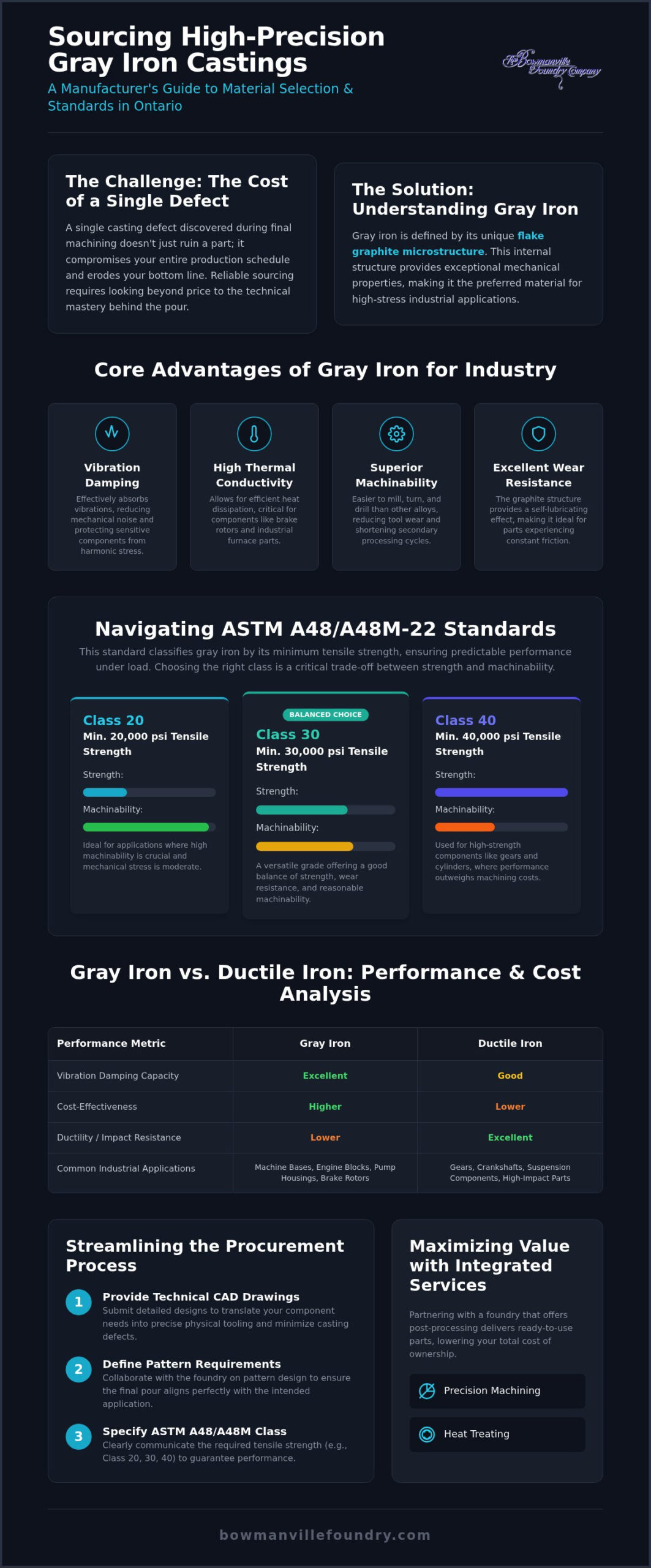
Gray iron is defined by its unique flake graphite microstructure. This internal structure provides the material with its signature grey appearance when fractured and, more importantly, its exceptional mechanical properties. For Canadian manufacturers, Understanding Gray Iron and its specific metallurgical characteristics is the first step toward successful component procurement. A reputable gray iron foundry Ontario will leverage these properties to produce parts that endure high-stress environments without compromising structural integrity.
The casting process begins with precise pattern development. This phase translates complex CAD designs into physical tooling. Molten iron is then poured into sand moulds, where the cooling rate is carefully managed to ensure the formation of the desired graphite flakes. This process allows for the creation of intricate geometries that would be prohibitively expensive to machine from solid billets. A local gray iron foundry Ontario understands the specific rigours of the Canadian climate and the stringent safety standards required by domestic regulatory bodies, making them a vital link in the industrial supply chain.
Key Properties of Gray Cast Iron
Gray iron offers several technical advantages that make it indispensable in heavy industry. Its high thermal conductivity allows for efficient heat dissipation, which is critical for components like brake rotors or industrial furnace parts. Additionally, the presence of graphite flakes provides a self-lubricating effect, significantly improving wear resistance in moving assemblies. This makes it an ideal choice for parts that experience constant friction.
Machinability is another standout feature. Because the graphite flakes break up the chips during the cutting process, gray iron is easier to mill, turn, and drill than many other ferrous alloys. This reduces tool wear and shortens secondary processing cycles, which ultimately lowers the total cost of the component. It’s a pragmatic choice for complex parts requiring high-precision finishing.
Why Industrial Engineers Favour Gray Iron
In Canada, gray iron remains the standard for machine bases, engine blocks, and pump housings. Its dimensional stability ensures that components maintain their shape even under significant pressure and temperature fluctuations. This reliability is why engineers choose it for high-volume production where consistency is paramount. It doesn’t warp or distort easily, providing a dependable foundation for precision machinery.
The material’s damping capacity is its most vital engineering trait; it effectively absorbs vibrations to reduce mechanical noise and protect sensitive internal components from harmonic stress. By sourcing from a domestic partner, engineers can collaborate directly on pattern design and material specifications. This ensures the final pour aligns perfectly with the intended application, reducing the risk of failure in the field.
ASTM Standards and Technical Specifications for Gray Iron
High-precision engineering depends on rigorous adherence to established standards. In the Canadian casting industry, the definitive benchmark is the ASTM A48/A48M specification. This standard classifies gray iron based on its minimum tensile strength rather than chemical composition alone. It provides a clear framework for procurement professionals to communicate their requirements to a gray iron foundry Ontario. By focusing on mechanical performance, the standard ensures that every part performs as expected under load.
Metallurgical control is the backbone of this consistency. A foundry must carefully balance carbon, silicon, and manganese levels to hit specific tensile targets. Carbon typically ranges from 2.5% to 4.0%, while silicon acts as a graphitizer to promote the formation of the necessary flake structure. Manganese is added to neutralize the effects of sulphur, ensuring the iron remains stable enough for processing. Maintaining this balance across large production runs requires a disciplined approach to melt chemistry and cooling rates.
Selecting the Right Gray Iron Class
Choosing the correct class involves a trade-off between strength and machinability. It’s a decision that impacts both the component’s lifespan and the cost of secondary operations.
- Class 20: Offers a minimum tensile strength of 20,000 psi. It’s ideal for non-structural components where high vibration damping and maximum machinability are required.
- Class 30 and 35: These are the workhorse grades for many Canadian industries. They provide a balanced profile of strength and wear resistance for pump housings and valve bodies.
- Class 40: With a 40,000 psi minimum tensile strength, this class is reserved for structural components that face higher mechanical stresses. It’s less machinable than Class 20 but offers superior pressure tightness.
Matching these classes to your engineering tolerances ensures you don’t over-specify the material, which can lead to unnecessary machining costs. For those looking to deepen their technical understanding, reviewing a comprehensive casting buyer’s guide can help align these ASTM classes with specific project budgets.
Quality Control and Testing Procedures
Modern foundries utilize several verification layers to guarantee material integrity. Spectrometer analysis is performed on every melt to verify the alloy chemistry before the pour begins. This prevents off-spec batches from ever reaching the moulding line. Once cast, Brinell hardness testing provides a non-destructive way to verify that the cooling rate produced the correct pearlite-to-ferrite ratio.
For critical industrial components, non-destructive testing (NDT) such as ultrasonic or magnetic particle inspection can detect internal voids or surface cracks. These rigorous protocols ensure that when you partner with a gray iron foundry Ontario, you receive components that are verified for safety and performance. This technical certainty is what separates a legacy institution from a simple commodity supplier.
Gray Iron vs. Ductile Iron: Performance and Cost Analysis
Determining whether to specify gray or ductile iron requires a pragmatic look at the component’s operational environment. While both materials originate from similar base elements, the metallurgical treatment of the melt creates distinct performance profiles. A specialized gray iron foundry Ontario helps engineers navigate these differences to avoid over-engineering parts that don’t require high ductility. Gray iron is typically more economical for static components like gear covers, brackets, or pump housings because it doesn’t require the magnesium treatment used to create ductile iron’s nodular graphite. It’s a reliable choice for parts where dimensional stability is the primary concern.
The decision often comes down to the graphite’s shape. Gray iron’s flakes are excellent for heat transfer and damping but create internal stress concentrators that limit ductility. In contrast, the spherical nodules in ductile iron allow the metal to bend before breaking. For Canadian manufacturers, choosing gray iron for static applications reduces raw material surcharges and simplifies the casting process. It’s about matching the material’s inherent strengths to the part’s functional requirements without adding unnecessary cost to the production cycle. For a detailed technical breakdown of how these microscopic graphite structures influence component survival under load, see our gray iron vs ductile iron casting engineering comparison.
Mechanical Property Comparisons
Ductile iron excels in applications involving shock loading or high-stress shock cycles due to its high yield strength. However, gray iron remains the superior choice for high-precision tool beds and industrial machine bases. Its flake graphite structure acts as an internal cushion. This reduces harmonic distortion that could otherwise ruin the accuracy of a machining centre. If your part is stationary and vibration control is paramount, gray iron offers better performance at a lower price point than ductile alternatives.
Tensile strength is another key differentiator. While ductile iron can reach much higher tensile levels, gray iron’s Class 40 specifications are more than adequate for most heavy-duty housings. It’s important to realize that higher strength often comes with increased tool wear during post-processing. By selecting gray iron for components like engine blocks or manifolds, you benefit from easier machining and better thermal management. It’s a balanced approach to industrial design.
Sourcing Malleable Iron as an Alternative
Malleable iron serves a specific niche in the Canadian hardware and industrial markets, particularly for thin-walled sections that require a degree of toughness. It’s produced by heat-treating white iron, resulting in a material that combines some benefits of both gray and ductile iron. While it’s less common than gray iron for large machine bases, it’s indispensable for small, complex parts that must withstand moderate impacts without fracturing.
Bowmanville Foundry supports all three major grades: gray, ductile, and malleable iron. This capability allows manufacturers to source their entire component catalogue from a single-source partner. It ensures consistent quality across different material specifications and simplifies the procurement process for diverse industrial projects. Whether you need the damping of gray iron or the toughness of malleable iron, having a partner that understands all three ensures you get the right material for the job.
Sourcing and Procurement: How to Partner with an Ontario Foundry
Transitioning from a technical design to a physical component requires a methodical procurement strategy. When you partner with a gray iron foundry Ontario, the success of your project depends on the clarity of the initial exchange. It’s not merely a transaction; it’s the start of a technical collaboration. Establishing a dependable supply chain for custom engineered castings involves four critical steps that align your engineering requirements with the foundry’s operational capabilities.
The first step is defining your material specifications. You must confirm the required ASTM A48 class, as discussed previously, to ensure the iron’s tensile strength matches your mechanical load. Second, provide detailed CAD drawings and specify pattern requirements. Precision at this stage prevents casting defects that lead to expensive machining failures. Third, evaluate the foundry’s capacity and lead times. Reliable foundries provide realistic schedules that account for current material availability and production volumes. Finally, review your post-processing needs. Sourcing ready-to-use parts directly from the pour site reduces secondary handling and logistics costs.
Essential Information for an Accurate RFQ
A vague Request for Quote (RFQ) often leads to pricing fluctuations or production delays. To receive an accurate estimate, your documentation should include the following details:
- Critical Dimensions: Clearly mark tolerances that are vital for the part’s function.
- Estimated Annual Usage (EAU): Foundries use this data to determine the most cost-effective moulding method and batch size.
- Surface Finish: Specify if the part requires a standard sand-cast finish or if secondary grinding is necessary.
- Heat Treatment: Indicate if stress relieving or annealing is required before the part reaches your facility.
Evaluating Foundry Reliability and Experience
In the Canadian manufacturing sector, tenure is a strong indicator of reliability. A facility that has been operating since 1902 possesses the institutional knowledge necessary to navigate complex metallurgical challenges. Localized support within Ontario is equally important; it reduces communication barriers and eliminates the shipping delays often associated with offshore sourcing. When you work with a domestic partner, you gain the advantage of on-site technical consultations and a deeper understanding of Canadian industrial standards.
Transparency is a hallmark of a professional partner. A reputable gray iron foundry Ontario will offer resources to help you make an informed decision rather than simply pushing for a sale. To streamline your procurement process and ensure you select the right material for your application, download our Free Casting Buyer’s Guide. This resource serves as a steady hand, guiding you through the intricate landscapes of iron specifications and foundry capabilities.
Maximizing Value with Post-Processing and Finishing Services
Procuring raw castings is only the first stage of the manufacturing cycle. To truly optimize your supply chain, you should consider the advantages of sourcing ready-to-use components. When a gray iron foundry Ontario provides integrated post-processing, it eliminates the logistical burden of coordinating between multiple vendors. This approach reduces the total cost of ownership by minimizing transportation expenses and secondary handling time. It ensures that the responsibility for the final part’s integrity rests with a single, expert partner who understands the material from the initial pour to the final inspection.
Heat treating is a critical post-processing step that can significantly enhance the performance of iron castings. By utilizing controlled heating and cooling cycles, a foundry can relieve internal stresses or modify the material’s hardness. This results in a more stable and durable component that’s better equipped to handle the rigours of industrial use. Additionally, specialized surface coatings such as industrial painting or plating provide essential protection against corrosion. These finishes ensure your parts maintain their functional and aesthetic qualities over time, even in harsh Canadian environments.
Machining and Precision Finishing
Internal machining capabilities allow a foundry to maintain tighter tolerances than what’s typically possible with a raw pour. Because the foundry staff understands the internal structure of the casting, they’re better positioned to identify and rectify minor defects before the finishing process begins. This significantly reduces scrap rates and ensures that only verified, high-quality components reach your assembly line. By removing third-party machine shops from the equation, you streamline your operations and gain greater control over production timelines. It’s a pragmatic way to ensure your project stays on schedule.
Custom Engineered Solutions from Bowmanville Foundry
Our modern facility is designed to support both small and medium production runs with the same level of technical precision. We don’t just pour metal; we act as a technical mentor to help you optimize your component design for manufacturability. By leveraging our century-long library of institutional knowledge and technical data, you can refine your patterns to reduce material waste and improve casting yield. This collaborative approach ensures that your project is grounded in technical reality from the very first mould, providing a comprehensive path from initial curiosity to technical certainty.
Precision, integrity, and technical mastery are the foundations of every project we undertake. If you’re ready to secure a dependable Canadian partner for your manufacturing needs, Contact the specialists at Bowmanville Foundry for your next gray iron project. We’re committed to ensuring your success through meticulous attention to detail and a “no-nonsense” approach to industrial excellence.
Securing Your Industrial Supply Chain with Precision Castings
Sourcing high-precision components requires more than just a purchase order; it demands a technical partnership rooted in metallurgical expertise. You’ve seen how adhering to ASTM A48 standards and leveraging integrated post-processing services can significantly reduce component failure and secondary handling costs. By selecting a partner that understands the specific nuances of vibration damping and thermal conductivity, you ensure your machinery operates with maximum efficiency and reliability.
As a premier gray iron foundry Ontario, Bowmanville Foundry has served the Canadian industry since 1902. We specialize in custom engineered iron components and provide comprehensive Technical Application Guides to help you navigate complex procurement decisions with certainty. Our modern facility is equipped to handle your most demanding specifications with pragmatic confidence and technical mastery, ensuring every part meets your exact requirements.
When you’re ready to move from initial design to a verified industrial solution, our team is here to guide the way. Request a Quote for Your Custom Gray Iron Project and let’s build something enduring together.
Frequently Asked Questions
What is the difference between gray iron and ductile iron for industrial use?
Gray iron is characterized by flake graphite, which provides superior vibration damping and thermal conductivity for static components. Ductile iron contains nodular graphite, offering higher tensile strength and elongation for parts subject to shock loading. While ductile iron is tougher, gray iron is often the more economical and machinable choice for machine bases, housings, and engine blocks where dimensional stability is the priority. For a deeper technical analysis of how these graphite structures affect component performance, review our comprehensive gray iron vs ductile iron casting comparison.
How do I choose the correct ASTM class for my gray iron casting?
Selection depends on the minimum tensile strength required by your application as defined in the ASTM A48/A48M standard. Class 20 is ideal for non-structural parts requiring maximum machinability and damping capacity. For structural components facing higher mechanical stresses, Class 35 or 40 provides a better balance of strength and wear resistance. It’s best to consult a technical guide to match these classes with your tolerances.
Does Bowmanville Foundry provide custom pattern development for new components?
Yes, we offer technical consultations to assist in the development and optimization of patterns for custom engineered components. Our team works directly from your CAD drawings to ensure the physical tooling produces accurate geometries while minimizing the risk of casting defects. This collaborative approach ensures that the final pour aligns with your specific design for manufacturability and reduces the need for extensive secondary handling.
What are the typical lead times for gray iron castings in Canada?
Typical lead times vary based on the complexity of the pattern and current production volumes at a gray iron foundry Ontario facility. Domestic sourcing generally offers more predictable schedules than offshore alternatives by eliminating international shipping delays. We recommend verifying current capacity during the RFQ phase to ensure your procurement timeline aligns with your internal production requirements and material surcharge fluctuations.
Can gray iron castings be heat treated to improve wear resistance?
Gray iron castings can undergo various heat treatment processes, such as stress relieving or annealing, to enhance their mechanical properties and dimensional stability. While the flake graphite structure already provides natural wear resistance, specialized thermal cycles can further stabilize the pearlite-to-ferrite ratio. These treatments are particularly useful for components that will operate in high-friction environments or face significant temperature variations during their service life.
Why is vibration damping important in gray iron applications?
Vibration damping is essential for absorbing mechanical energy and preventing harmonic resonance that can compromise machining accuracy or damage internal assemblies. The flake graphite in gray iron acts as an internal cushion, making it the premier material for tool beds and industrial machine bases. This property effectively reduces mechanical noise and protects sensitive equipment from the long-term effects of harmonic stress.
How does the procurement process work for custom engineered iron parts?
The process begins with a detailed RFQ that includes your ASTM class requirements, CAD drawings, and estimated annual usage. Once the technical specifications are verified and the quote is accepted, the project moves into pattern development and sample casting. Partnering with a domestic gray iron foundry Ontario allows for direct communication during these stages, ensuring that any design adjustments are addressed before full-scale production begins.
Does the foundry offer machining and finishing services for ready-to-use parts?
Yes, we provide comprehensive post-processing services, including machining, heat treating, and surface finishing, to deliver components that are ready for immediate assembly. By integrating these services at the foundry level, you reduce your total cost of ownership and eliminate the logistical complexity of managing third-party vendors. This single-source approach ensures that quality control is maintained from the initial melt through to the final finished part.
