
In high-impact industrial environments, the most rigid material isn’t always the safest choice. You’ve likely dealt with the frustration of a critical component snapping under sudden stress or the soaring costs of high scrap rates when trying to machine complex geometries. It’s a common challenge for Canadian engineering teams who need parts that are both resilient and highly workable. Identifying the right malleable iron casting applications is essential for maintaining operational safety and project timelines in harsh climates where material failure isn’t an option.
This guide explores why malleable iron remains the optimal selection for components that must withstand significant shock without failing. We’ll examine specific industrial use cases, from automotive standards like ASTM A602-94 to heavy-duty agricultural equipment and electrical fittings. You’ll discover how the unique metallurgical properties of this iron grade can reduce your production headaches, improve machinability, and ensure long-term durability for your most demanding projects. By the end of this article, you’ll be able to realize which iron grade best serves your specific mechanical requirements and helps you avoid costly post-casting errors.
Key Takeaways
- Understand how the specialized annealing process transforms brittle iron into a ductile, shock-resistant material suitable for high-stress environments.
- Identify critical malleable iron casting applications within the agricultural and electrical sectors, where component failure can lead to significant operational downtime.
- Learn how superior machinability and tighter “as-cast” tolerances help Canadian manufacturers reduce production cycles and minimize scrap rates.
- Explore how post-processing services, including heat treating and industrial coatings, can be customized to meet specific hardness and tensile strength requirements.
- Gain a practical framework for selecting the ideal iron grade by evaluating impact factors, tension loads, and the specific demands of your operating environment.
What is Malleable Iron and Why Does it Matter?
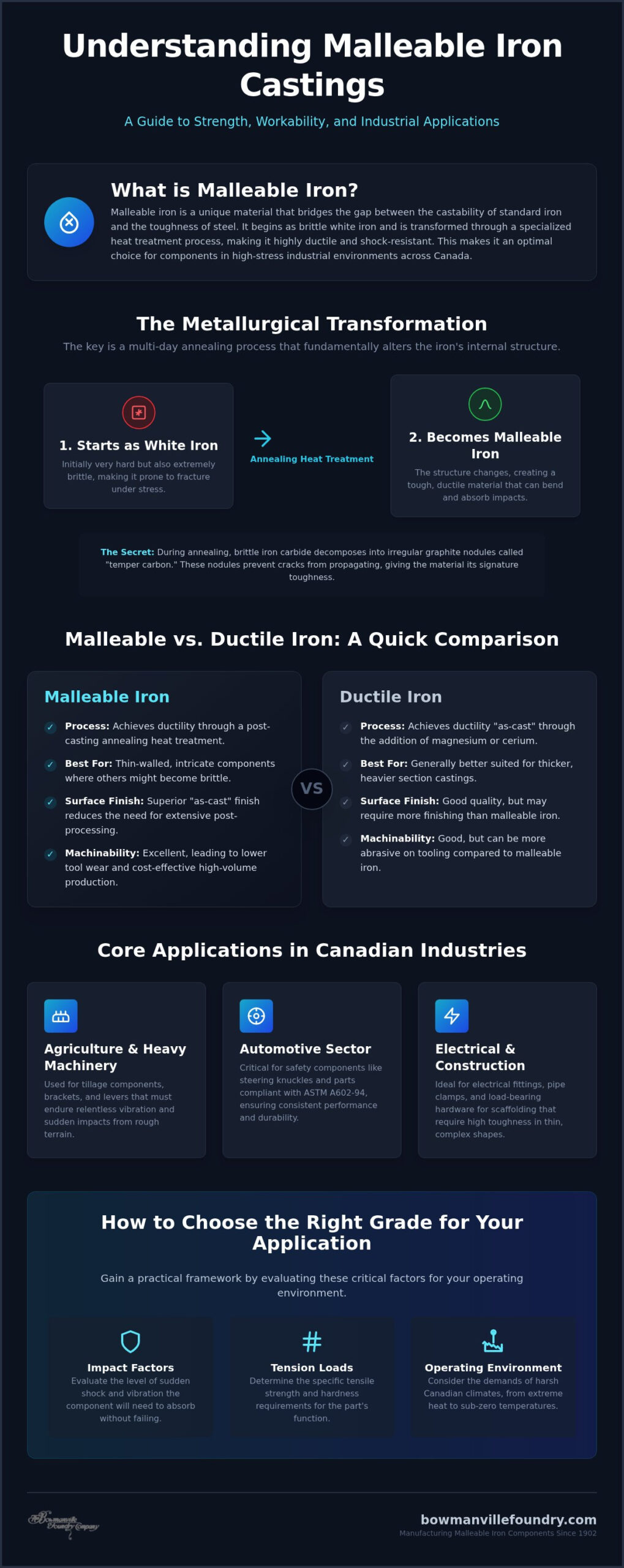
Malleable iron is a unique material that bridges the gap between the castability of iron and the toughness of steel. It begins its life as white iron, a material that’s incredibly hard but also very brittle. Through an extensive annealing heat treatment process, which can last several days, the internal structure is fundamentally altered. This transition is what makes various malleable iron casting applications possible in demanding Canadian industrial sectors like agriculture and heavy transport. The result is a metal that possesses high ductility and excellent shock resistance, allowing it to bend or deform without fracturing under sudden impact. This durability is why it remains a staple in foundry production, with Canadian experts like Bowmanville Foundry manufacturing these components since 1902.
The Metallurgical Advantage of Annealing
During the annealing process, iron carbide within the white iron decomposes into “temper carbon” nodules. These graphite aggregates are irregularly shaped, resembling popcorn under a microscope. This specific microstructure is what separates it from other iron types. Because these nodules stay isolated within a ferritic or pearlitic matrix, they don’t create the long cleavage planes found in gray iron. This prevents fracture propagation in heavy machinery and allows for parts that can withstand repeated stress. It’s especially ideal for thin cross-sections that require high toughness. Canadian engineering teams often specify this material when they need a component that can survive the transition from extreme summer heat to sub-zero winter temperatures without cracking.
Malleable vs. Ductile Iron: A Quick Comparison
While both materials offer ductility, their manufacturing paths and final characteristics differ. Ductile iron achieves its properties in the “as-cast” state through the addition of magnesium or cerium. Malleable iron, however, relies on the heat treatment of white iron to realize its mechanical benefits. This makes it better for thinner, more intricate castings where ductile iron might struggle with consistency. Engineers often choose it for its superior surface finish and machinability. Because the material doesn’t “chill” easily in thin sections during the initial pour, it allows for tighter tolerances and more complex geometries. When evaluating malleable iron casting applications, you must consider the specific stresses the part will face. ASTM A602-94(2022) remains the standard specification for automotive malleable iron castings, ensuring consistent performance for safety-critical parts. Malleable iron’s ability to be machined with lower tool wear often offsets the cost of the annealing process, making it a cost-effective choice for high-volume production runs.
- Wall Thickness: Malleable iron excels in thin-walled components where ductile iron may become brittle.
- Surface Quality: The annealing process often results in a smoother finish, reducing the need for extensive post-processing.
- Shock Absorption: The temper carbon nodules provide a unique ability to absorb energy from sudden impacts.
Core Malleable Iron Casting Applications in Industry
Malleable iron serves as the structural foundation for components that require a precise balance of design complexity and physical toughness. While basic industry lists often limit the material to simple pipe fittings; the scope of malleable iron casting applications is significantly broader in the Canadian industrial market. Its capacity to be cast into thin, detailed shapes while maintaining high tensile strength makes it a primary choice for engineers. Whether it is a steering knuckle for a heavy transport truck or a load-bearing clamp for construction scaffolding, this material delivers the reliability required for safety-critical hardware.
Agriculture and Heavy Machinery
Canadian agriculture demands machinery that can withstand relentless vibration and sudden impacts from soil-engaging tools. Tillage components, brackets, and levers face high-stress cycles that would cause brittle materials to fail. The high shock resistance of malleable iron allows these parts to absorb energy without cracking. Many manufacturers also prefer this material for ergonomic handles and complex levers on harvesters and tractors. These components require a smooth surface finish and intricate geometries that are difficult to produce through other casting methods. If you’re designing equipment for the rugged prairie landscape, consulting a free Casting Buyer’s Guide can provide the technical clarity needed to select the right iron grade for your mechanical loads.
Electrical and Utility Infrastructure
Utility infrastructure relies on malleable iron for high-voltage transmission hardware. Insulators, strain clamps, and suspension fittings must maintain their structural integrity under constant tension and harsh environmental exposure. The material is uniquely suited for these roles because it is highly compatible with hot-dip galvanizing. This protective coating is essential for long-term outdoor utility use in Canada’s varied climate. Beyond physical durability; the material’s magnetic properties play a vital role in electrical applications. They help manage electromagnetic characteristics in hardware that must operate near sensitive power lines.
In the automotive and transport sectors, safety is the primary reason for choosing malleable iron. Steering and suspension parts are frequently cast from this material because of its excellent fatigue strength. It provides a dependable solution for components that must handle the dynamic loads of heavy-duty vehicles. The hand tool industry also utilizes the material for C-clamps, pipe wrenches, and scaffolding hardware. These tools require the toughness to withstand high torque and repetitive use without snapping. The superior machinability of the iron ensures that threads and pivot points remain precise throughout the life of the tool. For structural scaffolding clamps and load-bearing brackets, understanding the specific demands of iron casting for construction hardware is essential to selecting the right grade and geometry for safe, long-term performance.
- Agricultural Components: Brackets, levers, and tillage tools that endure high-impact soil contact.
- Electrical Hardware: Galvanized insulators and clamps for long-term outdoor utility performance.
- Automotive Parts: Steering knuckles and suspension components that prioritize fatigue resistance.
- Construction Tools: High-torque wrenches and scaffolding hardware that require structural integrity.
Design Advantages: Realizing Complex Geometries
Engineering for high-performance industrial components requires a material that balances structural integrity with design flexibility. Malleable iron offers a distinct advantage in this area, allowing for the creation of intricate shapes that are difficult or impossible to achieve with steel forgings. Its fluidity during the casting process ensures it fills complex moulds completely, which is why malleable iron casting applications often involve parts with thin cross-sections and detailed features. This capability allows Canadian manufacturers to reduce part weight without compromising the strength required for heavy-duty service.
Optimizing for Machinability
One of the most significant economic benefits of this material is its superior machinability. The temper carbon nodules discussed earlier do more than just provide toughness; they act as a natural internal lubricant during cutting operations. This characteristic allows for faster spindle speeds and heavier feeds, which shortens production cycles and reduces tool wear. For high-volume industrial orders, these efficiencies translate into lower per-unit costs. Because the material is less prone to cracking or chipping during machining than more brittle alloys, scrap rates are notably lower. This reliability is vital for maintaining tight production schedules and ensuring that every component meets the required specifications before it leaves the facility.
Engineering for Intricate Shapes
Malleable iron flows more effectively into complex moulds than many steel alloys, enabling the integration of multiple features into a single cast component. Designers can realize “near-net-shape” parts that include lugs, bosses, and even internal threads as part of the initial pour. This reduces the need for extensive post-casting assembly or welding. The material’s ability to maintain structural integrity in thin-wall sections is particularly useful in applications like:
- Integrated Brackets: Complex mounting points can be cast directly onto a housing, eliminating the need for separate fasteners.
- Internal Passageways: Smooth internal geometries can be achieved for fluid or air transport components.
- Ergonomic Controls: Handles and levers can be shaped for operator comfort while retaining the toughness to survive impact.
Beyond shape complexity, the material’s excellent damping capacity provides a functional edge in moving machinery. It effectively absorbs noise and vibration, which protects surrounding components from fatigue and improves the overall lifespan of the equipment. When you combine this vibration control with the ability to hold tighter as-cast tolerances, it becomes clear why this material is a staple in precision engineering. By choosing the right grade, you can minimize the amount of finishing work required, ensuring your project remains both technically sound and financially viable.
Post-Processing and Finishing for Enhanced Performance
The initial casting defines the physical geometry, but post-processing is what prepares the part for its specific environment. In the context of malleable iron casting applications, raw components are frequently subjected to secondary heat treatments to tune their mechanical performance. Processes like quenching and tempering can significantly increase hardness for wear-intensive roles or enhance tensile strength for load-bearing hardware. This flexibility allows a single casting design to be adapted for multiple different field conditions simply by varying the final heat treatment cycle. It’s a methodical way to ensure that every component meets the exact safety and performance standards of your industry.
Corrosion Protection in Harsh Environments
In Canada’s varied climate, corrosion is a constant threat to industrial hardware. Malleable iron is a preferred substrate for hot-dip galvanizing because the metallurgical bond formed during the process is exceptionally durable. Unlike simple paints that may flake or peel; galvanizing creates a sacrificial zinc-iron alloy layer that protects the metal even if the surface is scratched. This is critical for utility infrastructure and agricultural tools that face road salt, high humidity, and sub-zero temperatures. The adhesion of protective coatings on iron is often superior to other casting metals, ensuring that the part’s lifecycle is significantly extended without requiring frequent maintenance. For indoor applications, simpler finishes like oil-dipping or sophisticated industrial paints provide a cost-effective barrier against moisture during storage and assembly.
Custom Machining and Ready-to-Use Components
While we previously discussed the inherent machinability of the material, precision secondary operations are where critical engineering specifications are realized. Sourcing ready-to-use components from a single supplier reduces the complexity of your supply chain and ensures that tolerances remain consistent across every unit. Secondary CNC operations, such as drilling, tapping, and milling, allow for the creation of high-precision interfaces that are not possible through casting alone. By receiving finished parts; your team can focus on final assembly rather than managing multiple vendors for machining and heat treating. This integrated approach reduces assembly labour and minimizes the risk of dimensional errors that can occur when parts move between different facilities. It also ensures that the final product is fully compatible with existing systems right out of the crate.
Selecting the right finishing process is just as important as choosing the iron grade itself. To explore how these secondary services can be applied to your next project, you can learn more about our post-processing services. By working with a partner that understands the entire lifecycle of the component, you can realize significant cost savings and improve the long-term reliability of your equipment.
- Heat Treating: Customizing hardness and ductility to meet specific ASTM standards.
- Surface Coatings: Options ranging from basic oil-dipping to high-performance industrial paints.
- Galvanizing: Providing a robust metallurgical bond for maximum outdoor durability.
- Precision CNC: Achieving exacting tolerances for complex mechanical interfaces.
How to Choose the Right Grade for Your Application
Selecting the correct material is a methodical process that balances mechanical requirements with production costs. When you evaluate malleable iron casting applications, you must first identify the primary stress factors your component will face. Is the part subjected to sudden impact, constant tension, or repetitive abrasive wear? Ferritic malleable iron, governed by ASTM A47, provides excellent ductility and impact resistance for general use. In contrast, pearlitic grades under ASTM A220 offer higher strength and wear resistance for more aggressive environments. For those in the automotive sector, adhering to ASTM A602-94(2022) ensures that safety-critical parts meet the rigorous standards necessary for modern vehicle production.
Environmental factors are equally critical in the Canadian industrial landscape. Temperature extremes can affect the fracture toughness of many metals; however, the unique microstructure of malleable iron helps it maintain integrity during deep-freeze conditions. If your hardware will be exposed to road salts or coastal humidity, you’ll need to account for the thickness of the galvanizing layer during the design phase. Consulting with foundry engineers early allows you to optimize the part geometry for the casting process. This collaboration often identifies ways to reduce weight or simplify machining, which can significantly lower your total cost of ownership.
Utilizing the Casting Buyer’s Guide
To help engineering teams navigate these technical choices, we provide a comprehensive, free Casting Buyer’s Guide. This resource acts as a mentor for comparing the specific properties of malleable, ductile, and gray iron. It includes detailed technical data sheets that outline tensile strength, yield points, and elongation percentages for various grades. Using this guide during the initial design phase helps prevent common casting failures by ensuring the material’s mechanical limits align with the part’s intended use. It’s a practical tool for realizing better performance and avoiding the high costs associated with selecting an over-engineered or under-performing alloy.
Next Steps: Requesting a Custom Quote
Moving from a design concept to a finished industrial component requires precise data. To receive an accurate quote, you should provide detailed specifications regarding your expected production volume, the required iron grade, and any necessary post-processing services. Providing clear 3D models or technical drawings helps our engineers assess the complexity of the geometry and the required tolerances. Whether you need raw castings or fully machined, galvanized components, clear communication at the start ensures the final product meets your exacting standards. You can request a quote for your custom iron components to begin the technical review of your project.
- Stress Assessment: Define if the part needs shock absorption (Ferritic) or high strength (Pearlitic).
- Standards Compliance: Ensure your specifications match current ASTM standards for your specific industry.
- Volume Planning: Account for production scales to optimize per-unit machining and heat treatment costs.
- Environmental Shielding: Determine if hot-dip galvanizing is required for Canadian outdoor exposure.
Optimizing Component Reliability with Malleable Iron
Malleable iron’s ability to withstand sudden impact while maintaining complex geometries makes it a cornerstone of Canadian heavy industry. Reliability is paramount. This material provides the ductility required for agricultural durability and the precision needed for electrical infrastructure. Its superior machinability and vibration damping capacity significantly reduce scrap rates and operational noise. By focusing on the right ASTM grades and post-processing treatments, you can ensure your components survive the harshest environments without premature failure.
Understanding the full scope of malleable iron casting applications is the first step toward realizing more efficient production cycles. Bowmanville Foundry has delivered custom-engineered solutions and comprehensive finishing services since 1902; we bring over a century of technical mastery to every project. To help your engineering team make informed material selections and avoid common procurement pitfalls, you can Download Your Free Casting Buyer’s Guide. We’re ready to help you move your next industrial project from the design phase to successful, long-term implementation.
Frequently Asked Questions
What are the most common industrial applications for malleable iron?
Malleable iron is used primarily in agricultural machinery, electrical transmission hardware, and automotive safety components. These malleable iron casting applications rely on the material’s ability to be cast into thin, intricate shapes that still offer high shock resistance. Common examples include tillage brackets, insulator caps, steering knuckles, and heavy-duty pipe wrenches used across Canada’s resource sectors.
Is malleable iron better than ductile iron for impact resistance?
Malleable iron often outperforms ductile iron in thin-walled components that require high impact resistance. While ductile iron is excellent for larger, thicker parts; its microstructure can become inconsistent in very thin sections. Malleable iron’s post-casting annealing process ensures uniform toughness and ductility throughout complex geometries. This makes it the safer choice for intricate parts that face sudden mechanical stress.
Can malleable iron castings be welded successfully?
Welding is generally not recommended for malleable iron castings because high heat can destroy the material’s carefully cultivated microstructure. The intense temperature causes the metal to revert to brittle white iron at the weld site, creating a significant risk of fracture under load. If joining is required; mechanical fasteners or specialized brazing techniques are the preferred industrial methods to maintain structural integrity.
How does the cost of malleable iron compare to other iron grades?
The initial cost of malleable iron is usually higher than gray iron because of the added time and energy required for annealing. However; the total cost of finished components is often lower due to superior machinability. Reduced tool wear and lower scrap rates during secondary CNC operations make it a cost-effective solution for high-volume Canadian manufacturing projects that require precise tolerances.
Why is malleable iron preferred for electrical conduit fittings?
Electrical conduit fittings require the high strength-to-weight ratio and thin-wall capability that malleable iron provides. These fittings must withstand significant mechanical stress during installation and service while remaining compact. Additionally; the material’s compatibility with hot-dip galvanizing ensures long-term protection against corrosion in Canada’s harsh outdoor environments, where moisture and temperature fluctuations are constant factors.
What surface finishes are available for malleable iron castings?
A wide range of surface finishes is available, including hot-dip galvanizing, zinc plating, oil-dipping, and industrial paints. Galvanizing is the most common choice for outdoor malleable iron casting applications due to its robust metallurgical bond. For internal components; oil-dipping or powder coating provides sufficient protection against oxidation during storage and assembly while maintaining a professional appearance.
How does the annealing process improve the properties of iron?
The annealing process improves iron by decomposing brittle iron carbides into temper carbon nodules. This transformation occurs over several days at high temperatures, fundamentally changing the metal’s internal structure. The resulting matrix allows the iron to deform slightly under stress rather than snapping. This gives the material the ductility and toughness required for heavy industrial use and safety-critical machinery.
What are the typical lead times for custom malleable iron production in Canada?
Lead times for custom production in Canada typically range from several weeks to a few months, depending on the project scope. The multi-day annealing cycle is a fixed technical requirement that cannot be rushed without compromising material quality. If your project includes complex machining or specialized coatings; these secondary services will add to the timeline. Early consultation with foundry engineers helps establish a realistic schedule.
