
Selecting the material with the highest tensile strength might seem like the safest engineering choice, but in the world of industrial castings, over-specifying can be just as detrimental as a structural failure. You’re likely weighing the trade-offs of malleable iron vs ductile iron while trying to decode complex metallurgical terminology and ASTM standards. It’s an understandably high-stakes decision; choosing the wrong grade for a high-stress environment can lead to catastrophic component failure or inflated production expenses that impact your bottom line.
We understand that navigating these technical landscapes requires more than just a data sheet; it requires a partner who understands the physical craftsmanship behind the metal. This article provides a clear technical framework to help you distinguish between these two materials so you can select the optimal grade for your specific project requirements. We will examine the critical differences in microstructure, mechanical properties, and cost-effectiveness, including why ductile iron often carries a 15% to 25% higher initial cost for high-pressure applications. By the end of this guide, you’ll have the confidence to apply standards like ASTM A197/A197M and ASME B16.3-2021 to your custom-engineered components while leveraging the expertise of a dependable Canadian foundry.
Key Takeaways
- Distinguish between the heat-treated microstructure of malleable iron and the nodular graphite structure of ductile iron to understand their distinct performance profiles.
- Analyze the core differences between malleable iron vs ductile iron to ensure your material choice balances load-bearing capacity with manufacturing efficiency.
- Identify why malleable iron remains the optimal selection for complex, thin-walled components that require exceptional machinability and surface finishing.
- Learn how to apply current ASTM and ASME standards to your design process to mitigate the risk of component failure in high-stress environments.
- Gain confidence in sourcing your industrial castings by partnering with a Canadian foundry that offers over a century of technical expertise and post-processing capabilities.
Understanding the Fundamentals: What are Malleable and Ductile Iron?
Successful engineering starts with a precise understanding of material science. While both materials share an “iron” label, choosing between malleable iron vs ductile iron requires looking beyond surface-level descriptions. Many procurement professionals mistakenly assume these metals are interchangeable in every design, but their internal carbon structures tell a different story. This microscopic geometry dictates how a finished part will respond to mechanical stress, vibration, and post-processing machining.
The primary distinction lies in how the carbon is managed during production. In standard gray iron, carbon exists as sharp flakes that can act as internal stress points. Both malleable and ductile iron seek to alter these shapes to improve toughness, yet they achieve this through entirely different manufacturing pathways. Understanding these fundamentals is the first step toward ensuring the structural integrity of your industrial castings.
The Evolution of Malleable Iron
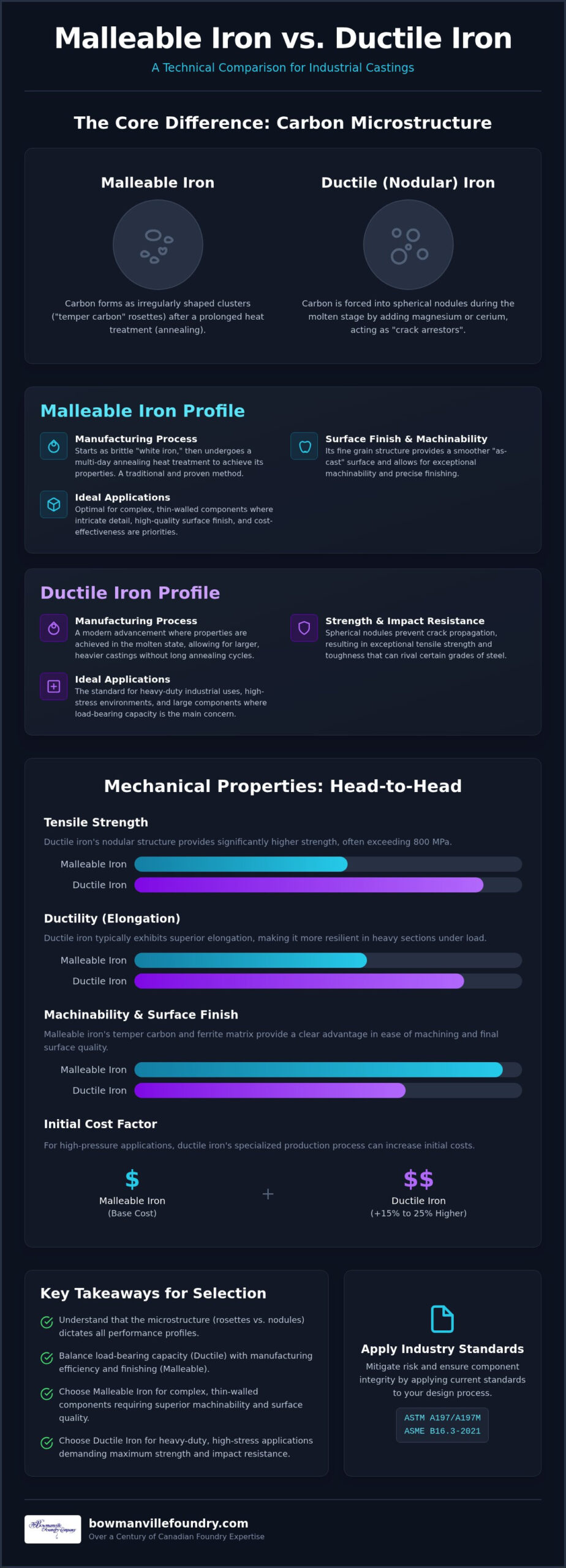
Malleable iron begins its life as “white iron.” In this initial state, the carbon is chemically combined with the iron as iron carbide, or cementite, which makes the casting incredibly hard but far too brittle for structural use. To achieve the desired properties, the material must undergo a rigorous annealing process. This controlled heating cycle can last for several days, causing the carbon to precipitate out of the cementite and form irregularly shaped clusters known as “temper carbon” rosettes.
These rosettes are surrounded by a ferrite or pearlite matrix, allowing the metal to deform and bend without fracturing. This process has been a cornerstone of Canadian manufacturing since the early 1900s. Since 1902, foundries have utilized this specific heat treatment to produce components that require a balance of toughness and intricate detail, particularly for parts with thin walls that would be difficult to cast in other materials.
The Innovation of Ductile Iron
Ductile iron represents a more modern metallurgical advancement. Rather than relying on a lengthy post-casting heat treatment, the properties of Ductile Iron are created while the metal is still in its molten state. By adding precise amounts of magnesium or cerium to the ladle, the graphite is forced to form into perfect spheres, or nodules. This is why the material is frequently called nodular iron.
These spherical nodules are critical because they act as “crack arrestors” within the metal. While flakes in gray iron provide a path for cracks to travel, the rounded shape of the nodules in ductile iron prevents crack propagation. This results in a material with exceptional tensile strength and impact resistance that often rivals certain grades of steel. Because the nodular structure is achieved during the pour, it allows for the production of larger, heavier castings that might not be practical for the long annealing cycles required for malleable iron.
Mechanical Properties: Comparing Strength, Ductility, and Machinability
Evaluating malleable iron vs ductile iron requires a granular look at how these metals behave under physical load. While their chemical compositions are similar, the resulting mechanical properties diverge significantly due to their distinct microstructures. Ductile iron is renowned for its superior tensile strength, making it the standard for heavy-duty industrial applications where raw power is required. Conversely, malleable iron offers unique advantages in precision and surface finish that often make it the more cost-effective choice for smaller, intricate components.
A material’s performance isn’t just about its peak strength; it’s also about how it handles deformation and secondary processing. Key mechanical differentiators include:
- Tensile Strength: Ductile iron generally offers higher peak strength, often exceeding 800 MPa in specific grades.
- Elongation: Ductile iron typically shows higher elongation percentages, indicating better ductility in large, heavy sections.
- Surface Finish: Malleable iron’s fine grain structure provides a smoother “as-cast” surface for small parts.
Tensile Strength vs. Yield Strength
In high-stress environments, ductile iron typically outperforms malleable iron in ultimate tensile strength. This is largely due to the high density of spherical nodules that reinforce the iron matrix. However, for many low-stress applications, the yield strength of malleable iron is more than sufficient. Yield strength is defined as the point where a material begins to undergo permanent deformation. Understanding Ductile Iron Properties reveals that while it can withstand higher loads, its performance is often tied to section thickness. Malleable iron is restricted by the annealing process. If a part is too thick, the core may remain as brittle white iron. For this reason, ductile iron is the non-negotiable choice for heavy, thick-walled castings.
The Machinability Advantage
One of the most compelling reasons to select malleable iron is its exceptional machinability. During the cutting process, the temper carbon rosettes within malleable iron act as a natural dry lubricant. This reduces friction at the tool edge, which directly translates to lower tool wear and decreased labour costs over long production runs. While ductile iron is also machinable, it typically requires more robust tooling and slower feed rates to achieve a comparable finish.
For projects requiring tight tolerances and complex geometries, the superior surface finish of malleable iron is a distinct advantage. It allows for the creation of thin-walled parts that maintain structural integrity after extensive machining. If you’re currently designing a component and need to verify which material aligns with your specific ASTM requirements, reviewing a Free Casting Buyer’s Guide can provide the necessary technical data to make an informed decision.
Manufacturing Processes: From the Foundry to the Finishing Centre
Transforming raw molten metal into a custom-engineered component requires a precise sequence of chemical adjustments and thermal cycles. While the initial melting phase is similar for most ferrous metals, the divergence between malleable iron vs ductile iron occurs during the pouring and cooling stages. In the foundry, these processes are managed with rigorous quality control to ensure that the final product meets the specific mechanical requirements of the project. A casting is rarely the final step; it’s the foundation for secondary operations that define the part’s ultimate utility.
For ductile iron, the focus is on the nodularization process. This involves adding magnesium or cerium to the molten iron just before it’s poured into the mould. This chemical reaction must be timed perfectly. If the magnesium fades before the metal solidifies, the graphite will not form the spherical nodules required for high tensile strength. This level of precision ensures that every batch of ductile iron maintains the structural integrity necessary for high-stress industrial environments.
The Annealing Cycle for Malleable Iron
The production of malleable iron is a marathon of thermal management. Once the initial “white iron” part is cast, it’s extremely hard and prone to cracking. To realize its namesake properties, the casting must enter a multi-day annealing cycle. This process involves heating the parts to temperatures between 800°C and 950°C in a controlled atmosphere, followed by a slow, methodical cooling phase. This long duration is essential for eliminating internal stresses and allowing the temper carbon rosettes to form properly.
Canadian engineers must account for this cycle during project planning. Because the annealing process can add several days to the production timeline, it affects total lead times. However, the result is a part with superior dimensional stability and reduced internal tension, which is often worth the additional time for precision hardware.
Post-Processing and Finishing Services
A high-quality casting often requires extensive secondary work to meet final specifications. Sourcing components from a facility with integrated Post-Processing Services provides significant logistical advantages. This includes precision machining to achieve tight tolerances and surface coatings to prevent corrosion in harsh Canadian climates. For ductile iron, additional heat treatments like normalizing or quenching can be used to further enhance hardness or wear resistance.
Using a single partner for both the casting and the finishing centre reduces the risk of communication errors between separate vendors. It ensures that the person machining the part understands the specific metallurgical nuances of the iron grade used. Whether your project requires complex drilling or protective surface treatments, these finishing steps are what truly turn a raw casting into a reliable industrial component.
Application and Selection Guide: Choosing the Right Iron Grade
Selecting the correct grade involves a careful analysis of the part’s final environment and the forces it will endure. While the technical data provides a baseline, real-world application requires a more nuanced approach to the malleable iron vs ductile iron debate. For instance, a component designed for a hydraulic system in Northern Ontario faces different stressors than a small electrical bracket used in a climate-controlled facility. Each material brings a specific set of advantages to the table, and the choice often hinges on the balance between raw strength and manufacturing efficiency.
Before finalizing your design, consider these primary selection criteria:
- Load Type: Is the part subjected to constant tension, or does it face sudden, high-impact shocks?
- Geometry: Does the design feature thin walls or intricate internal passages?
- Volume: Will the savings in machining costs for high-volume runs outweigh higher material costs?
When to Specify Malleable Iron
Engineers often turn to malleable iron for small, high-precision parts such as electrical fittings, hand tools, and pipe hardware. Its primary advantage in these applications is the ability to cast thin, complex walls that would be difficult to achieve with other irons. Additionally, malleable iron exhibits excellent toughness in cold Canadian climates, resisting the brittle fractures that can occur in standard cast irons when temperatures drop. If your project involves high-volume production with extensive secondary machining, the natural lubricity of malleable iron rosettes can significantly lower your total cost of ownership by extending tool life and reducing labour hours. For a deeper look at how these properties translate across industries, exploring specific malleable iron casting applications in automotive, agricultural, and electrical sectors can help validate your material selection.
When to Specify Ductile Iron
For components that must withstand extreme pressure or impact, ductile iron is non-negotiable. It’s the preferred choice for heavy machinery in the agricultural, automotive, and mining sectors. Because it provides the tensile strength of steel with the superior castability of iron, it’s ideal for large parts like crankshafts, steering knuckles, and heavy-duty brackets. While research indicates that ductile iron can have a 15% to 25% higher initial cost compared to malleable iron for critical applications, its ability to handle high-stress loads without failing often justifies the investment. It’s the reliable choice when structural failure isn’t an option.
Environmental factors like corrosion resistance also play a role in your final decision. Both materials respond well to surface coatings, but the smoother as-cast finish of malleable iron can sometimes reduce the amount of preparation needed for finishing. Balancing these material costs against your machining and finishing expenses is essential for a profitable production run. To help you navigate these specifications and ensure your project adheres to the latest industrial standards, we recommend you download our Free Casting Buyer’s Guide.
Partnering with a Canadian Foundry for Custom Iron Castings
Determining the right material for your project involves more than just a spreadsheet comparison of mechanical properties. When you’re deciding between malleable iron vs ductile iron, the institutional knowledge of your manufacturing partner becomes your most valuable asset. A foundry that has operated in Canada since 1902 possesses a deep understanding of how these metals behave under local environmental conditions and specific industrial stressors. This legacy of expertise allows us to act as a mentor, guiding you through the intricate technical landscapes of heavy manufacturing with pragmatic confidence.
Utilizing a local Canadian supply chain provides more than just logistical convenience. It offers a transparent partnership where technical data and application guides are readily available to support your procurement team. By choosing a domestic partner, you avoid the uncertainties of international shipping and tariffs while ensuring your project benefits from a century of physical craftsmanship and metallurgical mastery.
Custom-Engineered Iron Solutions
Collaboration between your design team and foundry engineers is the most effective way to optimize part performance. By reviewing technical data early in the design phase, you can adjust geometries to better suit the specific cooling rates and solidification patterns of your chosen iron grade. This proactive approach ensures your components meet strict ASTM standards for regulatory compliance while maintaining precise casting tolerances. Pattern development is a critical part of this phase; it’s where theoretical design meets physical craftsmanship to ensure repeatable accuracy across long production runs.
Streamlining Procurement with Ready-to-Use Components
Managing multiple vendors for casting, machining, and surface coating often leads to logistical bottlenecks and communication gaps. The practical choice between malleable iron vs ductile iron often hinges on how the part will be processed after it leaves the mould. By sourcing ready-to-use components from a facility that integrates Post-Processing Services, you can significantly reduce lead times and simplify your supply chain.
This vertical integration ensures that quality control is maintained from the initial pour through to the final inspection of the finished part. It provides a level of accountability that is difficult to achieve when shipping raw castings between separate vendors for secondary work. Whether your project requires high-precision drilling or specialized surface treatments for corrosion resistance, a single-source partner ensures the integrity of the component is never compromised. To begin your selection process with a clear technical framework, Download our Free Casting Buyer’s Guide to start your next project.
Optimizing Your Industrial Casting Strategy
Choosing between malleable iron vs ductile iron is a critical decision that influences both the safety and the cost-efficiency of your project. We’ve explored how the nodular structure of ductile iron provides the tensile strength needed for heavy machinery, while the unique annealing process of malleable iron delivers the machinability required for complex hardware. Aligning these metallurgical properties with your specific design goals ensures that every component performs reliably in the most demanding Canadian environments.
Since 1902, our team has specialized in custom-engineered iron components, offering a steady hand to guide you through intricate engineering challenges. By integrating comprehensive post-processing and finishing services, we help you streamline your supply chain and reduce lead times for ready-to-use parts. To ensure your next procurement decision is backed by technical certainty, Download the Free Casting Buyer’s Guide. We look forward to helping you realize your project’s full potential through precision and technical mastery.
Frequently Asked Questions
What is the main difference between malleable and ductile iron?
The primary difference lies in the shape of the graphite and the manufacturing method used to achieve it. Ductile iron contains spherical graphite nodules formed by adding magnesium to the melt, whereas malleable iron contains “temper carbon” rosettes created through an extensive multi-day annealing process. This microscopic distinction determines how the metal handles stress; ductile iron is typically better for heavy loads, while malleable iron excels in complex, thin-walled designs.
Is ductile iron stronger than malleable iron?
Ductile iron generally offers higher tensile and yield strength than its counterpart. In the comparison of malleable iron vs ductile iron, ductile iron is the standard choice for heavy-duty components like crankshafts and steering knuckles because its nodular structure prevents crack propagation. While malleable iron is tough and shock-resistant, it doesn’t match the raw load-bearing capacity found in high-grade ductile iron castings used in the agricultural and mining sectors.
Why would an engineer choose malleable iron over ductile iron?
An engineer would choose malleable iron for parts requiring exceptional machinability or very thin wall sections. The temper carbon rosettes act as a natural lubricant, which reduces tool wear and labour costs during high-volume secondary machining. It’s also the preferred material for small, intricate hardware and electrical fittings where a smooth as-cast surface finish is required to minimize post-processing preparation before final coating. Understanding the full range of malleable iron casting applications across automotive, agricultural, and electrical industries can further inform this decision.
Can malleable iron be welded as easily as ductile iron?
Welding both materials is challenging, but ductile iron is generally more manageable if proper pre-heating and post-heating procedures are followed. Malleable iron is particularly difficult to weld because high temperatures can cause the carbon to revert to its brittle white iron state, compromising the structural integrity of the joint. In most industrial applications, mechanical fasteners or specialized brazing techniques are recommended over traditional welding for these specific iron grades.
What ASTM standards apply to malleable and ductile iron castings in Canada?
In Canada, the most common standards are ASTM A47 for malleable iron and ASTM A536 for ductile iron. For specific applications like threaded fittings, engineers must also adhere to the updated ASME B16.3-2021 standard. These specifications ensure that mechanical properties, such as tensile strength and elongation, meet the safety requirements necessary for industrial infrastructure. Aligning your project with these standards is vital for regulatory compliance and long-term component durability.
How does the cost of malleable iron compare to ductile iron for custom parts?
Ductile iron can have a 15% to 25% higher initial material cost for critical, high-pressure applications. However, the total cost of ownership involves more than just the raw metal price. Malleable iron often reduces secondary expenses through faster machining and lower tool replacement rates. Conversely, the multi-day annealing cycle required for malleable iron can increase lead times, which may impact the overall project budget and scheduling for Canadian manufacturers.
Does heat treating significantly improve the properties of ductile iron?
Heat treating is a highly effective way to tailor the hardness and wear resistance of ductile iron castings. Processes like normalizing, quenching, and tempering can significantly enhance the material’s performance for high-friction environments. These secondary services allow engineers to achieve the strength of steel while maintaining the superior castability of iron. It’s a versatile solution for custom-engineered components that face extreme operational stressors in the field.
What are the typical lead times for custom iron casting production in Ontario?
Lead times for custom castings in Ontario depend heavily on the complexity of the part and the required material grade. Malleable iron typically requires more time than ductile iron because of the mandatory multi-day annealing process. Sourcing from a local foundry helps minimize logistical delays and provides better oversight during the design and finishing phases. For an accurate estimate tailored to your project, we recommend consulting with your manufacturing partner during the initial design stage.
