
A casting that arrives unfinished can add handling steps, supplier coordination and schedule risk to an already demanding procurement process. That is why comparing Canadian iron foundries 2026 means looking beyond the casting operation to material expertise, quality controls, delivery planning and post-processing capability.
Procurement professionals need consistent custom components and clear production schedules. Engineers need confidence that the selected iron grade suits the part’s mechanical requirements and service conditions. A foundry that supports material selection and coordinates finishing operations can help bring these requirements together.
This guide outlines practical factors for assessing Canadian iron foundries, from Gray, Ductile and Malleable Iron capabilities to quality management and integrated post-processing. It also explains how Bowmanville Foundry’s experience dating to 1902, ISO certification history and Free Casting Buyer’s Guide can support an informed evaluation. Use the criteria to build a shortlist and assess which foundry can produce components suited to your application.
Key Takeaways
- When comparing Canadian iron foundries 2026, assess material expertise, quality controls and delivery planning alongside the ability to supply finished components.
- Match Gray, Ductile or Malleable Iron to the part’s required strength, ductility, vibration damping and service conditions.
- Review how moulding capacity and process controls support consistent castings at the volumes and to the specifications your production requires.
- Integrated machining and heat treating can reduce hand-offs by coordinating casting and post-processing through one supplier.
- Bowmanville Foundry has produced iron castings since 1902 and works with three iron grades. Its Free Casting Buyer’s Guide can help inform procurement decisions.
The Canadian Ferrous Foundry Landscape in 2026
Iron procurement involves more than the casting process. Changes to cross-border supply routes and variation in scrap availability can affect production planning and delivery schedules. Tariffs may influence the movement of ferrous materials, but the impact depends on the trade measures and supply routes involved. Assess how a foundry plans for supply variability and communicates potential schedule changes instead of assuming one outcome applies across the market.
Iron is used in applications where components must withstand mechanical stress, wear or vibration. Ductile Iron combines high tensile strength with good ductility, while Gray Iron offers vibration damping and machinability. The right material depends on the component’s design and operating conditions. A foundry turns molten metal into components through processes that include mould preparation, pouring and solidification. Control at each stage contributes to consistent casting quality.
Economic Factors Influencing Procurement
Energy use and metal inputs shape foundry operations and production planning. Compare how a foundry communicates schedule changes and manages production when input availability or operating conditions shift. Domestic sourcing can simplify coordination and reduce reliance on long international routes, but it cannot eliminate supply-chain risk. Offshore sourcing may involve additional transit time and coordination. The right approach depends on your delivery requirements and inventory plan.
Assess the full production route, including inspection, handling, machining, other finishing operations, transport and inventory requirements. Consider how a delay or non-conforming casting could affect your production schedule. A foundry that coordinates these stages and communicates clearly can support continuity from order placement through receipt of finished components.
Technological Trends in Ferrous Casting
Digital design tools connect CAD files with pattern development, helping engineers communicate part geometry and identify design considerations before production. Review how drawing revisions are managed and how pattern details carry through to moulding. In sand casting, mold compaction, the pattern and any required core contribute to the cavity that forms the casting.
Automation in moulding and pouring can support repeatable process steps. For buyers, the practical question is how process controls and the quality management system help maintain consistency between production runs. Sustainability and ESG expectations also influence industrial operations. Look for documented environmental practices and process improvements rather than relying on broad claims about modernity. When comparing Canadian iron foundries 2026, focus on process control, clear supply planning and technical fit for the component.
Evaluating Material Expertise: Malleable vs. Ductile vs. Gray Iron
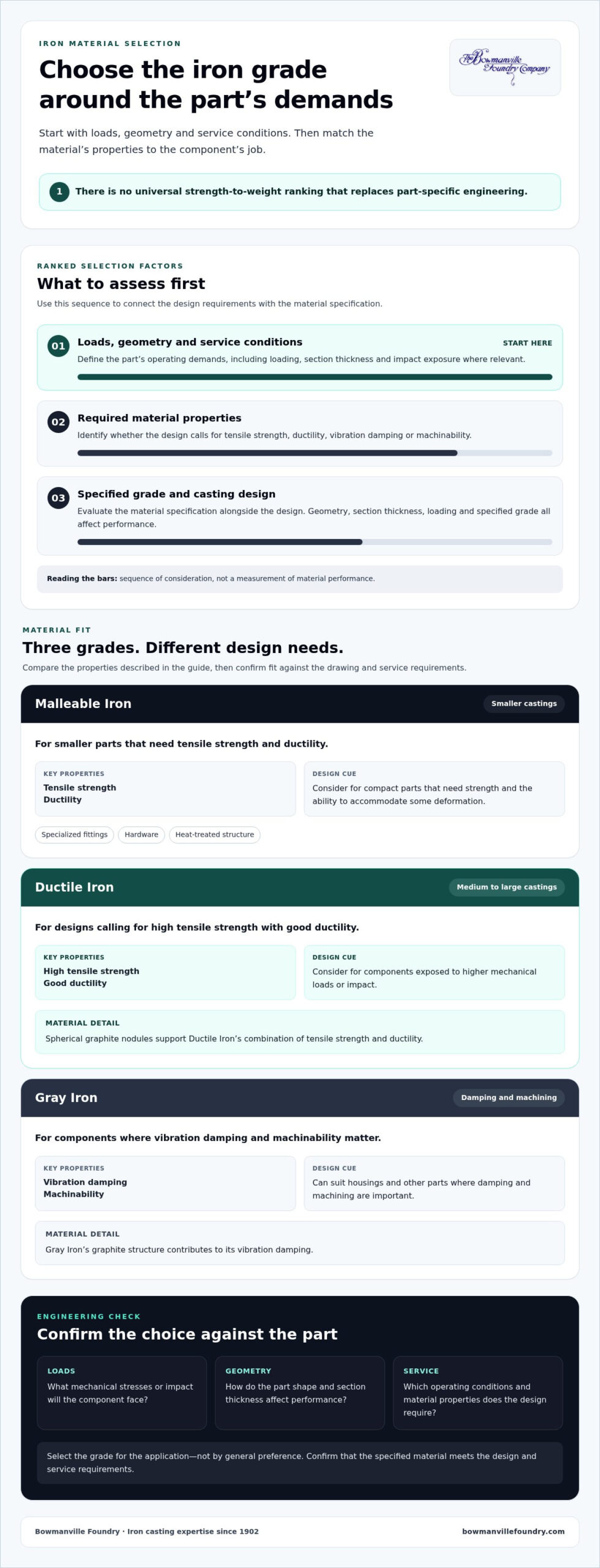
Start material selection with the part’s loads, geometry and service conditions. Malleable, Ductile and Gray Iron differ in strength, ductility, machinability and vibration damping. Select the grade for the application rather than by general preference. A foundry’s expertise matters when translating drawing requirements into a material and casting design that can meet them consistently.
- Malleable Iron suits smaller castings that need tensile strength and ductility.
- Ductile Iron combines high tensile strength with good ductility, making it suitable for components exposed to higher mechanical loads or impact.
- Gray Iron provides vibration damping and machinability, useful properties in housings and other components where those functions matter.
There is no universal strength-to-weight ranking that replaces part-specific engineering. Geometry, section thickness, loading and the specified grade all affect component performance. Evaluate the material specification alongside the design.
Malleable Iron: The Versatile Legacy Grade
Malleable Iron has a distinct role in casting because heat treatment changes the structure of the cast material and helps provide the required ductility. It remains relevant for compact parts such as specialized fittings and hardware, where a small casting needs strength and the ability to accommodate some deformation. Its use reflects specific design requirements, not simply tradition.
For a bracket, consider section thickness, loading direction, impact exposure and operating temperature. Malleable Iron may suit a smaller part that requires ductility. Ductile Iron may suit a design calling for high tensile strength and good ductility, particularly in medium to large castings. Let the drawing and service requirements guide the choice.
Ductile and Gray Iron Performance Metrics
Ductile Iron contains spherical graphite nodules that support its combination of tensile strength and ductility. Assess the required properties against the component’s geometry and load case rather than relying on a general strength-to-weight claim. Bowmanville Foundry produces Ductile Iron castings, including five grades of Austempered Ductile Iron.
Gray Iron’s graphite structure contributes to vibration damping, and the material is generally machinable. These characteristics can make it a suitable choice for housings and parts where damping and machining are important. Do not select by grade name alone. Confirm that the specified material meets the design and service requirements.
For procurement, state the applicable ASTM designation and revision in the drawing or purchase documents, and align inspection requirements with that specification. Verify the current standard for the project rather than assuming it. For help assessing iron casting requirements, review Bowmanville Foundry’s iron casting expertise.
Technical Capabilities and Modern Moulding Infrastructure
A foundry’s equipment influences which component sizes, geometries and production volumes it can handle efficiently and consistently. When comparing Canadian iron foundries 2026, assess the process behind a capability, not just the equipment list. Share the part’s maximum dimensions, casting weight, annual volume, critical features and delivery requirements so the technical discussion reflects the actual component.
Moulding Technology and Volume Scalability
Green sand moulding forms a cavity in compacted sand, often using a two‑half mold held in a flask. No-bake moulding uses a chemically bonded sand system that hardens without the same compaction method. Each process has different tooling, production and geometry considerations. The right choice depends on casting design, quantity and required repeatability.
For recurring production, a matchplate can carry multiple patterns to support the manufacture of similar castings. Automated moulding and pouring can make process steps more repeatable, while prototype work and sample approval can resolve design details before production. Review how the foundry plans the transition from initial samples to repeat orders and maintains process control as volumes change.
Component Fit, Pattern Accuracy and Quality
Component weight and dimensions affect mould handling, pouring and the space required for production. Provide CAD files and identify critical interfaces, machining allowances and tolerances on the drawing. Pattern development translates part geometry into the mold cavity. Draft, parting lines and core placement can all influence the final casting and should be reviewed during design.
Induction furnace technology can support controlled melting and alloy preparation. Ask how material chemistry is verified and traceability is maintained through production. Process monitoring can also help identify conditions that contribute to defects such as shrinkage, inclusions or incomplete filling. Review how inspection and corrective actions are documented within the quality management system.
ISO certification provides a structured framework for managing quality. Buyers should also consider how the quality management system applies to the work, including production controls, inspection records, non-conformance handling and corrective action. Bowmanville Foundry was the first foundry in Canada to achieve ISO certification, in 1996. That history is one point of reference; technical fit still depends on the part’s drawings, material requirements and production plan.
For a useful technical assessment, provide the component drawing, expected volume and key acceptance criteria. These details help connect moulding capacity, pattern design and quality controls to the requirements of the finished casting.
Supply Chain Resilience and Post-Processing Integration
A casting is not ready for production use if it still needs machining, heat treating or finishing from separate suppliers. Coordinating those steps through one foundry can reduce hand-offs, simplify scheduling and limit extra transit between facilities. It can also give procurement and engineering teams a clearer view of responsibility when a part needs review or corrective action. Integration can reduce coordination risk, but inspection and agreed acceptance criteria remain essential.
Geopolitical uncertainty and changes to trade conditions can affect sourcing plans, including the movement of ferrous inputs. Rather than assume a particular tariff outcome, assess how a foundry communicates changes to sourcing, production planning and delivery commitments. A Canadian supplier provides a domestic production route, while buyers should still plan for normal variability in material supply and schedules.
The Value of Integrated Post-Processing
Specify post-processing according to the component’s function. Heat treating changes material properties through a controlled thermal cycle, with the appropriate process depending on the iron grade and required performance. Machining can bring designated surfaces and features to drawing tolerances after casting. For surface protection, define the operating environment, preparation requirements, coating coverage and inspection criteria in the component specification. These details help ensure the finished part is assessed for its intended use, including exposure to moisture and seasonal conditions.
Bowmanville Foundry provides integrated post-processing, including machining and heat treating. Coordinating these operations with casting helps track part requirements from the initial drawing through to a ready-to-use component.
Managing Lead Times and Project Logistics
Plan lead times around the full production route, not just mould preparation or pouring. Include pattern and tooling work, sample approval, casting, post-processing, inspection and shipping in the schedule. Bowmanville Foundry’s typical lead times are four to eight weeks, depending on current business conditions. Share required in-service dates early and align forecasts with order timing. For repeat parts, review inventory levels and safety stock against actual usage and replenishment intervals.
For an accurate quotation on a complex casting, provide the latest CAD files or drawings, iron grade, initial and annual quantities, critical tolerances, required machining, heat treatment, finish and delivery schedule. Identify drawing revisions and acceptance requirements clearly. This lets the foundry assess the complete scope rather than an incomplete casting specification.
For support planning a finished iron component, request a casting quote from Bowmanville Foundry. Comparing Canadian iron foundries 2026 means assessing how each partner coordinates production steps, communicates schedules and supports the finished part’s requirements.
Selecting Your Partner: The Bowmanville Foundry Advantage
When comparing Canadian iron foundries 2026, look for a partner whose material range, engineering support and production experience align with your component requirements. Bowmanville Foundry has produced iron castings since 1902, with expertise in Malleable, Ductile and Gray Iron. Its experience with custom casting work and range of iron grades give procurement and design teams a single point of technical discussion for different applications.
Bowmanville Foundry serves customers across Canada. A technical or sales engineer can visit your facility to assess project needs and requirements. A direct technical discussion helps clarify how the part will function, which material properties matter and what details belong in the drawing or specification before production planning begins.
Technical Support for Industrial Casting
Material selection and part design are closely connected. Gray Iron may suit a component where vibration damping and machinability are priorities. Ductile Iron offers high tensile strength with good ductility. Malleable Iron can serve smaller parts that need strength and ductility. Share the operating conditions, loading, drawing and acceptance criteria to give the engineering discussion a practical starting point.
Bowmanville Foundry operates a 38,000 square foot plant and has a modern production facility. Its ISO certification history provides an additional quality-management reference for buyers evaluating manufacturing partners. For ongoing programmes, clear communication about drawing revisions, sample approval, production requirements and post-processing helps maintain continuity from order to order.
Start with the Buyer’s Guide
The Free Casting Buyer’s Guide can help procurement teams and engineers organize the information needed to assess a casting project. Use it to frame questions about iron grade, part geometry, quantities, tooling, tolerances and finishing requirements. A well-defined request supports a focused discussion of technical suitability and project planning.
For a project-specific review, prepare current CAD files or drawings, expected volumes, service conditions and any required machining or heat treating. Bowmanville Foundry’s technical and sales team can assess these requirements with you and help connect material choice and casting design to the intended use of the finished component.
Download the Free Casting Buyer’s Guide to start your selection process.
Make Your Next Casting Decision with Confidence
Comparing Canadian iron foundries 2026 means looking beyond the initial casting to material suitability, process control, delivery planning and finishing requirements. The right iron grade depends on the component’s geometry and service conditions. Integrated machining and heat treating can simplify coordination and bring a casting closer to ready-to-use condition.
Bowmanville Foundry has served Canadian manufacturers since 1902, producing Malleable, Ductile and Gray Iron castings. Its experience across these grades and integrated post-processing services give procurement teams and engineers a practical foundation for discussing custom component requirements.
Start with clear project information: drawings or CAD files, the intended application, required material properties, production quantities and finishing specifications. A focused technical discussion can help align the casting design with the part’s operating needs and production plan.
Request a custom iron casting quote from our engineering experts today. Share your requirements with Bowmanville Foundry to discuss the right material, casting design and post-processing for your component.
Frequently Asked Questions
What are the main differences between Canadian iron foundries in 2026?
Canadian iron foundries differ in the grades they produce, casting processes, component size and volume capacity, quality controls, lead times and post-processing services. When comparing Canadian iron foundries 2026, match these capabilities to your part’s drawings, material specification and production schedule. Consider whether engineering support and finishing operations are coordinated with casting. These factors help determine whether a foundry fits your application and ongoing requirements.
How do current scrap metal tariffs affect iron casting supply in Canada?
Tariffs can affect the sourcing and movement of ferrous scrap, but the impact on supply depends on applicable trade measures, material routes and foundry purchasing arrangements. Avoid assuming the effect is uniform across suppliers. For procurement planning, assess how a foundry communicates sourcing and scheduling changes, and share forecasts early. Evaluate specific tariff impacts using current, authoritative trade information relevant to the materials and routes involved.
Can Malleable Iron be used as a direct substitute for Ductile Iron?
Not automatically. Malleable Iron and Ductile Iron have different material characteristics and suit different component requirements. Malleable Iron is used for smaller castings that need good tensile strength and ductility, while Ductile Iron combines high tensile strength with good ductility and is suitable for medium to large castings. Before changing grades, review the part’s geometry, loading, service conditions and material specification with a foundry engineer.
What is the typical lead time for custom iron castings in Canada?
Bowmanville Foundry’s typical lead times are four to eight weeks, depending on current business conditions. The production schedule can depend on project scope, including tooling, sample approval, casting, inspection and required post-processing. Include your required delivery date and quantities when discussing a project so the schedule accounts for the full production route. Tooling can be produced in two to four weeks.
Why should I choose a Canadian foundry over an offshore manufacturer?
A Canadian foundry can support domestic sourcing and direct technical communication, which may simplify coordination across design reviews, production planning and delivery. Offshore manufacturing may suit some supply chains, but longer transport routes and additional hand-offs can affect planning. Compare the full supply arrangement, including lead-time visibility, quality documentation, post-processing and logistics. The right choice depends on your component requirements, production schedule and how your organization manages supplier and transit risks.
What post-processing services are essential for ready-to-use iron components?
The required services depend on the drawing and end use. Machining may be needed for specified interfaces, holes or surfaces that must meet dimensional tolerances. Heat treating may be specified to achieve required material properties. Surface finishing can be relevant where a component needs a defined protective treatment. Bowmanville Foundry offers post-processing services, including machining and heat treating. State the required operations and acceptance criteria in the component specification.
How do I ensure my iron casting meets ASTM standards?
Identify the applicable ASTM designation and revision in the drawing or purchase documents, then specify the required iron grade, inspection criteria and documentation. Ensure the standard matches the component’s design and service requirements. Review the requirements with the foundry during the technical assessment and clarify how material verification and inspection results will be recorded. Verify the current standard for your project rather than relying on an outdated drawing or specification.
What information is required for an accurate iron casting quote?
Provide current CAD files or engineering drawings, the required iron grade, initial and expected production quantities, critical dimensions and tolerances, and the component’s service conditions. Include any machining, heat treating, surface finishing, inspection and delivery requirements. Identify drawing revisions and features that affect fit or function. A complete specification allows the foundry to assess casting and post-processing together and prepare a quote based on the project requirements.
