
The hardest casting isn’t always the one that lasts longest. For wear resistant iron castings, service life depends on how the material responds to the actual wear mechanism, whether abrasion, impact or a combination of conditions. A hardness value alone can’t show how a component will perform in service.
Unplanned wear can mean replacement work and production downtime. An unclear specification can also result in a casting that doesn’t suit the application. Start with the operating conditions: what contacts the part, how loads are applied and whether other factors affect wear. Consider material grade, casting design and any required post-processing together.
This article explains how to identify the dominant wear mechanism, compare iron options and prepare a clear specification for supplier review. It also outlines how Gray Iron, Ductile Iron and Malleable Iron may be assessed for a particular duty. Bowmanville Foundry manufactures these iron castings and offers post-processing services. A technical review is needed to confirm whether a particular available grade fits your application.
Key Takeaways
- Identify whether abrasion, impact, corrosion or a combination is driving wear before selecting a material.
- Compare wear resistant iron castings by service conditions and component requirements, not hardness alone.
- Include operating details, drawings or CAD files, known failure history and acceptance criteria in your specification.
- Ask the foundry to confirm that a proposed grade and process suit the application before production begins.
- Bowmanville Foundry manufactures Gray Iron, Ductile Iron and Malleable Iron castings, and offers post-processing services.
What Makes Iron Castings Wear-Resistant in Service?
Wear-resistant iron castings are selected to limit material loss under defined operating conditions. The term describes a material’s intended response to a particular duty, not a guarantee of how long a component will last. Actual service life also depends on loading, component design, operating cycles and maintenance.
Wear resistance is a casting material’s ability to resist material loss in a specified service environment; it does not, by itself, guarantee component life. That distinction matters because “wear” can describe different forms of damage. Abrasion occurs as particles or contacting surfaces remove material. Impact loading can damage a part through repeated shock, while corrosion involves deterioration from the surrounding environment. A component may face several mechanisms at once.
Cast iron types differ in their structures and properties. A foundational overview of Cast iron describes types such as white cast iron and the role of alloying elements in forming hard carbides. This background helps explain why a material associated with abrasion resistance may not automatically suit a duty that also involves substantial impact. Selection starts with the conditions the casting must withstand.
Which wear mechanisms should a casting buyer identify?
Describe how material is lost rather than relying on a general label such as “abrasive service.” Identify whether particles strike or slide across the surface, whether surfaces repeatedly contact one another, and whether the part experiences shock. Record moisture, process material, temperature and operating cycles where known. These details help a foundry assess the dominant mechanism and any mixed conditions.
Failure history can clarify the duty. Note where wear appears, how the part has failed and whether the damage includes cracking, surface loss or corrosion. Avoid assuming that conditions are uniform across the component. Contact and loading may vary from one area to another, so identify the locations where damage occurs.
Why is abrasion resistance not the only design requirement?
A material choice must suit the complete component, not just its wearing surface. Geometry, section thickness and loading can affect casting design. Machinability matters if the part requires finishing to meet its intended fit or function. Prioritizing one property may involve trade-offs with other requirements, so a hardness figure alone cannot establish suitability.
Share the application details with the foundry for a technical review before specifying a material. Include the part’s function, wear pattern, loading, geometry and known failure history. The review can help determine whether a candidate iron grade and casting design fit the service conditions, or whether the specification needs further definition.
How Alloy Composition and Microstructure Affect Wear Resistance
Wear behaviour depends on more than an alloy’s name. Chemistry influences which phases form as iron solidifies, while the casting process and any heat treatment can affect the resulting microstructure and properties. As a result, two materials described broadly as abrasion-resistant may not respond alike under the same combination of particle contact, impact and operating conditions.
White iron is often discussed for abrasive duties because its microstructure can contain hard carbides. Ni-Hard and high-chromium iron are examples of white iron families referenced in the market. They are examples for comparison, not confirmed Bowmanville Foundry offerings. Don’t treat their grade designations or published property values as universal selection criteria, or apply them to another foundry’s materials without verification.
What role do carbides and hardness play in abrasive wear?
Hard microstructural constituents, including carbides, can help resist material removal as abrasive particles contact a surface. Hardness can therefore inform a material comparison, but it describes only one aspect of performance. A hardness value doesn’t establish how a casting will respond to shock, whether it can be machined as required, or whether its geometry and section thickness are suitable for the part.
Published values are meaningful only in context. Confirm the specific grade, test basis and supplier documentation before using them in a specification. If you are comparing data from different suppliers, check that the values were determined on a comparable basis before drawing conclusions.
When can toughness, machinability, or corrosion resistance change the choice?
A material selected to resist abrasion may be a poor fit if the component also sees significant impact and is vulnerable to brittle damage. Machining requirements matter too: the chosen material and casting design must support any required finishing. Moisture, process material and temperature can also change the service environment, particularly where abrasion occurs alongside corrosion or exposure to heat.
Grade properties must be assessed against the component’s actual service conditions, because no single material property can confirm suitability for every wear duty. Bowmanville Foundry manufactures Ductile Iron, Gray Iron and Malleable Iron castings and offers post-processing services. Confirm with the foundry whether an available grade and process fit your application. Discussing casting requirements with Bowmanville Foundry can help frame that review.
How to Compare Wear-Resistant Iron Casting Options for Your Duty
A useful comparison starts with the part’s duty, not a list of hardness values. For wear resistant iron castings, assess the wear mechanism alongside impact, environment, geometry and finishing needs. Gray Iron, Ductile Iron and Malleable Iron have different properties, but none should be assumed to provide equivalent wear performance. The appropriate grade depends on the application and the evidence required for acceptance.
Which material-selection questions belong in a comparison?
Use a consistent set of questions for each candidate. This helps engineering, procurement and the foundry compare materials against the same service requirements.
| Factor | What to record or confirm |
|---|---|
| Wear mechanism | What contacts the surface, and how is material removed? |
| Impact | Does the component experience shock or repeated impact alongside abrasion? |
| Environment | Record process material, moisture, temperature and operating cycles where known. |
| Geometry | Provide the part drawing, section thicknesses and critical features for review. |
| Machinability | Identify surfaces, dimensions or features that require machining after casting. |
| Evidence | Define required material data, test methods and acceptance criteria for supplier review. |
Make expected service performance specific. Define the area of concern and how wear or failure will be assessed, rather than relying on a general request for a “wear-resistant” grade. If acceptance depends on measurable criteria, agree on the relevant test method and supporting documentation with the supplier before production.
How should buyers treat white iron comparison charts?
White iron, including Ni-Hard and high-chromium iron, often appears in industry comparison charts. Treat these as background examples, not universal recommendations or evidence that a particular foundry supplies those materials. Confirm that any listed grade designation and standard apply to the proposed casting and purchase requirement. Values from one supplier’s chart shouldn’t be transferred to another material without verification.
Bowmanville Foundry manufactures Gray Iron, Ductile Iron and Malleable Iron castings. That information does not establish that any one grade is suitable for a specific wear duty. Ask the foundry to assess casting feasibility, section geometry and proposed post-processing against the part’s requirements. For broader material-selection context, see the iron casting grade selection guide.
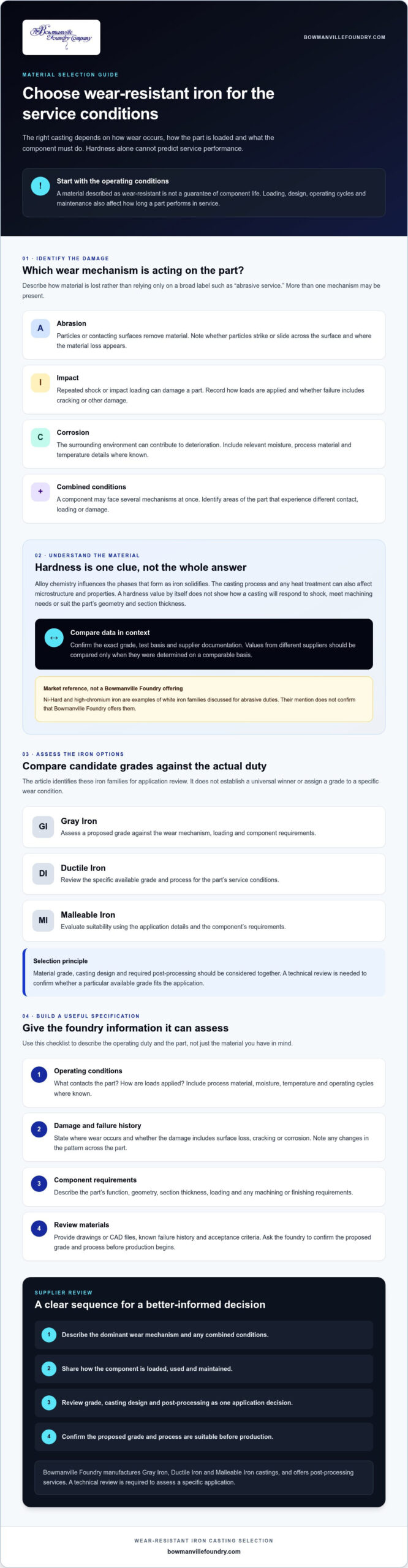
How to Specify a Wear-Resistant Iron Casting Before Requesting a Quote
A clear enquiry gives the foundry enough information to assess the component, its service conditions and production requirements. For wear resistant iron castings, work through the specification in sequence: document the duty, provide design information, review material options, agree on acceptance criteria and define how sample approval will work. This helps surface unanswered questions before production details are finalized.
What information should a casting enquiry include?
Send available part drawings and CAD files, along with current part details if the component is being replaced. Include expected quantities and describe the process material, loading, operating cycles, temperature and moisture conditions where known. If a part has failed prematurely, note where wear or damage occurred, how the component was loaded and how long it operated before the issue appeared.
Make the requirements clear and specific. A useful enquiry should identify:
- Critical dimensions, tolerances, surfaces and features that affect fit or function.
- Machining or other post-processing requirements, including any specified coatings or heat treatment. Ask the foundry to confirm whether these requirements can be accommodated.
- Inspection documentation or material evidence required for acceptance, including any test method or criteria your organization expects.
- Relevant service expectations, such as the wear areas of concern and the conditions under which the part must operate.
Distinguish mandatory requirements from preferences. If a drawing, existing specification or failure report contains information that may affect the design or material choice, include it with the enquiry. When a detail is unknown, say so rather than estimating; the foundry can identify which missing information needs to be resolved.
How can sample approval reduce production uncertainty?
Before full production begins, establish how you will review a prototype or sample casting. Agree in advance which dimensions, material requirements and inspection records will be checked, who will review them, and how approval will be recorded. The review criteria should reflect the component’s intended use and the information included in the purchase specification.
Sample approval can confirm that the casting and agreed requirements have been reviewed before production proceeds. It doesn’t, by itself, establish service life or prove performance under every operating condition. Don’t assume a particular test, certification or inspection method is included. Define what is required and confirm its feasibility with the foundry for the project.
Once the component, duty and acceptance requirements are documented, the foundry can review the design and material requirements. Request a technical assessment for your casting project to discuss the application with Bowmanville Foundry.
Choosing a Foundry for Wear-Resistant Iron Castings
A suitable supplier should be able to review the component and explain how its confirmed material range and production capabilities relate to the application. When evaluating a supplier for wear resistant iron castings, assess engineering support, casting process, quality requirements and finishing coordination, not just a material description or hardness figure. Ask what can be confirmed from your drawings and what still needs technical review.
What should procurement verify about a foundry’s capabilities?
Before selecting a supplier, confirm the specific iron grade, casting process, part size and production requirements directly with the foundry. Check that the proposed route can address the component’s geometry, critical features and any specified post-processing. Ask how quality requirements are documented and what technical records can be provided for your project. If certification is part of your supplier qualification process, request current certification details and supporting documentation, then verify that they apply to the work under consideration.
Bowmanville Foundry manufactures Gray Iron, Ductile Iron and Malleable Iron castings and offers post-processing services. When comparing suppliers, discuss which operations are required, such as machining, heat treating or surface coating, and confirm which can be included for the project. For further production planning context, consult the custom iron casting production guide.
How can Bowmanville Foundry assess a wear-duty project?
Provide available drawings, operating conditions and customer requirements for review. Include CAD files, loading and wear details, process material, critical dimensions and known failure history. This gives the foundry a basis to discuss casting feasibility, material options and post-processing needs. The suitability of a particular wear-duty application must be confirmed with Bowmanville Foundry, since no single grade is appropriate for every wear condition.
Before proceeding, align on the proposed grade and casting route, applicable acceptance criteria, required documentation and sample approval process. If a requirement cannot be confirmed, resolve it with the supplier before it becomes part of the production specification.
To review your application, contact Bowmanville Foundry to discuss your casting requirements. You can also ask about an on-site technical assessment with a technical/sales engineer.
Specify for the Service Conditions, Then Move Forward
Choosing wear resistant iron castings starts with the component’s real operating duty. Identify the dominant wear mechanism and note impact, environment, geometry and machining needs. Then compare candidate materials against those requirements instead of treating hardness as a complete measure of suitability.
A clear enquiry should include drawings or CAD files, loading and process details, known failure history and defined acceptance criteria. Review the proposed grade and casting route with the foundry, and agree on how sample approval will be handled before production.
Bowmanville Foundry manufactures Gray Iron, Ductile Iron and Malleable Iron castings and offers post-processing services. Confirm the suitability of a grade for a specific wear duty directly with the foundry, and clarify any required finishing or inspection before production.
Contact Bowmanville Foundry to discuss your casting requirements and request a technical assessment. Share the service conditions, part details and acceptance criteria so the team can review your requirements.
Frequently Asked Questions
What are wear-resistant iron castings used for?
Wear-resistant iron castings are used for components that lose material through contact with abrasive particles, sliding surfaces or other repeated wear in service. The appropriate material depends on the specific duty, including impact, operating environment, component geometry and required finishing. Describe the process material and wear pattern rather than relying on a general application label. This information helps a foundry assess whether an available grade may suit the component.
Which iron is best for abrasion resistance?
There isn’t one iron that is best for every abrasive application. Material selection depends on the type of contact, particle conditions, impact exposure, geometry and any machining or finishing requirements. White iron is often discussed for abrasive wear, while Gray Iron, Ductile Iron and Malleable Iron have different properties that need application-specific review. Compare confirmed grade data and supplier capabilities against your service conditions before specifying a material.
Is white iron always the best choice for wear resistance?
No. White iron may be considered for some abrasive duties, but abrasion resistance alone doesn’t establish suitability for a complete component. Significant impact, required machinability, geometry or combined environmental conditions may affect the choice. White iron examples and comparison charts are starting points, not proof that a particular grade fits your part or is available from a given foundry. Confirm grade, process feasibility and acceptance requirements with the supplier.
Can iron castings resist both abrasion and impact?
Some material choices may address a combination of abrasion and impact, but the balance depends on the specific grade, casting design and severity of each condition. A material selected primarily for resistance to abrasive removal may not suit a component exposed to substantial shock. Provide loading details, the wear pattern and the part geometry for technical review. The foundry should confirm whether an available material and casting process fit the application.
How do I specify a wear-resistant iron casting?
Start by documenting the service conditions, including the wear mechanism, impact, process material, moisture, temperature and operating cycles where known. Provide part drawings or CAD files, loading details, critical dimensions, tolerances, machining needs and known failure history. Then review material options with the foundry and agree on measurable acceptance criteria, required documentation and sample approval expectations before production. A clear specification helps suppliers assess the part and identify unanswered technical questions.
What is the difference between abrasion resistance and hardness?
Hardness measures a material’s resistance to localized indentation or surface penetration under a defined test. Abrasion resistance describes how well a material resists material loss from particle or surface contact during service. Hardness can inform a comparison, but it doesn’t prove how a casting will perform under impact, whether it can be machined as required or whether its geometry is suitable. Assess hardness alongside microstructure, loading and actual operating conditions.
Can Bowmanville Foundry assess a wear-duty casting project?
Bowmanville Foundry can review customer requirements and available drawings, operating conditions and component details. The foundry manufactures Gray Iron, Ductile Iron and Malleable Iron castings, but suitability for a specific wear-duty application must be confirmed with the foundry. Share the wear pattern, loading, process material, geometry and any failure history so the team can discuss whether an available grade and process may fit your requirements.
