
Choosing a Canadian casting supplier for mining industry components starts with the part’s service conditions, material requirements and production expectations. A directory listing or broad claim of mining experience cannot establish whether a supplier’s capabilities suit a specific component.
Choosing an iron grade is only one part of the decision. The casting process, design details and sample approval requirements also need to be addressed before production begins. This guide explains how to assess those factors and build a supplier evaluation around the component’s documented requirements.
You’ll learn how Gray Iron, Ductile Iron and Malleable Iron may fit different project needs, what information engineers need for a technical assessment, and what evidence can help demonstrate manufacturing capability. Bowmanville Foundry has produced iron castings since 1902 and offers these three material options, along with post-processing and a free Casting Buyer’s Guide. Use the steps below to clarify design, sample and production requirements early in the project.
Key Takeaways
- Assess a Canadian casting supplier for mining industry projects by matching documented capabilities to the component’s requirements, not its directory position.
- Compare Gray Iron, Ductile Iron and Malleable Iron against specified mechanical properties, geometry and service conditions.
- Review engineering input, quality system information and post-processing capabilities, not just material lists.
- Prepare clear design information and acceptance requirements so the foundry can assess feasibility and production needs.
- Use Bowmanville Foundry’s iron casting options, technical assessment support and free Casting Buyer’s Guide to inform project planning.
What Canadian mining buyers should assess in a casting supplier
Mining components can face project-specific loads, operating environments, geometric constraints and acceptance requirements. A supplier’s general experience in mining does not establish whether its materials, casting process or production controls suit a particular part. Assess a Canadian casting supplier for mining industry projects against the component’s defined requirements, not its directory position or broad industry labels.
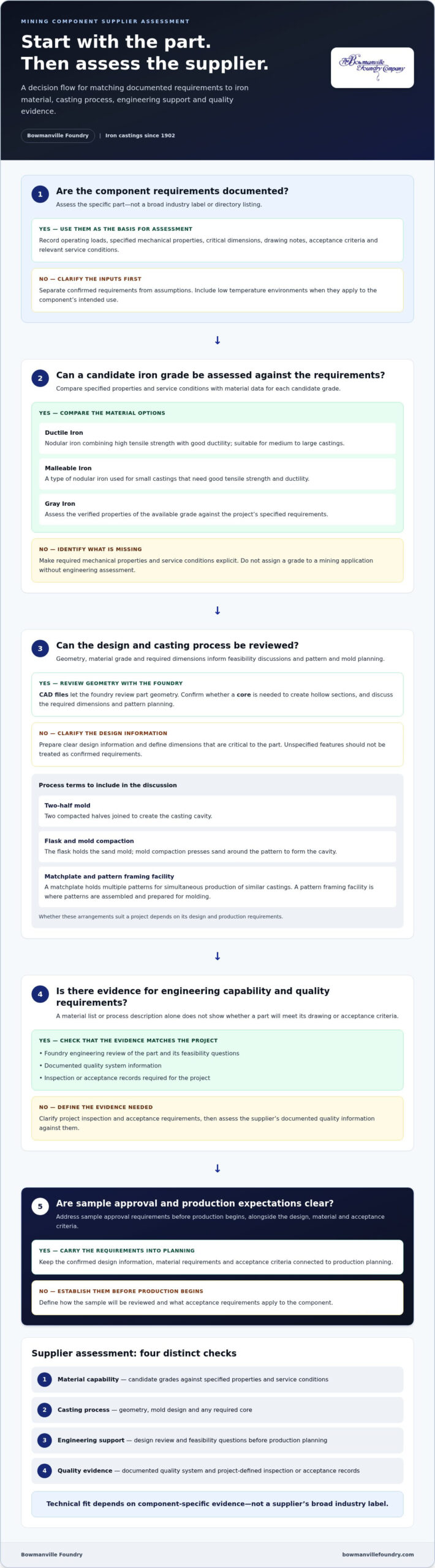
Keep the evaluation focused on four distinct areas:
- Material capability: Which iron grades can be assessed against the component’s specified mechanical properties and service conditions?
- Casting process: Can the proposed method produce the required geometry, including sections formed with a core where needed?
- Engineering support: Can foundry engineers review the design and identify feasibility questions before production planning?
- Quality evidence: Is the quality system documented, and are the inspection or acceptance records required for the project clearly defined?
These areas are related, but they answer different questions. An alloy name alone does not establish material suitability, and a process description does not show whether a part will meet its drawing or acceptance criteria. Start with the service conditions, then assess the material and manufacturing route against them.
Which component requirements should guide supplier assessment?
Begin with the component’s function and its interfaces with adjacent parts or equipment. Record operating loads, specified mechanical properties, critical dimensions, drawing notes and acceptance criteria. Include relevant service conditions, such as exposure to low temperature environments, when they apply to the component’s intended use. Do not assume a particular duty simply because the part is intended for mining equipment.
Clear inputs give a foundry engineer a basis for a technical assessment and help separate confirmed requirements from assumptions. A dimension with a stated tolerance, for example, is different from a feature that has not yet been defined on the drawing.
What does a supplier’s industry experience establish?
Stated experience provides context, but it does not prove that a supplier can produce a specific casting to its requirements. Look for a clear connection between the project’s drawings, material requirements and acceptance criteria and the supplier’s engineering and manufacturing capabilities. A technical assessment should address the part itself, rather than rely on the broad label “mining supplier.”
A general overview of metal casting processes can help clarify how molten metal, a prepared mold and part geometry relate. Use that background to frame project questions, not as evidence of a supplier’s capability. A directory can help identify suppliers, but technical fit depends on component-specific evidence.
How iron casting materials and processes affect mining component fit
Iron casting forms a component by pouring molten iron into a prepared mold and allowing it to solidify into the required shape. Material grade and mold design both affect whether the part can meet its drawing and service requirements. For a Canadian casting supplier for mining industry projects, material selection should follow the specified mechanical properties, component geometry and service conditions, not the intended industry alone.
How do Malleable Iron, Ductile Iron, and Gray Iron differ in selection?
Ductile Iron is a nodular iron that combines high tensile strength with good ductility, suitable for medium to large castings. Malleable Iron is a type of nodular iron used for small castings that need good tensile strength and ductility. Select Gray Iron based on the verified properties of the available grade and the project’s specified requirements. No grade should be assigned to a mining application without engineering assessment.
Compare the properties specified for the component with the material data for each candidate grade. If the drawing calls for a particular mechanical property, or the service conditions include low temperature environments, make that requirement explicit. A material name alone does not demonstrate that a casting will meet the project criteria.
Which casting-process details affect component feasibility?
CAD files let the foundry review part geometry when planning the pattern and mold. Geometry can affect how the mold is formed and whether a core, a hardened sand insert used to create hollow sections, is needed. These details inform feasibility discussions alongside material grade and required dimensions.
In a sand-casting setup, a two-half mold is formed by joining two compacted halves to create the casting cavity. A flask holds the sand mold, while mold compaction presses sand around the pattern to form that cavity. The pattern defines the casting’s shape, so part features and dimensional requirements are relevant to pattern planning.
For repeated production of similar castings, a matchplate holds multiple patterns for simultaneous production. A pattern framing facility is the workshop area where patterns are assembled and prepared for molding. Whether these arrangements suit a project depends on its design and production requirements. Address them during planning rather than assuming they follow from a supplier’s industry label.
A foundry engineer’s technical assessment can help resolve project-specific questions about the relationship between grade, geometry and production planning. Share the drawing, CAD files and material requirements so the discussion focuses on the part’s specifications. Buyers can discuss iron casting requirements with Bowmanville Foundry as they assess material and process fit.
How to compare Canadian casting suppliers beyond a directory listing
A directory can help identify foundries, but a listing or rank does not show whether a supplier can meet a component’s specifications. Compare documented capabilities with project requirements, and distinguish confirmed information from assumptions. Supplier fit is demonstrated by project-relevant capability and documented requirements.
Use the same comparison framework for each candidate. Record evidence, not impressions, in each category:
| Comparison area | Evidence to record |
|---|---|
| Material capability | Iron grades the supplier produces and material data relevant to the specified requirements. |
| Engineering input | How design details and production feasibility are reviewed through a technical assessment. |
| Quality system | Documented quality management system information and its relevance to the project’s acceptance criteria. |
| Post-processing | Finishing operations included in the project scope, such as machining, and any handoffs required. |
Mark each entry as documented, stated but not supported by project evidence, or still an assumption. This makes gaps visible. A stated material range, for example, is a capability claim; it does not show by itself that a particular grade meets the component specification.
What evidence helps assess quality and manufacturing capability?
Review the supplier’s quality management system alongside the component’s acceptance criteria. Confirm that the documentation relates to the project requirements rather than treating a general quality claim as proof that every part meets its specification. Include sample approval, the customer’s validation of a prototype casting before full production, in the project’s quality planning.
Bowmanville Foundry was the first foundry in Canada to achieve ISO certification, in 1996. When reviewing any certification information for procurement, check that it is current, accurately described and relevant to the project’s requirements.
How should buyers compare production and finishing scope?
Map the required work from casting through the finished component. Compare specified needs for machining, heat treating or coating with the scope described for each supplier. Distinguish work performed by the foundry from work assigned to post-processing suppliers, and record any handoffs that could affect drawing control, inspection records or delivery coordination.
One-stop-shopping means the foundry handles casting, post-processing and logistics for the customer. This approach can simplify coordination when those services align with the project scope, but it does not replace defining each operation and acceptance requirement. When assessing integrated iron casting and machining, compare the finishing scope with the component drawing and inspection needs. Judge a Canadian casting supplier for mining industry work by that evidence, not by directory visibility.
What to prepare before a mining casting technical assessment
A technical assessment is an evaluation of part-design feasibility by a foundry engineer. Useful feedback depends on clear, complete inputs. Before approaching a Canadian casting supplier for mining industry components, organize the information so the discussion can move from the part’s purpose to its design and production requirements.
- Define the component. Describe its function, where it fits in the assembly and how it connects to adjacent parts. Note which features are essential to fit or operation.
- Share design information. Provide available CAD files and drawings, including critical dimensions, tolerances, interfaces and drawing revisions. Identify details that are preliminary or still under design.
- Identify requirements. Document specified loads, service conditions, material requirements and acceptance criteria. Include requirements for low temperature environments or other conditions that affect material selection.
- Review feasibility. Use the assessment to discuss geometry, material, pattern planning and finishing scope. Establish whether a prototype and sample approval stage are part of the project plan before finalizing production requirements.
Which design and performance inputs should buyers assemble?
Gather the latest drawing and CAD files, dimensional requirements, component interfaces and relevant assembly information. Pair these with specified operating loads and service conditions rather than relying on a general description of the equipment. Include the required iron grade or material properties if already defined, along with inspection and acceptance criteria. If sample approval is planned, identify who will review the sample and what requirements it must meet.
Keep document revisions consistent. If a drawing and CAD file show different geometry, flag the discrepancy instead of leaving the foundry to infer which version governs. Clear inputs focus the assessment on the actual part design.
How does a technical assessment support the next decision?
The assessment gives the foundry engineer a structured basis to review whether the part design can be produced to the stated requirements. It can identify questions about geometry, material selection, pattern design or finishing needs that should be resolved before the project advances. It does not replace complete specifications; it helps identify where more definition or discussion is needed.
Use the findings to decide what information or design changes are needed next. Guidance on optimizing custom iron casting production can help connect design choices with production planning while keeping the component’s requirements at the centre of the discussion.
For project-specific technical support, Discuss your casting requirements with our team.
How Bowmanville Foundry can support a Canadian mining casting project
Bowmanville Foundry produces Malleable Iron, Ductile Iron and Gray Iron castings for industrial projects. For buyers assessing a Canadian casting supplier for mining industry components, these material options provide a basis for a project-specific technical assessment. Drawings, specified properties and service conditions guide the discussion; the intended industry alone does not establish material suitability.
The foundry operates a 38,000-square-foot plant and produces three grades of Gray Iron and five grades of Austempered Ductile Iron. A technical or sales engineer can review project information and discuss how the component’s geometry, material requirements and production needs relate to casting feasibility.
Which Bowmanville Foundry capabilities may fit the project scope?
Start with the requirements for the finished component. Bowmanville Foundry’s Malleable Iron, Ductile Iron and Gray Iron castings can be assessed against its drawing and service conditions. The range of Gray Iron and Austempered Ductile Iron grades gives buyers options to discuss with an engineer. Selection remains dependent on the part’s specifications.
Bowmanville Foundry also offers post-processing services when a casting needs further operations. Include specified machining or other finishing requirements in the project scope so the discussion accounts for the finished component. A guide to choosing an iron casting grade can help organize material questions for the technical review.
What are the next steps for a Canadian buyer?
Share current drawings or CAD files, material specifications, critical dimensions and acceptance criteria. Include known service conditions and identify unresolved design questions. These inputs help the technical or sales engineer focus on the component and its production requirements, including any planned sample approval stage.
Typical lead times are four to eight weeks, depending on current business conditions. Tooling can be produced in two to four weeks. These timelines can inform project planning, while actual scheduling depends on current business conditions and project requirements.
Use the free Casting Buyer’s Guide as an early-stage reference while assembling project information. To discuss drawings, material requirements or production planning, contact Bowmanville Foundry or arrange a visit with a technical or sales engineer.
Turn project requirements into a clear next step
A supplier decision is more useful when the people responsible for design, procurement and component acceptance share the same project requirements. Before moving toward a production commitment, align the current drawing revision, required material properties and acceptance criteria. Record unresolved items for review so assumptions do not become part of the specification by default.
This gives the supplier discussion a practical focus: which details are established, which need engineering input and what must be resolved before the next project stage. Keep the assessment tied to the component and its documented requirements rather than relying on general industry experience or directory visibility.
A Canadian casting supplier for mining industry projects should be part of a technical conversation grounded in the part’s design and intended service conditions. Use that conversation to clarify open questions and determine a suitable path for project planning.
Discuss your mining casting requirements with Bowmanville Foundry to take the next step with a clear basis for technical decision-making.
Frequently Asked Questions
Can iron castings be suitable for mining equipment?
Yes, iron castings can be suitable when the selected material and design meet the component’s documented requirements. A part with mounting interfaces, for example, may need those dimensions and tolerances specified alongside its loads and service conditions. The mining application label alone does not establish material suitability. Provide the drawing and acceptance requirements so the proposed grade and manufacturing plan can be assessed against the component.
How do I choose a Canadian casting supplier for a mining project?
Compare suppliers using a project-specific record of material capability, engineering support, quality information and production scope. Assess a Canadian casting supplier for mining industry projects against evidence relevant to your component, not directory rank or a broad industry label. Keep a list of documented capabilities, assumptions and outstanding questions for each candidate. This helps align technical and procurement reviews before requirements are finalized.
What is Austempered Ductile Iron used for?
Austempered Ductile Iron is Ductile Iron that has undergone an austempering heat-treatment process. Its suitability depends on the properties required by the component, its design and its service conditions. Compare grade information with the project specification rather than assuming the material fits based on its name. If the specification is still being developed, identify the required properties and discuss them with a foundry engineer.
Can a foundry machine iron castings after production?
Yes, machining can form part of post-processing when the component drawing calls for it. Mark machined surfaces and controlled dimensions on the drawing, and distinguish them from features that remain as cast. This helps define the finished-part requirements and inspection basis. If the component requires other finishing operations, include them in the project scope so they can be considered during production planning.
What does sample approval mean in iron casting?
For a useful approval stage, define the review criteria before assessing the sample. Identify the governing drawing revision, the dimensions or features requiring review, and who can record acceptance or request changes. Document feedback against those criteria to prevent subjective comments from becoming production instructions. The project team can then keep design revisions and approval records aligned as requirements are resolved.
How can a foundry help assess a casting design?
A foundry engineer can identify design details that need clarification before production planning advances. Provide the current drawing, related CAD files, interface information and notes on features that remain provisional. If a dimension differs between two design documents, for example, flag the discrepancy rather than leaving it open to interpretation. This gives the engineering discussion a clear reference and helps track outstanding design decisions.
