
A directory listing can tell you which materials a foundry produces, but not whether its capabilities match your component’s requirements. Choosing a Canadian foundry for industrial components means comparing the part’s service conditions, geometry, material requirements, and finishing needs with the foundry’s documented production scope and technical support.
Before committing a design or production schedule, define the requirements that will guide the decision. This guide explains how to compare material range, casting capabilities, quality practices, and post-processing support, and what information to prepare for a technical assessment.
Bowmanville Foundry has produced small and medium-sized Ductile, Gray, and Malleable Iron castings since 1902. It was the first foundry in Canada to achieve ISO certification, in 1996. The sections ahead explain how these iron families serve different component needs, what to include in a technical assessment, and how to plan for finishing after casting.
Key Takeaways
- Assess a Canadian foundry for industrial components by matching its documented capabilities to your part’s service conditions, geometry, and finishing requirements.
- Understand how CAD files, patterns, a two‑half mold, and a core help translate component geometry into a casting.
- Compare material range, casting scope, technical resources, quality practices, and post-processing support.
- Prepare drawings, critical dimensions, material requirements, and operating conditions for a focused technical assessment.
- Compare your project needs with Bowmanville Foundry’s small and medium-sized Ductile, Gray, and Malleable Iron casting capabilities.
What to assess when sourcing a Canadian foundry for industrial components
A supplier listing may identify materials or industries served, but it cannot establish whether a foundry suits a particular component. Start with the part’s function, operating environment, geometry, and required finished condition. Those details let procurement and engineering teams compare a foundry’s stated production scope and technical support against the actual job.
Requirements vary across Pumps and Valves, Railroad, Agriculture, Hardware, and Electrical applications. A component exposed to repeated loading, contact with moving parts, or low temperature environments may have different material and design requirements from one used in less demanding conditions. Describe the operating environment and the consequences of failure so the foundry can assess the application, not just the part name.
Which project requirements should be defined first?
Before requesting a technical assessment, gather the information engineering has already established. A clear project brief helps surface questions early and makes design discussions more productive.
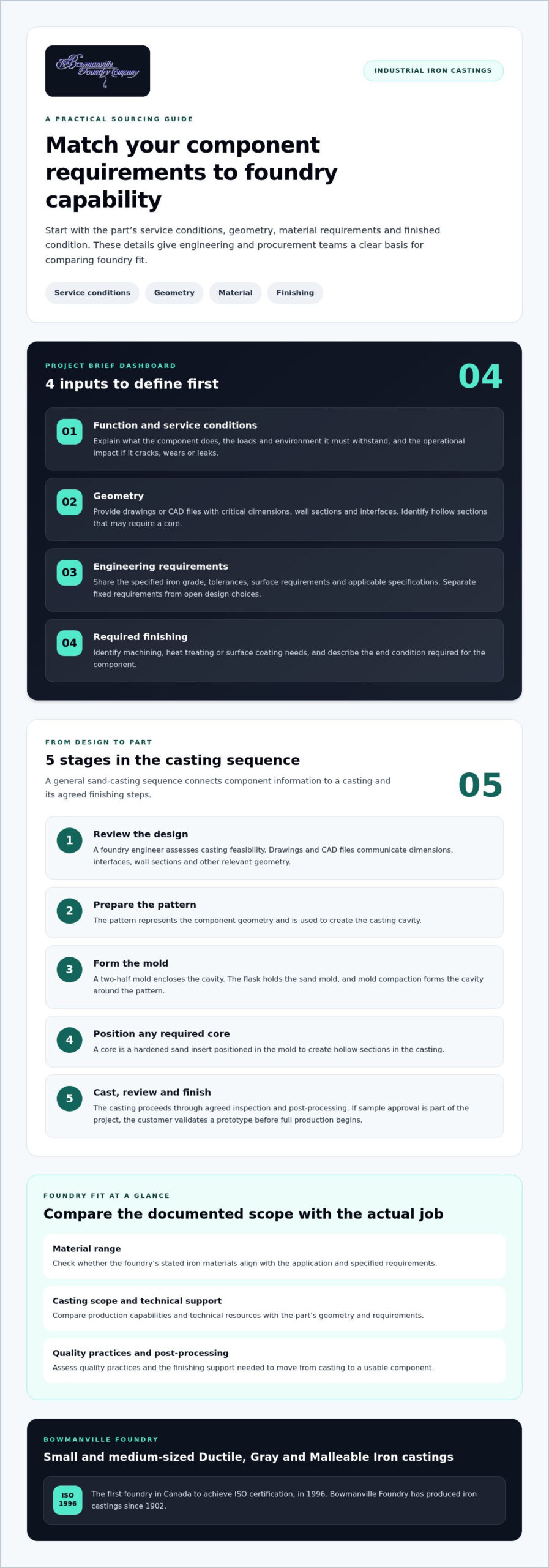
- Function and service conditions: Explain what the component does, how it operates, and the loads or environment it must withstand. Describe the operational impact if it cracks, wears, leaks, or otherwise fails.
- Geometry: Provide drawings or CAD files showing critical dimensions, wall sections, and interfaces. Identify hollow sections that may require a core and features that could affect how the casting is formed.
- Engineering requirements: Share the specified iron grade, tolerances, surface requirements, and applicable specifications. Separate fixed requirements from design choices that remain open to review.
- Required finishing: Identify any machining, heat treating, or surface coating needed to meet the component’s intended fit and finish. Describe the required end condition so finishing can be considered alongside the casting.
This information also provides context for discussing the metal casting process, from forming a mould around the intended geometry to producing a casting for subsequent finishing.
What does foundry fit mean for an industrial buyer?
Foundry fit means the material range, casting scope, production capabilities, and support align with the part’s documented requirements. A general material category is only a starting point: buyers also need relevant technical information and a clear way to discuss design and application needs. Bowmanville Foundry produces small and medium-sized Ductile, Gray, and Malleable Iron castings, which buyers can compare with their component and production requirements.
Technical support is especially useful early in design, when a technical assessment can clarify whether the part’s geometry and requirements suit casting. For an ideal iron casting grade, consider the material-selection guide alongside the service conditions. Grade selection should follow the specified application requirements, not a generic preference. Also assess how quality practices and post-processing services fit the project, including any finishing coordination needed to move from casting to a usable component.
How custom iron casting turns component requirements into production
Custom casting translates a component’s geometry and material requirements into a mold and then into an iron part. Understanding the sequence helps buyers connect drawings, patterns, and design decisions to production. The steps below describe a general casting process; specific methods depend on the part and the foundry.
- Review the design. A foundry engineer carries out a technical assessment of the part’s casting feasibility. Drawings and CAD files communicate dimensions, interfaces, wall sections, and other geometry that may affect the mold.
- Prepare the pattern. A pattern is the form used to create the casting cavity. Its shape represents the component geometry, and the approved design guides how the cavity is formed. Clear drawings help keep the pattern aligned with the intended part.
- Form the mold. In a common sand-casting arrangement, the pattern forms a cavity in a two‑half mold. The flask is the metal frame that holds the sand mold. During mold compaction, sand in the flask is squeezed to take the shape of the pattern and form the casting cavity.
- Position any core required by the design. A core is a hardened sand insert used to create hollow sections in a casting. It is positioned within the mold according to the component geometry, forming a hollow feature as part of the casting.
- Cast, review, and finish the part. The mold is used to form the iron casting, which can then proceed through the agreed inspection and post-processing steps. If sample approval is part of the project, the customer validates a prototype casting before full production begins.
How do patterns and molds shape a casting?
The pattern establishes the shape of the cavity, and the two‑half mold encloses that cavity for casting. The flask supports the sand mold, while mold compaction forms the cavity around the pattern. If the design includes hollow sections, a core occupies the space that must remain open in the finished part. Together, these elements connect the drawing to the physical casting.
Where does technical assessment fit in the process?
A technical assessment is a foundry engineer’s evaluation of a part design’s feasibility. Drawings and CAD files allow the engineer to review geometry and discuss manufacturing requirements before production decisions are finalized. Sample approval gives the customer a defined review point before full production. Record the review criteria and any revisions so the approved sample and production documentation refer to the same design.
Bowmanville Foundry produces small and medium-sized Ductile, Gray, and Malleable Iron castings. For buyers planning custom iron casting production, sharing current drawings and CAD files can focus the technical discussion on geometry and project requirements.
How to compare iron foundry capabilities for your component
Compare foundries against the same project criteria, rather than relying on directory categories. Assess whether the material range and production scope fit your part, then review the technical resources, quality practices, and finishing support available. Specific documents and clear explanations are more useful than general claims of capability.
Use these criteria to structure your comparison:
- Material range: Look for named iron families and relevant technical data or application guidance. This helps you relate material options to the component’s service requirements.
- Casting scope: Review the stated part sizes and production work the foundry handles, then compare that scope with your component.
- Technical resources: Look for application information and support for design review or technical assessment. These resources can inform early discussions about material and geometry.
- Quality: Review certification details, quality practices, and how quality is managed. These provide a basis for understanding the foundry’s approach.
- Post-processing: Review the finishing services offered and how they relate to the casting. This helps clarify how the part can reach its required finished condition.
Which material and application evidence should buyers review?
Confirm whether the foundry produces Ductile, Gray, and Malleable Iron castings, then compare its technical data with your application requirements. Material names alone do not establish suitability. Review the engineering basis for the grade against specified service conditions instead of assuming that a material commonly used in an application will meet every component’s needs. Application guidance for gray iron casting applications and a material-selection guide can inform grade discussions.
How can buyers evaluate quality and production scope?
Look for specific information about certification, quality practices, and the types and sizes of castings produced. Bowmanville Foundry was the first foundry in Canada to achieve ISO certification, in 1996. Its custom quality system delivers low casting return rates. The clean, modern 38,000-square-foot facility provides further context for its production operations. Consider these details alongside your project requirements.
Bowmanville Foundry produces small and medium-sized Ductile, Gray, and Malleable Iron castings and offers post-processing services. Compare these capabilities with your component’s requirements, then note any technical questions to address. This keeps the comparison focused on project-specific evidence rather than general supplier claims.
What information to prepare for a foundry technical assessment
A well-organized project brief helps a foundry engineer understand what the component must do and what the design requires. For a Canadian foundry for industrial components, drawings, service conditions, material requirements, and finishing needs provide a practical starting point. Gather them in a consistent sequence, and mark which requirements are fixed and which may be reviewed.
What should a casting project brief contain?
Start with the component’s function and operating environment. Describe what it connects to or supports, the conditions it will encounter, and the consequences of failure. Include the expected quantity or production context, such as whether the project is for a new part or ongoing production.
- Share design files. Attach available CAD files and current drawings. Identify critical dimensions, interfaces, and tolerance requirements, and state which drawing revision governs the assessment.
- State material requirements. Include the specified iron grade and any applicable engineering or customer specifications. If material selection is still under review, identify the service requirements guiding the decision.
- Describe the required finish. Note surface-condition expectations and any required machining, heat treating, or coating. Identify the surfaces or features that need post-processing so they can be considered alongside the casting design.
- Flag open questions. Separate confirmed requirements from items needing discussion, such as a design feature that may affect machining or an unclear specification.
For projects requiring machining after casting, consider the relationship between iron casting and machining during planning. Finishing requirements can affect how the part is specified and reviewed.
How can post-processing requirements be coordinated?
Machining, heat treating, and surface coating may be part of a component’s overall project scope. State which operations are required, which surfaces or dimensions they affect, and the condition the part must meet after finishing. This clarifies how casting and post-processing relate without assuming every operation applies to every component.
Bowmanville Foundry offers post-processing services. Define the requested end condition in the project brief, whether finishing is coordinated as part of the casting project or specified as a separate requirement.
Technical resources, including application information and material guidance, can inform early design and grade discussions. Once your drawings, requirements, and questions are assembled, discuss your project with a technical or sales engineer to assess the component and plan next steps.
Why consider Bowmanville Foundry for Canadian industrial components?
Choosing a foundry means matching material and production scope to the component’s requirements, then assessing how technical resources and finishing support fit the project. Bowmanville Foundry has produced iron castings since 1902. Its product range includes small and medium-sized Ductile, Gray, and Malleable Iron castings, a defined scope buyers can compare with their part and production needs.
Typical lead times are four to eight weeks, depending on current business conditions. Tooling can be produced in two to four weeks. These are planning references, not guaranteed schedules; project details and current conditions inform production planning.
What technical resources support the sourcing decision?
Material evaluation is more useful when engineering requirements are considered alongside technical information. Bowmanville Foundry provides Iron Grades Technical Data and an Iron Grades Application Guide to support material and application discussions. Its free Casting Buyer’s Guide can also help organize questions about grade selection and project planning before a technical assessment.
The foundry operates a clean, modern facility measuring 38,000 square feet. Its custom quality system delivers low casting return rates. Buyers can consider these details alongside the foundry’s small and medium-sized casting scope when evaluating project fit.
What are the next steps for a potential project?
Prepare current drawings or CAD files, material requirements, service conditions, and finishing details, then submit the project through the quote request pathway. A clear brief gives a technical or sales engineer a practical basis for discussing the part’s design and production requirements. An engineer can also visit your facility to assess your needs.
A video tour offers another way to learn about the foundry and its facility. Whether you are at an early design stage or preparing a production project, a direct technical discussion can clarify the next steps. Buyers seeking a Canadian foundry for industrial components can discuss industrial casting requirements with Bowmanville Foundry, request a quote, or arrange a video tour.
Move your casting project toward a clear decision
Before advancing a sourcing decision, align engineering, procurement, and production teams on fixed requirements and questions that still need technical review. This keeps material selection, component geometry, and finishing expectations connected as the project moves from design discussion to supplier planning.
Bring the current drawing package into the discussion and identify unresolved points, such as a material choice or a feature that affects the finished part. A focused technical conversation can clarify what information your team needs to proceed. Record agreed assumptions and open questions so everyone has a shared reference as specifications develop.
When you are ready to discuss a component or request a project-specific review, discuss your industrial casting requirements with Bowmanville Foundry. Share your project brief to start a technical discussion about a casting solution suited to your application.
Frequently Asked Questions
Can a Canadian foundry supply industrial customers in the United States?
Yes. Bowmanville Foundry serves industrial customers in Canada and the United States. For a U.S. project, prepare the same core technical package as for a domestic sourcing decision: part drawings, material requirements, production context, and finishing expectations. A complete brief helps engineering and procurement teams discuss component fit, production planning, and the information needed to move the project forward.
What does ISO certification tell a buyer about a foundry?
ISO certification indicates that a foundry’s quality management system has been assessed against the requirements of the applicable standard. It provides evidence of formal quality processes, but does not certify that every individual casting will be free of defects or confirm that a supplier suits every component. Evaluate certification alongside production scope, technical communication, and the requirements of your part.
What is sample approval in iron casting?
Sample approval is the customer’s review and validation of a prototype casting before full production begins. It gives engineering and procurement teams an opportunity to compare the sample with the drawing and agreed requirements, including fit at interfaces and features that affect assembly. Record revisions or acceptance criteria clearly so the approved sample and production documentation refer to the same design.
How do CAD files support a custom casting project?
CAD files provide digital geometry that can communicate features not easily understood from a part name or brief description. For example, a model can clarify the relationship between mounting faces, openings, and adjoining sections. Share the current revision and identify critical dimensions or features that need attention. This keeps design discussions tied to the intended component geometry.
What is a core used for in an iron casting?
A core forms a hollow section or internal passage that the external mould surface alone cannot create. For example, a component with an internal opening may need a core positioned within the mould cavity. Identify these internal features on the drawing or CAD model, and distinguish them from openings that the mould itself can form. Clear geometry helps the foundry assess the design.
Can a foundry provide machining or other post-processing for castings?
Yes. Bowmanville Foundry offers post-processing services for castings. Depending on the part’s requirements, finishing may include machining, heat treating, or surface coating. Specify the finished condition you need, including the surfaces or dimensions that are critical after processing. This lets the project team consider finishing alongside casting requirements and coordinate the part’s intended use with its final condition.
