
Selecting the right iron alloy is only half the battle when designing components for Canada’s unforgiving industrial environments. Without a high-quality corrosion resistant coating for iron castings, even the most robust metallurgical design will eventually succumb to oxidation. You likely recognize the significant financial burden that comes with premature component failure and the constant maintenance required to manage surface degradation. It’s a common challenge for procurement professionals who must balance long-term performance with strict industrial safety regulations.
This guide provides the technical clarity you need to protect your malleable, ductile, and gray iron components from harsh environmental factors. We’ll help you understand the complexities of various industrial treatments and surface finishes while ensuring your parts meet rigorous ASTM standards. We’ll examine the specific benefits of different barrier applications and explain how a dedicated foundry partner can integrate these processes to deliver ready-to-use, durable components.
Key Takeaways
- Learn how the unique graphite structures of gray and ductile iron influence oxidation patterns and dictate your material protection strategy.
- Discover how to select the optimal corrosion resistant coating for iron castings by matching specific barrier properties with your industrial service environment.
- Evaluate the performance of metallic treatments like hot-dip galvanizing to ensure compliance with ASTM standards and long-term durability in harsh climates.
- Understand the strategic trade-offs between internal alloying and post-process surface treatments to balance initial procurement costs with total lifecycle value.
- Identify the benefits of coordinating casting and finishing with a single foundry partner to streamline your supply chain and ensure component readiness.
Understanding the Mechanisms of Corrosion in Iron Castings
Iron corrosion isn’t just a surface stain; it’s a complex electrochemical reaction where the metal gives up electrons to oxygen in the presence of an electrolyte like water. This fundamental understanding of the Mechanisms of Corrosion is vital for engineers and procurement professionals who manage heavy equipment. Without a high-performance corrosion resistant coating for iron castings, the base metal inevitably returns to its natural, stable state as iron oxide. This process is particularly aggressive in ferrous alloys because the rust layer is porous and non-adherent, allowing moisture to reach the fresh metal beneath.
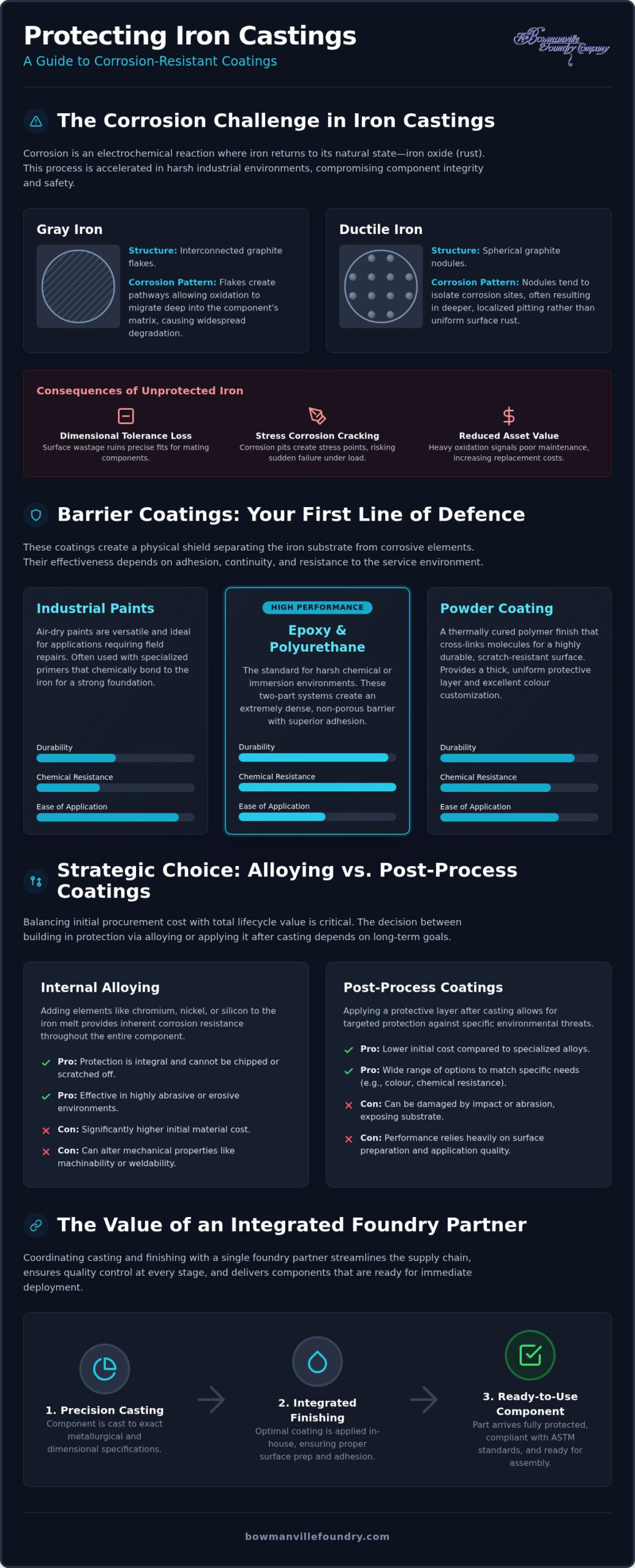
Internal metallurgy significantly influences how this degradation manifests. In gray iron, the interconnected graphite flakes can create pathways that allow oxidation to migrate deeper into the component’s matrix. Conversely, the spherical graphite nodules in ductile iron tend to isolate the corrosion sites, though this can sometimes result in deeper, localized pitting rather than uniform surface rust. The “as-cast” surface texture also dictates the initial oxidation rate. Rougher surfaces, typical of sand casting, provide numerous microscopic valleys where moisture and contaminants can settle, creating ideal conditions for early-stage rust development.
Why Industrial Environments Accelerate Component Degradation
Industrial settings often introduce aggressive electrolytes that transform a slow chemical reaction into a rapid galvanic process. Humidity, salt spray, and exposure to industrial chemicals are primary catalysts. In the Canadian climate, seasonal temperature shifts and road salts create a particularly hostile environment for iron components. These fluctuations cause the metal to expand and contract, which can compromise the bond of inferior surface treatments. When moisture is trapped against the metal surface, the resulting ion exchange leads to rapid material depletion that can compromise the entire assembly.
The Structural Consequences of Unprotected Iron
Failing to specify a corrosion resistant coating for iron castings leads to consequences that extend far beyond aesthetics. As the iron converts to rust, it loses the mechanical properties that were the basis of its selection. This degradation impacts both safety and the bottom line for Canadian operations.
- Dimensional Tolerance Loss: Even minor surface wastage can ruin the precise tolerances required for mated components or moving parts.
- Stress Corrosion Cracking: In high-load applications, corrosion pits act as stress concentrators, which may lead to sudden failure under mechanical load.
- Reduced Asset Value: Heavy oxidation often signals a lack of maintenance, reducing the resale value of equipment and increasing the frequency of costly part replacements.
Barrier Coatings: Paints, Epoxies, and Powder Finishes
Barrier coatings act as a physical shield, separating the ferrous substrate from the corrosive elements discussed in the previous section. Unlike sacrificial methods, these organic finishes rely on a continuous, non-porous film to prevent electrolytes from reaching the metal. Selecting a corrosion resistant coating for iron castings often starts with industrial-grade primers. These primers aren’t merely a base layer; they are engineered to form a tenacious chemical bond with the iron, providing the essential foundation for subsequent topcoats. Many industrial primers also contain specialized pigments that inhibit oxidation even if the primary barrier is slightly compromised.
The choice between air-dry paints and baked-on polymer finishes depends largely on the service environment and production volume. Air-dry paints are often selected for their ease of field repair and lower initial equipment costs. In contrast, baked-on polymer finishes, such as powder coating, involve a thermal curing process that cross-links the coating molecules. This results in a significantly more durable surface that resists scratching and chipping during transport and assembly. Powder coating is especially valued for exposed hardware because it allows for precise colour customization while maintaining a thick, uniform protective layer. Technical insights on the Corrosion of Cast Irons emphasize that the effectiveness of these barriers is directly tied to their permeability and adhesion strength.
High-Performance Epoxy and Polyurethane Systems
Epoxy coatings are the standard for components facing harsh chemical processing or immersion. They provide exceptional resistance to fuels, oils, and industrial solvents, making them ideal for internal machinery parts. However, epoxies can chalk or degrade when exposed to consistent sunlight. For outdoor agricultural or construction equipment, a polyurethane topcoat is typically applied over the epoxy to provide essential UV stability. High-performance epoxy systems can withstand over 1,000 hours of salt spray testing without significant film failure or loss of adhesion.
The Critical Importance of Surface Preparation
A barrier is only as good as its bond. Applying a corrosion resistant coating for iron castings without rigorous surface preparation is a recipe for premature failure. Shot peening or sandblasting is necessary to remove foundry scale and oils while creating a specific surface profile that allows the coating to “anchor” into the metal. This mechanical tooth prevents “under-film” corrosion creep, where rust spreads beneath the coating from a single point of damage. Proper cleaning ensures that contaminants don’t interfere with the chemical bonding process. If you’re looking for components that arrive ready for assembly, choosing a partner that provides integrated post-processing services ensures these critical preparation steps are never overlooked.
- Mechanical Cleaning: Shot peening removes tenacious foundry scale that can flake off.
- Degreasing: Solvent or alkaline washes eliminate residual oils from the machining process.
- Profile Creation: Abrasive blasting creates the required surface area for polymer adhesion.
Metallic and Chemical Conversion Treatments
Metallic treatments offer a fundamentally different approach than the barrier coatings previously discussed. While paints and epoxies isolate the metal, metallic coatings often provide sacrificial protection. This means the coating material, typically zinc, oxidizes in place of the underlying iron. For components requiring maximum outdoor longevity, hot-dip galvanizing according to ASTM A153 is the industry standard. This process involves immersing the iron casting into molten zinc, creating a series of zinc-iron alloy layers that are metallurgically bonded to the surface. It’s a rugged solution that withstands physical abrasion and decades of environmental exposure in the Canadian climate. Utilizing this type of corrosion resistant coating for iron castings ensures that even if the surface is gouged, the surrounding zinc continues to protect the iron substrate.
When dimensional tolerances are too tight for the thick layer of galvanizing, electroplating provides a viable alternative. Electroplating deposits a much thinner metallic layer, often zinc or nickel, through an electrochemical bath. This allows for precise control over coating thickness, ensuring that machined threads and tight-fitting assemblies remain functional after treatment. Additionally, phosphate conversion coatings transform the iron surface into a layer of insoluble crystalline phosphates. This isn’t just a corrosion resistant coating for iron castings on its own; it’s a critical preparation step that significantly enhances the adhesion and performance of subsequent organic topcoats by creating a porous surface that “locks” the paint in place.
Zinc-Rich Primers and Cold Galvanizing
In scenarios where hot-dip tanks aren’t practical due to part size or logistical constraints, zinc-rich primers serve as an effective alternative. Often called cold galvanizing, these liquids contain a high percentage of zinc dust in a binder. They provide cathodic protection, which is a significant advantage. If the coating is scratched, the surrounding zinc will still protect the exposed iron from rusting. This method is particularly useful for complex casting geometries where uniform immersion in a molten bath might be difficult or lead to trapped air pockets.
Black Oxide and Phosphating for Internal Components
Not every component requires the heavy-duty protection of galvanizing. For internal parts or indoor machinery, black oxide and phosphating offer a more measured approach. These chemical conversion treatments provide mild corrosion resistance without altering the part’s dimensional accuracy. This is essential for threaded components where even a few microns of buildup can cause assembly issues.
- Black Oxide: Provides a sleek, non-reflective finish with basic protection when paired with a post-treatment oil-dip.
- Manganese Phosphating: Often used on gears and bearings to improve wear resistance and provide a reservoir for rust-inhibiting lubricants.
- Oil-Dip Finishes: Act as a secondary barrier that fills the microscopic pores of the conversion coating for essential temporary rust prevention.
Alloying vs. Post-Process Coatings: A Strategic Comparison
Protecting iron from environmental degradation doesn’t always happen on the surface. Alloying elements like Nickel, Chromium, and Copper can be integrated during the melting process to enhance the base metal’s inherent resistance. Nickel improves the matrix’s toughness and resistance to alkaline solutions, while Chromium helps form a stable oxide layer that resists further oxidation. Copper additions are also used to improve resistance to atmospheric corrosion by promoting a denser, more protective rust layer. For specialized chemical applications, high-silicon irons offer extreme acid resistance that surface treatments alone cannot match. However, from a cost-analysis perspective, using a standard iron grade paired with a robust corrosion resistant coating for iron castings is often more economical than producing a high-alloy specialty part. This is particularly true for large production runs where the premium on raw materials would significantly outweigh the cost of secondary finishing.
Malleable iron offers a distinct advantage when considering secondary finishes. The specific annealing process used to produce malleable iron often results in a surface layer that is low in free graphite. This decarburized “skin” facilitates a superior mechanical bond with various coatings compared to the graphite-rich surface of gray iron. Because the surface is more uniform, chemical conversion layers and primers can realize a more tenacious grip on the substrate. This synergy between the material’s metallurgy and the corrosion resistant coating for iron castings reduces the risk of delamination and extends the component’s functional life in the field.
Selecting the Right Iron Grade for Your Environment
Ductile iron castings are the preferred choice for high-stress applications where both structural integrity and corrosion resistance are paramount. Their ability to withstand mechanical shock makes them ideal for heavy machinery that operates in abrasive or corrosive environments. Gray iron castings remain a staple for municipal water infrastructure because they perform exceptionally well when buried or submerged. ASTM standards such as A536 for ductile iron and A47 for malleable iron define the specific chemical and mechanical requirements for these corrosion-resistant grades.
The Synergy of Material and Finish
The relationship between the iron substrate and its finish is critical for long-term performance. In the Canadian climate, matching thermal expansion coefficients between the iron and the coating is essential to prevent cracking during extreme temperature shifts. Heat treatments can also be used to organize the surface microstructure to improve coating uniformity. Before applying any surface finish, implementing proper stress relief for iron castings ensures that residual internal tensions from the casting process do not cause dimensional instability or compromise coating adhesion after treatment. Designers should always aim to avoid “liquid traps” or sharp internal corners where moisture can accumulate and initiate the oxidation process. If you’re ready to optimize your component design for maximum durability, you can contact our technical team to discuss your specific project requirements.
- Thermal Matching: Ensures the coating expands and contracts at a similar rate to the iron.
- Geometry Optimization: Incorporating fillets and radii to ensure even coating thickness.
- Surface Cleanliness: Utilizing annealing to burn off residual casting lubricants.
Selecting the Optimal Coating for Your Application
Industrial procurement requires a pragmatic approach to material protection. The choice of a corrosion resistant coating for iron castings must align with the specific chemical and physical stresses of the service environment. Marine applications, for instance, demand thick, multi-stage barrier systems that can withstand constant salt spray and high humidity. Components destined for underground burial, such as water infrastructure parts, typically utilize bituminous coatings or specialized thick-film epoxies to resist soil-borne electrolytes. For industrial machinery, the priority shifts toward a balance of abrasion resistance and chemical protection. This ensures the finish doesn’t chip away under mechanical load or during routine maintenance.
These protective standards are also vital for architectural ironwork and perimeter security; to see how custom-fabricated gates and fences utilize these durable finishes, visit Apex Gateworks Inc.
Budgeting for surface treatments shouldn’t focus solely on the initial application cost. A lower-cost primer might save money upfront but lead to premature failure and high maintenance costs over the component’s lifecycle. Total lifecycle value is realized when the coating matches the expected service life of the iron grade itself. Compliance with international standards, such as those set by ASTM and ISO, provides a reliable framework for this selection. These specifications ensure that the finishing process meets verifiable durability and safety benchmarks, reducing the risk of unexpected field failures in critical infrastructure.
While protecting individual components is essential for industrial longevity, the same logic applies to the buildings that house them; for those seeking durable structural solutions, Bradberry Steel provides pre-engineered steel systems designed for resilient performance.
Environmental Selection Framework
Selecting the right protection involves a systematic evaluation of the exposure risk. Each environment presents unique challenges that dictate the necessary chemistry of the finish. Using the wrong system can lead to delamination or rapid oxidation, regardless of the quality of the underlying iron.
- Marine environments: These require high-build epoxy or polyurethane systems to combat salt-induced galvanic reactions.
- Underground burial: Components should utilize bituminous coatings or specialized epoxy resins designed for soil immersion.
- Industrial machinery: Prioritize powder coatings or baked polymers that offer high impact and abrasion resistance.
Streamlining Production with Integrated Finishing
Sourcing ready-to-use components from a single partner simplifies the supply chain and enhances overall quality. Bowmanville Foundry manages post-processing services as an integrated part of the manufacturing flow. This approach reduces lead times by eliminating the need to transport raw castings to a separate finishing house. It also ensures that quality control remains consistent from the initial pour through to the final corrosion resistant coating for iron castings. When the foundry understands the intended final finish, they can adjust the casting process to optimize surface chemistry for better adhesion. To make more informed decisions about your next project, Download our Free Casting Buyer’s Guide to optimize your material selection.
Optimizing Component Longevity Through Strategic Finishing
Effective material protection requires more than just an afterthought; it’s a calculated decision involving metallurgy, surface preparation, and specific environmental stressors. We’ve explored how matching the right corrosion resistant coating for iron castings to your application can significantly reduce maintenance costs and prevent premature structural failure. Whether your project requires the rugged protection of hot-dip galvanizing or the chemical resistance of advanced epoxy systems, the goal is to achieve a durable finish that complies with industry standards.
Bowmanville Foundry brings over 120 years of Canadian manufacturing expertise to every project. Since 1902, we’ve provided a steady hand in the production of high-quality malleable, ductile, and gray iron components. Our facility offers comprehensive post-processing services, including precision machining and heat treating, ensuring your parts arrive ready for immediate use. We provide the technical data and application guides necessary to make certain your material selection is optimized for its service environment.
When you’re ready to secure the long-term reliability of your iron components, Request a Quote for Custom Coated Iron Castings. We look forward to helping you build more resilient industrial solutions.
Frequently Asked Questions
What is the most durable corrosion resistant coating for iron castings?
Hot-dip galvanizing according to ASTM A153 is typically the most durable option for outdoor industrial applications. It creates a metallurgical bond that provides both a physical barrier and sacrificial protection. For environments involving constant chemical immersion or extreme acidic conditions, thick-film epoxy systems or specialized polymer linings are often preferred. The choice depends on balancing the specific environmental triggers against the required service life of the component.
Can ductile iron be galvanized without affecting its mechanical properties?
Ductile iron can be successfully galvanized without compromising its mechanical properties. The standard zinc bath temperature, which remains near 450°C, is well below the critical transformation temperatures of the iron matrix. However, it’s essential to monitor the silicon and phosphorus content of the alloy to prevent excessive coating thickness or brittleness. Proper metallurgical control ensures the casting retains its specified tensile strength and ductility after the thermal immersion process.
How long do powder-coated iron castings last in outdoor environments?
Industrial-grade powder coatings generally last between 10 and 20 years in outdoor environments, depending on the exposure level. In the Canadian climate, the use of UV-stable polyester topcoats is vital to prevent surface chalking from sun exposure. The longevity of the finish is directly linked to the quality of the initial abrasive blasting and the application of a high-performance zinc-rich primer to prevent under-film corrosion from spreading.
What is the difference between a barrier coating and sacrificial protection?
A barrier coating physically isolates the iron surface from moisture and oxygen using materials like paint or epoxy. If the barrier is breached, the underlying iron begins to oxidize immediately. Sacrificial protection, such as zinc galvanizing, utilizes a more reactive metal that oxidizes in place of the iron. This cathodic protection ensures that even if the surface is scratched or damaged, the surrounding zinc continues to protect the exposed iron substrate.
Is it better to use a corrosion-resistant alloy or a secondary coating?
For most applications, a standard iron grade paired with a secondary corrosion resistant coating for iron castings is the most economical choice. While specialized alloys like high-silicon or nickel-rich irons provide inherent resistance to extreme acids, their material costs are significantly higher. Coatings offer a versatile and cost-effective way to achieve high durability without the premium price of complex metallurgical alloying, especially for large production runs or municipal infrastructure.
What ASTM standards govern the coating of iron castings in Canada?
Several ASTM standards are utilized in Canada to ensure coating quality and durability. ASTM A153 is the benchmark for hot-dip galvanizing on iron hardware, while ASTM A123 covers larger structural castings. For organic finishes, ASTM D3359 is frequently employed to verify adhesion strength. These standards provide a reliable framework for procurement professionals to ensure that their components meet the necessary safety and performance requirements for rigorous industrial use.
How does surface preparation affect the lifespan of an industrial coating?
Surface preparation determines the vast majority of a coating’s ultimate lifespan. Abrasive blasting removes foundry scale and residual oils while creating a microscopic surface profile that allows the coating to anchor into the metal. Without this mechanical tooth, even a high-quality corrosion resistant coating for iron castings will lose adhesion and delaminate. Proper cleaning prevents contaminants from being trapped beneath the film, which stops premature rust creep and localized failure.
Does Bowmanville Foundry provide machined and coated ready-to-use parts?
Bowmanville Foundry provides fully integrated post-processing services to deliver machined and coated components that are ready for immediate assembly. Our capabilities include precision machining, heat treating, and coordinating specialized surface finishes through our established network of partners. By managing the entire process from the initial pour to the final treatment, we maintain strict quality control and reduce lead times, providing a reliable single-source solution for your custom iron requirements.
