
What if the precision you achieve on the shop floor is destined to vanish the moment a component enters service? For many industrial engineers, the frustration of a part warping after hours of secondary machining is a costly reality. This instability often stems from residual internal tensions created during the cooling phase of the foundry process. Implementing a rigorous protocol for stress relief for iron castings is not merely an optional finishing step; it’s a technical necessity for any component where dimensional tolerances are non-negotiable.
You’ll learn the exact thermal processes required to ensure your custom iron components maintain their integrity and longevity. This guide provides a detailed technical overview of subcritical temperature ranges required by current industry standards, such as ASTM A278, alongside optimal holding times based on section thickness. We also clarify the critical cooling rates needed to prevent new stresses from forming, providing a clear path from initial casting to a dimensionally stable, finished product.
Key Takeaways
- Identify how non-uniform cooling in the mould creates internal tensions that lead to warping and spontaneous cracking during service.
- Master the technical parameters of thermal stress relief for iron castings to maintain precise dimensional stability during secondary machining.
- Determine whether your component requires subcritical stress relief or full annealing based on your specific grade of iron and mechanical performance goals.
- Establish a controlled thermal cycle, including precise heating rates and “soak” durations, to achieve thermal equilibrium without risking thermal shock.
- Learn how consolidating casting and heat treatment at a single Canadian facility reduces scrap rates and ensures consistent component longevity.
Understanding Residual Stress in Iron Castings
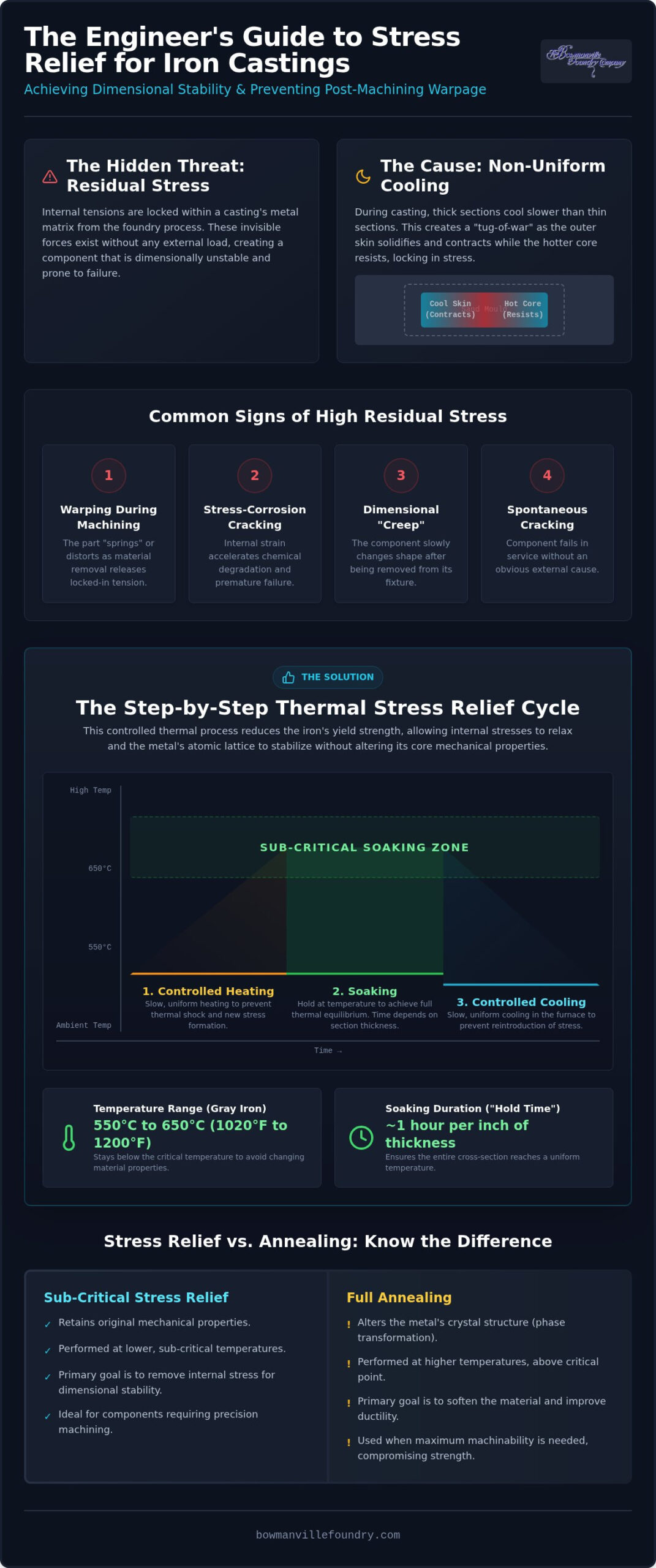
Residual stress represents a state of internal tension locked within the metal matrix of a component. These hidden forces exist without any external load. They’re a byproduct of the casting process itself. When molten iron is poured into a mould, it doesn’t cool at a perfectly uniform rate. This discrepancy creates a tug-of-war between different regions of the casting. If these forces aren’t addressed through professional stress relief for iron castings, the component remains in a precarious state. It might appear sound upon extraction, but the internal lattice is under immense strain. This strain remains dormant until a trigger, like machining or thermal cycling, forces the metal to find a new, often distorted, equilibrium.
The Mechanics of Casting Cooling
The cooling phase is where most residual stress originates. In a sand mould, heat dissipation is rarely symmetrical. Thick sections retain heat significantly longer than thin ribs or flanges. As the outer skin solidifies and begins to contract, it’s physically restrained by the hotter, more plastic core. Thermal contraction is the physical reduction in volume as iron transitions from a liquid state to a solid crystalline structure. Because the sand mould and the faster-cooling sections resist this movement, the metal is stretched beyond its natural equilibrium. The Science of Thermal Stress Relief is grounded in understanding how these cooling gradients dictate the final stability of the part. Complex geometries with sharp transitions between wall thicknesses are particularly susceptible to these forces because the cooling rate varies so drastically across the part.
Signs of High Residual Stress
Identifying these invisible forces before they cause a field failure is critical for quality control. High residual stress often reveals itself during secondary operations or early in the component’s lifecycle. Common indicators include:
- Unexpected warping or “springing” during the first machining pass as material removal releases internal tension.
- Stress-corrosion cracking where the internal strain accelerates chemical degradation in industrial environments.
- Dimensional changes or “creep” that occur after the part is removed from its machining fixture.
- Spontaneous cracking in high-stress industrial environments without an obvious external cause.
Ignoring these signs leads to inconsistent mechanical performance across a production run. A part that meets specifications on Monday might be out of tolerance by Friday simply because the internal stresses haven’t been neutralized. This lack of stability increases scrap rates and compromises the longevity of the final assembly. Proactive thermal processing is the only reliable way to ensure the metal matrix is relaxed and ready for precision work.
The Science of Thermal Stress Relief
Thermal stress relief works by utilizing the inverse relationship between temperature and a material’s yield strength. At ambient temperatures, the yield strength of the iron is high enough to contain residual stresses without immediate deformation. As the component is heated in a controlled furnace, its yield strength begins to decline. Once this strength drops below the level of the internal residual stresses, the metal undergoes minute plastic deformation. This process allows atoms to rearrange themselves from high-energy, strained positions into a more stable lattice configuration. Professional stress relief for iron castings ensures this relaxation happens uniformly, preventing the metal from finding its own equilibrium through warping or cracking later in the production cycle.
Achieving this relaxation requires a delicate balance. The process must be performed at sub-critical temperatures, meaning the heat remains below the point where the metal’s crystal structure changes. If the temperature rises too high, the iron undergoes a phase transformation that can significantly alter its mechanical properties. For projects requiring high-precision tolerances, consulting with a technical partner about post-processing services can prevent costly errors during machining by ensuring the thermal cycle is tuned to the specific iron grade.
Temperature Thresholds for Iron Grades
The industry-accepted temperature range for gray iron castings typically sits between 550°C and 650°C (1020°F to 1200°F). Staying within this sub-critical window is vital to avoid altering the pearlite-ferrite balance of the material. Ductile and malleable iron grades may require adjusted ranges to preserve their specific ductility and tensile requirements. Exceeding these thresholds often softens the iron too much, which improves machinability but compromises the component’s ability to withstand operational loads in high-stress industrial environments.
Soak Times and Uniformity
A successful thermal cycle depends on the “soak” period, where the casting is held at a constant temperature to achieve total thermal equilibrium. Industry standards generally calculate this duration based on the casting’s thickness. A common baseline is one hour of soak time for every 25mm of section thickness, with a minimum hold of two hours regardless of size. This ensures the core of a thick section reaches the same temperature as the surface. Consistency in the furnace atmosphere is equally important to prevent oxidation. Once the soak is complete, the cooling rate must be strictly managed. A furnace cool to 260°C is standard for most parts, though complex geometries may require a slower descent to 95°C to avoid re-introducing thermal stresses through rapid contraction.
Stress Relief vs. Annealing: Which Does Your Casting Need?
Choosing between these two thermal processes depends entirely on the intended service environment and the required mechanical properties of the finished component. While both involve heat, their objectives are distinct. Stress relief for iron castings is a subcritical treatment designed to neutralize internal tensions without significantly lowering the material’s hardness or tensile strength. In contrast, full annealing involves heating the metal above its critical transformation temperature to soften the matrix, refine the grain structure, and maximize ductility. It’s essentially a metallurgical “reset” that’s often used when a part is too hard to machine or requires high impact resistance.
For malleable iron components, annealing isn’t just an option; it’s a fundamental requirement of the manufacturing process to transform brittle white iron into a tough, workable material. Ductile iron may also undergo annealing to increase ferrite content, which improves elongation at the expense of some yield strength. However, if you’re working with high-precision gray iron, stress relief is usually the superior choice. It provides the necessary dimensional stability for tight-tolerance work without the higher energy costs and longer furnace times associated with supercritical annealing cycles.
Criteria for Process Selection
The decision-making framework typically balances desired final hardness against dimensional stability requirements. If a component must withstand heavy wear, you can’t afford the softening that comes with annealing. You also need to consider the role of previous work-hardening; if heavy rough-machining has already taken place, the resulting surface stresses can be neutralized through a subcritical stress relief cycle. Engineering teams often refer to a Casting Buyer’s Guide to align their material selection with these post-processing requirements, ensuring the chosen iron grade and heat treatment work in tandem rather than in opposition.
Impact on Machinability
The impact of proper thermal selection on secondary operations is profound. A stress-relieved casting exhibits consistent behaviour during milling and turning because the metal matrix isn’t fighting against itself. This stability prevents tool chatter and deflection, which are common when hidden internal stresses cause the metal to “push back” against the cutting head. By ensuring the part remains stationary at a microscopic level, you achieve a superior surface finish in critical bores and eliminate the risk of “spring-back” after the component is removed from its machining fixture. This consistency is what ultimately reduces scrap rates and ensures every part in a production run performs to the same standard.
How to Perform Stress Relief: A Step-by-Step Thermal Cycle
Executing a successful thermal cycle is a precision operation that requires meticulous control over temperature gradients and time. It isn’t enough to simply reach a target temperature; the path taken to get there, and the method of return to ambient conditions, determines the final stability of the metal. If the cycle is rushed, the resulting thermal shock can cause immediate cracking or introduce new, uneven stresses. A standardized approach to stress relief for iron castings ensures that the internal lattice is relaxed uniformly, providing a reliable foundation for subsequent precision machining.
Phase 1: Controlled Ramp-Up
The initial heating phase must be gradual to prevent the exterior of the casting from expanding significantly faster than the core. For heavy section castings, industry standards often dictate a maximum heating rate of 50°C to 100°C per hour. This slow progression ensures that the entire mass of the component moves toward the target temperature in a synchronized manner. Effective furnace management also requires adequate air circulation to prevent “hot spots” that could cause localized distortion. For a 50kg ductile iron casting with varying wall thicknesses, an ideal heating rate often remains below 80°C per hour to maintain thermal symmetry across the component’s geometry. Managing these variables is a core part of the integrated post-processing services offered at modern Canadian foundries.
Phase 2: The Soak and Cooling
Once the casting reaches the subcritical range of 550°C to 650°C, it enters the “soak” period. During this time, the furnace temperature must be held constant until the entire component reaches thermal equilibrium. Verification of internal temperature, often through the use of thermocouples placed in the furnace load, is essential to ensure the core has reached the necessary threshold for atomic rearrangement. As established in the 2024 updates to ASTM A278, the soak time should be at least one hour per 25mm of section thickness, with a minimum hold of two hours for all parts.
The cooling phase is perhaps the most critical step in preventing the re-introduction of stress. The transition from the soaking temperature must be handled via furnace cooling, where the heat is reduced at a controlled rate while the parts remain inside. For most standard geometries, it’s safe to remove the castings from the furnace once they reach 260°C for final cooling in still air. However, for highly complex or thin-walled components, a slower furnace cool to 95°C is required to prevent the rapid contraction that occurs when hot metal meets room-temperature air. This methodical descent ensures the dimensional integrity of the part remains locked in before it ever reaches the machining centre.
Optimizing Performance with Bowmanville Foundry Post-Processing
Consolidating the manufacturing process within a single facility eliminates the technical disconnect often found between foundries and third-party heat treatment providers. Since 1902, Bowmanville Foundry has provided custom engineered iron components to Canadian industrial sectors, refining our post-processing capabilities to meet the most rigorous tolerances. By maintaining internal control over the entire cycle, from the initial pour to the final thermal soak, we ensure that every stage of stress relief for iron castings is executed with metallurgical precision. This integrated approach doesn’t just improve quality; it provides a transparent chain of custody for technical data that engineers rely on when specifying finishing services for high-stakes applications.
Our commitment to technical mastery is rooted in a “no-nonsense” partnership with our clients. We understand that in heavy manufacturing, consistency is the foundation of safety and performance. By providing extensive documentation and adhering to established industry standards, we act as a steady hand that guides procurement professionals through the complexities of material science. This transparency ensures that the final component isn’t just a piece of iron, but a precisely engineered asset ready for the demands of the field.
Ready-to-Use Iron Components
Receiving components that are both machined and stress-relieved directly from our facility significantly reduces logistics complexity within the Canadian supply chain. Instead of managing multiple vendors and the risks associated with transporting heavy castings between sites, our clients receive ready-to-use parts that have already cleared strict quality control benchmarks. Procurement professionals looking to eliminate quality disputes between separate casting and machining vendors can benefit from exploring turnkey iron casting services in Canada that consolidate every production step under a single roof. We verify that every batch meets the necessary ASTM standards, such as ASTM A278/A278M, ensuring that the dimensional stability discussed in previous sections is a physical reality rather than a theoretical goal. This streamlined workflow minimizes the risk of handling-related damage and ensures that the material properties remain consistent from the furnace to the assembly line.
Consulting with Our Metallurgists
Our role extends beyond simple production; we act as technical mentors to help you optimize the performance of your custom iron components. Reviewing casting designs for thermal stability early in the engineering phase often reveals opportunities to minimize residual stress through geometry adjustments rather than relying solely on thermal cycles. We customize heat treatment protocols for unique applications, adjusting ramp rates and soak times based on the specific chemistry of your gray, ductile, or malleable iron. This level of technical oversight ensures that your components perform reliably in high-stress industrial environments. If you’re ready to improve the longevity of your parts and reduce scrap rates during secondary machining, Request a Quote for Your Next Casting Project to speak with our engineering team.
Securing Long-Term Component Integrity
Achieving dimensional stability in custom iron components is a matter of metallurgical discipline. By neutralizing internal tensions through a controlled thermal cycle, you eliminate the risk of warping during precision machining and prevent spontaneous cracking in the field. This guide has detailed the subcritical thresholds and cooling rates required to maintain material properties while ensuring the metal matrix is fully relaxed. Implementing professional stress relief for iron castings isn’t just about meeting an ASTM standard; it’s about protecting your production schedule and significantly reducing scrap rates across your entire run.
Bowmanville Foundry has been a dependable technical partner to Canadian industry since 1902. We specialize in malleable, ductile, and gray iron, offering full-service post-processing and machining from a single facility to simplify your supply chain. We invite you to Download our Free Casting Buyer’s Guide to select the right iron grade and understand how our expertise can support your engineering goals. Our team is ready to act as your knowledgeable guide through every technical hurdle to ensure your next project’s success.
Frequently Asked Questions
How much does thermal stress relief typically cost for iron castings?
Costs depend on furnace volume, batch weight, and the duration of the thermal cycle. Since the process is energy-intensive, requiring 13 to 15 million Btu per ton of saleable iron, fuel surcharges may apply. Most Canadian foundries quote based on the total weight of the load and the specific temperature requirements. Consolidating this step with the initial casting process often reduces overall logistics expenses compared to using a third-party heat treater.
Does stress relief change the hardness of gray or ductile iron?
No, subcritical stress relief does not significantly alter the hardness or tensile strength of the iron. Because the process is performed between 550°C and 650°C, it remains below the critical transformation temperature where phase changes occur. This allows the internal lattice to relax without softening the pearlite-ferrite balance. If you require a softer material for high-speed machining, a full annealing process would be necessary instead.
Can I skip stress relief if my casting has a simple geometry?
You can skip the process for simple shapes where dimensional tolerances are generous. However, even simple geometries experience non-uniform cooling in the sand mould, which creates residual tension. If the component requires precision bores or tight flat tolerances, skipping the treatment often leads to warping once the outer skin is machined away. It’s best to evaluate the risk of dimensional “creep” before bypassing this technical safeguard.
What is the difference between natural aging and thermal stress relief?
Natural aging involves storing castings outdoors for several months to allow seasonal temperature fluctuations to relax the metal matrix. While this legacy method was common in the early 20th century, it only removes about 10% to 15% of residual stresses. Modern thermal stress relief for iron castings is far more efficient, neutralizing approximately 90% of internal tensions in a single 24-hour cycle. It provides the certainty required for today’s fast-paced Canadian manufacturing timelines.
How long does a typical stress relief cycle take at the foundry?
A standard cycle usually takes between 18 and 36 hours from start to finish. This duration includes a gradual ramp-up to avoid thermal shock, a soak period of at least one hour per 25mm of thickness, and a strictly controlled furnace cool. The cooling phase is often the longest part of the process, as the temperature must drop slowly to 260°C or lower before the parts are safely removed from the furnace.
Will stress relief prevent my castings from rusting?
No, thermal stress relief does not provide corrosion resistance or prevent oxidation. In fact, the high temperatures in the furnace can sometimes create a light scale on the surface of the iron. If rust prevention is a requirement for your project, you’ll need to specify secondary finishing services such as painting, oiling, or plating after the thermal processing and machining steps are completed at the facility.
Is stress relief required for malleable iron after the annealing process?
Stress relief is typically not required for malleable iron because the initial annealing process already involves high temperatures and a very slow cooling cycle. This long thermal journey naturally relaxes the metal matrix as it transforms the white iron into its malleable state. However, if the component undergoes heavy secondary machining or welding after the initial anneal, a subcritical stress relief cycle might be necessary to restore dimensional stability.
Can stress relief fix a casting that has already warped?
No, thermal stress relief cannot reverse physical distortion that has already occurred. The process is a preventative measure designed to relax internal tensions before they cause movement. If a part has warped during machining, the metal has already found a new, distorted equilibrium. While you might be able to re-machine the part to the correct dimensions after stress relieving it, the original material lost to warping cannot be recovered.
