
With pig iron prices reaching as high as $500 per tonne in July 2026, the challenge of maintaining a predictable industrial budget has never been more demanding. Many procurement managers find that the initial quote for a project rarely reflects the final invoice, especially when hidden secondary operations and shifting trade tariffs enter the equation. Understanding the specific iron casting cost factors is the only way to move beyond guesswork and achieve true price stability in your production cycle.
It’s frustrating to watch project ROI dwindle due to long lead times or unexpected logistical surcharges. You likely realize that a lower sticker price on a raw casting often masks significant expenses in machining or heat treating. This guide provides a clear framework for estimating costs and optimizing your designs to lower per-unit expenses. We’ll explore how material choice, such as the cost-reduction potential of malleable iron, and the benefits of a domestic supply chain can help you regain control over your manufacturing expenses.
Key Takeaways
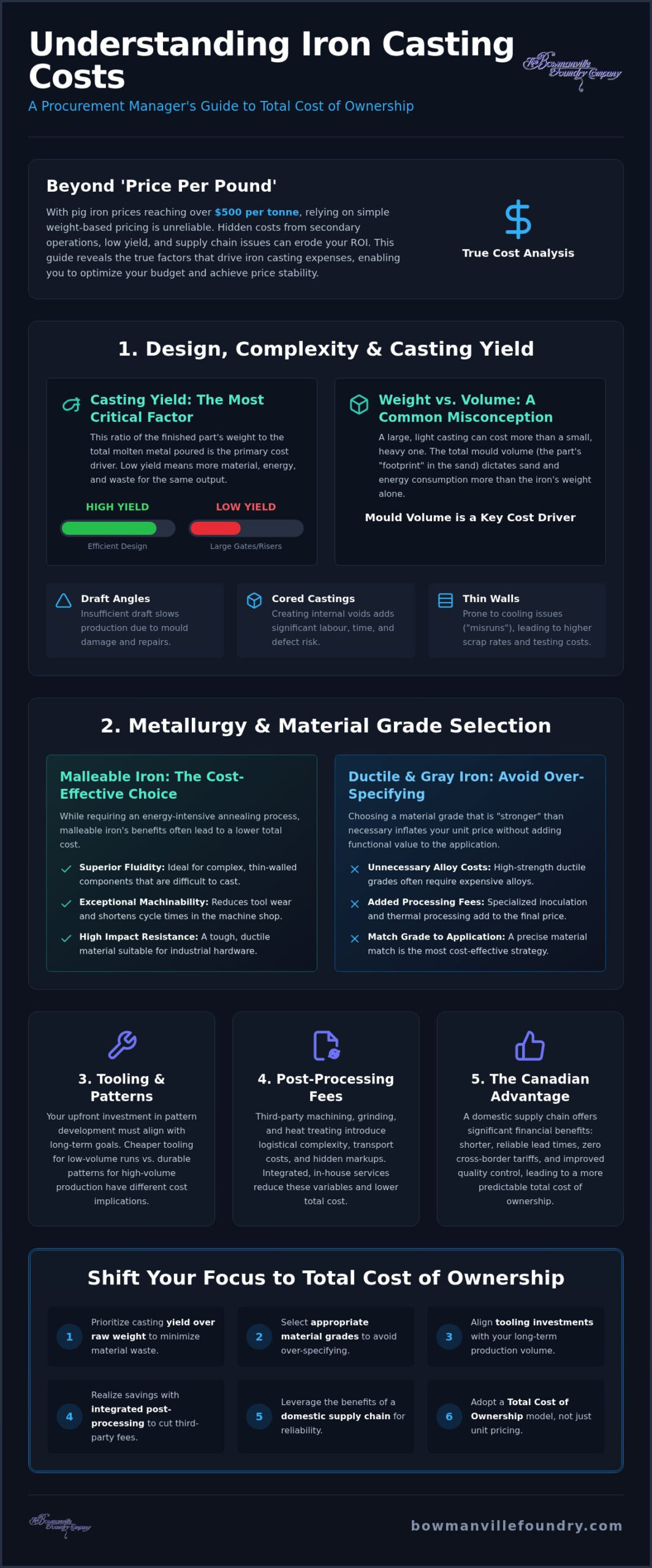
- Learn how prioritizing casting yield over raw weight allows you to minimize material waste and optimize your production budget.
- Understand the primary iron casting cost factors, including how material grades like malleable or ductile iron impact base melt prices and secondary energy requirements.
- Discover how to select the appropriate tooling and pattern materials to align your initial investment with long-term production volume goals.
- Realize the financial benefits of integrated post-processing by reducing the logistical complexity and hidden markups associated with third-party machining.
- Shift your focus from simple unit pricing to a total cost of ownership model that accounts for domestic lead times and reliable supply chain performance.
Fundamental Iron Casting Cost Drivers: Design and Complexity
Procurement professionals often rely on the “price per pound” metric, but this approach fails to capture the technical realities of modern foundry economics. The primary driver of expense isn’t just the mass of the metal, but the efficiency with which that metal is utilized. One of the most critical iron casting cost factors is the casting yield. This ratio represents the weight of the finished component compared to the total weight of the molten Cast iron poured into the mould. When a design requires large gating systems or risers to manage cooling, the yield drops. This forces the foundry to consume more energy and material to produce the same net output, directly impacting your bottom line.
Complexity also dictates the sand-to-metal ratio, which is a key indicator of production speed. Intricate parts often require cored castings to create internal voids or complex geometries. These sand cores must be manufactured separately, handled with precision, and eventually removed during the cleaning process. This adds significant labour hours and increases the risk of defects. Similarly, thin-walled designs are prone to “misruns” or rapid cooling issues. These parts often incur higher scrap rates and require more frequent non-destructive testing to ensure structural integrity. When yield is low, costs rise.
The Impact of Geometry on Moulding Costs
The physical shape of a part determines how quickly it can move through the production line. Draft angles are essential; they allow the pattern to be removed from the sand without damaging the mould. If draft is insufficient, production slows down due to frequent mould repairs. Parting line placement also plays a role in labour costs, as it dictates where “flash” or excess metal will form. Undercuts necessitate expensive core work because they prevent a clean vertical draw of the pattern from the sand.
Weight vs. Volume: A Strategic Comparison
It’s a common misconception that weight is the only indicator of price. A large, light casting can often cost more than a small, heavy one because it requires a larger flask. Large flasks consume more energy for handling and require a higher volume of sand to be processed and reclaimed for every tonne of iron poured. When evaluating your project, you must realize that the total volume of the mould often influences the iron casting cost factors more than the weight of the iron itself. Efficient designs minimize the “footprint” in the sand to maximize the number of parts per mould. This reduces the total energy required for every unit shipped.
Metallurgy and Material Grade Selection: Malleable vs. Ductile Iron
Selecting the right alloy is a technical decision that carries heavy financial weight. While the base price of iron is dictated by global commodity markets, the final cost of a specific grade is influenced by the precise chemistry and thermal processing it requires. One of the most overlooked iron casting cost factors is the energy consumption associated with post-casting heat treatments. For instance, malleable iron requires a multi-day annealing process to transform brittle white iron into a tough, ductile material. This energy-intensive step adds to the initial production cost but often pays for itself through improved mechanical reliability and superior castability in thin sections.
The North American casting industry has seen significant shifts in material preference as engineers seek to balance performance with process efficiency. Choosing a grade that is “stronger” than necessary can lead to unnecessary processing fees. High-strength ductile iron grades often require expensive alloys or specialized inoculation techniques to ensure the correct nodular structure. If your application doesn’t demand extreme tensile strength, over-specifying the material grade simply inflates the unit price without adding functional value.
Malleable Iron: The Cost-Effective Choice for Thin Sections
Malleable iron is a unique material that excels where other irons might fail, particularly in intricate industrial hardware. Its superior fluidity during the pour makes it ideal for complex, thin-walled components that require high impact resistance. While the annealing process takes time, the resulting microstructure offers exceptional machinability. This reduces tool wear and shortens cycle times in the machine shop. If you are designing small, complex parts, you might find that malleable iron castings provide a lower total cost than steel or high-alloy alternatives.
Gray and Ductile Iron: Performance vs. Price
Gray iron remains the most economical choice for many applications due to its simple chemistry and excellent vibration dampening. It doesn’t require the specialized nodularizers, such as magnesium or cerium, that are essential for ductile iron production. Ductile iron, however, provides a higher strength-to-weight ratio. The cost difference between these two often comes down to the specialized inoculation and the quality control required to verify the graphite shape. To optimize your budget, evaluate ASTM standards carefully to ensure the selected grade matches the actual stress requirements of the part; this prevents the hidden costs of over-engineering.
Upfront Investment: Pattern Development and Tooling
Pattern development represents the most significant upfront expenditure in any new industrial project. Unlike raw material prices that fluctuate with the market, tooling is a fixed investment that dictates the long-term viability of your production run. High-quality pattern engineering ensures that the final product adheres strictly to design specifications, which directly reduces the need for expensive secondary machining later in the cycle. When you invest in precision tooling at the outset, you are effectively pre-paying for a lower scrap rate and more consistent dimensional accuracy across thousands of cycles.
One of the most strategic iron casting cost factors involves the decision between single-cavity and multi-cavity moulds. While a multi-cavity pattern plate requires a higher initial investment, it significantly lowers the per-unit production fee by allowing the foundry to pour multiple parts in a single cycle. This approach maximizes the use of every “pour” and optimizes the labour costs associated with mould handling and cleaning. For high-volume components, the initial cost of complex tooling is quickly recovered through these operational efficiencies.
Pattern Material Selection and Durability
The choice of pattern material must align with your projected production volumes to avoid over-spending on temporary projects or under-investing in long-term programmes. Wood and plastic patterns are suitable for low-volume prototyping or short-run industrial hardware because they are relatively inexpensive to produce and modify. However, for high-speed automated lines, aluminium or steel tooling is necessary to withstand the abrasive nature of the sand-moulding process. Constant friction from the sand causes pattern wear, which gradually alters dimensional tolerances and can lead to part rejection if the tooling is not replaced or refurbished.
Amortizing Tooling Costs Over Production Runs
To realize the true value of your investment, you must calculate the “break-even” point where the higher cost of metal tooling is offset by lower per-piece prices. This analysis should include the efficiency of gating and riser designs, which are critical for maximizing casting yield and reducing waste. Precision patterns also require professional maintenance and secure storage to ensure they remain viable for repeat orders over several years. Foundries that provide integrated storage and maintenance help protect your capital investment from environmental degradation or physical damage between production runs, ensuring that your tooling is ready for use the moment a new order is placed.
Post-Processing and Secondary Operation Fees
The journey from molten metal to a finished industrial component doesn’t end when the iron solidifies in the mould. For many procurement professionals, post-processing and secondary operation fees are the most variable iron casting cost factors, often accounting for a significant portion of the final invoice. Sourcing “Ready-to-Use” components from a single supplier eliminates the logistical friction and hidden markups associated with transporting heavy castings between multiple facilities. When a foundry manages the entire lifecycle, from the initial pour to the final surface coating, the risk of dimensional errors or material handling damage is greatly reduced.
Machining tolerances are a primary driver of these secondary costs. While a standard industrial casting might meet general requirements, high-precision applications necessitate additional machining passes to achieve tight tolerances. This requirement often dictates the initial casting process; for example, a part requiring extensive machining might be designed with specific “finish allowances” to ensure there is enough material to reach the final dimensions without uncovering internal porosity. Surface finishing requirements, such as painting, plating, or galvanizing, also add layers of protection and cost, depending on the environmental exposure the part will face in the field.
Integrated Machining and Finishing
Reducing logistical costs by performing machining at the foundry centre is a pragmatic way to protect your project budget. One technical challenge that often inflates machining labour is the presence of “hard spots” or iron carbides, which can occur if the cooling rate isn’t perfectly controlled. These spots cause rapid tool wear and increase cycle times. By utilizing integrated Post-Processing Services, you ensure that the machining team and the metallurgical team are in constant communication, allowing for immediate process adjustments if material consistency issues arise.
Heat Treatment and Performance Enhancement
Heat treatment is essential for achieving specific hardness levels or providing necessary stress relief in complex geometries. Processes like normalizing, annealing, and quenching require significant energy, which is a major component of the total production expense. While the annealing of malleable iron is a fundamental part of its production, other grades might require specialized cycles to enhance impact resistance or wear properties. To guarantee that these treatments have been successful, foundries use non-destructive testing and metallurgical verification. This ensures the component meets all safety and performance standards before it ever leaves the facility.
If you are looking to streamline your supply chain and reduce the complexity of your next project, consider the advantages of working with a partner that offers a full suite of Post-Processing Services to deliver finished, high-performance components.
The Canadian Advantage: Logistics, Quality, and Total Cost
Procurement professionals often find that the lowest unit price is a deceptive metric in heavy manufacturing. True efficiency is measured by the Total Cost of Ownership (TCO), which accounts for every expense from the initial design phase to final assembly. When evaluating iron casting cost factors, domestic sourcing in Canada offers a level of price stability that offshore markets cannot match. By eliminating international freight volatility and the 25% tariffs currently applied to many imported derivative products as of late 2025, manufacturers can maintain tighter control over their production budgets. These hidden overseas costs often transform a perceived bargain into a financial liability by the time the parts reach your facility.
Operating within a domestic supply chain also removes the risks associated with currency exchange fluctuations. When you realize that a sudden shift in the value of the Canadian dollar can erase the perceived savings of a foreign contract, the value of a local partner becomes clear. Additionally, Canadian foundries must adhere to stringent industrial safety and environmental standards. For instance, Ontario’s updated technical standards for foundries, which came into effect on March 31, 2026, ensure that your components are produced with modern air pollution controls. This compliance reduces your long-term regulatory risk and aligns your brand with sustainable manufacturing practices.
Reducing Lead Times and Supply Chain Risk
Domestic sourcing is a strategic hedge against the stockouts and project delays that plague international logistics. When a foundry is located within the same region, lead times are measured in weeks rather than months. This proximity allows for on-site consultations and immediate technical support, which are invaluable during the prototyping phase. Manufacturers can also take advantage of the 50% freight rate discount on interprovincial steel and iron shipments that began in Spring 2026. You can learn more about Managing Iron Casting Lead Times for Major Projects to see how a reliable local partner keeps your assembly lines moving without the need for excessive inventory carrying costs.
Quality Assurance and Casting Reliability
The “Cost of Failure” in high-stress industrial applications often far exceeds the initial purchase price of the part. A single defective casting can lead to catastrophic equipment downtime, expensive recalls, or safety incidents. Bowmanville Foundry’s legacy, which dates back to 1902, provides a level of institutional knowledge that minimizes these risks. This century of expertise ensures that the team understands the intricate iron casting cost factors that influence the performance of your components. To help you make the most informed decision for your next project, Download Your Free Casting Buyer’s Guide to master iron grade selection and optimize your total production expenses.
Securing Long-Term Value in Your Casting Procurement
Achieving budget stability in industrial manufacturing requires more than just monitoring metal prices. It demands a strategic understanding of how design yield, material metallurgy, and logistical proximity interact to form the final invoice. By prioritizing high-performance malleable and ductile iron and utilizing integrated post-processing, you can eliminate the hidden markups and quality risks that often derail complex projects.
Optimizing the various iron casting cost factors requires a holistic view of the production cycle, from the initial pattern engineering to the final surface treatment. As a trusted Canadian manufacturer since 1902, we specialize in helping partners navigate these technical landscapes with precision and transparency. Our comprehensive in-house post-processing services ensure that your components arrive ready for assembly, reducing your total cost of ownership and strengthening your domestic supply chain.
Ready to optimize your next production run? Request an Accurate Iron Casting Quote for Your Next Project today. We look forward to helping you achieve technical mastery and financial certainty in your manufacturing operations.
Frequently Asked Questions
How does the quantity of castings ordered affect the unit cost?
Unit costs decrease as order volumes increase because fixed expenses, such as pattern setup and machine preparation, are spread across a larger number of parts. For high-volume runs, automated moulding lines produce hundreds of moulds per hour, which significantly lowers the labour cost per piece compared to manual or low-volume processes. High-volume orders also allow the foundry to optimize material usage and furnace efficiency, leading to more competitive pricing.
What is the difference between rough casting cost and finished component cost?
Rough casting cost refers to the price of the part as it exits the sand mould after basic cleaning and gate removal. Finished component cost includes all necessary secondary operations, such as precision machining, heat treating, and surface coating. These post-processing steps are vital iron casting cost factors that can sometimes double the initial rough price, depending on the complexity of the required tolerances and mechanical properties.
Why is ductile iron often more expensive to produce than gray iron?
Ductile iron requires the addition of specialized alloys, such as magnesium or cerium, and more rigorous metallurgical controls during the melting process to achieve its nodular graphite structure. These additives and the extra processing time increase the base melt price. Gray iron has a simpler chemistry and excellent castability, making it the more economical choice for industrial applications where high tensile strength and ductility are not the primary requirements.
Can design changes really reduce my iron casting quote?
Strategic design modifications can significantly lower your production expenses by improving casting yield and reducing the need for complex sand cores. For example, increasing draft angles or simplifying geometry to allow for a natural parting line reduces the labour required for mould preparation and cleaning. Small adjustments to wall thickness can also prevent high scrap rates, which is one of the most impactful iron casting cost factors in a project quote.
What are the typical lead times for custom iron castings in Canada?
Typical lead times for custom iron castings in Canada generally range from six to twelve weeks, depending on the complexity of the component and whether new tooling must be engineered. Domestic sourcing provides a substantial advantage over offshore alternatives, which often face transit times of several months and unpredictable delays at international ports. Staying within a Canadian supply chain ensures more reliable delivery schedules and lower inventory carrying costs.
How do raw material surcharges work in the foundry industry?
Surcharges are variable fees added to the base price to account for market fluctuations in the cost of pig iron, scrap steel, and energy. Foundries typically use transparent industry indexes to adjust these charges on a monthly or quarterly basis. This mechanism protects both the foundry and the client from the extreme price volatility often seen in global commodity markets, ensuring that the base contract remains fair and sustainable.
Is it cheaper to machine castings at the foundry or at a separate shop?
It’s generally more cost-effective to machine castings at the foundry to eliminate the logistical expenses and markups associated with shipping heavy parts to a separate facility. Integrated machining also ensures a single point of accountability for the final dimensions. If a subsurface defect is uncovered during machining, the foundry can immediately adjust the casting process, whereas a separate machine shop would still charge for the wasted labour on a rejected part.
How do I know which iron grade is the most cost-effective for my part?
The most cost-effective grade is the one that matches the material’s mechanical properties to the specific stresses of your application without over-specifying. Malleable iron is often the superior choice for small, thin-walled parts requiring high impact resistance, while gray iron is ideal for vibration dampening in heavy frames. Consulting with metallurgical experts during the design phase ensures you don’t pay for premium alloys or heat treatments that your application doesn’t technically require.
