
Choosing the strongest material for a project seems straightforward, but the most rigid iron grade is often the first to fail when Canadian winter temperatures plummet and shock loads increase. You likely recognize that structural integrity isn’t just about tensile strength. It’s about how a component behaves under real-world stress and relentless corrosive exposure. Selecting the right iron casting for construction hardware requires a balance between mechanical properties and the ability to cast complex, thin-walled geometries that off-the-shelf parts simply cannot match.
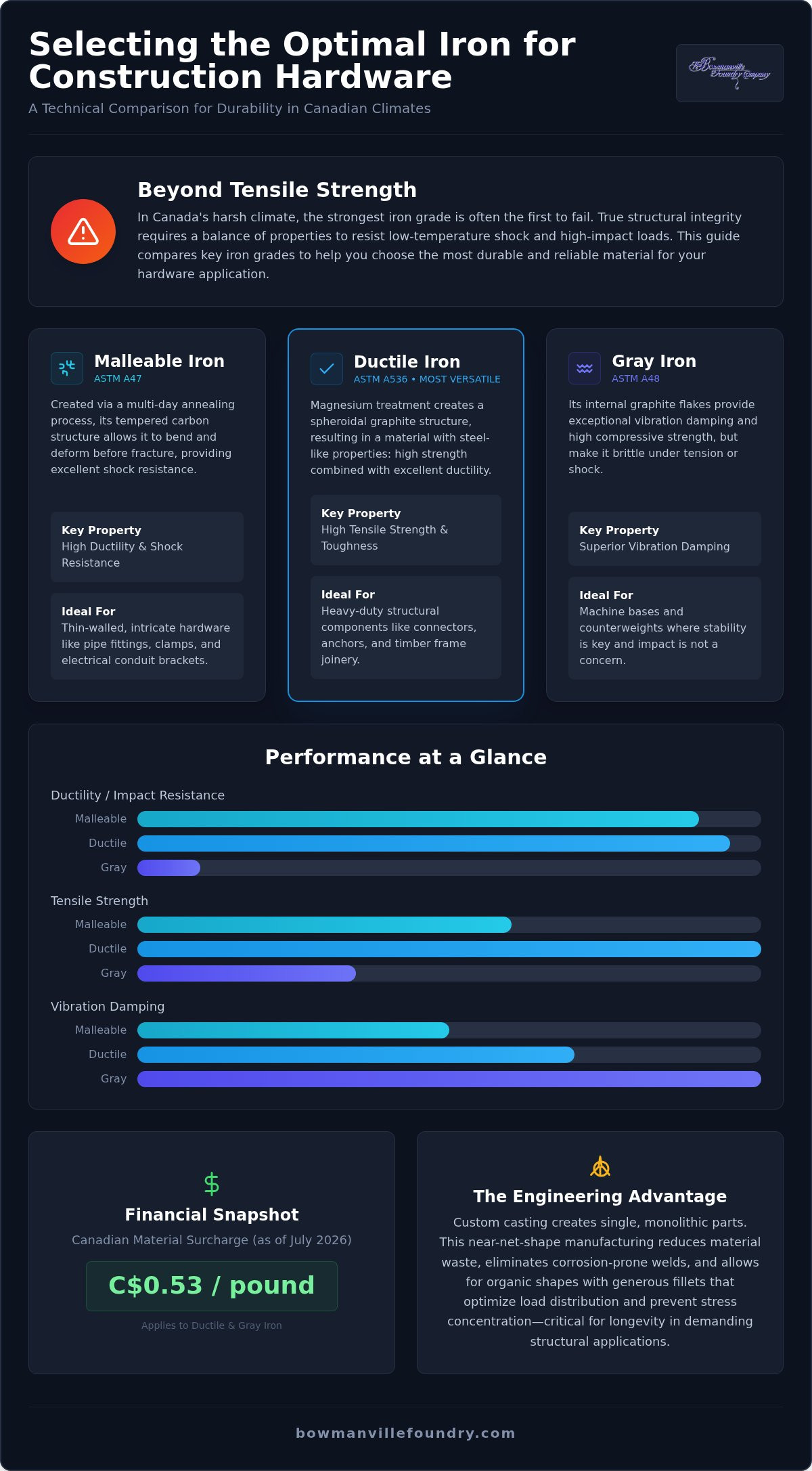
This technical guide provides the clarity needed to select the optimal iron grade for your specific hardware applications, ensuring long-term durability in our unique climate. We’ll analyze the performance of malleable, ductile, and gray iron under the latest ASTM A536-26 and ASTM A48 standards. You’ll also gain insight into current Canadian material surcharges, which sit at C$0.53 per pound for ductile and gray iron as of July 2026. This overview will help you navigate procurement with technical certainty and fiscal precision, moving from initial design requirements to a finished, ready-to-use component.
Key Takeaways
- Distinguish between malleable and ductile iron to select the grade that best balances shock resistance with complex geometry requirements.
- Master the application of ASTM A47 and ASTM A536 standards to guarantee the structural integrity of your hinges, brackets, and anchors.
- Evaluate how specialized iron casting for construction hardware maintains mechanical performance in harsh Canadian climates and under high-impact loads.
- Learn why post-processing services like precision machining are essential for achieving the tight tolerances required in modern structural fittings.
- Streamline your supply chain by leveraging the technical expertise and reduced lead times of a domestic Canadian manufacturing partner.
The Role of Ferrous Castings in Modern Construction Hardware
Ferrous metals have served as the backbone of the building industry for centuries, yet the methods used to produce them have evolved significantly. While historical structures relied on wrought iron, modern projects utilize advanced iron casting for construction hardware to meet rigorous safety and performance standards. This shift from manual forging to engineered casting allows for the mass production of brackets, hinges, and anchors that possess consistent metallurgical properties. Modern Cast iron production ensures that every component, from a simple pipe hanger to a complex structural connector, meets precise engineering specifications that were impossible to achieve with older smithing techniques.
One primary reason iron remains the preferred material for these components is its inherent versatility. Engineers can specify different grades to match the specific environmental stresses of a Canadian job site. Unlike complex steel fabrications that require extensive welding and multi-part assembly, a single casting can replace several individual pieces. This near-net-shape manufacturing reduces material waste and eliminates the heat-affected zones that often lead to premature failure in welded steel joints. When you realize that every weld is a potential point of ingress for corrosion, the value of a monolithic iron part becomes clear.
The ability to create organic shapes is another critical advantage. In structural hardware, sharp angles are often sites of stress concentration. Casting allows for generous fillets and tapered sections that optimize load distribution, ensuring that anchors and connectors can withstand the dynamic forces common in heavy-duty construction. This design freedom allows iron casting for construction hardware to outperform fabricated steel in both aesthetics and mechanical longevity.
Defining Construction Hardware Applications
Construction hardware encompasses a broad range of components that must maintain structural integrity under load. Typical applications where custom iron castings excel include:
- Structural connectors: Heavy-duty plates and timber frame joinery that require high bearing strength and resistance to shifting loads.
- Pipe fittings and conduit: Components like couplings and elbows that benefit from the thin-walled precision of malleable iron.
- Architectural hardware: Decorative elements that must also serve a functional, load-bearing purpose in public spaces or heritage restorations.
The Engineering Advantage of Custom Castings
Utilizing custom-engineered castings allows designers to integrate multiple features into a single part, which significantly reduces on-site assembly time and labour costs. Modern foundry techniques achieve much tighter tolerances than standard forged alternatives, often eliminating the need for secondary machining on non-critical surfaces. Iron is favoured for its vibration-damping properties in structural fittings because its internal graphite structure effectively absorbs and dissipates mechanical energy, preventing fatigue in connected members. By choosing a domestic Canadian partner with a long history of craftsmanship, firms ensure their hardware is built to survive the thermal expansion and contraction cycles typical of our climate.
Malleable vs. Ductile Iron: Choosing the Right Grade for Hardware
Selecting the correct iron casting for construction hardware usually comes down to a choice between malleable and ductile grades. These materials aren’t interchangeable. Their internal structures dictate how a component will respond to the stresses of a job site. While both offer significant advantages over standard gray iron, understanding their specific metallurgical properties is essential for ensuring long-term structural integrity.
Malleable iron is often the gold standard for smaller, intricate hardware. It begins its life as white iron, which is hard and brittle. Through a controlled, multi-day annealing process, the foundry transforms the material’s carbon into tempered carbon nodules. This metallurgical shift creates a part that can bend and deform before it breaks. It’s exceptionally well-suited for thin-walled castings like pipe clamps, electrical conduit fittings, and brackets where precision and shock resistance are paramount.
According to the American Foundry Society, the metalcasting process allows for complex geometries that are difficult or impossible to achieve through other manufacturing methods. This is especially true for malleable iron, which offers superior pourability into narrow mould sections. This fluidity ensures that even the most complex hardware geometries are filled completely, reducing the risk of internal voids or surface defects.
Malleable Iron: The Hardware Specialist
Malleable iron provides a smoother surface finish than ductile iron, making it the ideal substrate for galvanized coatings. The uniform grain structure ensures that the zinc bond is consistent, providing superior corrosion resistance in harsh Canadian environments. It also offers exceptional machinability. If your project requires extensive threading, drilling, or tapping, malleable iron’s structure allows for faster cutting speeds and reduced tool wear. If you’re uncertain which material fits your unique specification, reviewing a comprehensive casting buyer’s guide can clarify these technical nuances.
Ductile Iron: The Heavy-Duty Alternative
For larger structural anchors or components subject to massive tensile loads, ductile iron is the logical specification. Unlike malleable iron, which requires extensive heat treatment to gain its properties, ductile iron achieves its strength through the addition of magnesium to the molten metal. This causes the graphite to form into spheres or nodules rather than flakes. This nodular structure gives the material high yield strength and excellent elongation properties.
Ductile iron behaves similarly to carbon steel but offers the cost-efficiency and design flexibility of a casting. It’s the preferred choice for heavy-duty structural fittings that must endure extreme pressure and fatigue without failure. For a deeper technical breakdown of how these two materials compare across microstructure, mechanical properties, and cost-effectiveness, see our malleable iron vs ductile iron comprehensive engineering comparison. While it may not match malleable iron for thin-walled precision, its ability to support heavy structural loads makes it indispensable for large-scale infrastructure and heavy construction applications.
Mechanical Properties and Load Requirements for Structural Fittings
Designing for structural applications requires more than just picking a material; it requires adherence to rigorous testing protocols. For iron casting for construction hardware, this means navigating the specific ASTM standards that define mechanical limits. While tensile strength often gets the most attention, yield strength is the more critical metric for hardware designers. It represents the point where a bracket or anchor will permanently deform. If a component is part of a moving assembly, such as a heavy-duty hinge, hardness and wear resistance become equally vital to prevent premature galling or material loss.
Thermal expansion is another factor that cannot be ignored in the Canadian construction sector. Metals expand and contract significantly between a +30°C summer and a -40°C winter. Iron’s coefficient of thermal expansion is relatively low compared to aluminum, making it more stable for large-scale structural fittings. However, designers must still realize how these shifts affect the tolerances of bolted joints and threaded connections over time. Using a material with predictable thermal behaviour is essential for maintaining the integrity of building envelopes and structural skeletons.
Understanding ASTM Grade Designations
ASTM designations provide a clear roadmap for material performance. A common malleable iron grade like 32510 indicates a minimum yield strength of 32,500 psi and 10% elongation. In contrast, ductile iron uses a three-number system like 65-45-12, representing tensile strength, yield strength, and elongation percentage. Matching these specifications to the safety factors required by provincial building codes is essential for legal compliance and structural safety. Maintaining a national supply chain with consistent chemistry ensures that every batch of iron poured in a Canadian foundry meets these exact mechanical benchmarks without variation.
Brittle Fracture and Cold Weather Performance
The transition from ductile to brittle behaviour is a major concern for northern projects. Many standard materials become glass-like in extreme cold, leading to catastrophic failure under sudden shock loads. Selecting iron grades with high impact toughness is non-negotiable for hardware used in outdoor infrastructure. The specialized annealing process used in malleable iron transforms the internal structure to ensure the material remains tough and resists brittle failure even when temperatures drop well below freezing. This metallurgical stability provides a level of reassurance that off-the-shelf, non-certified imports cannot match, especially when human safety depends on the hardware’s ability to absorb energy without fracturing.
Post-Processing and Surface Treatments for Construction Environments
The journey from a molten pour to a functional component doesn’t end when the metal cools. While the initial mould defines the shape, an “as-cast” finish is rarely sufficient for iron casting for construction hardware. Structural applications demand a level of precision that raw castings cannot provide, particularly where components must interface with other building materials. Post-processing ensures that every bracket, anchor, and connector meets the exact dimensional requirements of the site plan while possessing the surface resilience needed to survive decades of exposure.
Heat treating is a critical first step in this phase. While we’ve discussed how annealing creates the tempered carbon nodules in malleable iron, specific mechanical property targets often require additional cycles. These controlled heating and cooling processes allow a foundry to fine-tune the balance between hardness and ductility. By adjusting these parameters, a manufacturer can produce hardware that is tough enough to resist wear in moving hinges but flexible enough to absorb sudden impact loads without fracturing.
Hot-Dip Galvanizing for Iron Hardware
In the Canadian climate, corrosion is the primary threat to hardware longevity. Iron components used in coastal regions or near salted roadways face constant oxidation pressure. Malleable iron is the superior substrate for hot-dip galvanizing because its uniform surface texture allows for a consistent metallurgical bond with the zinc. This process creates a protective layer that is much thicker and more durable than standard paint or powder coatings. Because the casting process allows for complex geometries, galvanizing ensures that even internal recesses and deep fillets receive a uniform coating, providing total protection against the elements.
Machining and Finishing for Ready-to-Use Parts
Precision machining is what turns a metal shape into a structural tool. Bolt holes, threaded ports, and mating surfaces require tolerances that only secondary operations can achieve. Integrating these post-processing services at the foundry level reduces your internal labour costs and simplifies the supply chain. When a single partner handles the pattern development, the pour, and the final machining, there’s a significantly lower risk of dimensional drift across large production runs. This single-source approach guarantees that every part arrives at the job site ready for immediate installation.
Ensuring your hardware can withstand the rigours of the field starts with choosing a partner who understands the entire lifecycle of the part. If you’re ready to move from design to production, you can contact our technical team to discuss your specific finishing requirements and ensure your components are built for Canadian conditions.
Optimizing Production with a Canadian Casting Partner
Sourcing iron casting for construction hardware from a domestic partner isn’t just about geography; it’s about mitigating risk. In a period of unpredictable global logistics, a national foundry provides a level of supply chain stability that offshore manufacturers cannot match. When you work with a Canadian partner, you eliminate the complexities of transcontinental shipping, customs delays, and the high carbon footprint associated with long-distance freight. This proximity allows for more agile production schedules and shorter lead times, which is essential for construction projects that operate on tight, non-negotiable deadlines.
Collaborative engineering is where the true value of a local partnership becomes apparent. Rather than sending a design into a void, you engage in a technical dialogue from the pattern development stage to the final pour. This ensures that the component is designed for manufacturability, reducing the likelihood of casting defects and ensuring that the final part meets the structural requirements discussed in previous sections. Quality control protocols are strictly maintained, ensuring that every safety-critical fitting conforms to the necessary metallurgical standards, providing the technical certainty required for modern infrastructure.
Streamlining the RFQ Process
To receive an accurate and timely quote for your iron casting for construction hardware, your request for quotation (RFQ) should be as detailed as possible. Include specific ASTM grade requirements, such as ASTM A47 for malleable iron or ASTM A536 for ductile iron, along with expected production volumes and critical tolerances. Understanding pattern costs upfront is vital; a high-quality pattern is a long-term investment that ensures dimensional consistency over thousands of cycles. Local expertise is invaluable here, as a domestic partner can offer guidance on material selection that accounts for Canadian environmental factors like sub-zero impact toughness.
The Bowmanville Foundry Difference
Operating since 1902, Bowmanville Foundry brings over a century of institutional knowledge to every project. We specialize in custom-engineered solutions for unique architectural and structural requirements that generic suppliers often overlook. Whether you need thin-walled malleable iron for electrical fittings or high-strength ductile iron for structural anchors, our team provides the technical data and post-processing services needed for ready-to-use components. To streamline your procurement process and avoid common pitfalls, Download our Free Casting Buyer’s Guide to start your project today.
Securing Structural Integrity with Engineered Iron
Selecting the correct iron casting for construction hardware is a decision that dictates the safety and longevity of your structural assembly. You now understand the critical distinction between malleable iron for thin-walled precision and ductile iron for high-tensile loads. By adhering to ASTM standards and prioritizing domestic manufacturing, you ensure that your hardware remains resilient against Canada’s harsh thermal cycles and corrosive environments. This technical certainty is what separates a reliable build from a potential failure point.
Bowmanville Foundry has been a trusted Canadian manufacturer since 1902. We specialize in malleable, ductile, and gray iron, providing the technical expertise required to solve complex engineering challenges. Our comprehensive in-house finishing and machining services eliminate the need for multiple vendors, delivering ready-to-use parts directly to your facility. This integrated approach reduces lead times and maintains the tight tolerances your projects demand. We’re committed to helping you navigate these intricate metallurgical choices with confidence.
Request a Quote for Your Custom Construction Hardware today to discuss your specific load requirements and material grades with our technical team. We look forward to partnering with you on your next infrastructure project.
Frequently Asked Questions
What is the best type of iron for construction brackets?
Malleable iron is generally the superior choice for standard brackets because it allows for thin-walled designs without sacrificing toughness. For brackets that must support massive structural loads, ductile iron is the preferred alternative. Both materials offer better vibration damping than steel. This choice ensures that the hardware can withstand the mechanical stress of a construction site while remaining cost-effective for high-volume production.
How does malleable iron differ from ductile iron in hardware applications?
The primary difference lies in the internal structure and the manufacturing process. Malleable iron undergoes an extensive annealing process that makes it ideal for small, intricate parts. Ductile iron gains its strength through the addition of magnesium during the pour, making it better for larger, high-tensile applications. Designers typically choose based on the required wall thickness and the specific load-bearing needs of the project. For a full technical breakdown of these differences, our guide on malleable iron vs ductile iron covers microstructure, ASTM standards, and cost-effectiveness in detail.
Can iron castings be used for safety-critical structural fittings?
Iron castings are a staple in safety-critical structural fittings because they provide predictable mechanical performance. When produced to rigorous ASTM standards, these components offer the impact resistance and yield strength necessary for anchors and connectors. Their ability to dissipate energy makes them particularly useful in seismic zones or high-vibration industrial environments where brittle failure is not an option.
Is cast iron hardware resistant to corrosion in Canadian winters?
Raw iron will oxidize, but iron casting for construction hardware is exceptionally durable when paired with hot-dip galvanizing. This treatment creates a thick, protective zinc layer that resists the corrosive effects of road salt and heavy moisture. In the Canadian climate, this surface protection is mandatory for any hardware exposed to the elements to prevent structural degradation over time.
Why should I choose custom iron castings over fabricated steel hardware?
Custom castings eliminate the need for complex welding, which is often a source of structural weakness and corrosion. A single casting can replace multiple fabricated steel parts, reducing on-site assembly time and labour costs. Additionally, casting allows for fillets and tapered sections that distribute stress more evenly than the sharp angles found in standard steel fabrications.
What ASTM standards apply to iron hardware for construction?
The most relevant standards are ASTM A47 for malleable iron and ASTM A536 for ductile iron. These specifications dictate the minimum tensile strength, yield strength, and elongation percentages required for legal compliance. Following these benchmarks ensures that every component in the supply chain behaves predictably under the loads specified in Canadian building codes.
What post-processing services are necessary for construction hardware?
Most construction hardware requires precision machining for bolt holes and threaded ports to ensure a perfect fit during installation. Heat treating is also essential to reach specific hardness or ductility targets. Finally, surface treatments like galvanizing or specialized coatings are necessary to protect the component from environmental wear and oxidation in the field.
How do lead times for iron castings compare to other manufacturing methods?
Sourcing from a domestic foundry significantly reduces lead times compared to offshore manufacturing or multi-stage steel fabrication. While initial pattern development takes time, the actual production of iron casting for construction hardware is highly efficient for large runs. Working with a national partner eliminates the logistical delays associated with international shipping and customs clearance.
