
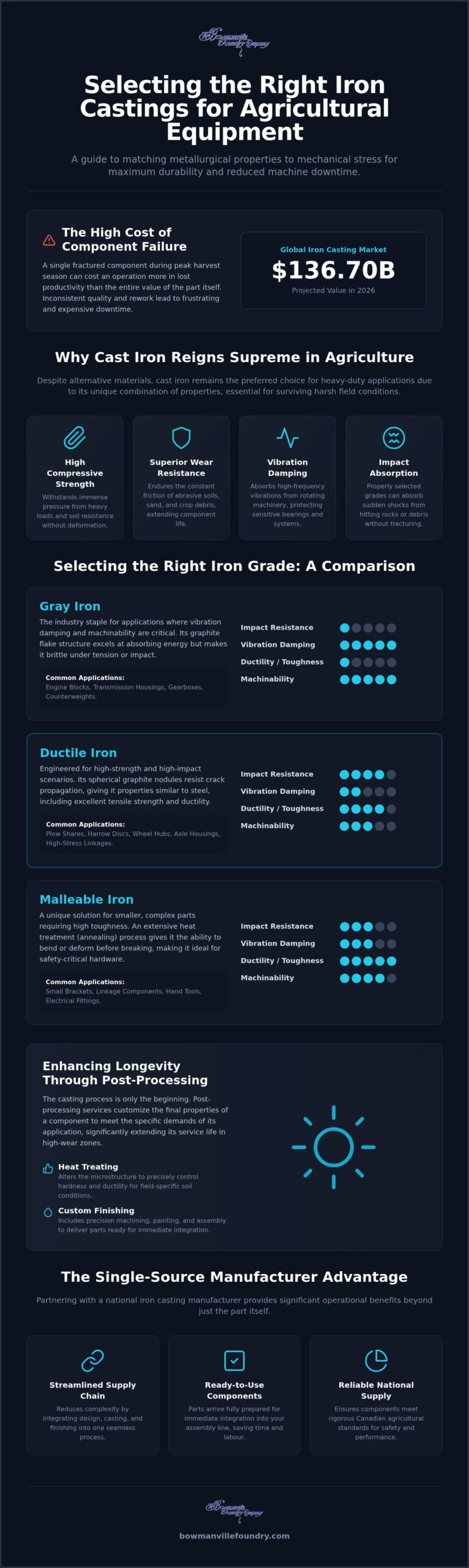
A single fractured component during the peak of the harvest season can cost an operation more in lost productivity than the entire value of the part itself. It’s a frustrating reality for many equipment manufacturers who face inconsistent quality and the need for extensive machining rework on their sourced parts. Selecting the right iron castings for agricultural equipment is not just a matter of finding the lowest price; it’s about matching metallurgical properties to the specific mechanical stresses of the field. With the global iron casting market projected to reach $136.70 billion in 2026, the demand for precision-engineered components has never been higher.
You likely understand that the balance between impact resistance and weight optimization is critical for modern machinery performance. We’ll help you navigate these technical choices by explaining how to select and optimize iron casting grades for maximum durability. This guide provides a methodical look at the differences between gray, ductile, and malleable iron, offering a path toward reduced machine downtime and a more reliable national supply chain. By the end, you’ll have the technical certainty needed to choose ready-to-use components that arrive fully prepared for immediate integration into your assembly line.
Key Takeaways
- Understand why iron castings for agricultural equipment remain the industry standard for managing high-impact loads and abrasive soil conditions.
- Learn the specific mechanical advantages of malleable iron for small components compared to the high-strength properties of ductile and gray iron grades.
- Discover how to map specific implements, such as harrows and plow shares, to the ideal iron grade to maximize wear resistance and component life.
- Identify how heat treating and other post-processing services can be used to customize the hardness and ductility of your castings for field-specific applications.
- Realize the operational benefits of partnering with a single-source manufacturer to streamline your supply chain and deliver ready-to-use parts.
The Critical Role of Iron Castings in Agricultural Machinery Performance
Agricultural implements operate in some of the harshest environments on earth. While alternative materials have been tested over the decades, Cast iron remains the preferred choice for heavy-duty applications due to its unique combination of compressive strength and wear resistance. High-quality iron castings for agricultural equipment must withstand the constant friction of abrasive soils while maintaining structural integrity under heavy cyclic loading. Unlike lighter alloys, iron provides the necessary mass and durability required for tillage, seeding, and harvesting components that face daily exposure to impact and debris.
Precision is vital in modern farming. Equipment manufacturers now require components that offer a specific balance of strength and weight. Custom engineering allows for the optimization of these parts, ensuring that extra material is only present where the mechanical stress is highest. This approach reduces the overall weight of the machinery, which helps lower fuel consumption and soil compaction, without compromising the part’s ability to survive a full season of hard labour. Selecting a manufacturer that understands these national agricultural standards ensures that every component meets the rigorous safety and performance benchmarks required by the industry.
Understanding Mechanical Stress in the Field
Soil resistance creates immense pressure on tillage components. When a plow share or harrow disc hits a submerged rock at high speed, the material must absorb that impact without fracturing. Many “off-the-shelf” components fail because they lack the specific grain structure needed to handle these sudden shocks. Beyond impact, vibration damping is a critical factor for harvesting mechanisms. Gray iron, for example, excels at absorbing the high-frequency vibrations produced by rotating machinery, which protects sensitive bearings and internal systems from premature wear. Parts designed for generic use often don’t account for the specific soil densities and moisture levels found in Canadian field conditions, leading to unexpected failures during peak windows.
The Economic Advantage of Custom Engineered Iron
The true cost of a component includes its impact on machine uptime. While standard parts might seem cost-effective initially, the long-term expense of frequent replacements and lost productivity is significant. Tailored metallurgy allows engineers to customize the hardness and ductility of a part to extend its service life in high-wear zones. Additionally, custom iron castings for agricultural equipment allow for more complex designs that integrate multiple functional features into a single piece. This reduces the need for additional fasteners and secondary assembly labour, simplifying the supply chain and creating a more robust final product that’s ready for immediate field deployment.
Selecting the Right Iron Grade: Malleable, Ductile, and Gray Iron
Selecting the appropriate material grade for iron castings for agricultural equipment is a critical engineering decision that dictates the longevity of the final machine. While some manufacturers suggest a universal approach, the diverse mechanical properties of cast iron mean that gray, ductile, and malleable iron each serve distinct functional roles. Gray iron remains a staple for components like transmission housings and engine blocks where vibration damping and superior machinability are paramount. Its ability to absorb energy prevents the transmission of harmonic stress to more delicate internal components. However, when the application requires significant resistance to impact or tensile loads, engineers must look toward ductile or malleable options.
Malleable Iron for Agricultural Hardware
For smaller components that require a high degree of toughness, choosing malleable iron casting Canada services provides a unique metallurgical solution. Malleable iron starts as white iron and undergoes an extensive annealing process. This heat treatment transforms brittle carbides into “temper carbon” nodules, resulting in a material that can bend before it breaks. It’s the ideal choice for brackets, links, and lever arms. In many cases, malleable iron outperforms other grades in thin-walled sections because it maintains its shock-absorbing properties even in complex, lightweight geometries where ductile iron might struggle with casting consistency.
Ductile Iron for High-Stress Implements
When the design calls for maximum tensile strength and yield strength in heavy frames, analyzing the ductile iron foundry Ontario standards for SG (spheroidal graphite) iron is essential. Also known as nodular iron, this material features spherical graphite nodules that stop cracks from propagating. It’s the primary choice for large structural components that must manage internal pressures, such as those found in irrigation systems or fluid power housings. While malleable iron excels in smaller hardware, ductile iron is prioritized for massive frame components where sheer load-bearing capacity is the dominant requirement.
Choosing between these grades requires a deep understanding of how each material reacts under field conditions. Matching the right iron castings for agricultural equipment to their intended mechanical stress profile ensures that the machinery remains operational throughout the most demanding harvest cycles. If you’re unsure which grade fits your specific design, you can consult our resource library for detailed metallurgical specifications and material comparisons.
Common Agricultural Components and Their Casting Requirements
Modern farming implements are sophisticated assemblies where each part faces a unique set of mechanical stresses. Mapping these components to the correct metallurgy is essential for operational reliability. While tillage tools require extreme surface hardness, seeding components demand high dimensional precision, and harvesting machinery needs superior fatigue resistance. Using high-quality iron castings for agricultural equipment ensures that these varied requirements are met through controlled foundry processes. It’s not just about the shape of the part; it’s about how the internal grain structure responds to the rigours of the field.
Tillage and Ground-Engaging Tools
Ground-engaging components like plow shares, cultivator sweeps, and harrow disks operate in high-abrasion environments. These parts are constantly scoured by soil, requiring materials with high hardness to maintain their edge. However, hardness alone isn’t enough. These tools must also resist fracturing when they strike hidden rocks, particularly during late-autumn or early-spring work when ground temperatures are low. Brittle failure in a tillage tool can lead to costly downtime during a critical planting window.
For heavier, non-engaging components, gray iron casting applications are often the standard for counterweights and rollers. Gray iron provides the necessary mass to keep tools at the correct depth while absorbing the jarring vibrations of uneven terrain. In Canadian field conditions, selecting a grade that maintains its impact resistance at sub-zero temperatures is a vital safety consideration for any equipment manufacturer.
Structural Brackets, Pivots, and Links
Articulating joints and mounting brackets are the backbone of any foldable implement. These parts must maintain tight tolerances over thousands of cycles to prevent “slop” in the machinery. Understanding how to choose iron casting grade for these safety-critical links is essential for manufacturers who prioritize longevity.
Beyond tillage, seeding and planting equipment relies on precision-cast hubs and seed drill components. These parts must be perfectly concentric and dimensionally stable to ensure accurate seed placement. Similarly, harvesting equipment like balers and combines contains complex internal mechanisms that face mechanical fatigue. Protecting these expensive assets requires high-strength iron castings that can handle constant load reversals without cracking.
- Pivots: Require high yield strength to resist deformation under the weight of heavy wings or booms.
- Brackets: Must provide dimensional stability to ensure that hydraulic cylinders and pins align perfectly during assembly and operation.
- Links: Often benefit from malleable iron’s ductility, allowing them to absorb sudden shocks without immediate failure.
Consistent metallurgy across these parts prevents uneven wear in the bushings and pins they support. By sourcing custom iron castings for agricultural equipment from a partner with deep technical expertise, manufacturers can ensure that every pivot and link performs as intended, reducing the risk of structural failure when the pressure is on.
Enhancing Component Longevity through Post-Processing and Finishing
The journey from a raw foundry pour to a field-ready component involves critical secondary operations that define the part’s ultimate performance. While the base metallurgy of iron castings for agricultural equipment provides the necessary foundation, post-processing services transform these raw shapes into high-performance assets. These operations are not optional add-ons; they are essential engineering steps that ensure a component can survive the transition from the controlled environment of a factory to the unpredictable conditions of a farm. By integrating heat treating, machining, and coating into a single manufacturing flow, producers can deliver ready-to-use parts that simplify assembly and extend equipment life.
Heat Treating for Wear and Impact Resistance
Heat treating is a precise science that modifies the iron’s microstructure through controlled heating and cooling cycles. This process is vital for achieving the perfect balance between surface hardness and core toughness. For components like plow shares that face constant abrasion, a hardened surface prevents premature thinning. However, the core must remain ductile enough to absorb the shock of hitting a stone without shattering. This is especially important for parts exposed to repetitive cyclic loading, where internal stresses can lead to fatigue cracking if the material hasn’t been properly tempered. A well-executed heat treatment ensures the casting remains resilient throughout its entire service life.
Protective Coatings for Harsh Environments
Canadian agricultural environments present unique challenges that go beyond mechanical wear. Equipment often sits in high-humidity storage or operates in fields saturated with corrosive liquid fertilizers and irrigation water. Without a robust surface finish, even the strongest iron castings for agricultural equipment can suffer from surface degradation. Protective coatings act as a barrier against chemical oxidation and the freeze-thaw cycles common in northern climates. These coatings must be applied with precision to maintain tight dimensional tolerances, ensuring that protective barriers don’t interfere with the fit of mounting brackets or articulating pivots. Beyond protection, a professional finish improves the functional quality of OEM parts, signaling a commitment to long-term reliability.
Precision machining further enhances these components by ensuring that rotating parts, such as hubs and pulleys, maintain perfect balance. When a part is machined to exact specifications, it reduces harmonic vibration, which protects the entire drive system from premature wear. To see how these secondary operations can optimize your machinery, explore our full range of post-processing services designed for heavy-duty industrial applications.
Partnering with a National Iron Casting Manufacturer for Custom Ag Solutions
Selecting the right metallurgy is only half the battle; the other half is ensuring that your supply chain can deliver those specifications consistently. For manufacturers of heavy machinery, the decision to partner with an established foundry is a strategic investment in operational stability. Legacy institutions like Bowmanville Foundry, operating since 1902, provide more than just parts. They offer over a century of institutional knowledge that helps bridge the gap between theoretical design and physical craftsmanship. By choosing a partner that understands the nuances of iron castings for agricultural equipment, you gain access to a steady, knowledgeable hand that can guide you through complex technical landscapes.
The most significant advantage of a modern partnership is the shift away from fragmented manufacturing. Many offshore options treat casting and post-processing as separate silos, which often leads to quality disputes and extended lead times. In contrast, custom iron casting production is most effective when the foundry manages the entire lifecycle of the component. This integrated approach ensures that the person pouring the iron understands the requirements of the person machining the final surface. It results in fewer errors, reduced rework, and a ready-to-use component that arrives at your facility prepared for immediate assembly.
The Value of a Single-Source Supply Chain
Relying on iron casting and machining Canada services significantly reduces logistical complexity. When you source from a national partner, you mitigate the risks of international shipping disruptions and tariff fluctuations. Direct communication between your design engineers and the foundry technicians allows for rapid prototyping and pattern development. This transparency is vital for maintaining ASTM compliance and ensuring that every batch meets rigorous safety standards. A local partner realizes the gravity of harvest deadlines and can adjust production schedules to support your peak requirements, providing a level of responsiveness that offshore competitors simply can’t match.
Engineering Support and the Casting Buyer’s Guide
Effective engineering support starts long before the first pour. By utilizing technical data to refine part designs for better castability, you can reduce material waste and optimize component weight. Our team supports clients through every stage, from initial pattern development to final heat treating and finishing. This collaborative process ensures that the iron castings for agricultural equipment you receive are engineered for maximum durability in the field. To help you make more informed procurement decisions, we offer a free Casting Buyer’s Guide that outlines the essential factors in material selection and foundry standards. You can download our guide or request a technical consultation to discuss the specific requirements of your next project.
Optimizing Your Equipment for Long-Term Field Reliability
Selecting the right metallurgical grade is the first step in preventing peak-season failures. By matching specific iron castings for agricultural equipment to their unique mechanical stress profiles, you ensure your machinery can withstand the rigours of the field. Whether your design requires the vibration damping of gray iron or the specialized shock resistance of malleable iron, integrated post-processing ensures every part arrives ready for immediate installation without the need for additional rework.
Bowmanville Foundry leverages over 120 years of institutional knowledge to simplify the complexities of industrial procurement. With comprehensive in-house machining and heat treating services, we provide a dependable national supply chain for custom-engineered components across Canada. Our commitment to precision and ASTM compliance ensures that your implements perform reliably under the most demanding conditions. Request a Technical Consultation for Your Agricultural Components to refine your designs and optimize your next production run. We look forward to helping you build more durable, high-performance machinery for the modern farm.
Frequently Asked Questions
Why is ductile iron preferred over gray iron for agricultural implements?
Ductile iron offers significantly higher tensile strength and yield strength compared to gray iron. While gray iron is excellent for vibration damping in engine housings, ductile iron’s spherical graphite structure allows it to withstand bending and heavy structural loads without fracturing. This makes it the superior choice for high-stress components like implement frames and wheel hubs that face extreme field conditions and heavy impact.
Can malleable iron be used for high-impact farm machinery parts?
Malleable iron is specifically engineered for high-impact applications where toughness and ductility are required. Its unique annealing process creates a material that can absorb sudden shocks without immediate brittle failure. It is often utilized for smaller structural brackets, hinges, and links that must maintain their integrity under the jarring impacts common in tillage and seeding operations, especially in colder Canadian climates.
How does heat treating improve the performance of iron castings in the field?
Heat treating modifies the internal microstructure of the iron to achieve a specific balance of surface hardness and core ductility. This process is essential for iron castings for agricultural equipment because it allows a part to resist abrasive wear on its exterior while remaining tough enough to handle internal stresses. Controlled heating and cooling cycles ensure that components like plow shares last longer in high-friction soil environments.
What are the most common causes of casting failure in agricultural equipment?
Most failures stem from selecting an incorrect iron grade or using parts with inconsistent metallurgical quality. Brittle fracture often occurs when a material lacks the impact resistance needed for sub-zero temperatures or sudden rock strikes. Other causes include mechanical fatigue from repetitive cyclic loading and corrosive degradation caused by liquid fertilizers. Professional foundries mitigate these risks through rigorous testing and adhering to precise engineering specifications throughout the pour.
Does Bowmanville Foundry provide machining for custom agricultural castings?
Bowmanville Foundry provides a full suite of post-processing services, including precision machining and heat treating. This integrated approach allows us to deliver ready-to-use components that fit perfectly into your assembly line. By handling both casting and machining under one roof, we ensure tighter quality control and reduce the logistical delays often associated with using multiple third-party vendors for secondary operations, streamlining your entire supply chain.
What ASTM standards apply to iron castings for agricultural machinery?
Several ASTM standards are critical for agricultural applications, including ASTM A48 for gray iron, ASTM A536 for ductile iron, and ASTM A47 for malleable iron. These standards define the required tensile strength, yield strength, and elongation properties. Adhering to these benchmarks ensures that every component meets the safety and durability requirements necessary for heavy-duty industrial and farming equipment, providing technical certainty for procurement professionals.
How can I reduce the weight of my agricultural components using iron castings?
Weight reduction is achieved through custom engineering that optimizes the part’s geometry to place material only where mechanical stress is highest. By utilizing high-strength ductile or malleable iron, you can often design thinner-walled sections that maintain the same structural integrity as heavier, thicker parts. This precision approach helps reduce fuel consumption and soil compaction without sacrificing the overall service life of the machinery in the field.
Why should I choose a national iron casting manufacturer for my OEM parts?
Partnering with a national manufacturer reduces supply chain risks and ensures your components meet Canadian industrial standards. National foundries provide better communication between your engineering team and the production floor, leading to faster prototyping and more reliable quality control. Sourcing iron castings for agricultural equipment domestically also eliminates the uncertainties of international shipping and tariffs, providing a more stable and responsive partnership for your manufacturing needs.
