
Why do engineers still specify a material standard first established over a century ago for modern, high-precision industrial components? If you’ve spent hours scouring the web only to find paywalled technical data or vague summaries, you understand the difficulty of verifying ASTM A47 malleable iron properties for a critical project. It’s a common challenge to balance the need for high ductility with the requirement for superior machinability, especially when cold-weather performance or impact resistance is a primary concern for your specific application.
We’ve developed this technical reference to eliminate that uncertainty and provide the clarity your engineering team requires. You’ll gain a comprehensive understanding of the current ASTM A47/A47M-99(2022)e1 standard, including a deep dive into the mechanical differences between common grades like 32510 and 35018. We’ll explore how the unique ferritic structure of this iron facilitates easier post-processing and why it remains a dependable choice for thin-walled industrial hardware. This article serves as a steady guide through the intricate metallurgical landscape of malleable iron castings, helping you move from initial curiosity to technical certainty.
Key Takeaways
- Understand the metallurgical role of the ferritic matrix in providing the superior ductility and toughness required for modern engineering components.
- Learn to distinguish between Grade 32510 and Grade 35018 by decoding the ASTM numbering system for minimum yield strength and elongation.
- Explore how ASTM A47 malleable iron properties result in world-class machinability, reducing tool wear through the natural lubricating effect of temper carbon.
- Evaluate the performance of malleable iron in challenging environments, specifically regarding its corrosion resistance and reliability in cold-weather applications.
- Gain insights into optimizing your production cycle by leveraging integrated post-processing services and century-long foundry expertise.
Understanding ASTM A47: The Standard for Ferritic Malleable Iron
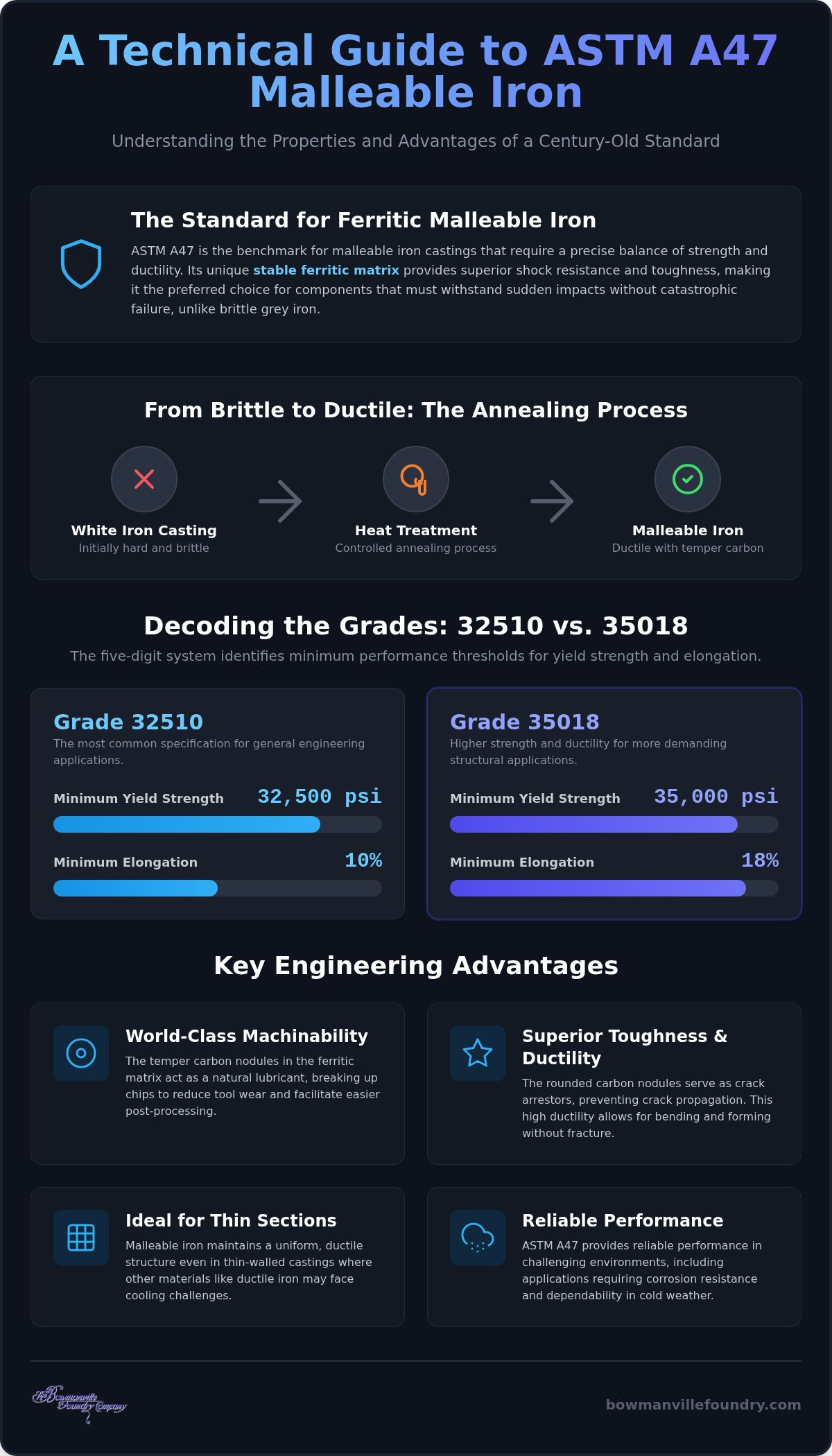
ASTM A47 serves as the definitive benchmark for ferritic malleable iron castings used in general engineering applications. While several iron standards exist, this specific designation addresses materials that require a precise balance of strength and ductility. In the Canadian industrial landscape, Malleable iron has played a critical role since the early 20th century, providing a reliable solution for heavy machinery and infrastructure. Unlike grey iron, which contains brittle graphite flakes, ASTM A47 materials utilize a stable ferritic matrix. This structural difference is the primary reason why ASTM A47 malleable iron properties include superior shock resistance and toughness. It’s the preferred choice for components that must withstand sudden impacts without catastrophic failure.
The Annealing Process and Microstructure
The creation of ASTM A47 iron starts as white iron, a material that is hard and notoriously brittle. A meticulously controlled heat treatment process, known as annealing, transforms this raw casting into a stable ferritic structure. During this process, carbon precipitates out of the iron solution, forming small, rounded clusters called temper carbon nodules. These nodules are essential for the material’s performance. They act as crack arrestors that prevent crack propagation through the metal. Because the material lacks the sharp flake graphite found in grey iron, the overall mechanical integrity is significantly improved. This transition from a brittle state to a ductile one ensures the casting can be formed or machined into complex shapes without fracturing.
Scope of Application for Ferritic Grades
Engineers must distinguish ferritic malleable iron from its pearlitic counterparts, which are governed by the ASTM A220 standard. Ferritic grades prioritize ductility and machinability over the higher hardness levels found in pearlitic iron. This makes ASTM A47 particularly suitable for thin-section castings. In these scenarios, ductile iron often faces cooling rate challenges that can lead to inconsistent properties, whereas malleable iron maintains a uniform structure. The standard also dictates general engineering requirements, specifying that castings must be reasonably smooth and free of defects that could compromise their functional life. For professionals looking to optimize ASTM A47 malleable iron properties, understanding these microstructural nuances is the first step toward successful component design.
Mechanical Properties: Grade 32510 vs. Grade 35018
The classification of malleable iron is based on a standardized five-digit numbering system that identifies the material’s minimum performance thresholds. For example, Grade 32510 indicates a minimum yield strength of 32,500 psi and a minimum elongation of 10 percent. This system provides engineers with a clear, predictable framework for selecting the right material based on ASTM A47 malleable iron properties. Yield strength is the specific point where the iron begins permanent deformation. Understanding this threshold is vital for ensuring the structural integrity of a component under load, as it defines the limit of the material’s elastic behaviour.
Tensile and Yield Strength Requirements
Grade 32510 is the most common specification for general engineering. It targets a minimum tensile strength of 50,000 psi alongside its 32,500 psi yield strength. In contrast, Grade 35018 offers higher strength thresholds, requiring a 35,000 psi yield and 18 percent elongation for more demanding structural applications. These properties represent a significant shift from grey iron casting applications, where the material is often limited by its lack of a distinct yield point and lower ductility. While grey iron excels in vibration damping, ASTM A47 grades provide the tensile resilience necessary for parts that must carry significant loads without fracturing. You can find the full technical specifications in the official ASTM A47/A47M-99(2014) documentation.
Ductility and Elongation Standards
The elongation properties of ASTM A47, typically ranging from 10 percent to 18 percent, distinguish it from other ferrous alloys. This high degree of ductility makes the iron ideal for parts subject to bending or “malleable” adjustments during assembly. It allows the metal to absorb energy and deform slightly rather than failing catastrophically under sudden stress. To ensure these standards are met, foundries use standard tension test specimens to verify compliance with national safety requirements. These tests confirm that each batch maintains the necessary mechanical integrity for its intended industrial use. For those looking to secure high-quality components, working with an established malleable iron supplier ensures that these rigorous testing protocols are strictly followed. Meticulous specimen testing remains the only way to guarantee that the finished casting will perform as expected in the field.
Engineering Advantages: Machinability and Toughness
Malleable iron is widely recognized as the most machinable of all ferrous casting alloys. This distinction is a direct result of the material’s unique microstructure. During the cutting process, the temper carbon nodules act as a natural lubricant. This reduces the heat generated at the tool tip and prevents the metal from adhering to the cutting edge. Consequently, ASTM A47 malleable iron properties allow for exceptionally high cutting speeds and superior surface finishes without the rapid tool wear associated with other cast irons.
The ferritic matrix plays a supporting role in this efficiency. By maintaining a material hardness that typically falls between 110 and 156 HB, the iron remains soft enough for high-speed machining while providing the strength needed for structural loads. This balance ensures that components are both durable and economical to produce. It’s a pragmatic solution for high-volume manufacturing where tool life directly impacts the bottom line. The consistency of this hardness range across the casting allows for predictable machining results, which is essential for maintaining tight tolerances in precision engineering.
Machinability Ratings and Tool Life
When comparing machinability ratings, ferritic malleable iron often achieves scores 20 to 50 percent higher than many ductile iron grades. These faster cycle times translate to significant cost savings during production. Choosing ASTM A47 allows manufacturers to reduce total production costs by maximizing the throughput of their CNC equipment. For precision parts, the benefits of integrated iron casting and machining cannot be overstated. By handling both casting and post-processing within a single supply chain, you eliminate the logistical delays and quality risks associated with moving components between multiple vendors. It ensures that the specific metallurgical benefits of the iron are fully realized during the machining phase.
Fatigue Resistance and Damping Capacity
Beyond its workability, ASTM A47 is valued for its ability to withstand cyclic loading. This makes it a staple in the automotive and agricultural sectors, where components face repetitive stress over long service lives. The material offers a damping capacity that is notably higher than steel, meaning it can absorb vibration more effectively. While it doesn’t match the damping levels of grey iron, it provides a much higher tensile strength, offering a middle ground for engineers. The temper carbon nodules within the matrix also serve as internal stress relievers. They help distribute loads more evenly across the casting, which further enhances the fatigue life of the finished product. This combination of ASTM A47 malleable iron properties makes it an enduring choice for parts that must survive harsh, vibrating environments without cracking.
Critical Considerations for Industrial Applications
Applying these materials in the field requires a nuanced understanding of how environmental factors influence ASTM A47 malleable iron properties. In the Canadian climate, where temperatures frequently drop below freezing, the impact resistance of a material becomes a safety-critical metric. Ferritic malleable iron is particularly valued here because it retains its toughness at lower temperatures better than many standard carbon steels or grey irons. This reliability extends to outdoor industrial and agricultural settings where exposure to moisture is constant. While not inherently stainless, the material exhibits a natural resistance to atmospheric corrosion that often exceeds that of unalloyed steels.
The “malleability” of this iron is a functional advantage for post-casting operations. Engineers often specify this grade for parts that require coining, punching, or minor bending during final assembly. These operations must be planned carefully during the design phase to avoid overstressing the matrix. To ensure the final component meets all structural requirements, consult an experienced malleable iron casting supplier early in the process. Their expertise helps optimize geometry to prevent cracking during secondary forming.
Welding and Repair Restrictions
A frequent error in industrial maintenance is attempting to repair ASTM A47 components using traditional welding. The intense heat of the welding process destroys the carefully cultivated ferritic structure. As the weld pool cools rapidly, it forms brittle martensite. This hard phase lacks the ductility of the original casting and creates a significant risk of sudden, catastrophic failure under load. Standard ASTM protocols require explicit permission for any welding repairs. When joining is necessary, engineers should prioritize mechanical fasteners or specialized brazing techniques that operate below the critical transformation temperature of the iron.
Thermal Stability and Magnetic Properties
For applications involving heat, ferritic malleable iron offers reliable thermal stability. It can withstand elevated temperatures up to approximately 650°C for short durations without significant loss of mechanical integrity. Beyond this point, the microstructure may begin to revert, affecting the ASTM A47 malleable iron properties established during annealing. Additionally, the material possesses excellent magnetic permeability. This makes it a preferred choice for electrical hardware and fittings that must carry magnetic flux. When designing assemblies, engineers must also account for thermal expansion to ensure that tolerances remain within acceptable limits during temperature fluctuations. If you need high-precision components, contact us today to discuss your specific engineering requirements.
Sourcing ASTM A47 Castings and Post-Processing
Sourcing from a Canadian foundry with a legacy spanning over 120 years provides a level of certainty that international brokers often cannot match. Bowmanville Foundry has manufactured malleable iron since 1902, maintaining a deep institutional knowledge of how to manipulate ASTM A47 malleable iron properties to meet specific industrial demands. This expertise is critical when optimizing custom iron casting production, as it ensures that the geometry of the part aligns with the metallurgical cooling rates required for a consistent ferritic matrix. Every pour is subjected to rigorous quality control measures to verify that the chemical composition and physical performance meet the current ASTM A47/A47M-99(2022)e1 standards.
The role of secondary operations is equally vital in delivering ready-to-use industrial components. By managing the transition from raw casting to finished part within a single facility, we maintain absolute control over the material’s integrity. This integrated approach reduces the inherent complexity of industrial procurement. It acts as a steady hand that guides the project from technical specifications to physical craftsmanship, ensuring that the final component performs reliably in the field.
Custom Pattern Development and Engineering
Modern casting facilities allow for the realization of complex, thin-walled designs that were once considered difficult to produce. Our engineering support team works alongside your designers to provide guidance on how to choose the ideal iron casting grade for your specific load requirements. By integrating pattern development and molding processes under one roof, we significantly reduce lead times and eliminate the risk of communication errors between disparate vendors. This streamlined approach ensures that the high-precision nature of ASTM A47 castings is preserved from the initial CAD model to the final shakeout.
Machining, Heat Treating, and Surface Finishes
The journey from a raw casting to a ready-to-use industrial component often requires secondary operations. Our post-processing services include precision turning, milling, and drilling to meet high-tolerance specifications. While the inherent ASTM A47 malleable iron properties provide excellent machinability, our integrated facility ensures that these operations are performed by technicians who understand the material’s behaviour under tool pressure. We also offer various surface coating options to enhance the natural corrosion resistance of the iron, providing a finished product that is prepared for immediate installation. It’s a no-nonsense approach to manufacturing that prioritizes precision, integrity, and technical mastery above all else.
Advancing Your Engineering Strategy with ASTM A47
Selecting the right material for industrial components requires a careful balance of mechanical resilience and production efficiency. By mastering the nuances of ASTM A47 malleable iron properties, you ensure that your designs withstand cyclic loading and sudden impacts while simultaneously benefiting from significantly faster machining cycles. Whether you are developing thin-walled hardware or heavy-duty agricultural machinery, the stable ferritic structure of this iron provides a level of reliability that has remained an industry benchmark for over a century.
Bowmanville Foundry has functioned as a specialist in ASTM A47 standards since 1902. Our modern facility is fully equipped to produce high-precision, custom-engineered components that meet the rigorous technical requirements of your specific application. We prioritize technical mastery and transparency to help you move from initial design curiosity to final technical certainty. To further refine your material selection strategy and ensure the success of your next project, Download Our Free Casting Buyer’s Guide for Expert Grade Selection. We look forward to providing the steady, knowledgeable hand your craftsmanship requires.
Frequently Asked Questions
What is the main difference between ASTM A47 Grade 32510 and 35018?
The primary difference lies in the minimum yield strength and elongation thresholds defined by the five-digit grade designation. Grade 32510 requires a minimum yield strength of 32,500 psi and 10 percent elongation. Grade 35018 specifies a higher yield strength of 35,000 psi and a significantly greater elongation of 18 percent. Engineers choose the latter for structural applications that demand higher ductility and the ability to withstand greater deformation before failure.
Can ASTM A47 malleable iron be used for pressure-containing parts?
ASTM A47 malleable iron is frequently used for pressure-containing components such as pipe fittings, valve bodies, and flange bolts. Its high ductility and impact resistance make it suitable for fluid handling systems where sudden pressure surges or mechanical shocks occur. However, engineers must verify that the specific casting meets the pressure-temperature ratings required by the relevant piping codes. Consulting with a specialist foundry ensures the material’s internal integrity is sufficient for these critical applications.
How does the machinability of malleable iron compare to ductile iron?
Malleable iron is generally considered more machinable than ductile iron due to its unique microstructural characteristics. The temper carbon nodules within the ferritic matrix act as a natural lubricant that reduces tool friction and heat buildup. This allows for significantly faster cutting speeds and improved tool life compared to ductile iron grades. These ASTM A47 malleable iron properties make it the preferred choice for high-volume production where minimizing machining cycle times is a priority.
Why is welding generally discouraged for ASTM A47 castings?
Welding is discouraged because the intense localized heat permanently alters the iron’s carefully annealed microstructure. This thermal cycle causes the carbon to re-dissolve and then cool rapidly, forming a hard, brittle phase known as martensite. This transformation alters the mechanical behaviour of the material and creates a high risk of cracking under load. If joining is necessary, mechanical fasteners or specialized brazing are safer alternatives that preserve the casting’s structural performance.
What are the typical hardness ranges for ferritic malleable iron?
Ferritic malleable iron typically exhibits a hardness range between 110 and 156 Brinell (HB). This relatively low hardness, combined with a uniform grain structure, is what facilitates the material’s exceptional machinability. While the iron is soft enough to allow for efficient metal removal, it retains sufficient strength for demanding industrial service. Maintaining this specific range is a core part of the quality control process during the heat treatment phase at a modern casting facility.
Does ASTM A47 iron perform well in sub-zero Canadian temperatures?
Yes, ASTM A47 iron performs exceptionally well in sub-zero environments, making it a staple for Canadian industrial and agricultural equipment. Unlike many carbon steels that become brittle when the temperature drops, ferritic malleable iron maintains its toughness and impact resistance. This cold-weather reliability ensures that critical components, such as brackets or hitch assemblies, don’t suffer catastrophic failure during winter operations. It remains a dependable choice for infrastructure exposed to the harsh northern climate.
What information is required to get an accurate quote for ASTM A47 castings?
To provide an accurate quote, a foundry requires detailed technical drawings, the specific ASTM grade, and the projected production volume. You should also specify any required post-processing services, such as precision machining, heat treating, or surface coatings. Mentioning specific mould requirements or end-use environments helps the engineering team identify potential design optimizations. Bowmanville Foundry uses these details to ensure the final component meets all ASTM A47 malleable iron properties and performance targets.
Is ASTM A47 malleable iron magnetic?
ASTM A47 malleable iron is ferromagnetic and possesses excellent magnetic permeability. This characteristic makes it highly suitable for electrical hardware, conduit fittings, and components used in magnetic assemblies. The ferritic matrix allows magnetic flux to pass through the material efficiently, which is a requirement for many specialized industrial applications. Because it combines this magnetic performance with high physical strength and ductility, it’s often preferred over non-ferrous alternatives in heavy-duty electrical environments.
