
Specifying the highest possible tensile strength for a gray iron casting isn’t just expensive; it’s often a fundamental engineering error that compromises the very damping and machinability your project requires. Most engineers recognize that the ASTM A48/A48M-22 standard is the backbone of gray iron procurement, yet the correlation between ASTM A48 gray iron classes and real-world mechanical performance remains a persistent source of confusion. Selecting a Class 50 when a Class 35 would suffice doesn’t just inflate costs. It can lead to increased brittleness and unnecessary production delays at the foundry.
You’ve likely felt the pressure to over-engineer components to avoid the risk of casting failure, but true technical mastery lies in choosing the precise grade for the job. This comprehensive guide will help you master the technical specifications of these materials so you can select the optimal class for your industrial casting project. We’ll examine the classification system from Class 20 through Class 60 and provide a clear framework for evaluating tensile requirements against the practicalities of modern Canadian manufacturing.
Key Takeaways
- Understand the strength-based philosophy of the ASTM A48 standard to ensure your material specifications align with physical project requirements.
- Learn to balance the inverse relationship between tensile strength and vibration damping to optimize the performance of heavy load-bearing components.
- Compare the specific mechanical properties of different ASTM A48 gray iron classes, from the high-machinability Class 20 to the industrial workhorse Class 30.
- Discover how section thickness sensitivity and cooling rates affect the final strength of a casting and how to verify these properties using test bars.
- Identify the benefits of sourcing custom gray iron castings from an established Canadian foundry to reduce lead times and ensure strict adherence to technical standards.
Understanding the ASTM A48 Standard and Gray Iron Classification
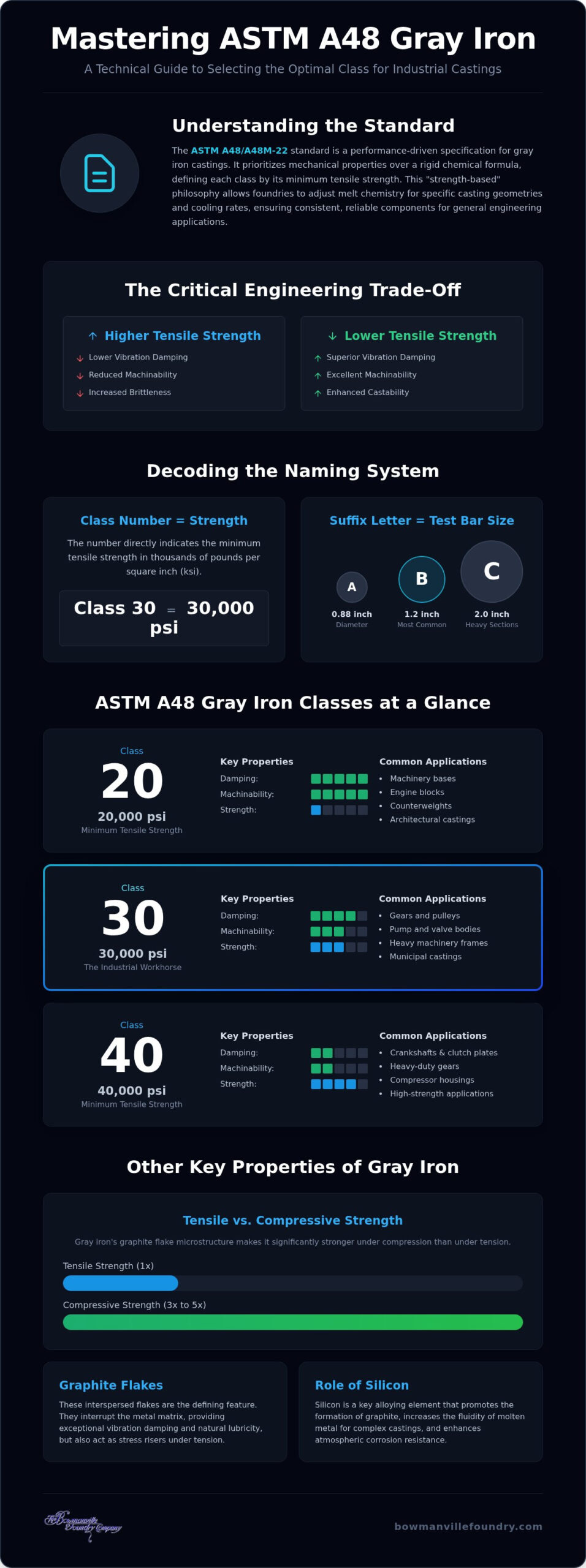
The ASTM A48/A48M-22 standard serves as the primary technical specification for gray iron castings intended for general engineering use. It’s a performance-driven standard that prioritizes mechanical properties over rigid chemical formulas. This “strength-based” philosophy is central to the standard; it defines the material by its minimum tensile strength rather than a specific recipe of iron, carbon, and silicon. By focusing on the end result, the standard allows foundries to organize the melt chemistry to account for the unique cooling rates and geometries of specific parts. This flexibility is essential because the same chemical composition can yield different mechanical properties depending on the thickness of the casting walls.
A defining characteristic of this material is its microstructure. Gray iron contains graphite in the form of flakes, which are interspersed throughout the metal matrix. These flakes act as internal stress risers but also provide exceptional vibration damping and lubricity. When a piece of this iron is fractured, the exposed graphite flakes give the metal a distinctive grey colour. This microstructure is what separates ASTM A48 gray iron classes from other ferrous alloys, providing the unique balance of castability and compressive strength that industrial projects demand.
The Naming Convention: Deciphering Class Numbers
The classification system uses a numerical designation that directly corresponds to the material’s minimum tensile strength. For example, a Class 30 designation indicates that the iron must achieve a minimum tensile strength of 30,000 psi (30 ksi). While the number is the most visible part of the spec, it’s often accompanied by a suffix letter like A, B, or C. These letters indicate the size of the test bar used during the verification process:
- Suffix A: Uses a 0.88 inch diameter test bar.
- Suffix B: Uses a 1.2 inch diameter test bar, which is the most common standard.
- Suffix C: Uses a 2.0 inch diameter test bar for heavier sections.
In addition to these classes, engineers often use the Unified Numbering System (UNS) for global cross-referencing. A Class 30 iron, for instance, is identified as UNS F12101. This dual-coding ensures that procurement remains accurate across international supply chains.
Why ASTM A48 is the Industry Standard for Gray Iron
ASTM A48 provides a reliable framework for material consistency across various Canadian industries, from heavy machinery to municipal infrastructure. Gray iron is a ferrous alloy characterized by its flake graphite microstructure. This standard is distinct from ASTM A536, which covers ductile iron, and ASTM A47, which governs malleable iron. While ductile iron offers higher ductility and impact resistance, the ASTM A48 classes are chosen for their superior machinability and ability to dampen mechanical vibrations. It’s a dependable standard that has allowed foundries to provide predictable, high-quality components for over a century.
Mechanical and Physical Properties of Gray Iron Classes
Choosing the right grade from the available ASTM A48 gray iron classes requires a nuanced understanding of metallurgical trade-offs. While it’s tempting to prioritize the highest tensile strength, doing so often reduces the material’s ability to absorb energy. The graphite flakes that define this material serve as internal dampers; as tensile strength increases in higher classes, these flakes typically become smaller and more dispersed. This change simultaneously lowers the vibration damping capacity. It’s a reliable trade-off that makes lower-strength classes like 20 or 25 ideal for engine blocks and machinery bases where noise reduction and stability are paramount.
Silicon plays a vital role in this balance by promoting graphite formation and increasing the fluidity of the molten metal. This fluidity is critical for pouring complex geometries without defects. Beyond castability, silicon enhances the material’s resistance to atmospheric corrosion. Gray iron’s high thermal conductivity also makes it the preferred choice for heat dissipation in brake rotors and industrial furnace components. If you’re currently evaluating material specifications for a new project, the team at Bowmanville Foundry can help you balance these physical properties to ensure long-term component reliability.
Tensile Strength vs. Compressive Limits
Gray iron is unique because its compressive strength is typically 3 to 4 times its tensile strength. This characteristic makes it exceptionally reliable for heavy load-bearing applications like machinery pedestals or column bases. However, engineers must account for its inherent brittleness. Unlike steel or ductile iron, gray iron lacks a distinct yield point; it undergoes very little plastic deformation before fracture. To ensure you aren’t over-stressing a component, you can consult our guide on how to choose iron casting grade to evaluate stress profiles against the limits defined in the Standard Specification for Gray Iron Castings.
Hardness and Machinability Trade-offs
Machinability is another area where lower ASTM A48 gray iron classes shine. As the class number rises, so does the Brinell Hardness (BHN). A Class 20 iron typically sits around 150 to 180 BHN, offering excellent tool life and fast cycle times. In contrast, Class 40 or 50 iron features a pearlitic matrix that is significantly harder, which increases tool wear and requires slower machining speeds. The graphite flakes in lower-strength classes act as a natural lubricant and chip breaker. This results in a superior surface finish for complex parts that require extensive post-processing or precision threading.
Comparing Common ASTM A48 Classes: 20 through 40
Selecting the correct grade from the full spectrum of ASTM A48 gray iron classes is a balancing act between mechanical resilience and manufacturing efficiency. While every class follows the same basic metallurgical principles, the performance gap between a Class 20 and a Class 50 is significant. Most industrial applications fall within the 20 to 40 range. This is where the material’s damping and machinability properties are most pronounced for standard engineering tasks.
Lower Strength Classes (20, 25, 30)
Class 20 is the entry point for gray iron. It offers the highest vibration damping and the best machinability of the group. It’s typically reserved for non-structural components like machine bases, decorative castings, or brackets where tensile stress is minimal. Because Class 20 and 25 don’t require as stringent chemistry control as high-strength grades, they’re often the most cost-effective options for large-volume production runs where weight and noise reduction are the primary goals.
Class 30 is widely considered the workhorse of the industry. It provides a reliable middle ground. It offers enough strength for general industrial machinery while retaining the ease of machining that makes gray iron attractive to procurement teams. You can find many of these grades used in common gray iron casting applications across the manufacturing sector, ranging from pulleys to standard pump housings.
High-Strength Gray Iron (Class 35, 40, and Above)
When projects demand higher load-bearing capabilities, engineers move toward Class 35 and 40. These grades require a more pearlitic matrix and tighter control over cooling rates to ensure the graphite flakes remain small and uniform. Typical applications include automotive cylinder liners, high-pressure valves, and heavy-duty gearboxes where surface wear resistance is just as essential as tensile strength. These classes require more sophisticated foundry practices to manage the increased risk of internal stresses during the cooling process.
Moving into Class 50 or 60 requires specialized technical expertise. The material becomes increasingly brittle and sensitive to section thickness in these ranges. These high-strength classes are often used in specialized high-pressure hydraulic components. However, there’s a transition point where it’s worth considering a shift to ductile iron. If a part needs both high strength and significant impact resistance, the ductility of ASTM A536 grades might offer a more robust solution than pushing ASTM A48 gray iron classes to their absolute metallurgical limits.
Engineering Considerations: Beyond Tensile Strength
Engineering for gray iron involves more than hitting a tensile target. You have to account for how the metal behaves as it cools within the mold. While the minimum tensile strength defines the ASTM A48 gray iron classes, successful project outcomes depend on understanding secondary physical properties like thermal expansion and surface finish. Gray iron generally maintains a stable coefficient of thermal expansion, making it predictable for components that experience frequent temperature cycling. However, the final surface finish is heavily influenced by the graphite flake size. Lower classes often result in a slightly coarser finish, while high-strength grades allow for tighter tolerances and smoother machined surfaces.
Verification is another vital step in the procurement process. Foundries use standardized test bars to confirm that a specific melt meets the required class. These bars provide a controlled environment to measure tensile requirements, but they don’t always reflect the exact state of a complex casting. If you need assistance navigating these technical trade-offs, the experts at Bowmanville Foundry can provide the technical data and post-processing insights required to finalize your specifications.
Vibration Damping and Sound Attenuation
One of the most valuable traits of gray iron is its ability to absorb energy. The interconnected network of graphite flakes acts as a series of internal dampers that convert mechanical vibrations into low-level heat. This unique microstructure makes gray iron significantly more effective at sound attenuation than steel or even ductile iron. Machine tool builders rely on this damping capacity to minimize resonance and chatter during high-speed cutting operations. By selecting the right class, you can ensure that a machine bed provides the necessary stability to maintain precision over years of heavy use.
Section Sensitivity and Design Geometry
Section sensitivity is a critical factor when designing for heavy-duty applications. In a thick casting, the centre cools much more slowly than the surface. This slow cooling results in larger graphite flakes and a coarser matrix, which can lead to lower strength in the core of the part. This is why a Class 30 iron might behave like a Class 20 iron in a four-inch thick section. To mitigate this, engineers often adjust pattern designs or select a higher initial class from the ASTM A48 gray iron classes to compensate for the expected drop in core strength. You can consult our iron casting design guide to learn more about optimizing geometries for consistent metallurgical results across varying wall thicknesses.
Sourcing ASTM A48 Castings from a Canadian Foundry
Procuring industrial components requires a partner that understands the nuances of metallurgy and the logistical demands of North American supply chains. Sourcing your castings from a Canadian foundry with over 120 years of experience, such as Bowmanville Foundry, provides a level of technical certainty that imported alternatives often lack. Local sourcing significantly reduces lead times and allows for direct quality oversight, ensuring that the ASTM A48 gray iron classes specified in your designs are the exact grades delivered to your facility. This proximity facilitates clearer communication and a more collaborative approach to solving complex engineering challenges.
Quality Control and Specification Adherence
Maintaining material integrity across every pour is the cornerstone of reliable manufacturing. Foundries utilize standardized testing procedures to verify that every batch meets the precise requirements of the specified class. This process involves spectrometer analysis to confirm the chemical balance and physical tensile testing to ensure mechanical compliance. By maintaining strict traceability for every component, foundries can provide the documentation necessary for critical industrial applications. This rigorous focus on quality assurance prevents the risk of casting failure and ensures that the material performs as expected under operational stress.
Post-Processing and Finishing Services
The utility of a casting often depends on what happens after it leaves the mold. Post-processing services can significantly enhance the performance of various ASTM A48 gray iron classes. For instance, specialized heat treating can relieve internal stresses or modify the matrix structure to improve wear resistance. Additionally, surface coatings can be applied to protect components from corrosion in harsh environments. To streamline your supply chain, you can utilize integrated iron casting and machining Canada to receive turnkey parts that are ready for immediate assembly. This approach reduces the number of vendors in your workflow and ensures that the final machining meets your precise engineering tolerances.
Navigating the complexities of material selection and foundry procurement is a detailed task. To assist in this process, we recommend utilizing a Free Casting Buyer’s Guide to better understand the variables that impact cost and quality. By leveraging deep institutional knowledge and advanced technical capabilities, you can move from initial design to technical certainty with confidence.
Optimizing Your Casting Selection for Long-Term Performance
Mastering the technical nuances of gray iron involves balancing tensile strength with vital physical properties like vibration damping and thermal conductivity. As we’ve explored, the success of your industrial components depends on understanding how section thickness sensitivity and precise class selection dictate real-world performance. Choosing between various ASTM A48 gray iron classes requires a methodical approach to ensure both structural integrity and manufacturing efficiency.
Since 1902, Bowmanville Foundry has served as a trusted Canadian manufacturer, providing the deep technical expertise and comprehensive data sheets necessary for informed engineering decisions. From initial material selection to full-service post-processing and finishing, we’re committed to the success of your custom casting projects. To simplify your procurement process and ensure you receive a turnkey solution that meets your exact specifications, Download our Free Casting Buyer’s Guide to select the perfect iron grade.
With the right technical framework and an experienced foundry partner, you can move forward with the confidence that your components are engineered for durability and precision.
Frequently Asked Questions
What is the difference between ASTM A48 Class 30 and Class 35?
The primary difference lies in the minimum tensile strength requirements. Class 30 iron must achieve at least 30,000 psi, while Class 35 requires a minimum of 35,000 psi. Metallurgically, a Class 35 iron typically possesses a more pearlitic matrix and finer graphite flakes. While this results in higher strength and improved wear resistance, it also causes a slight decrease in machinability and vibration damping compared to the lower class.
Does ASTM A48 specify the chemical composition of the iron?
No, the ASTM A48 standard does not mandate a specific chemical composition. It’s a performance-based specification that prioritizes mechanical properties, specifically tensile strength. This approach allows foundries to organize the chemistry of the melt to account for varying wall thicknesses and cooling rates. While elements like carbon and silicon are essential, the foundry has the technical flexibility to adjust these levels to achieve the required class for a specific geometry.
Why is gray iron preferred over steel for machine bases?
Gray iron is preferred for machine bases primarily because of its superior vibration damping capacity. The unique flake graphite microstructure absorbs mechanical energy and converts it into heat, which minimizes resonance and chatter during operation. Steel lacks this internal damping capability. Additionally, gray iron offers excellent compressive strength and dimensional stability over time. These traits ensure that machine tools maintain precision and produce high-quality surface finishes without the interference of external vibrations.
Can gray iron be heat treated to increase its hardness?
Yes, gray iron can be heat treated to increase its surface hardness or relieve internal stresses. Processes such as flame or induction hardening are commonly used to create a wear-resistant surface layer on specific areas of a casting. While heat treatment can improve hardness, it’s essential to realize that it does not significantly change the modulus of elasticity. Foundries often use stress-relieving cycles to ensure dimensional stability before final precision machining begins.
How does section thickness affect the tensile strength of an ASTM A48 casting?
Section thickness has a direct impact on the cooling rate, which determines the final strength of the casting. Thicker sections cool more slowly, leading to the formation of larger graphite flakes and a coarser pearlite matrix. This results in lower tensile strength in the centre of heavy sections. When specifying ASTM A48 gray iron classes, engineers must consider the thickest part of the design to ensure the material meets the required specifications throughout the entire component.
What are the typical applications for Class 20 gray iron?
Class 20 gray iron is typically used for non-structural components where high strength isn’t the primary requirement. Typical applications include stove parts, decorative castings, and drainage grates. Its high graphite content provides the best machinability and vibration damping within the ASTM A48 gray iron classes. This makes it an ideal choice for complex parts that require extensive machining or for applications where noise reduction and heat dissipation are more critical than load-bearing capacity.
Is ASTM A48 gray iron weldable?
Gray iron is generally considered difficult to weld because of its high carbon content and inherent brittleness. The rapid cooling associated with welding can create a hard, brittle zone that is prone to cracking. While welding is possible for repair or salvage, it requires specialized procedures, including extensive preheating and slow cooling. Many engineers prefer to avoid welding gray iron in structural applications, instead relying on precise casting designs to eliminate the need for joined components.
How do I choose between gray iron and ductile iron for my project?
The choice depends on your requirements for ductility and impact resistance. Gray iron is the superior choice for applications needing vibration damping, high compressive strength, and excellent machinability. However, if your project involves high tensile loads or the risk of sudden impact, ductile iron is more appropriate because of its ability to deform before fracturing. You should evaluate the operating environment and stress profiles of your part to determine which material offers the best long-term reliability.
