
When you are manufacturing malleable iron parts for industrial service in Canada, you judge a metal casting factory (foundry) on ductility, tensile strength, and quality-control certification before you commit tooling. Standard commercial pricing for custom iron castings averages around 19 CAD per unit depending on order volume and tooling requirements, according to recent market research. Choosing the proper alloy grade keeps components reliable under demanding loads.
Key Takeaways: Manufacturing malleable iron parts provides high impact resistance and ductility through heat treatment, making it ideal for thin-walled components that must flex without fracturing.
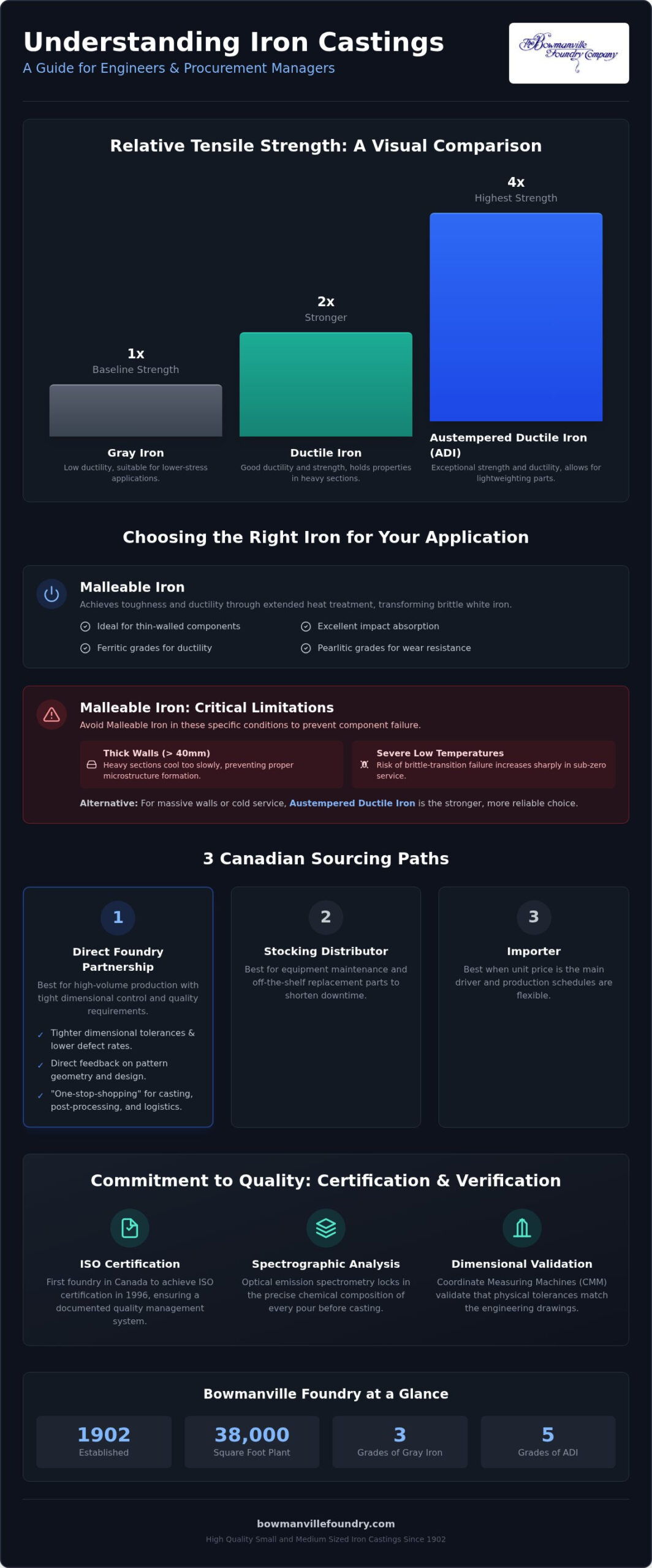
- Austempered Ductile Iron offers 4 times the tensile strength of standard gray iron.
- Avoid malleable iron for components with wall thicknesses exceeding 40 millimetres or severe cold.
- Choose ferritic grades for maximum ductility and pearlitic grades for superior wear resistance.
- Bowmanville Foundry was Canada’s first ISO-certified foundry, ensuring documented metallurgical and dimensional integrity.
Manufacturing malleable iron parts: 3 Canadian sourcing paths that fit your build
You typically face one of three situations. If you run high-volume production and need tight dimensional control, work directly with a metal casting factory so pattern geometry matches the green sand casting process before metal is poured. If you maintain equipment and need off-the-shelf replacements, a regional stocking distributor shortens downtime. If your schedule is flexible and unit price dominates, an importer can fill the gap, though you accept longer lead times and less pattern feedback.
Direct foundry partnerships, in the work we see with clients, produce tighter dimensional tolerances and lower defect rates because design engineers can adjust draft, shrink, and core prints on site. Purchasing directly from the foundry gives you an all-in-one service (one-stop-shopping) model covering casting, post-processing, and cross-border logistics. That path suits manufacturers who must meet rigorous quality management system standards.
Reach out to the facility to arrange a plant visit or request a technical assessment on your next casting project so alloy selection matches the duty cycle.
Heat treatment gives Malleable Iron its toughness
Malleable Iron starts as white iron; extended heat processing transforms brittle carbides into irregular nodules of graphite (temper carbon). That microstructure lets the alloy flex without fracturing, so you gain strength together with toughness. Three grades of Malleable Iron are manufactured here, each with different strength and ductility levels.
White iron behaves like unbaked glass; after annealing, malleable iron behaves more like toughened safety glass because internal stresses relax. Engineers specify it for smaller foundry components that must absorb impact. Designers compare grades on the iron grades technical data pages when they need load-bearing numbers: ferritic grades for high ductility, pearlitic grades when wear resistance matters more. More on this: Iron Grades Technical Data.
ADI reaches four times Gray Iron tensile strength
Austempered Ductile Iron provides four times the strength of Gray Iron while retaining strong ductility, and it is twice as strong as regular nodular iron (Ductile Iron). Use the comparison table when you shortlist alloys, then open the iron grades application guide to match grade to duty. More on this: Iron Grades Application Guide.
| Material Grade | Relative Tensile Strength | Ductility Performance |
|---|---|---|
| Gray Iron | Baseline | Low |
| Ductile Iron | 2x Gray Iron | Medium |
| Austempered Ductile Iron (ADI) | 4x Gray Iron | High |
One practical payoff: ADI lets you thin casting walls and still hold mechanical integrity, so a lightweight cast frame can perform in the same range as high-tensile structural steel. Gray Iron remains appropriate for lower-stress, thick sections where sudden fracture risk is acceptable.
If you need high-strength components, contact the metal casting factory for a technical assessment on wall thickness and heat-treat route.
When thick walls and deep cold rule out malleable iron
Skip Malleable Iron when walls must stay uniform above 40 millimetres, or when the part will sit in severe low-temperature service.
Heavy sections cool too slowly in the primary casting, so graphite forms as flakes instead of the temper-carbon structure you need after batch heat treatment. In sub-zero service the brittle-transition risk rises sharply, and thick malleable sections can fail early.
For massive walls that still need fracture toughness and higher tensile properties, Austempered Ductile Iron is the stronger route. Nodular iron also holds consistent mechanical properties through a heavy cross-section when ADI is not required.
Contact the technical team to schedule an on-site technical or sales engineer visit and walk through your wall-thickness and temperature limits.
Spectrographic checks confirm chemical exposure and tolerance data
Foundries confirm chemical-exposure tolerance with spectrographic analysis and standardized mechanical tests before parts enter severe service. Hands-on sample casting in aggressive media exposes microstructural flaws before you fund a full run, which is how premature corrosion failures get caught early.
Optical emission spectrometry locks chemical composition before the pour. Coordinate measuring machines validate physical tolerances against the drawing. Certified test protocols protect the equipment your castings go into.
A commenter in the practicalmachinist.com thread "Custom Cast Iron castings, any rec’s? | Page 2":
"In the past my dealings with foundries lead me to leave all the pattern building and modification to them, but stuff like this it isn’t really financially feasible to do that, so you either need to work closely with the foundry or know your stuff enough to do it all yourself without their help." (source)
That is why you either verify specifications yourself or stay close to qualified foundry engineers before you cut tooling.
Tip: Always request full spectrographic material test reports before approving final casting production tooling.
You can review material test reports by contacting the engineering team and requesting a site visit.
5 Pattern checks before you release tooling to production
Pattern approval proves dimensional accuracy before volume manufacturing. Shrinkage allowance on the pattern sets final component tolerance, so you check the tool against CAD before any mould is rammed.
- CAD inspection: Confirm draft angles and core prints match foundry practice.
- Pattern construction: Build the physical pattern in wood, resin, or metal in a dedicated pattern facility.
- Dimensional checking: Measure the finished tool against the original geometry.
- Sample casting: Run a test pour with a two-half mould in a rigid flask.
- Sample approval: Inspect the prototype for metallurgical soundness and dimensions.
A commenter in the practicalmachinist.com thread "Custom Cast Iron castings, any rec’s? | Page 2":
"I got a quote a couple years ago to send that CAD file to a foundry that specialized in doing this kind of low volume, no pattern casting, and the quote was approx. $1500.00 per casting." (source)
That figure reflects low-volume work without standard pattern equipment. Situation: you hold CAD but no pattern budget. Action: decide whether to fund proper tooling or pay per-piece premium methods. Outcome: a clear quote boundary before capital is spent. Direct technical review still ensures pattern geometry meets casting requirements before you invest.
ISO-backed controls protect critical industrial castings
Critical industrial parts need documented dimensional tolerances, metallurgical integrity, and a formal quality management system. Verifying foundry certifications, from the client work we track, is what prevents costly field failures in severe service. In 1996, The Bowmanville Foundry was the first foundry in Canada to achieve ISO certification.
Quality control uses optical emission spectrometry to confirm chemistry before pouring. Microstructural analysis checks graphite nodule formation in nodular iron. Magnetic particle inspection finds surface and near-surface defects. Tension tests confirm ultimate tensile strength and elongation. Those steps support long service life on heavy equipment parts.
Among Bowmanville Foundry’s Google reviews, Joe (5★) wrote:
"100 plus years outstanding quality from a family run business. I would highly recommend them. "
Decades of consistent output show what certified process control delivers in day-to-day metal casting. Customers can contact the team to discuss project requirements or plan a facility tour.
Where cast iron earns its place in Canadian plants
Malleable Iron components see wide use in municipal piping networks, automotive steering mechanisms, heavy machinery, and electrical fittings across Canada. Design engineers often pick it for thin-walled geometry that must absorb shock: the post-anneal microstructure supplies toughness under cyclic loads without cracking.
The alloy pours with the ease of cast iron yet resists fracture more like steel, so it fits high-vibration equipment, while standard gray iron still suits stationary blocks under mainly compressive load. For projects that need both strength and ductility, the metal casting factory runs a controlled green sand casting process and an all-in-one service path from mould creation through logistics.
Visit the facility with your technical drawings when you want a quote sized to the actual print.
Frequently asked questions
What is malleable iron?
Malleable iron is a cast ferrous alloy heat-treated so hard iron carbide becomes graphite rosettes in a ductile ferrite matrix. Bowmanville Foundry produces 3 grades of Malleable Iron with varying strength and ductility. That heat-treat route raises impact resistance so small components can bend instead of fracture under stress.
What are the key properties of malleable iron?
Malleable iron offers high strength, strong machinability, solid wear resistance, and meaningful ductility. The annealed microstructure absorbs shock loads. Properties stay stable in low-temperature service (conditions cold enough to change material behaviour). Design engineers choose it when intricate parts need toughness without brittle failure.
Which applications are suitable for malleable iron piping?
Malleable iron piping components suit steam distribution systems, hydraulic circuits, and industrial fluid transportation where vibration is present. Threaded joints can be cast to seal under demanding operating pressures. Contact the technical team if you want an on-site visit for a custom piping assessment.
How does malleable iron compare to cast iron?
Malleable iron provides higher tensile strength and elongation than traditional gray cast iron. Gray iron breaks under sharp impact because of brittle graphite flakes; malleable iron deforms before it fails. Choose based on whether your load is dynamic or mainly static compression.
What qualities make malleable iron suitable for heavy-duty applications?
High fracture toughness and yield strength support heavy-duty structural parts in the right section sizes. Austempered Ductile Iron provides four times the strength of gray iron according to engineering metallurgical data when you need still higher performance. The modern metal casting factory uses controlled heat treatment for consistent results in demanding industrial environments. Call the facility for detailed technical specifications or custom tooling quotes on your requirements.
Selecting the Right Iron Grade for Your Components
Selecting the correct grade for manufacturing malleable iron parts means matching tensile strength, elongation, and yield to the real duty cycle. The Bowmanville Foundry team works through those mechanical checks with you so designs are sound before production metal is poured. For material reference sheets, download the casting buyer’s guide or contact the technical engineering department for a project evaluation in 2026. Operating under established ISO certification, the metal casting factory supports custom industrial work across Canada and the United States. Request a quote or schedule a facility visit when you are ready to review engineering specifications in detail.
