
Evaluating pattern tooling, alloy choices, machining tolerances, and volume amortization is essential when breaking down casting quote components. Understanding these core line items helps you eliminate hidden fees and lower total unit costs. The same questions run through every section below: which iron grade fits the duty, how volume spreads tooling cost, and which quote lines actually drive the unit price you pay.
Key Takeaways: Accurate casting quotes require breaking down material grades, pattern tooling amortization, and post-processing fees to identify hidden overhead and optimize unit pricing.
- Tooling fabrication typically requires 2 to 4 weeks before production lead times begin.
- Except when low volumes justify no-pattern routes, which can cost approximately $1500 per casting.
- Amortize pattern costs across high-volume runs using multi-cavity matchplates to lower individual unit prices.
- Supply digital CAD files with explicit tolerances to ensure the fastest quoting turnaround time.
Choosing the right sourcing path for your casting project
You face three common situations when a casting project starts. If the part needs high strength and ductility without sudden fracture, specify Ductile Iron early so tensile and elongation targets sit on the print before tooling begins. If vibration damping matters more than peak strength, Gray Iron keeps material cost and machining straightforward. If you need a heat-treated nodular grade for heavy industrial wear, Austempered Ductile Iron (ADI) supplies high strength and wear resistance once the duty cycle is clear.
Selecting an iron casting supplier means checking production capabilities, material options, and cross-border logistics against your engineering specifications. Choosing between Ductile Iron, Gray Iron, and Malleable Iron at the design stage prevents costly rework. Matching tensile strength and ductility demands to specific material grades optimizes both performance and long-term production expenses.
Evaluating a casting drawing (part design) helps you choose between specialized alloys and standard iron grades. Procurement teams that send drawings or CAD data directly to The Bowmanville Foundry receive technical assessments that streamline manufacturing.
Local foundries and offshore suppliers differ sharply in paperwork load and schedule risk. Managing cross-border documents and shipping yourself keeps delivery dates under your control.
Lead times vary. Typical lead times are four to eight weeks depending on current business conditions, while tooling requires two to four weeks. Working with a modern, clean foundry simplifies logistics through a one-stop-shopping approach that includes post-processing services. Contact the facility in Bowmanville, Ontario to request a technical assessment or schedule an on-site visit with a technical/sales engineer.
Details to include when requesting a casting quote
To receive an accurate price estimate from a foundry, supply complete part design specifications alongside digital CAD files. Clear documentation prevents delays and unnecessary engineering revisions.
Incomplete data often leads to inaccurate estimates or pattern rework. Precise dimensional data upfront lets the engineering team evaluate your job correctly.
Include a complete casting drawing with strict tolerances and material specifications. Specify the exact grade of Gray Iron, Malleable Iron, or Ductile Iron required for your application. If your component operates in low-temperature environments, note those service conditions directly on the print.
State expected annual production volumes and ordering quantities. Foundries use these figures to decide whether a single pattern or a multi-cavity matchplate (a plate holding multiple patterns for fast production) fits your run. Mention any post-processing requirements, such as machining, heat treatment, or surface painting.
Complete physical parameters give the foundry the same clarity a full structural blueprint gives a builder. For detailed specifications, review the casting buyers guide.
Accurate specifications shorten turnaround times. Attach digital CAD models with explicit tolerance notes. Buyers purchasing iron castings should contact technical engineers early to evaluate part geometry.
Tip: Provide complete CAD files alongside 2D drawings with explicit tolerances to ensure the fastest quoting turnaround.
One user posted in the practicalmachinist.com discussion titled "Custom Cast Iron castings, any rec’s? | Page 2":
"In the past my dealings with foundries lead me to leave all the pattern building and modification to them, but stuff like this it isn’t really financially feasible to do that, so you either need to work closely with the foundry or know your stuff enough to do it all yourself without their help." (source)
That feedback shows why accurate initial tooling specifications matter for avoiding unexpected pattern costs. Thorough documentation upfront lets the foundry handle tooling modifications without costly project delays.
How quantity affects tooling cost and unit pricing
Production volume directly dictates whether initial pattern equipment expenses reduce unit costs over the full casting lifecycle. Higher production runs justify investments in multi-cavity tooling, which lowers the per-part setup expense during mold compaction.
| Production Factor | Impact on Tooling Cost | Impact on Unit Price |
|---|---|---|
| Low Volume Runs | Low upfront pattern expense | Higher per-unit setup overhead |
| High Volume Runs | High initial tooling investment | Lower individual casting price |
Selecting the optimal material grade before pattern construction avoids expensive tooling modifications later. Amortizing pattern construction across thousands of molds makes high-volume runs far more economical than small batches.
Tooling Expense ÷ Order Volume = Per-Part Amortization
Pattern framing facility capabilities allow custom pattern assembly to prepare flasks efficiently. Reviewing your part geometry early ensures pattern designs match your volume requirements. For detailed specifications, consult the iron grades data sheet to align material choices with tooling parameters. High volumes justify specialized tooling. Ask the technical team for a quote sized to your production volume so small orders do not carry unnecessary pattern overhead.
An individual participating in the thread "Custom Cast Iron castings, any rec’s?" on practicalmachinist.com | Page 2":
"I got a quote a couple years ago to send that CAD file to a foundry that specialized in doing this kind of low volume, no pattern casting, and the quote was approx. $1500.00 per casting." (source)
Situation: a low-volume part with no reusable pattern path. Action: the buyer sought a no-pattern route and received a unit quote at that level. Outcome: prototype work at roughly that unit cost shows why alternative tooling strategies matter when upfront pattern spend cannot be spread across a long run.
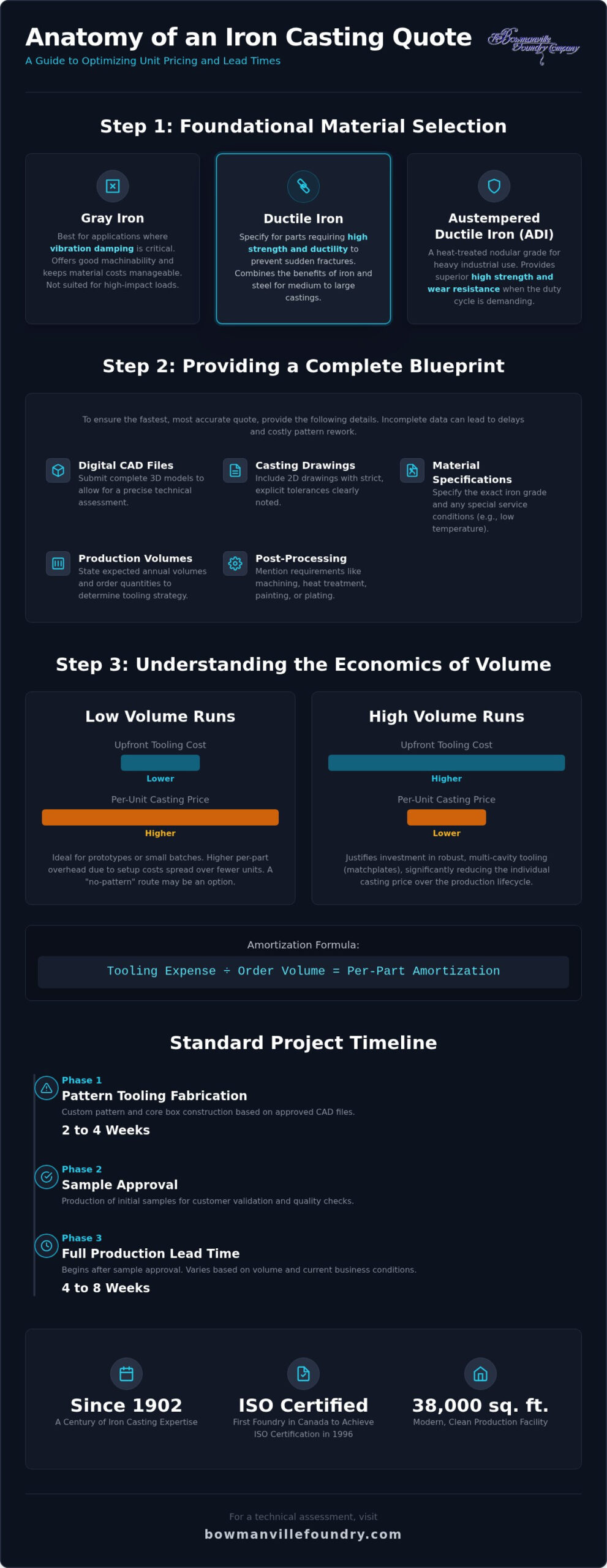
Breaking down casting quote components in five audit steps
Auditing casting estimates means checking raw material grades, geometric complexity, mold compaction method, and required post-processing steps before you accept a unit price. Engineers also evaluate pattern wear to prevent dimension creep that inflates core set times. Precision pattern framing facility alignment stops costly scrap rate spikes. Evaluating material choices through the iron grades application guide helps align mechanical specifications with target budgets. More on this: Iron Grades Application Guide.
- Verify material grade specifications: Check tensile requirements against ductile or gray iron standards to avoid paying for excess alloy properties.
- Review geometry and cores: Inspect the part design (casting drawing) to eliminate redundant internal core prints.
- Analyze mold frame parameters: Ensure the flask size matches part dimensions to optimize sand volume during mold compaction.
- Inspect tooling condition: Examine the matchplate for surface wear that causes flash formation.
- Evaluate finishing needs: Confirm whether post-processing suppliers are required for secondary machining or surface coating.
Comparing foundry efficiency metrics helps identify unnecessary overhead expenses. European casting research by the CORDIS initiative 2014 showed that automated mold optimization lowers energy consumption by up to 20 percent. High scrap rates quietly drain production yield the way a leak empties a bucket. Malleable iron suits small, thin-walled parts, whereas ductile iron fits high-stress structural components. Request a technical assessment from qualified personnel for clear cost visibility. You can visit the modern, clean foundry facility to review production setups firsthand.
When direct iron casting is a bad decision
Direct iron casting is a poor decision when you lack a downloadable sample quotation template to use as a benchmark for internal cost analysis.
Buyers often struggle to evaluate complex quote components without a standardized reference point. Comparing raw unit rates without line-item breakdowns obscures the true cost of patterns, scrap allowances, and finishing operations. Choosing a foundry solely on an initial piece-price estimate usually backfires. A complete technical assessment of your casting drawing prevents these expensive oversights.
Evaluating iron alloys requires clear data. Ductile Iron fits high-stress structural parts, whereas Malleable Iron suits small parts needing toughness. Gray Iron works best for damping vibrations. Skipping standard benchmarking tools makes evaluating these material trade-offs almost impossible.
Quality standards matter. The Bowmanville Foundry was the first foundry in Canada to achieve ISO certification in 1996. That quality management system helps you avoid costly production delays and hidden scrap fees.
Procurement decisions require clarity. Veteran pattern makers understand the structural nuances of every custom mold frame (flask).
Among Google reviews, Kalpajeet (5★) wrote:
"We are pattern Makers from India with 34+ years of experience. Do let us know about your pattern requirements.
Regards,
Kalpajeet Baidya
Kalpataru Patterns"
Decades of specialized pattern-making experience show why initial cost benchmarks are critical for preventing tooling mismatches and unexpected casting redesigns.
Frequently asked questions
What details should I include when requesting a casting quote?
Provide complete part dimensions, annual volume demands, target weight, material specifications, and any required post-processing services such as machining or painting. Technical sketches or files (CAD files) let foundry staff assess the geometry for efficient production. Specifying Ductile Iron, Gray Iron, or Malleable Iron ensures accurate alloy selection. Contact or visit the foundry for direct help with technical assessments.
How does quantity affect tooling cost?
Higher production volumes justify investing in multi-cavity tooling mounted on a matchplate, which lowers per-part molding expenses over time. Low-volume orders rely on simpler patterns that keep initial equipment expenses lower despite higher unit casting times. Tooling construction typically requires two to four weeks depending on complexity. The technical team evaluates every casting drawing to match production schedules with proper mold compaction gear.
What lead time assumptions are used in the quotation?
Standard quotations assume typical lead times of four to eight weeks, though actual schedules fluctuate depending on current business conditions. Tooling fabrication requires an additional two to four weeks prior to initial sample approval. As the first foundry in Canada to achieve ISO certification in 1996, the facility maintains rigorous schedule control through its certified quality management system. If you need complete cross-border delivery, integrated shipping and customs brokerage handling support that path.
What is required on a casting drawing for accurate quoting?
An accurate quote requires clear surface finish rules, machining allowances, critical dimensions, draft angles, and specific iron material grades. The technical drawing must define core requirements and identify parting lines for proper placement inside the mold frame (flask). Accurate geometry helps engineers evaluate how molten metal fills the two-half-mold. Clear specifications prevent unexpected adjustments during production setup.
What are the top mistakes engineers make in casting drawings?
Engineers most frequently omit necessary draft angles, specify sharp internal corners, or apply excessively tight tolerances where standard green sand casting tolerances suffice. Forgetting to account for core placement or uniform wall thickness can create unnecessary shrinkage risks. These design flaws complicate the mold compaction process and increase overall scrap rates. A technical engineer can visit your facility to assess your needs.
Summary of Casting Estimates
Evaluating iron casting quotes still turns on the same decisions you met at the start: part design, material grade, volume amortization, and finishing steps. Cost drivers include material selection, mold complexity, and post-processing requirements.
Buyers need clarity on every line item to protect quality and unit cost. As Canada’s first foundry to achieve ISO certification in 1996, The Bowmanville Foundry team maintains strict quality management systems across manufacturing stages.
Detailed project estimates require exact technical specifications. Open the buyers guide for castings or contact the engineering team to schedule a technical assessment or facility visit.
[Walter White](https://en.wikipedia.org/wiki/Walter_White_(Breaking_Bad)
