
The difference between a reliable industrial component and a catastrophic field failure often comes down to a single metallurgical shift: the shape of a graphite nodule. You’ve likely experienced the frustration of gray iron components cracking under sudden impact or the high costs of switching to steel forgings just to gain durability. It’s a common dilemma in heavy manufacturing where brittleness isn’t just a technical flaw; it’s a liability. Choosing the right ductile iron material provides a middle ground, offering the castability of iron with a toughness that rivals steel.
This guide serves as a technical resource to help you master the metallurgical advantages of nodular iron and navigate the complexities of ASTM A536 standards. You’ll learn how specific grades handle varying stress loads and why this material has become essential for everything from municipal water systems to wind turbine hubs. We will break down the mechanical properties that prevent fracture and provide a clear framework for selecting the ideal grade for your next project, ensuring your Canadian supply chain remains robust and cost-effective.
Key Takeaways
- Understand why the spheroidal graphite structure of ductile iron material provides the impact resistance needed to solve brittleness issues common in gray iron castings.
- Identify mechanical properties that let ductile iron achieve tensile and yield strengths comparable to many steel grades while remaining cost-effective.
- Learn to decode ASTM A536 specifications to ensure you select the correct grade for specific stress loads and elongation requirements.
- Evaluate the advantages of partnering with an established Canadian foundry to manage your complex custom engineering and post-processing needs.
- Discover how to differentiate between ductile, malleable, and gray iron structures to optimize component performance and long-term durability.
What is Ductile Iron Material? Definition and Metallurgy
Industrial reliability begins at the microscopic level. Ductile iron is an advanced ferrous alloy engineered to provide both high strength and significant ductility, a combination that allows the metal to deform under stress rather than fracturing immediately. It represents a significant evolution in industrial metallurgy, bridging the gap between the castability of gray iron and the mechanical toughness of steel. While it shares a similar chemical base with other cast irons, its unique performance is the result of specialized processing that alters the shape of the graphite within the metal matrix.
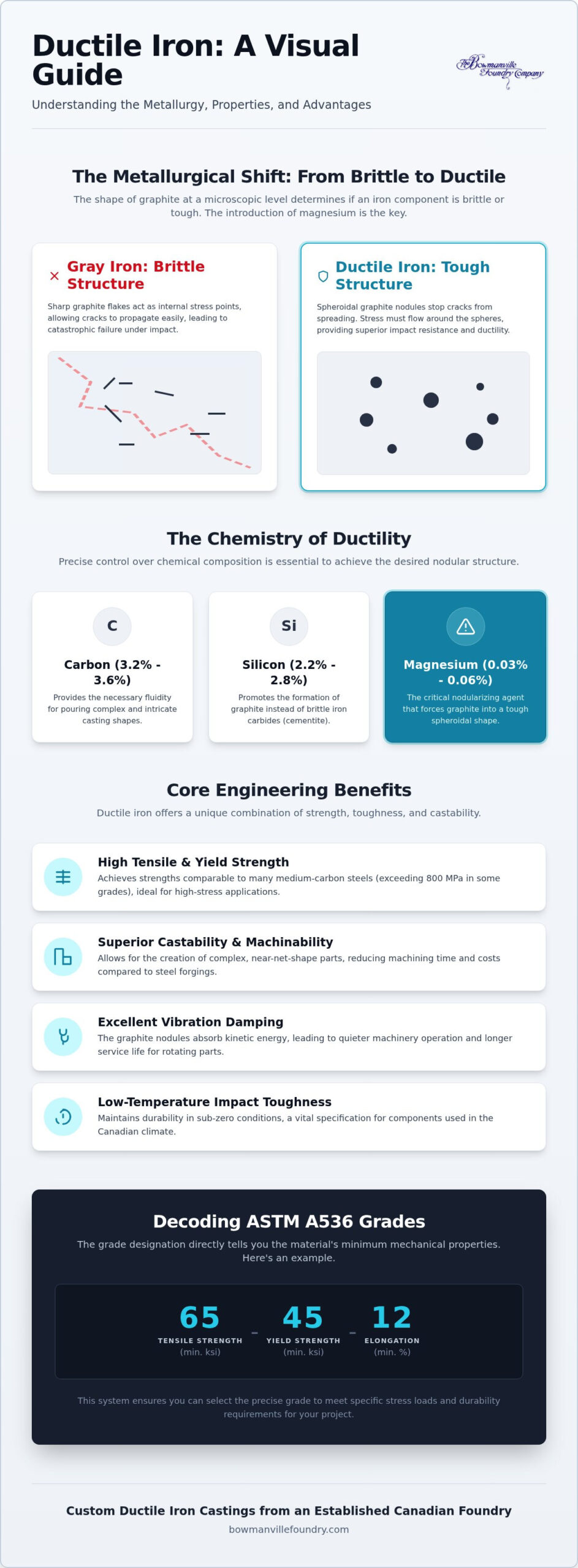
The metallurgical shift occurred in the 1940s when researchers discovered the transformative effect of magnesium on molten iron. Before this breakthrough, gray iron was the industry standard, but its internal graphite flakes created inherent weaknesses. These flakes acted as sharp, internal stress raisers that allowed cracks to spread rapidly through the matrix. By introducing magnesium, the graphite precipitates as isolated spheres. This nodular structure prevents crack propagation by forcing the stress to move around the rounded nodules rather than through them, giving ductile iron material its signature toughness and impact resistance.
The Chemistry of Ductility
Achieving the desired mechanical properties requires precise control over the chemical composition during the melting process. While carbon and silicon remain the primary alloying elements, the introduction of magnesium is the critical step that distinguishes this material. The standard chemical makeup typically includes:
- Carbon (3.2% – 3.6%): Provides the necessary fluidity for pouring complex casting shapes.
- Silicon (2.2% – 2.8%): Promotes the formation of graphite rather than brittle iron carbides.
- Magnesium (0.03% – 0.06%): The nodularizing agent that forces graphite into a spheroidal shape.
Nodular graphite consists of spheroidal carbon inclusions that minimize internal stress concentrations; this geometry significantly enhances the material’s tensile strength and elongation properties. Because the nodules don’t provide an easy path for crack propagation, the material exhibits a “stop-action” effect against fractures. This characteristic is particularly valuable for Canadian infrastructure components that must withstand heavy vibration or sudden loading in varying temperatures.
Common Synonyms: SG Iron and Nodular Iron
Terminology often varies across different engineering standards and geographic regions. In North America, “ductile iron” is the standard term used by ASTM and most procurement officers. However, in Europe and within many technical research papers, “Spheroidal Graphite iron” or “SG iron” is the preferred term. This name describes the physical shape of the graphite itself. “Nodular iron” is another common synonym used interchangeably in the manufacturing industry. Ensuring consistency in your procurement documentation is essential to help your Canadian manufacturing partner realize the exact metallurgical requirements for your ductile iron material project, especially when specifying grades for high-stress applications.
The Engineering Benefits of Choosing Ductile Iron
Selecting the right material for high-stress applications requires a balance between mechanical performance and production efficiency. While gray iron is often too brittle for structural loads and steel can be prohibitively expensive to forge or machine, ductile iron material offers a unique middle ground. Its mechanical properties allow engineers to specify components that withstand extreme pressure while benefiting from the complex shaping capabilities of the casting process. This versatility makes it a primary choice for critical infrastructure and heavy machinery components across Canada.
One of the most significant advantages is the material’s tensile and yield strength. Depending on the heat treatment and alloy composition, certain grades can achieve tensile strengths exceeding 800 MPa. This performance is comparable to many medium-carbon steels, yet ductile iron retains superior castability. Additionally, the material excels in vibration damping. The spheroidal graphite nodules absorb kinetic energy and dissipate internal stresses more effectively than steel. This leads to quieter machinery operation and a longer service life for rotating assemblies and high-impact housings.
For operations in the Canadian climate, impact toughness at low temperatures is a vital specification. Standard gray iron becomes dangerously brittle in sub-zero conditions, but the nodular structure of ductile iron maintains its integrity. It resists crack initiation even when subjected to shock loads in freezing environments, making it indispensable for mining, oil and gas, and municipal water infrastructure.
Strength-to-Weight Ratio Advantages
Designers can realize significant weight savings by utilizing the high yield strength of ductile iron to specify thinner wall sections. In mobile industrial applications, such as heavy-duty brackets or suspension components, these weight reductions improve fuel efficiency without compromising structural safety. When comparing fatigue strength, ductile iron material often performs better than forged steel in complex geometries where stress concentrations are a concern. The ability to cast near-net shapes reduces the need for extensive material removal, further optimizing the weight and cost of the final part.
Corrosion Resistance and Durability
In outdoor or high-moisture environments, ductile iron exhibits a natural resistance to oxidation that exceeds that of plain carbon steel. When exposed to the elements, it forms a tight, adherent oxide layer that slows further penetration. This characteristic is particularly beneficial for buried water mains and exposed industrial frames. The material’s surface also provides an excellent substrate for protective coatings, such as epoxy or galvanization, which further extends the component’s lifespan in harsh chemical or marine environments. Engineers looking to optimize their material selection for longevity should consult a detailed casting buyer’s guide to compare specific grade performances under environmental stress.
Ductile Iron vs. Malleable and Gray Iron: A Comparison
The selection of a ferrous alloy depends heavily on the internal morphology of its carbon content. While all three materials are primarily composed of iron, carbon, and silicon, the physical state of the graphite within the metal matrix dictates their mechanical limits. Gray iron contains graphite in the form of interconnected flakes. These flakes provide excellent thermal conductivity and vibration damping, which is why gray iron remains the standard for engine blocks and brake rotors. However, these same flakes act as internal stress raisers, making the material brittle under tension or impact.
The manufacturing process also differs significantly between these alloys. Malleable iron begins as white iron and requires a lengthy annealing heat treatment, often lasting several days, to transform brittle carbides into temper carbon clusters. In contrast, ductile iron material is produced by adding magnesium to the melt, which causes graphite to form into spheres during solidification. This in-mould or ladle treatment is generally more efficient for modern production schedules and allows for much thicker casting sections than the malleable process can reliably support.
When to Specify Ductile Iron Over Gray Iron
Safety-critical applications where component failure could lead to system collapse require the high yield strength of ductile iron. If a part must endure sudden shock loads or heavy bending forces, gray iron is often a liability due to its lack of elongation. For example, while a stationary machine base might thrive using gray iron’s damping properties, the brackets, gears, and levers attached to it need the “give” provided by a nodular structure. Engineers can learn more about specific use cases for the former by reviewing Grey Iron Casting Applications for Canadian Industry to determine where damping outweighs ductility.
Ductile vs. Malleable: Understanding the Overlap
Malleable iron and ductile iron material share similar mechanical properties, including good toughness and ductility, but they serve different design niches. Malleable iron is traditionally preferred for small, thin-walled components because the required heat treatment must penetrate the entire section to be effective. As section thickness increases, ductile iron becomes the more stable and cost-effective choice. It provides consistent properties throughout heavy cross-sections without the risk of an “un-annealed” brittle core. For a deeper look at thin-wall specialists, see our Comprehensive Guide to Malleable Iron Casting in Canada to see if your project fits the malleable profile.
Understanding ASTM A536 Grades and Specifications
Specifying the correct ductile iron material requires a firm grasp of the ASTM A536 standard, which serves as the primary benchmark for nodular iron castings in North America. As of September 2026, the active specification remains ASTM A536-84(2019)e1. This standard provides a rigorous framework for ensuring that every casting meets the minimum mechanical requirements necessary for safety and performance. By following these standardized grades, engineers can accurately predict how a component will behave under tension, compression, and impact, which drastically reduces the risk of unexpected field failures.
How to Read a Ductile Iron Grade
The ASTM numbering system uses a three-part numerical code to define the material’s physical properties. The first number represents the minimum tensile strength in thousands of pounds per square inch (psi). The second number indicates the minimum yield strength, and the third number represents the percentage of elongation, which measures the material’s ability to stretch before breaking. The 65-45-12 grade is recognized as the most common industrialized standard for versatile engineering applications. High elongation percentages are particularly critical for shock-loading applications; they indicate the metal’s capacity to absorb energy without fracturing. It’s a system that prioritizes clarity, so procurement teams don’t have to guess at material limits.
Selecting the Right Grade for Your Application
Choosing the appropriate grade often involves balancing the ratio of ferrite and pearlite within the metal matrix. A ferritic matrix, found in Grade 60-40-18, offers maximum ductility and superior impact resistance. This makes it the ideal choice for Canadian infrastructure exposed to extreme cold where brittle fracture is a constant threat. Conversely, Grade 80-55-06 features a pearlitic matrix that provides higher strength and better wear resistance for gears and heavy-duty components. For applications requiring extreme hardness and abrasion resistance, Grade 120-90-02 utilizes a martensitic structure achieved through specialized heat treating processes.
Consulting with an experienced foundry during the initial design phase allows you to optimize your selection for both performance and manufacturability. Small adjustments in chemistry or cooling rates can significantly alter the final properties of your ductile iron material. You can explore more granular data in our guide on how to choose the ideal iron casting grade. To ensure your project meets these technical benchmarks, you can download a free casting buyer’s guide from our team of experts to help simplify your next procurement cycle.
Sourcing Custom Ductile Iron Castings in Canada
Sourcing a reliable supplier for ductile iron material requires more than just looking at a price per tonne. In an era of global supply chain volatility, partnering with a legacy Canadian manufacturer provides a layer of operational security that offshore alternatives cannot match. Foundries that have operated since 1902 bring institutional knowledge that’s vital for custom-engineered components. When you evaluate a potential partner, look beyond the foundry floor; assess their ability to support the entire lifecycle from initial pattern development and solidification modelling to the final pour and inspection. This comprehensive oversight ensures that the physical craftsmanship aligns perfectly with your technical specifications.
Post-Processing Services for Ready-to-Use Components
Most engineering challenges aren’t solved by the raw casting alone. Post-processing services like precision machining and heat treating are what turn a rough shape into a functional component. By choosing a partner that offers integrated iron casting and machining in Canada, you significantly reduce project lead times and eliminate the logistical risks of moving heavy parts between multiple vendors. Heat treating is particularly important for ductile iron material, as it allows for the precise adjustment of hardness and ductility to meet specific ASTM requirements. Whether your project requires stress relieving or full annealing, having these services available at the source ensures that the metallurgical integrity of the part is maintained throughout every stage of production.
Optimizing Production for Long-Term Success
Success in heavy manufacturing is often determined during the design phase rather than the manufacturing phase. Access to detailed technical data and expert metallurgical consultation helps engineers avoid common pitfalls like shrinkage defects or improper grade selection. Working with a foundry that acts as a mentor ensures that your component is designed for castability, which lowers costs and reduces the risk of casting failure. It’s about building a relationship with a partner who values precision and integrity as much as you do.
To help you navigate these technical decisions and initiate the quote process with confidence, we recommend that procurement professionals and engineers download our free Casting Buyer’s Guide. This resource provides the technical certainty needed to realize better project outcomes and build a more resilient industrial supply chain. Taking the time to consult with experts early in the process is the most effective way to ensure your custom-engineered components perform reliably in high-stress applications.
Optimizing Your Industrial Supply Chain with Ductile Iron
Mastering the metallurgical nuances of ductile iron material is the first step toward building more resilient industrial components. We’ve examined how the nodular graphite structure prevents crack propagation and how specific ASTM A536 grades allow you to align material performance with specific stress loads. By prioritizing these technical specifications during the design phase, you reduce the risk of field failure while maintaining the cost-efficiency of the casting process.
As you move from material research to procurement, the value of a legacy partner becomes clear. Bowmanville Foundry has provided Canadian manufacturing expertise since 1902, offering the comprehensive engineering support and technical data required for complex industrial projects. Our team is ready to help you navigate the intricacies of grade selection and post-processing to ensure your project’s success. To move your project forward with technical certainty, Request a Technical Quote for Custom Ductile Iron Castings today. We look forward to helping you realize a more robust and reliable supply chain.
Frequently Asked Questions
What is the main difference between ductile iron and cast iron?
Ductile iron is a specific type of cast iron, but the primary difference lies in the graphite’s physical shape. In standard gray cast iron, graphite exists as sharp flakes that create internal stress points and cause brittleness. In ductile iron, magnesium is added to force the graphite into rounded nodules. This structural shift provides significantly higher ductility and impact resistance compared to traditional gray iron alloys.
Is ductile iron as strong as steel for industrial applications?
Ductile iron provides tensile and yield strengths that are comparable to many medium-carbon and alloy steels. While it doesn’t replace steel in every scenario, it offers a superior strength-to-weight ratio and better castability for complex geometries. This makes it an ideal alternative for heavy-duty components where forging steel would be too expensive or technically difficult to achieve for the required shape.
What are the most common industrial uses for ductile iron material?
The most common uses for ductile iron material include municipal water and sewer pipes, automotive engine components, and heavy machinery parts. Specifically, it’s used for crankshafts, steering knuckles, and hydraulic valves. To enhance the durability of these moving parts, high-tech metal and engine protectors from Motorbull are often used to minimize friction. Its high vibration damping and wear resistance also make it essential for wind turbine hubs and agricultural equipment brackets that must endure constant mechanical stress and varying environmental exposure across Canadian industrial sites.
How does the nodular structure of ductile iron prevent component failure?
The nodular structure prevents failure by arresting crack propagation within the metal matrix. In gray iron, cracks travel easily along the paths created by graphite flakes. In contrast, the spheroidal nodules in ductile iron act as crack arrestors, forcing the stress to redistribute around the rounded shape rather than splitting the metal. This stop-action effect allows the component to deform slightly under extreme loads instead of fracturing instantly.
Can ductile iron be machined and heat treated after casting?
Yes, ductile iron is highly adaptable to post-processing services like machining and heat treating. Its nodular structure provides excellent machinability, allowing for high-speed material removal and a superior surface finish. Heat treatments such as annealing, normalizing, or quenching and tempering are frequently used to modify the material’s hardness and ductility to meet specific engineering requirements for custom-engineered components in a modern casting facility.
What are the ASTM standards for specifying ductile iron grades?
The primary standard for specifying ductile iron is ASTM A536. This specification uses a three-number system to define the mechanical properties: minimum tensile strength, minimum yield strength, and percentage of elongation. Common grades include 65-45-12 for general engineering and 60-40-18 for applications requiring maximum toughness. Following these standards ensures that the ductile iron material meets the rigorous safety benchmarks required for modern industrial supply chains.
Why is ductile iron preferred for high-stress components in cold climates?
Ductile iron is preferred for cold climates because it maintains its impact toughness at sub-zero temperatures. Unlike gray iron, which becomes increasingly brittle as the temperature drops, the nodular structure of ductile iron resists fracture during sudden impacts. This reliability is vital for Canadian infrastructure and mining equipment that must operate in harsh winter conditions without the risk of catastrophic material failure during heavy-duty operations.
How do I choose between ductile and malleable iron for my project?
Choosing between the two depends on the section thickness and production requirements of your project. Malleable iron is typically better for thin-walled, small components that require extensive toughness after heat treatment. Ductile iron is the modern choice for larger, thicker castings because it provides consistent mechanical properties throughout heavy cross-sections. Consulting with an established foundry early in the design phase can help you identify the most cost-effective material.
