
Selecting the wrong grade of ductile iron isn’t just a minor oversight; it’s a calculated risk that can lead to catastrophic component failure under load. While the ASTM A536-24 standard provides a rigorous framework for mechanical properties, the transition from theory to a finished, machined casting is often fraught with uncertainty. You likely realize that the three-number naming convention for ASTM A536 ductile iron grades defines tensile strength, yield strength, and elongation, but understanding how these figures translate to real-world performance requires a deeper look at metallurgy.
We understand the pressure of balancing high-stress durability with efficient machinability. It’s frustrating when a grade that looks perfect on a datasheet causes excessive tool wear or fails to provide the necessary impact resistance in the field. This guide serves as a technical resource to help you master these specifications and select the optimal material for your specific industrial components. We’ll provide a clear framework to help you choose between ferritic and pearlitic microstructures. By the end of this article, you’ll have a comprehensive understanding of everything from 60-40-18 to 120-90-02 grades, giving you the confidence to source high-quality castings that meet your exact engineering standards.
Key Takeaways
- Understand the unique spheroidal graphite structure of nodular iron and why the ASTM A536-24 standard remains the benchmark for North American industrial specifications.
- Gain a technical breakdown of the five primary ASTM A536 ductile iron grades to identify the ideal balance between high elongation and superior tensile strength.
- Learn how to evaluate stress profiles and yield strength requirements to prevent permanent deformation in critical high-load industrial components.
- Discover how section thickness and cooling rates impact final mechanical properties and how to optimize casting designs for grade-specific shrinkage rates.
- Realize the operational benefits of collaborating with an established Canadian foundry on integrated pattern development and post-processing finishing to ensure component quality.
The Fundamentals of ASTM A536 Ductile Iron Specifications
The ASTM A536-24 standard serves as the definitive benchmark for North American foundries, providing a rigorous framework for the mechanical properties of ductile iron castings. This standard ensures that engineers and procurement professionals receive components with predictable performance. While gray iron has been a manufacturing staple for centuries, the development of Ductile iron, also known as nodular or spheroidal graphite iron, revolutionized the industry by offering a material that bridges the gap between traditional cast irons and carbon steel. Ductile iron is a material that combines the castability of iron with the toughness of steel.
The primary purpose of the ASTM A536 standard is to codify the relationship between the material’s internal microstructure and its external performance. In Canada, where industrial equipment often operates in extreme thermal and mechanical environments, adhering to these specifications isn’t just a matter of compliance; it’s a requirement for safety and longevity. By standardizing ASTM A536 ductile iron grades, the industry ensures that a casting sourced from a reputable Canadian foundry will meet the same minimum tensile and yield requirements regardless of the specific production run.
The Spheroidal Advantage: Ductility vs. Brittleness
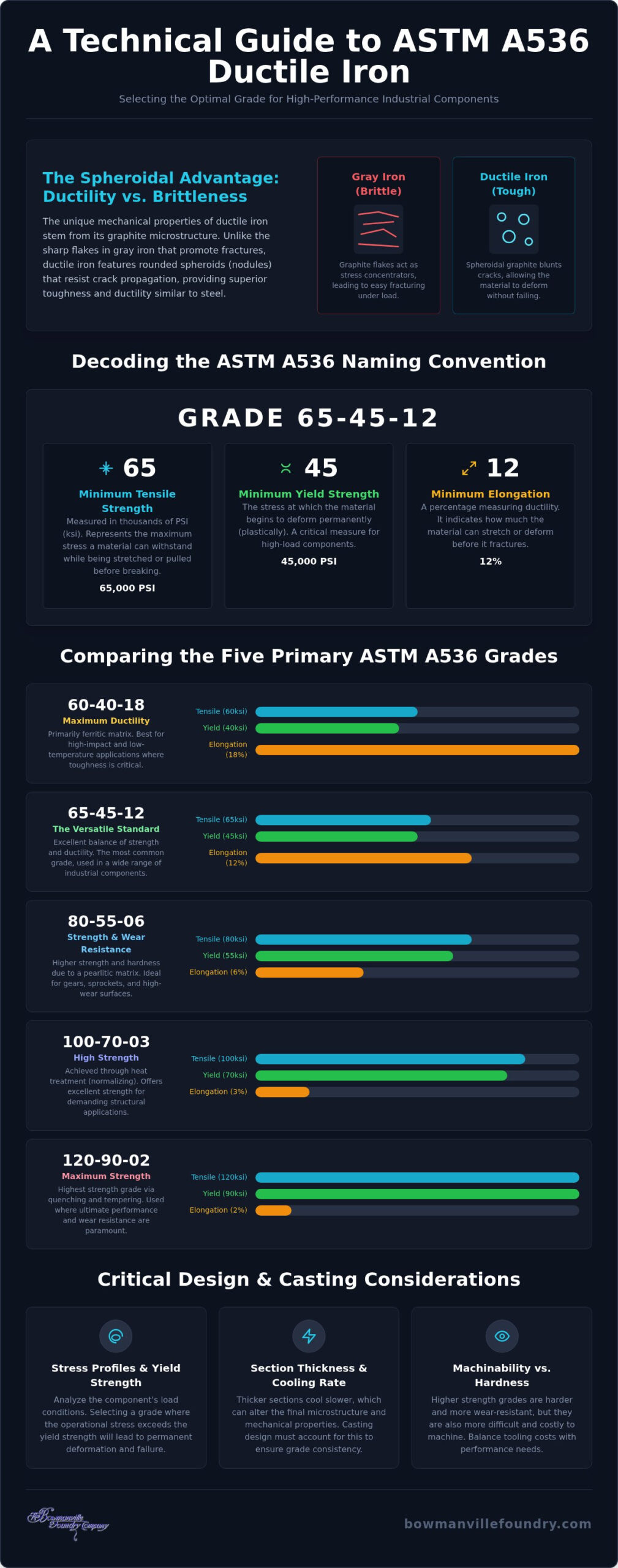
The defining characteristic of ductile iron lies in its graphite morphology. In gray iron, graphite forms as sharp, elongated flakes. These flakes act as internal stress concentrators, providing a path for cracks to propagate easily, which results in a brittle material. During the casting process for ductile iron, foundries introduce a nodulizer, typically magnesium, which causes the graphite to form into spheres or nodules instead of flakes.
These spheroids blunt potential cracks rather than encouraging them. This structural difference allows the material to deform without fracturing, a property known as ductility. This mechanical relationship between material flexibility and structural integrity is why engineers prefer ductile iron for high-impact applications. It provides the necessary “give” to survive sudden shocks that would shatter gray iron components.
Understanding the ASTM Naming Convention
The naming convention for ASTM A536 ductile iron grades utilizes a three-number system that explicitly states the minimum mechanical properties of the material. For example, consider Grade 65-45-12, one of the most versatile and widely used specifications. Each number represents a critical performance metric:
- 65: Represents the minimum tensile strength in thousands of pounds per square inch (65,000 psi).
- 45: Indicates the minimum yield strength (45,000 psi), the point at which the material begins to deform permanently.
- 12: Denotes the minimum elongation percentage, which measures the material’s ability to stretch before breaking.
Foundries utilize these targets to guide their metallurgical processes. By adjusting the cooling rates and chemical compositions, they can tailor the casting to meet these specific procurement requirements. This system allows for a clear, no-nonsense dialogue between the design engineer and the foundry, ensuring the final part is fit for its intended purpose.
Decoding the Standard: Understanding the Five Primary Ductile Iron Grades
ASTM A536-24 is a performance-based standard. It doesn’t mandate a strict chemical recipe, meaning foundries aren’t tied to specific percentages of carbon or silicon. Instead, the standard prioritizes mechanical results. This flexibility allows a foundry to adjust alloying elements to reach the target properties based on the specific casting’s geometry. The core trade-off across the ASTM A536 ductile iron grades is the inverse relationship between tensile strength and elongation. As the material gets stronger, it becomes less capable of stretching before failure.
The Ferritic Grades: 60-40-18 and 65-45-12
Grade 60-40-18 represents the peak of ductility within the standard. Its matrix is primarily ferritic, providing maximum impact resistance. This is critical for Canadian operations where equipment must withstand brittle fracture risks in sub-zero temperatures. Grade 65-45-12 is the general-purpose workhorse. It offers a slight increase in strength while maintaining excellent machinability. These ferritic grades are easier to cut and shape. This reduces tool wear and total production costs for complex industrial components.
The Pearlitic Grades: 80-55-06, 100-70-03, and 120-90-02
As we move into higher-strength ASTM A536 ductile iron grades, the microstructure shifts toward pearlite. Grade 80-55-06 introduces more pearlite into the matrix to increase hardness. This grade is a staple for heavy machinery parts like crankshafts or gears. For even higher load requirements, Grade 100-70-03 provides a fully pearlitic structure. It sacrifices elongation for significant tensile strength. The Ductile Iron Pipe Research Association highlights how these strength characteristics are vital for infrastructure that must resist high internal pressures.
At the top end, Grade 120-90-02 often requires specialized heat treatment, such as quenching and tempering, to achieve a martensitic matrix. It’s chosen for extreme wear environments where strength is the absolute priority. Selecting between these options requires a deep understanding of the final application’s stress profile. If you’re unsure which specification fits your project, reviewing a casting buyer’s guide can help clarify the metallurgical selection process.
Material Selection: Balancing Tensile Strength, Yield, and Elongation
Evaluating a component’s stress profile is the first step in successful material procurement. You must determine whether the part will face constant static loads, sudden impacts, or repetitive cycling. For many engineering applications, the yield strength is more important than the ultimate tensile strength. It represents the point where the material undergoes permanent deformation. If your design requires a safety margin against catastrophic failure, prioritizing elongation is essential. High elongation allows the metal to stretch under extreme stress, which can prevent sudden fractures in high-impact environments.
A logical selection framework starts with the most ductile of the ASTM A536 ductile iron grades and moves toward higher strength only as the load requirements dictate. If 60-40-18 provides enough strength, its superior impact resistance makes it the safest choice. However, if the design involves sliding contact or high surface pressure, the shift to a pearlitic grade becomes necessary to prevent premature wear. Foundries standardize these properties by controlling the cooling rate within the mould, allowing for a tailored approach to every casting project.
Selecting the right material involves more than just reading a datasheet. You can learn more about this process in our guide on How to Choose the Ideal Iron Casting Grade.
Performance Comparison: Ductile Iron vs. Mild Steel
Grade 65-45-12 is frequently chosen as a direct replacement for mild steel fabrications. It offers comparable strength but with the added benefits of the casting process. Ductile iron is approximately 10% lighter than steel, providing an improved strength-to-weight ratio that is highly valued in the automotive and heavy equipment sectors. Casting complex, near-net-shape geometries reduces the need for extensive machining and eliminates the labour-intensive welding associated with steel bar stock. This transition often results in a part that is both lighter and more cost-effective to produce.
Wear Resistance and Surface Hardness
The hardness of ASTM A536 ductile iron grades is directly tied to the pearlite content in the matrix. Higher pearlite levels naturally increase the Brinell Hardness Number (BHN), making the material more resistant to abrasion. For components like gears, gearboxes, and rollers, choosing a pearlitic grade like 80-55-06 or 100-70-03 provides a durable surface that often eliminates the need for expensive secondary heat treatments. This inherent hardness extends the service life of parts operating in harsh, abrasive conditions without the risk of surface cracking often seen in hardened steel.
Design and Post-Processing Considerations for Ductile Components
Successful casting design requires more than just defining a final geometry; it involves understanding how different ASTM A536 ductile iron grades behave during solidification. Pattern development must account for specific shrinkage rates, which vary slightly depending on the intended matrix structure. Section thickness is a critical variable in this process. A heavy section cools more slowly than a thin one, which can lead to variations in graphite nodule size and matrix composition within a single part. A foundry with deep institutional knowledge manages these cooling rates to ensure that the mechanical properties remain consistent throughout the entire component.
Transitioning from a raw casting to a finished, functional part requires a coordinated approach between the foundry and the machine shop. You can find detailed insights on optimizing this workflow in our guide to Integrated Iron Casting and Machining in Canada.
Heat Treating for Enhanced Properties
Heat treatment is a precise tool for refining material properties after the initial pour. Foundries utilize annealing for ferritic grades to maximize impact toughness and ductility, which is essential for parts facing extreme vibrations. Conversely, normalizing and tempering are used to achieve the high-strength pearlitic structures required for heavy-load applications. Beyond property enhancement, stress relieving is a vital step for complex castings. This process removes internal residual stresses that might otherwise cause the part to warp or distort during final machining, ensuring the component maintains its dimensional integrity over its service life.
Machinability and Surface Finishing
Machining speed is often the deciding factor in total part cost. While all ASTM A536 ductile iron grades are machinable, the ferritic options provide the longest tool life. Grade 60-40-18 is considered the gold standard for high-volume machining because its soft, ferritic matrix allows for faster cutting speeds with minimal tool wear. As the pearlite content increases in higher grades, the material becomes harder, requiring more robust tooling and slower feed rates.
Once machining is complete, surface finishing prepares the part for its operating environment. Ductile iron provides an excellent substrate for various coatings, including painting, powder coating, or galvanizing. Achieving critical tolerances requires a partner who understands how custom-engineered iron components respond to these finishing steps. If you’re looking to streamline your supply chain, consider sourcing ready-to-use ductile iron castings that have already undergone integrated machining and heat treating.
Optimizing Your Ductile Iron Casting Production in Canada
Choosing a foundry with a legacy that dates back to 1902 provides a level of certainty that is essential for high-stakes industrial projects. This depth of experience allows for a more nuanced understanding of how metallurgical variables affect the final product. Every pour must strictly adhere to the ASTM A536-24 specification to ensure the integrity of the finished component. High-quality production relies on a combination of traditional craftsmanship and modern facility controls. This ensures that the chosen ASTM A536 ductile iron grades consistently meet their minimum property requirements.
Collaborating with your foundry during the initial pattern development stage is one of the most effective ways to reduce material waste. By refining the design early, you can optimize gating and riser systems to improve yield and shorten lead times. Detailed engineering support helps identify potential issues before the first drop of metal is poured. You can explore more about this collaborative process in our guide on Optimizing Custom Iron Casting Production.
From Pattern to Pour: The Value of Engineering Support
Early involvement from foundry engineers prevents common casting defects like porosity or inclusions. Modern casting facilities utilize sophisticated thermal modelling and chemistry controls to maintain precise grade properties across different production batches. This level of oversight is necessary for complex components that require tight tolerances. Canadian manufacturers benefit from local technical support and reduced logistics risks. Working with a domestic partner ensures that communication remains clear and that any technical adjustments can be made quickly without the delays associated with international shipping.
Next Steps: Sourcing Your Components
Preparing a technical Request for Quotation (RFQ) for ductile iron castings requires clarity on mechanical requirements and post-processing needs. You should specify the required grade, any necessary heat treatments, and the desired surface finish. Choosing a “ready-to-use” component supplier is often the most efficient path for national industrial projects. This integrated approach combines casting with machining and finishing services, delivering a part that is ready for immediate assembly. To streamline your procurement process and avoid common pitfalls, you can download our Free Casting Buyer’s Guide for a detailed walkthrough of the selection and sourcing journey. Mastering the technical specifications of ASTM A536 ductile iron grades is the foundation of a successful procurement strategy.
Advancing Your Industrial Casting Strategy
Mastering the technical nuances of ASTM A536 ductile iron grades is a prerequisite for any successful engineering project. You’ve seen how the transition from ferritic to pearlitic microstructures dictates everything from impact resistance to surface hardness. By prioritizing yield strength and elongation during the selection process, you ensure that your components can withstand the rigorous demands of their operating environments. Successful production doesn’t end at the pour; it requires a holistic approach that integrates precise casting design with expert heat treating and machining.
With over 120 years of Canadian foundry expertise, we specialize in delivering custom-engineered iron components that meet your exact specifications. Our integrated post-processing and finishing services provide a streamlined path from initial concept to a ready-to-use part. We invite you to request a quote for custom ductile iron castings to see how our institutional knowledge can support your next national industrial project. We look forward to helping you achieve technical certainty in your manufacturing operations.
Frequently Asked Questions
What is the difference between ASTM A536 and ASTM A395?
ASTM A536 is the general industrial standard for ductile iron castings. ASTM A395 is a more specialized specification intended for pressure-retaining parts used at elevated temperatures. While both standards cover nodular iron, A395 mandates stricter control over chemical composition, particularly silicon and phosphorus levels. This ensures the material maintains its integrity under internal pressure. For most non-pressure industrial components, the standard ASTM A536 ductile iron grades provide the necessary performance and flexibility.
Can ductile iron be welded if repairs are needed?
Ductile iron can be welded, but the process requires strict adherence to specialized metallurgical procedures. Because the material has a high carbon content, rapid cooling after welding can create brittle carbides in the heat-affected zone. To prevent cracking, you should utilize pre-heating and post-weld heat treatment. Using high-nickel filler rods is also a common practice to maintain the ductility of the joint, ensuring the repaired section performs reliably under mechanical stress.
Which ASTM A536 grade is best for low-temperature applications in Canada?
Grade 60-40-18 is the optimal choice for low-temperature applications across Canada. This grade features a fully ferritic matrix that provides maximum impact toughness and elongation. In sub-zero environments, materials often become more brittle; however, the high ductility of 60-40-18 helps prevent catastrophic fracture. It remains the standard for components that must survive sudden shocks in extreme cold without compromising the structural integrity of the industrial assembly.
How does section thickness affect the properties of a ductile iron casting?
Section thickness directly influences the cooling rate of the molten metal, which dictates the final microstructure. A thick section cools slowly, often leading to larger graphite nodules and a higher percentage of ferrite in the matrix. Conversely, thin sections cool rapidly, which can increase hardness but reduce ductility. Experienced foundries adjust the inoculants and chemical balance of ASTM A536 ductile iron grades to ensure uniform mechanical properties throughout parts with varying thicknesses.
Is heat treating always necessary for ASTM A536 Grade 80-55-06?
Heat treating is not always required for Grade 80-55-06. Many modern foundries achieve the necessary balance of pearlite and ferrite in the as-cast state through precise control of the cooling process. However, if the casting has highly irregular section thicknesses or complex geometries, a normalizing heat treatment might be used to ensure the mechanical properties are consistent. This extra step guarantees that the final part meets the minimum tensile and yield requirements.
How do I know if my casting meets the specified ASTM A536 grade?
You can confirm your casting meets the standard by reviewing the Certified Material Test Report (CMTR) provided by the foundry. This document records the results of physical tests performed on test coupons poured from the same melt. The report verifies the minimum tensile strength, yield strength, and elongation percentages. Reputable suppliers also perform regular spectrographic analysis and microstructural checks to ensure the graphite nodules are correctly formed and distributed.
What are the typical lead times for custom ductile iron production?
Typical lead times for custom ductile iron production depend on whether you require new pattern development or are using existing tooling. The initial engineering and pattern-making phase can take several weeks to ensure the geometry is optimized for the casting process. Once production begins, the cycle includes moulding, pouring, cooling, and post-processing finishing. We recommend discussing your specific timeline early in the procurement process to align the foundry schedule with your project milestones.
Can Grade 65-45-12 replace carbon steel fabrications?
Grade 65-45-12 is an excellent candidate to replace carbon steel fabrications. It offers a yield strength comparable to many mild steels while providing superior vibration damping and better corrosion resistance. By choosing a casting over a welded fabrication, you can realize significant weight savings and reduce the labour costs associated with complex machining and welding. This grade allows for the creation of near-net-shape components that are difficult to produce using traditional steel stock.
