
Selecting a Canadian iron foundry for pump components starts with how each part must perform in service, not just a grade label. Match the material and casting design to the component’s function, geometry, and operating requirements, then assess whether the foundry’s processes and quality system fit the project. Drawings are essential, but the service conditions help explain what the part must do.
Confidence in a material choice comes from comparing grade information with the actual application. This guide explains how Ductile, Gray, and Malleable Iron may fit different pump-component requirements, and what information helps a foundry engineer carry out a useful technical assessment. It also covers how CAD files, geometry, core requirements, and post-processing shape casting feasibility and project planning.
When assessing a foundry, consider its quality system, production capabilities, and approach to sample approval. Established in 1902, Bowmanville Foundry achieved Canada’s first ISO certification in 1996 and produces small and medium sized iron castings for the Pumps and Valves industry. The sections ahead connect material selection, casting design, quality controls, and finishing into a practical sourcing framework.
Key Takeaways
- Define a pump component’s function, geometry, and operating conditions before beginning a material assessment.
- Understand how CAD files, mold and core requirements, tooling, and sample approval fit into casting development.
- Compare Ductile, Gray, and Malleable Iron using grade-specific technical data, not grade names alone.
- Assess a Canadian iron foundry for pump components by reviewing its quality system, material information, technical communication, and process fit.
- Prepare drawings, grade questions, and post-processing requirements for a focused quote request for small and medium sized castings.
Canadian Iron Foundry for Pump Components: Start with the Part’s Service Requirements
A pump component is defined by the work it performs, the geometry that enables that function, and the conditions it encounters in service. Begin with those engineering requirements rather than a preferred material or catalogue description. Define the component’s requirements before selecting a casting grade. A Canadian iron foundry for pump components can then assess the part against its intended use and casting requirements.
Bowmanville Foundry serves the Pumps and Valves industry with small and medium sized iron castings. For a productive first discussion, separate what the component does from how it is shaped and where it operates. General information about foundries and casting processes is available in this Foundry overview, but the pump part still needs a project-specific engineering review.
Which pump-component details belong in the initial specification?
Describe the part’s role in the pump assembly and the interfaces it must maintain with adjoining components. A casing, cover, or other component may have different geometry and interface requirements, so identify the specific part rather than relying on a general assembly description. Provide CAD files or drawings with the applicable revision clearly identified. Note critical dimensions, mating surfaces, openings, and features that affect the casting shape or later machining.
Include the operating information available in the project record or customer requirements. Depending on the application, this may include the pumped medium, operating temperature and pressure, exposure to rotation or vibration, and duty cycle. Treat these as project details to document, not assumptions about design limits. Flag missing or provisional values so they can be distinguished from approved requirements during the technical assessment.
- Part function and position in the pump assembly
- Current drawing revision, CAD files, and interface details
- Critical dimensions and features that affect casting feasibility
- Customer-provided operating conditions and known duty requirements
- Open questions, assumptions, or requirements awaiting engineering review
Why service conditions matter before material selection
Material selection depends on the demands placed on the specific component. Separate documented requirements from assumptions. For example, record a specified operating condition as a requirement, but mark an estimated value as an assumption that needs review. This prevents a preliminary grade preference from being mistaken for an approved engineering decision.
The component’s function and service conditions guide the grade comparison, but they do not establish by themselves that a casting will meet every performance requirement. Geometry, interfaces, and intended service all inform the assessment. Use the foundry’s technical data and application guidance to compare material options against the actual part requirements. The published guide to choosing the ideal iron casting grade can help structure the comparison. Bring the component information together before settling on a grade.
How Pump-Component Casting Design Moves from CAD Files to a Sample
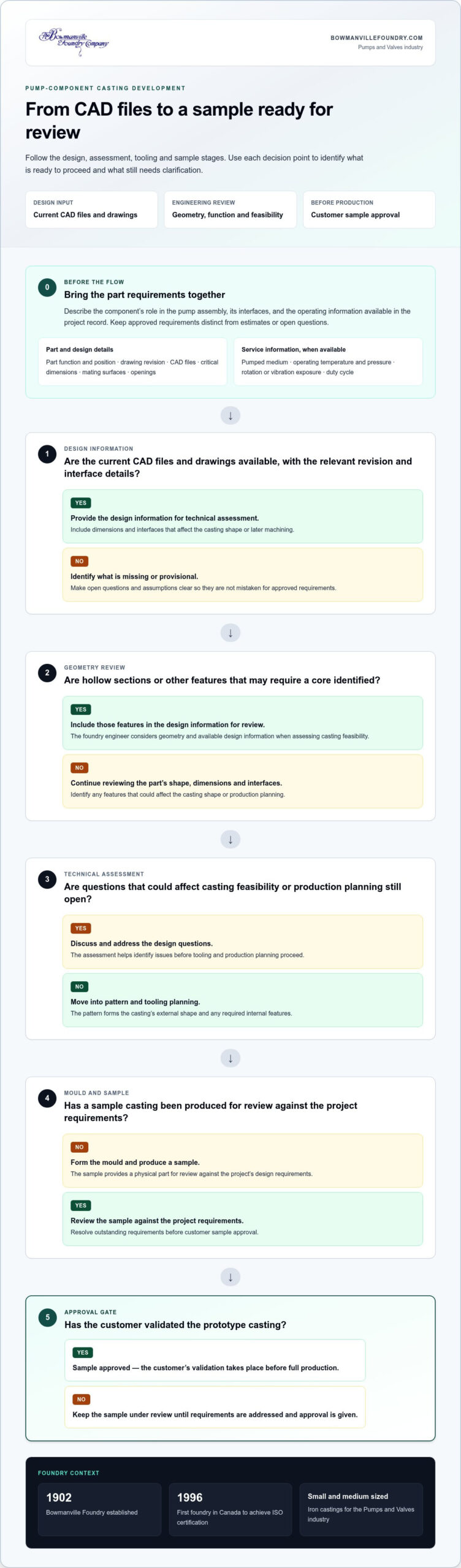
Moving a pump-component design into casting production involves more than sending a drawing to the foundry. The design information must be reviewed for casting feasibility, translated into tooling and mold requirements, and assessed through a sample before full production begins. For a Canadian iron foundry for pump components, this sequence gives engineering and procurement teams clear stages for resolving design questions and aligning on the part.
- Provide the design information. Supply current CAD files and drawings, including relevant revisions and interface details. Identify features that affect the casting shape, such as hollow sections or geometry that may require a core.
- Complete a technical assessment. A foundry engineer reviews the part geometry, intended function, and available design information to identify questions that may affect casting feasibility or production planning.
- Plan the tooling and pattern. After addressing design questions, develop the pattern and associated tooling to form the casting’s external shape and any required internal features.
- Form the mold and produce a sample. The pattern is used to prepare the mold. The resulting sample provides a physical part for review against the project’s design requirements.
- Review and approve the sample. Sample approval is the customer’s validation of a prototype casting before full production begins. It creates a defined opportunity to assess the sample and resolve outstanding requirements.
What happens during a technical assessment?
During a technical assessment, the engineer considers how the component’s geometry relates to its intended function and how the design can be produced as a casting. CAD files communicate three-dimensional form, while drawings clarify dimensions and interfaces. Reviewing both can identify features that need discussion before tooling and production planning proceed. The assessment supports a shared understanding of the part and its requirements; it does not replace the customer’s design authority.
How mold and pattern terms relate to part design
Pattern and mold terminology describes how design geometry is transferred into sand. A matchplate holds multiple patterns for simultaneous production of similar castings. The pattern forms the mold cavity, while a core creates a hollow section where required by the part design. These terms help engineering and procurement teams discuss how the drawing translates into a casting.
A two-half mold forms a casting cavity by joining two compacted sand halves around the pattern. The flask is the metal frame that holds the sand mold during casting. Mold compaction is the act of squeezing sand in a flask to take the shape of the pattern, forming the cavity. A core is a hardened sand insert used to create hollow sections in a casting.
A clear design handoff supports a focused assessment and sample review. For a pump-component project, contact Bowmanville Foundry about a technical assessment and provide the relevant design information for discussion.
Ductile, Gray, or Malleable Iron: Compare Pump-Component Requirements
A grade comparison is useful when each material description is tied to the component’s requirements and supporting data. A single strength figure cannot establish pump-component suitability on its own. Ductile and Malleable Iron are described here in terms of tensile strength and ductility. Bowmanville Foundry produces three grades of Gray Iron. For a project-level comparison, refer to the applicable grade-specific technical data.
| Iron family | Documented material information | How to apply it |
|---|---|---|
| Ductile Iron | A nodular iron described as combining high tensile strength with good ductility. | Compare those characteristics with the pump component’s documented design and service requirements. |
| Gray Iron | Bowmanville Foundry produces three grades of Gray Iron. Grade-specific property values are not included here. | Use the relevant Gray Iron grade data to assess properties against project requirements. Do not infer values from the family name. |
| Malleable Iron | Described as a type of nodular iron used for small castings requiring good tensile strength and ductility. | Consider whether the material description and grade data address the component’s specified needs. |
What to compare in the foundry’s iron-grade technical data
For a project-level comparison, record the exact grade and the properties reported for it, including units, test basis, and any conditions attached to the values. Compare equivalent properties only. Tensile strength and ductility, for example, are different measures. Values reported on different bases should not be treated as directly equivalent. If the project requires a value that is not shown in the applicable data, flag it for engineering review rather than estimating it.
This method keeps material evidence distinct from design assumptions. It also helps engineering and procurement teams identify which questions can be answered from published documentation and which need a technical discussion.
How to use application guidance without overgeneralizing
Application guidance can help organize questions about pump-component duties, but a general material description does not establish suitability for every part. Use the Gray Iron casting applications guide to inform the discussion, then relate its guidance to the specific component and service requirements. Assess Bowmanville Foundry’s three Gray Iron grades using their respective technical information rather than treating them as interchangeable based on the family name.
For a Canadian iron foundry for pump components, a sound grade decision connects the part’s documented requirements to the properties reported for the proposed grade. If the comparison depends on data that is not yet available, keep that question open for engineering review instead of filling the gap with an assumed value.
How to Evaluate a Canadian Foundry’s Quality and Technical Support
For pump-component procurement, evaluate documented quality practices alongside the technical needs of the part. A certification is useful evidence, but it does not replace project-specific material information, clear communication, or a process suited to the component’s design. Consider how the foundry’s quality system and technical support relate to the requirements you provide.
What quality-system evidence can inform supplier evaluation?
A quality management system is a structured set of procedures and processes for ensuring product quality and supporting continuous improvement. In a foundry, it provides a framework for managing work consistently and addressing quality requirements. Bowmanville Foundry’s custom quality system delivers low casting return rates.
Use quality-system evidence as part of a practical review. Consider how the foundry communicates requirements, manages technical documentation, and relates its work to your part’s specifications. A clear discussion should connect the drawing and material requirements to the proposed casting process, inspection expectations, and any post-processing needed. This gives procurement and engineering teams a shared understanding of the project, beyond a general certification statement.
- Quality system: Understand how documented procedures support consistent work and continuous improvement.
- Material information: Review applicable grade-specific data and application guidance for the requested casting.
- Technical communication: Note how design questions, revisions, and project requirements are discussed and recorded.
- Process fit: Relate casting and post-processing needs to the component’s design and delivery requirements.
How technical support helps resolve design questions
Technical support is most useful when it turns a project brief into specific questions for engineering review. Bowmanville Foundry provides technical data, application guides, and a free Casting Buyer’s Guide to support material and casting discussions. A technical/sales engineer can also visit your facility to assess needs and requirements. These resources help teams clarify project information before production planning advances.
If a drawing raises questions about casting design or post-processing, include them in the technical discussion. The published custom iron casting production engineering guide can also help frame design and production considerations. Use general guidance to support the discussion, then relate it to the specific project requirements and technical review.
To review material and casting guidance alongside your project requirements, explore the foundry’s technical resources. For direct project support, contact Bowmanville Foundry to discuss your casting requirements.
From Pump-Component Requirements to a Bowmanville Foundry Quote
A useful quote request brings engineering and procurement information together in one handoff. For a Canadian iron foundry for pump components, the part’s function, drawings, material questions, and finishing requirements help define the project for technical review. Complete information focuses the discussion, while open questions can be identified rather than obscured by assumptions.
What information helps prepare a pump-component quote request?
Gather current drawings and CAD files, and identify each revision so the project team works from the correct design. Include the component’s intended function and relevant service information supplied for the project. If you have a preferred grade, state it as a starting point. If material selection is still open, describe the question and the requirements behind it so the assessment can consider the design alongside the available information.
Document required machining or other post-processing against the project specifications. Identify the surfaces, dimensions, or interfaces affected, and distinguish required operations from options still under discussion. This clarifies whether the request covers a casting alone or a finished component with defined post-processing. Where possible, use drawing notes or specifications instead of verbal shorthand to describe the requirement precisely.
- Current drawings, CAD files, and revision information
- Part function and available service requirements
- Preferred grade, if known, and outstanding material questions
- Documented machining and post-processing requirements
- Open design points that need technical discussion
What to expect when working with Bowmanville Foundry
Bowmanville Foundry provides custom casting production and post-processing for pump-component projects. Its iron casting families include Ductile, Gray, and Malleable Iron. Discuss casting and specified finishing needs together so the project handoff reflects the component requirements and any post-processing is included in the planning.
Quote requests, video tours, and visits from a technical/sales engineer are available ways to discuss project requirements. A quote request can begin with the information your team has. A video tour provides a view of the foundry, while an engineer visit can support an assessment of needs and requirements at your facility. Choose the option that best suits the questions your team needs to address.
Bring together the design record, service information, grade questions, and post-processing specifications for a focused project discussion. Request a quote or arrange a video tour.
Move Your Pump-Component Project Forward
Prepare a concise project handoff before requesting a quote. Separate approved requirements from open engineering questions, and identify the drawing revision that governs the discussion. This gives your team a clear reference as the design moves from assessment toward a casting decision.
For a Canadian iron foundry for pump components, the most useful inquiry connects the component’s intended role with the information available for review. You do not need to resolve every technical question before starting a conversation. Identify what is established, note what still needs assessment, and include the post-processing requirements that affect the finished part.
That preparation helps turn procurement into a defined engineering discussion with fewer assumptions carried forward. Bowmanville Foundry can discuss your project through a quote request or video tour. Request a quote or arrange a video tour to discuss your pump-component requirements.
Frequently Asked Questions
Can a Canadian iron foundry produce custom pump components?
Yes. Bowmanville Foundry produces custom small and medium sized Ductile, Gray, and Malleable Iron castings for the Pumps and Valves industry. This describes the foundry’s casting scope, not a guarantee that a particular grade or casting will meet a specific pump duty. For an initial project discussion, identify the component and provide available design documents. The foundry can review the project requirements without assuming performance from the part category alone.
Does Bowmanville Foundry serve pump-component buyers in the United States?
Yes. Bowmanville Foundry serves customers in Canada and the United States. U.S. pump-component buyers can use the quote-request option to begin a project discussion with the foundry. Include the part information available to your team and identify requirements that remain open for review. This gives the discussion a clear project context without assuming that a general description is enough to define the casting.
Can I request an on-site technical/sales engineer visit for a pump casting?
Yes. A Bowmanville Foundry technical/sales engineer can visit your facility to assess your needs and requirements. A visit provides an opportunity to discuss the pump casting in its project context and review the information your team can share. Bring relevant design documents and outline the questions you want to address. The visit is for assessment and discussion, not a promise of a particular technical outcome or schedule.
What does sample approval mean in an iron casting project?
Sample approval is the customer’s validation of a prototype casting before full production begins. It gives the customer a stage to assess the prototype against the project’s requirements before proceeding. The term describes the customer’s validation step; it does not establish specific acceptance criteria or imply that every project follows an identical review. Define project requirements clearly so the sample can be assessed in the context of the part.
Can a pump casting include hollow sections?
A casting can be designed with hollow sections formed by a core, a hardened sand insert used to create internal geometry. Whether a particular pump component can be cast with the required hollow features depends on its design and technical assessment. Relevant geometry and design information help evaluate feasibility. Review the part design before assuming a hollow section can be produced in a specific component.
Can post-processing be part of a custom iron casting project?
Yes. Post-processing can be included in a custom iron casting project. Secondary operations include machining, heat treating, and surface coating. Describe the required operations using the project specifications, and note which features or surfaces they apply to. State required tolerances, finishes, or performance outcomes in the project documentation for discussion.
