
To obtain accurate supplier quotes, an iron casting RFQ checklist must clearly specify material grades, dimensional tolerances, and inspection requirements. Canadian market pricing for custom iron castings varies widely depending on complexity and volume. You secure accurate proposals by submitting complete technical documentation upfront: the same decision questions that open this guide (process fit, alloy grade, tolerances, tests, volume and tooling) close it when you judge whether a formal RFQ is ready or still premature.
Key Takeaways: To receive accurate iron casting quotes, you must provide 3D CAD files, specific ASTM/SAE material grades, and defined GD&T to prevent costly tooling rework.
- KEY SPECIFIC: Tooling for complex internal geometries can typically be produced within 2 to 4 weeks.
- HONEST CAVEAT: Formal RFQs are ineffective if geometry or alloy selection remains open, leading to inaccurate pricing.
- RECOMMENDATION: Specify Gray Iron for vibration damping or Ductile Iron for high-strength structural load paths.
- INFORMATION GAIN: Incomplete production parameters can drive low-volume costs to approximately $1500.00 per casting without patterns.
Select an iron casting process that matches your geometry and volume
Your component design, required material strength, and production volume decide which iron casting route belongs in the inquiry. Three situations come up often: a machine base that needs vibration control is a Gray Iron candidate; a stress-bearing structural part usually points to Ductile Iron for higher tensile strength; a smaller component that still needs strength and ductility fits Malleable Iron. Those choices set mold method, core needs, and the documents you attach to the RFQ.
Gray Iron provides strong damping capacity for machine bases, while Ductile Iron supplies high strength for load paths that cannot fracture abruptly. For smaller parts that still need tensile strength, Malleable Iron is the practical fit. Forming cavities relies on mold compaction (squeezing the sand) around patterns inside a metal frame. Complex internal voids need a core (hollow section insert) so wall thickness stays controlled.
Evaluating the design before patterns are cut prevents tooling rework. You can compare iron options against your drawings and strength targets, then request a technical assessment or schedule a facility visit with the team. More on this: The Bowmanville Foundry.
Specify exact iron alloys and material grades for a priced quote
Accurate casting quotes need material specifications written in standardized ASTM or SAE iron grades. When a quote request omits mechanical properties, estimates stay broad instead of priced to the part. You can review iron grade data and lock the alloy to the application before files go out. More on this: Iron Grades Technical Data.
Gray Iron suits parts that need vibration damping; Ductile Iron supplies high tensile strength for structural duty; Malleable Iron fits small components that need both strength and ductility. State these grades explicitly beside the CAD set. Selecting the alloy early prevents redesign loops later. In 1996, The Bowmanville Foundry was the first foundry in Canada to achieve ISO certification, so alloy preparation follows documented quality management systems. You can request a technical assessment or schedule a facility visit to confirm alloy options against your duty cycle.
Material choice sets final part performance and is what keeps manufacturing timelines predictable once procurement starts.
Tip: Verify whether your component requires Ductile Iron for high tensile strength or Gray Iron for vibration damping prior to submitting CAD files.
That discipline shows up in long-run supply relationships. Among Bowmanville Foundry’s Google reviews, Joe (5★) wrote:
"100 plus years outstanding quality from a family run business. I would highly recommend them. "
Precise grade calls and certified process control are what make that kind of multi-decade result repeatable on new programs.
Define dimensional tolerances and GD&T so patterns stay stable
Complete dimensional specifications prevent pattern revisions during the first inquiry pass. Submitting preliminary CAD files with general tolerance guidelines gives the foundry enough geometry to quote without an engineering stall.
Call out critical machined surfaces rather than raw cast features at the start: that single decision changes tool design. For unmachined draft angles, standard tolerances usually suffice. Tight geometric dimensioning and tolerancing (GD&T) names the datum features that tell patternmakers how to build a two-half mold. Unclear drawings force conservative estimates; defined geometric boundaries protect your schedule.
Align mechanical needs with dimensional limits in the metal grades guide. Technical and sales engineers can review early drawings and run a technical assessment before flask work begins.
Quotes for first casting setups track the complexity of tooling and pattern creation. That cost risk is concrete in open shop discussion. Inside the practicalmachinist.com thread "Custom Cast Iron castings, any rec’s?", one contributor noted:
"I got a quote a couple years ago to send that CAD file to a foundry that specialized in doing this kind of low volume, no pattern casting, and the quote was approx. $1500.00 per casting." (source)
Situation: a low-volume iron part sent as CAD without a full production frame. Action: the shop priced a no-pattern route. Result: about C$1500.00 per casting. The figure is what incomplete production parameters do to unit cost, and why tolerance and datum detail belong in the RFQ before anyone cuts wood or metal.
Build mechanical and surface tests into the RFQ from day one
Clear mechanical testing and surface inspection protocols in the request for quotation are what make delivered parts reliable in service.
Missing hardness limits create machining delays on the shop floor; a written window stops that disruption. Tensile strength, yield strength, and elongation confirm structural integrity on Ductile Iron or Gray Iron. Hardness testing supports machinability and wear resistance on industrial duty cycles.
To set the requirement set, download the buyers guide. Surface finish standards act as the acceptance gate: visual rules such as MSS SP-55 define allowable surface conditions, and non-destructive testing finds internal flaws before finish machining.
| Testing Category | Standard Inspection Methods | Quality Purpose |
|---|---|---|
| Mechanical Properties | Tensile, Yield, Elongation | Verifies material strength specifications |
| Hardness Testing | Brinell Hardness (HBW) | Ensures machinability and wear resistance |
| Surface & Internal Quality | Visual MSS SP-55, NDT | Detects surface imperfections and internal voids |
If the matrix still leaves a grade or NDT method open, contact the technical team for help closing the specification.
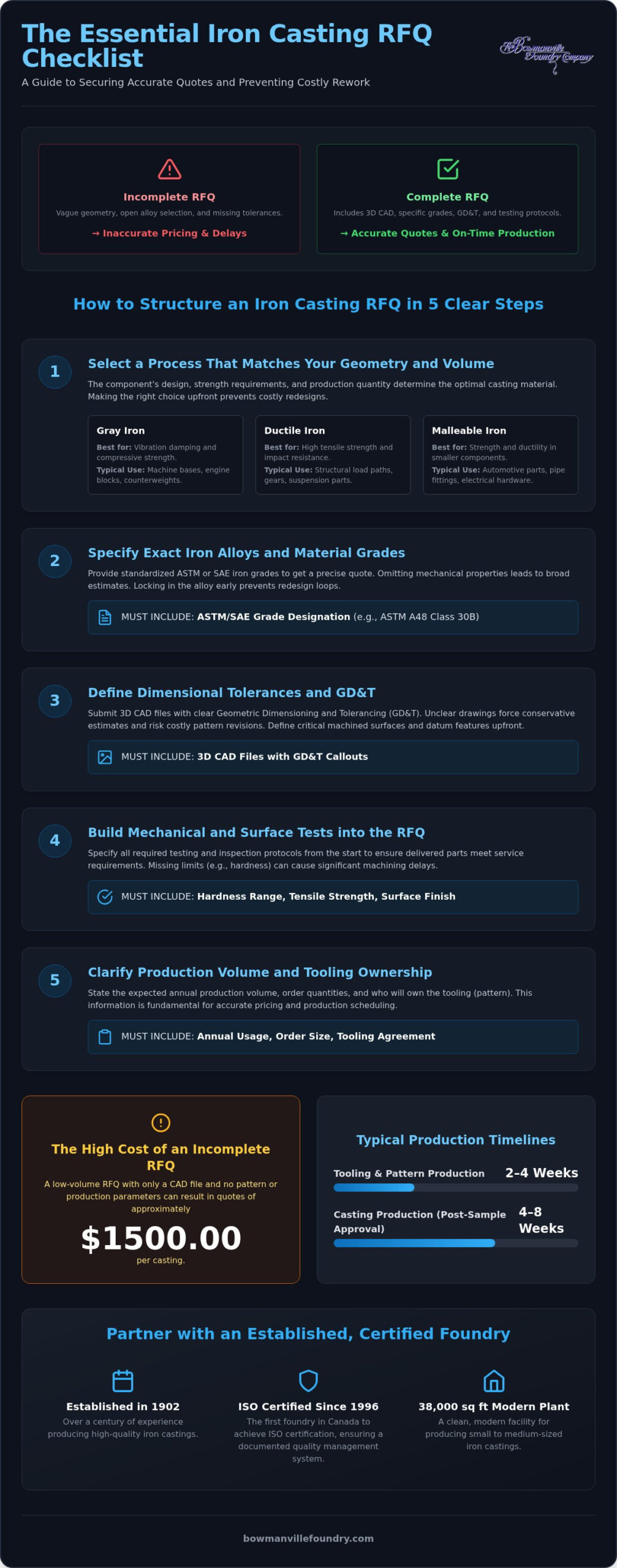
How to structure an iron casting RFQ checklist in 5 clear steps
A correctly structured Request for Quotation is how foundries return usable lead times and technical assessments on an iron casting project. A complete engineering package removes the usual production stalls, and clear first-pass specifications let patternmakers judge matchplate layouts and flask needs immediately.
Format the request in five steps:
- Define part geometry: Supply 3D CAD files alongside 2D engineering drawings showing critical tolerances.
- Specify material requirements: State the exact grade of Gray Iron, Malleable Iron, or Ductile Iron needed for your application.
- Detail internal features: Indicate whether a core is necessary for complex geometries.
- Select finishing options: Outline post-processing requirements, such as machining or surface treatments, for one-stop-shopping.
- Set order quantities: State expected annual volumes and batch sizes to determine optimal pattern tooling layout.
Organized documentation shortens the quotation phase and limits tooling changes after kickoff. Engineering review of the package before production is available; reach the engineering team or visit the facility when the custom casting scope needs a walk-through.
Prioritize critical checklist items that stop quoting delays
Geometric parameters and material grades come first if you want an accurate initial estimate without quoting friction. Supply core design needs, annual unit volumes, and specific grades such as Ductile Iron or Malleable Iron in the opening package. Leave secondary finishing details for a later technical assessment so the first exchange stays unblocked.
What few people think of: CAD files without tolerance expectations stall the path, because pattern framing engineers must re-check mold compaction before they design the flask and matchplate (a plate holding multiple patterns for simultaneous production of similar castings).
Treat the first package like a structural blueprint rather than a full interiors plan: establish baseline cost on primary geometry and alloy, then layer finish. Component pricing varies across a broad market price band (6 samples from the top 10) based on analysis of current industry casting data, so early effort belongs on the specifications that move the number.
A technical or sales engineer can visit your site to assess needs; send a direct note when you want that review scheduled.
Clarify production volume and tooling ownership before you commit
Tooling ownership sets long-term production cost and who controls the equipment behind your iron castings.
When you buy custom pattern equipment, confirm ownership rights so the patterns remain your physical asset. Tooling style drives unit price breaks: a single-piece pattern suits lower runs, while a matchplate supports rapid mold compaction on higher volumes. Volume also decides manual methods versus automated work in a flask.
At The Bowmanville Foundry, the pattern framing facility maintains tooling to extend pattern life. For complex internal geometries, specialized equipment builds each core. Tooling can be produced in two to four weeks. Local Canadian manufacturing simplifies tooling transfers and shortens the supply chain. Ask the technical team for an on-site technical or sales engineer visit when the tooling strategy needs a structured review.
A commenter in the homemodelenginemachinist.com thread "Metal casting at home" put the risk this way:
"So you can end up getting mixed/bad advice from folks on foundry forums, and other places, just because you may be using different materials or equipment." (source)
Equipment choices and grade selection change the advice that applies; written technical parameters keep guidance tied to your tooling and alloy, not to a generic setup.
When an iron casting RFQ is the wrong approach
Formal quote requests fail when geometry or alloy selection is still open. An RFQ built on incomplete CAD produces inaccurate pricing and revision cycles you did not budget.
In the pattern framing facility, premature requests push production right. A technical assessment checks part feasibility before mold preparation. Machined bar stock fits rapid prototyping; custom tooling fits higher-volume manufacturing. Quotes without settled parameters consume calendar time, and low volumes may not carry pattern cost.
Close the design decisions first, then issue the RFQ. Engineers at the modern, clean foundry can walk Ductile Iron, Gray Iron, and Malleable Iron selection with you before any formal package goes out.
Frequently asked questions
Is sending an iron casting RFQ a commitment to place an order?
An iron casting RFQ checklist is an inquiry for technical and pricing estimates only. Requesting a quote places no contractual obligation on your purchasing department. Foundries evaluate CAD files and material specifications to build an accurate proposal. For a project-level read, contact the engineering team and have them evaluate the component package.
Can an RFQ include an existing or transferred iron casting mold?
You can list tooling transfers inside an iron casting RFQ checklist so existing equipment is evaluated on its merits. Transferred patterns or flasks need a technical assessment for fit with modern molding machinery. The Bowmanville Foundry runs a pattern framing facility that inspects incoming tooling before production approval. Send existing tooling specifications to the technical engineers to arrange that evaluation.
How long is an iron casting quotation valid?
Cast iron quotations stay valid for a limited window, typically thirty days, because raw material costs move. Across the broader market, standard casting prices swing across a wide sample range by alloy grade and processing path. Submit complete technical specifications when you need a firm, time-bound estimate, and ask for a personalized quote when you want current schedule figures and production terms held.
What alloy should I specify for an iron casting (not aluminum)?
When you request quotes from an iron facility, specify iron grades rather than aluminum alloys. The facility specializes in Ductile Iron, Gray Iron, and Malleable Iron rather than light metals. Ductile Iron offers high strength and elongation; Gray Iron provides strong damping capacity. Work with the technical engineers to pick the iron grade that matches the mechanical application.
What tests should be included in the RFQ?
Name chemical analysis, tensile testing, and dimensional inspection in the request. Quality verification should track established standards so the part holds under service loads. ISO certification (first in Canada at this facility in 1996) frames the quality management system behind those checks. Contact the quality team or visit the clean facility when you want testing capability reviewed against your print.
Next Steps for Your Iron Casting Requirements
A thorough iron casting RFQ checklist is how you obtain accurate technical assessments and precise first quotes. Complete CAD files, material specifications, and mold compaction requirements remove delay from sample approval. The Bowmanville Foundry supports manufacturing procurement managers across Canada and the United States with that review discipline, and the same ISO-certified quality management system first achieved in 1996 still governs work in 2026. Download the casting buyers guide or request a custom quote when you are ready to pressure-test tooling, post-processing, and logistics with engineering.
