
In 2026, the most expensive iron casting isn’t the one with the highest price tag; it’s the one that arrives three weeks late to your assembly line. When sourcing iron castings for construction equipment in Canada, procurement teams often find themselves trapped between rising energy surcharges and the 25 percent global tariff on imported steel derivatives that took effect in late 2025. You’ve likely realized that relying on the lowest price-per-pound often leads to quality inconsistencies or stalled production schedules. This guide provides the technical framework you need to evaluate foundry capacity, material grades, and supply chain resilience effectively.
We’ll show you how to move beyond basic procurement to find reliable national partners, like Bowmanville Foundry, who offer technical certainty. By understanding the ROI of integrated post-processing and the current C$200 per net ton scrap market, you’ll be equipped to stabilize your costs. We’ll also examine the stricter 2026 nodularity and traceability standards required to ensure your heavy-duty components perform in the field without failure. This methodical approach ensures you select a partner capable of delivering finished parts that meet the rigorous demands of the Canadian construction sector.
Key Takeaways
- Understand how 2026 tariff structures and the C$200 per net ton scrap market impact the domestic sourcing of iron castings for construction equipment Canada.
- Compare the mechanical properties of malleable, ductile, and gray iron to determine the most durable material grade for specific heavy-machinery applications.
- Evaluate the technical capacity of a foundry’s moulding lines and induction furnaces to ensure precision and reliability for high-volume component production.
- Realize the cost-saving benefits of integrated post-processing, such as machining and heat treating, which streamline the path from raw casting to ready-to-use component.
- Gain access to a comprehensive decision-making framework for selecting a national partner that offers technical certainty and long-term supply chain stability.
The Canadian Ferrous Foundry Landscape in 2026
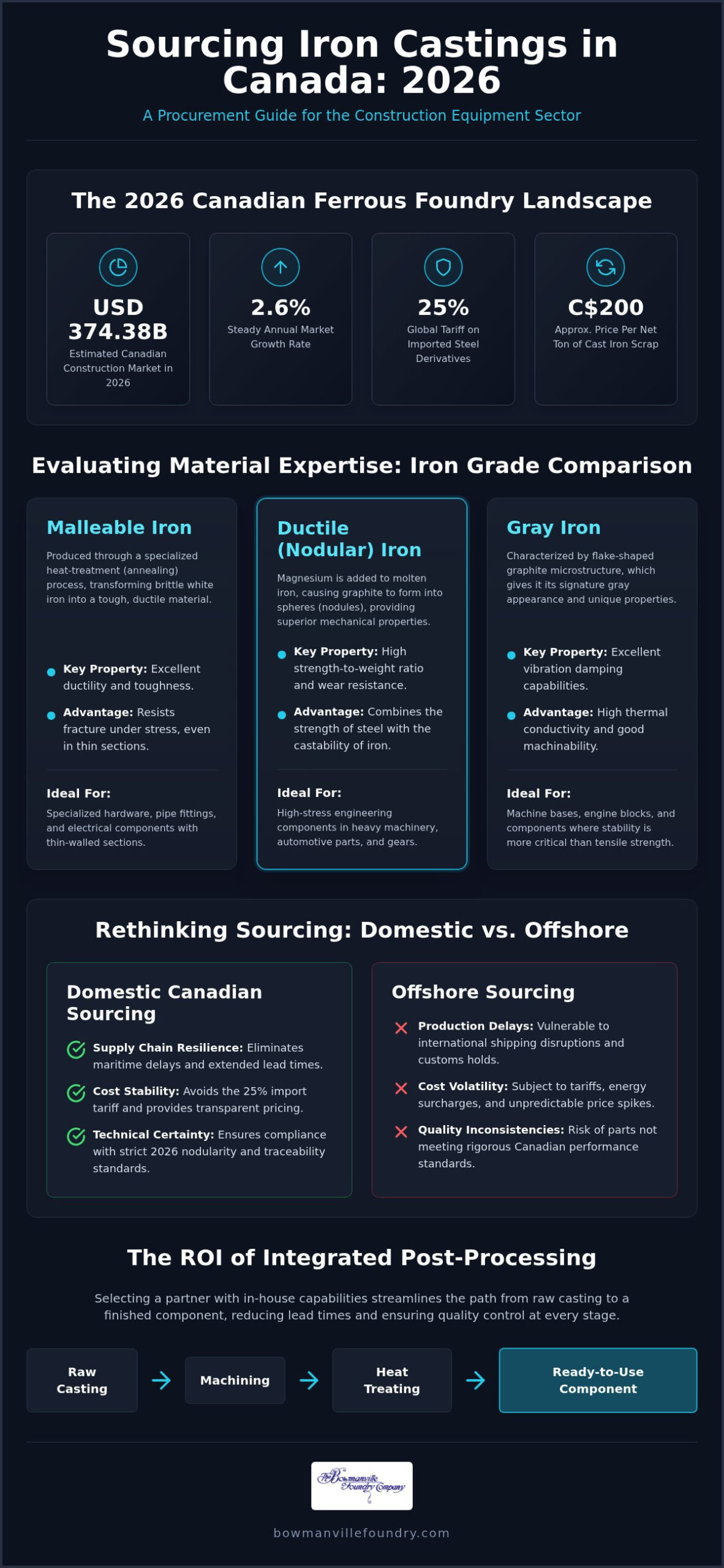
The Canadian construction market is estimated to reach USD 374.38 billion in 2026, representing a steady growth of 2.6%. This expansion has placed a significant spotlight on the domestic foundry industry. While some sectors within primary metal manufacturing have faced sales declines recently, foundries remain a resilient exception. The fundamental durability of Cast iron makes it the preferred material for high-stress applications where structural integrity isn’t negotiable. Modern casting facilities have adapted to this demand by shifting toward high-efficiency production models that prioritize material precision over sheer volume.
Geopolitical shifts and trade regulations have fundamentally altered sourcing strategies this year. The 25% global tariff on imported steel-derivative products, which took effect in late 2025, has made domestic procurement more than just a logistical preference; it’s now a financial necessity. When sourcing iron castings for construction equipment Canada, professionals must also account for the volatility of raw material markets. As of September 2026, cast iron scrap prices are approximately C$200.00 per net ton. These domestic market conditions, combined with the complexities of Canada Customs Tariff T2026, have pushed many firms to abandon offshore supply chains in favour of stable, national partners.
Economic Factors Influencing Procurement
Energy costs continue to dictate the structure of foundry surcharges in 2026. High-efficiency induction furnaces help mitigate some of these expenses, but the total cost of ownership remains the most accurate metric for evaluating a partner. Domestic sourcing eliminates the risk of extended lead times and maritime delays that often plague international shipments. By choosing a Canadian foundry, you gain technical certainty and a more transparent cost structure. This transparency is vital when managing budgets for large-scale infrastructure projects that can’t afford unexpected price spikes or material delays.
Technological Trends in Ferrous Casting
Technological advancement in the industry has moved toward deep digital integration. CAD-integrated pattern development now allows engineers to simulate metal flow and cooling rates before the first pour. This process significantly reduces the risk of internal porosity or dimensional inaccuracies in complex components. Automation in the moulding and pouring process has also become standard, ensuring that every casting meets the stricter 2026 nodularity and traceability requirements. These modern facilities don’t just produce parts; they provide data-backed assurance that each component will withstand the rigours of the job site.
Evaluating Material Expertise: Malleable vs. Ductile vs. Gray Iron
Selecting the correct ferrous alloy is a critical decision that influences both the longevity and safety of heavy machinery. While some procurement guides focus exclusively on steel, the diverse range of iron grades offers specialized mechanical advantages for iron castings for construction equipment Canada. The evolution of Canada’s Iron and Steel Industry has refined these casting processes, allowing engineers to match specific component requirements with the precise material properties of malleable, ductile, or gray iron.
Malleable Iron: The Versatile Legacy Grade
Malleable iron is distinguished by its unique heat-treatment process. It begins as white iron and undergoes an extensive annealing cycle that transforms brittle carbides into “temper carbon” clusters. This results in a material that combines excellent castability with significant ductility and toughness. It’s particularly effective for specialized construction hardware, pipe fittings, and electrical components where thin-walled sections must resist fracturing under stress. When comparing malleable iron vs ductile iron for brackets or hinges, the choice often depends on the specific section thickness and the required surface finish for post-processing.
Ductile and Gray Iron Performance Metrics
Ductile iron, often called nodular iron, is the industry standard for high-stress engineering components. By adding magnesium to the molten metal, graphite forms into spheres rather than flakes. This structural shift provides superior strength-to-weight ratios and exceptional impact resistance, making it ideal for axle housings and suspension parts in heavy construction machinery. In 2026, industry practices emphasize stricter nodularity standards to ensure these components can withstand the extreme temperature fluctuations typical of the Canadian climate.
Gray iron remains a staple for components where vibration damping and thermal conductivity are paramount. The flake graphite structure excels at absorbing mechanical energy, which protects sensitive internal gears and engines from excessive wear. It’s also highly machinable and cost-efficient for large, complex shapes like engine blocks or heavy counterweights. Matching the correct ASTM standards to your application ensures that your iron castings for construction equipment Canada meet the necessary safety and performance benchmarks. For those seeking technical certainty in material selection, reviewing a foundry’s technical resources can help clarify the optimal grade for your specific project.
Technical Capabilities and Modern Moulding Infrastructure
To maintain technical certainty in procurement, you must look beyond material grades to the physical infrastructure of the foundry. High-precision induction furnace technology is essential for maintaining alloy consistency across medium to high volumes. These furnaces allow for exact temperature control and chemical adjustment, ensuring that every batch meets the specific mechanical requirements of the construction sector. When evaluating a partner for iron castings for construction equipment Canada, the ability to maintain these tight metallurgical windows is what separates a reliable component from one prone to premature field failure.
Foundry capacity is also defined by the physical dimensions and weight ranges a facility can handle. A versatile partner should offer a range of moulding options that accommodate everything from small, high-precision brackets to large, heavy-duty structural housings. This flexibility ensures that your entire bill of materials can be managed through a single, stable supply chain, reducing the administrative burden of managing multiple vendors with varying quality standards.
Moulding Technology and Volume Scalability
The choice between green sand and no-bake moulding depends on the complexity and volume of the order. Automated green sand lines are highly efficient for producing high volumes of smaller components, significantly reducing unit costs through speed and repeatability. For larger, more intricate geometries common in heavy-duty machinery, no-bake moulding provides the rigid structure necessary to maintain dimensional stability during the pour. Modern facilities also offer rapid prototyping capabilities, allowing for the verification of new designs before you commit to full-scale production runs.
Precision and Tolerances in Engineering
Achieving critical tolerances is the hallmark of a capable foundry partner. Pattern development is the foundation of this accuracy; high-quality patterns ensure that the final casting reflects the precise dimensions specified in your CAD models. Advanced process control protocols, including real-time monitoring of sand consistency and metal temperature, are used to prevent common casting defects like shrinkage or inclusions. For iron castings for construction equipment Canada, adhering to ISO 9001:2015 standards ensures a repeatable, data-driven manufacturing process.
This level of control ensures that complex components fit seamlessly into your final assembly, reducing the need for expensive corrective machining. Comprehensive quality control also involves stricter nodularity standards and raw material traceability, which have become industry benchmarks in 2026. By choosing a partner with a legacy of technical mastery, you ensure that every part is delivered with the documentation required to prove its structural integrity and adherence to your engineering specifications.
Supply Chain Resilience and Post-Processing Integration
In 2026, the standard for industrial procurement has evolved from simply buying raw parts to securing finished, ready-to-use components. Fragmented supply chains, where a casting moves from the foundry to a machine shop and then to a coating facility, create unnecessary bottlenecks and logistical risks. For iron castings for construction equipment Canada, this fragmentation often results in cumulative lead times that can stall major infrastructure projects. A single-source partner eliminates secondary transit times and ensures that quality risk is managed under one roof, providing a clear line of accountability for the final product’s performance.
The Value of Integrated Post-Processing
Many construction components require specific mechanical enhancements after the initial pour to meet engineering specifications. For instance, heat treating iron castings allows for the precise adjustment of hardness and tensile strength, ensuring the part can withstand abrasive environments. Surface coatings are equally vital for resisting corrosion in the diverse Canadian climate, where exposure to road salts and high humidity can degrade unprotected ferrous metals. Integrated machining ensures that critical tolerances are met by the same technical team that understands the casting’s internal structure. This approach reduces the likelihood of discovering subsurface defects only after the part has reached an external shop, which would otherwise lead to costly reworks and project delays.
Managing Lead Times and Project Logistics
Effective logistics management in the current market requires more than just a production schedule; it requires a proactive strategy for inventory stability. Maintaining safety stock for high-demand components is a reliable way to insulate your operations from sudden market shifts or transportation disruptions. When you request an iron casting quote for a complex project, ensure it includes all post-processing steps to obtain a realistic view of the total timeline. Consolidating these services allows you to realize significant time savings by removing the weeks typically lost to vendor-to-vendor transit. If you’re looking to streamline your procurement process and reduce logistical complexity, you can contact our technical specialists to evaluate a consolidated manufacturing plan for your components.
By shifting toward a model of integrated supply, Canadian construction firms can better manage the total cost of ownership. This strategy doesn’t just reduce the immediate administrative burden; it builds a more resilient foundation for long-term project success. Technical certainty is achieved when the foundry provides a comprehensive path from the initial melt to the final, machined part, ensuring each component is ready for immediate installation upon arrival at the assembly centre.
Selecting Your Partner: The Bowmanville Foundry Advantage
Choosing a manufacturing partner is a decision that impacts your operational stability for years. Bowmanville Foundry, established in 1902, provides a level of institutional knowledge that is rare in the modern industrial sector. With over 120 years of expertise in iron castings for construction equipment Canada, we’ve developed a deep understanding of how malleable, ductile, and gray iron grades perform under the most demanding field conditions. This legacy isn’t just about history; it’s about the technical certainty that comes from over a century of physical craftsmanship and metallurgical refinement.
Our national distribution network ensures that high-quality components are accessible across the country, backed by dedicated engineering support. We provide more than just parts; we offer a partnership rooted in technical mastery. Whether you require high-strength ductile iron for impact-resistant machinery or specialized malleable iron for construction hardware, our team works with you to ensure the material selection aligns perfectly with your engineering requirements. This steady, knowledgeable approach reduces the inherent complexity of industrial procurement.
The Professional Choice for Industrial Iron
A modern casting facility must balance advanced automation with the wisdom of skilled labour. As the industry faces a looming skilled-labour shortfall, where approximately 22% of the workforce is approaching retirement, our established team provides the continuity your projects require. We prioritize transparent communication and provide detailed technical data to help procurement professionals make informed decisions. Building a long-term partnership with a foundry that understands your specific assembly requirements reduces the complexity of sourcing iron castings for construction equipment Canada.
Next Steps for Your Casting Project
To help you navigate the intricate technical landscapes of metallurgy, we provide resources designed for professional researchers and engineers. You can learn how to choose the ideal iron casting grade by accessing our detailed selection guides. These resources offer a comprehensive path from initial design curiosity to final technical certainty, helping you move beyond basic price-per-pound metrics to focus on total cost of ownership.
If you’re ready to stabilize your supply chain and ensure the structural integrity of your components, consulting with our engineering team is the next logical step. We can assist in material selection and provide a clear framework for your integrated post-processing needs. Download the Free Casting Buyer’s Guide to start your selection process.
Strengthening Your 2026 Procurement Strategy
Successfully managing the technical and economic complexities of the 2026 market requires a shift from transactional sourcing to strategic, long-term partnerships. By prioritizing material expertise and integrated post-processing, you can effectively mitigate the risks of tariff volatility and domestic supply chain delays. Technical certainty in selecting the precise grade of malleable, ductile, or gray iron ensures that your components meet the rigorous safety and performance standards required on Canadian job sites. This methodical approach to sourcing reduces the inherent complexity of industrial procurement while stabilizing your production costs.
As a domestic manufacturer operational since 1902, Bowmanville Foundry specializes in delivering these high-performance iron castings for construction equipment Canada. Our integrated machining and heat treating services provide a streamlined path to ready-to-use parts, significantly reducing your total cost of ownership. We’re committed to sharing our library of institutional knowledge to ensure your project’s success through every stage of production. Request a custom iron casting quote from our engineering experts today. We look forward to helping you build a more resilient and technically certain supply chain for your heavy-duty components.
Frequently Asked Questions
What are the main differences between Canadian iron foundries in 2026?
Canadian foundries in 2026 are distinguished by their level of digital integration and the breadth of their metallurgical expertise. While some facilities focus purely on high-volume commodity parts, others provide specialized engineering support for malleable, ductile, and gray iron. The ability to offer integrated post-processing, such as machining and heat treating, is a major differentiator. Foundries like Bowmanville Foundry, operational since 1902, combine this modern technology with over a century of institutional knowledge.
How do current scrap metal tariffs affect iron casting prices in Canada?
Current scrap metal prices in Canada for cast iron are approximately C$200.00 per net ton as of September 2026. While raw material costs fluctuate, the 25 percent global tariff on imported steel-derivative products implemented in late 2025 has increased the value of domestic ferrous scrap. These economic factors contribute to the total cost of iron castings for construction equipment Canada, making domestic sourcing more predictable than relying on volatile offshore supply chains affected by international trade duties.
Can malleable iron be used as a direct substitute for ductile iron in construction?
Malleable iron isn’t a direct substitute for ductile iron because their mechanical properties and internal structures differ significantly. Ductile iron offers superior impact resistance and strength-to-weight ratios for high-stress engineering components. Conversely, malleable iron is preferred for specialized construction hardware and thin-walled parts requiring excellent surface finish. Choosing the wrong grade can lead to component failure, so it’s essential to consult technical data or a comprehensive buyer’s guide before finalizing your material selection.
What is the typical lead time for custom iron castings in Canada?
Lead times for custom iron castings vary based on the complexity of the pattern and the volume of the order. Typically, the process involves pattern development, moulding, and pouring, followed by secondary operations. Utilizing a foundry that offers integrated post-processing can reduce overall timelines by eliminating the need to transport parts between multiple vendors. This “one-stop-shop” approach ensures that ready-to-use components reach your assembly centre faster than fragmented offshore alternatives that face transit delays.
Why should I choose a Canadian foundry over an offshore manufacturer?
Choosing a Canadian foundry provides greater supply chain resilience and technical certainty. Domestic sourcing eliminates the risks associated with international shipping delays and the 2026 tariff impacts on imported ferrous goods. National partners offer direct access to engineering support and transparent communication, which is vital for maintaining quality standards. Foundries like Bowmanville Foundry have supported the national market since 1902, ensuring that iron castings for construction equipment Canada meet rigorous domestic safety regulations.
What post-processing services are essential for ready-to-use iron components?
Essential post-processing services include precision machining, heat treating, and surface coating. Machining ensures that custom engineered components meet critical dimensional tolerances for final assembly. Heat treating is necessary to adjust the hardness and tensile strength of the iron, while surface coatings protect against corrosion in the varied Canadian climate. Integrating these services at the foundry level reduces logistical complexity and ensures that every part is delivered in a ready-to-use state, improving your overall return on investment.
How do I ensure my iron casting meets ASTM standards?
Ensuring compliance with ASTM standards requires a foundry with robust quality control protocols and raw material traceability. In 2026, industry practices emphasize stricter nodularity standards and precise dimensional inspections. You should partner with a facility that maintains ISO 9001:2015 certification and provides comprehensive documentation for every pour. This verification process confirms that the material properties, such as tensile strength and elongation, align with the specific engineering requirements of the Canadian construction sector.
What information is required for an accurate iron casting quote?
To receive an accurate iron casting quote, you must provide detailed technical specifications. This includes 3D CAD files or 2D drawings, the desired iron grade, and the estimated production volume. It’s also vital to specify any required post-processing services, such as machining or heat treating, and the required delivery schedule. Providing this comprehensive data allows the foundry’s engineering team to evaluate the technical requirements and provide a transparent cost structure for your project, ensuring there are no hidden surcharges.
