
Choosing an iron grade by strength alone can send a casting project in the wrong direction. For custom heavy equipment castings, the part’s loads matter, but so do its geometry, operating environment, machining needs and inspection requirements. If these details are unclear at the outset, technical review can be delayed and material selection becomes harder to assess.
A useful first step is to define the part: gather current drawings or CAD files, describe service conditions, identify critical dimensions and list required finishing or inspection criteria. This information gives foundry engineers a basis for evaluating feasibility and discussing suitable iron options.
This guide explains how to prepare a project for technical assessment, compare Gray Iron, Ductile Iron, Malleable Iron and Austempered Ductile Iron against the component’s demands, and understand how casting, post-processing and quality review fit together. With the right information in hand, buyers and design engineers can approach the technical review with clearer expectations and a more defined path from part concept to production.
Key Takeaways
- Define equipment loads, motion, mating parts and service conditions before specifying custom heavy equipment castings.
- Understand how geometry, mold preparation and sample approval connect part design with production.
- Compare Gray Iron, Ductile Iron and Malleable Iron according to the component’s operating demands.
- Set machining, heat-treatment, coating and inspection requirements by identifying the casting’s required delivery condition.
- Prepare for technical review with the drawing revision, CAD files, quantity, application and delivery requirements. Mark open engineering questions clearly.
Custom heavy equipment castings: define the part before selecting a foundry
Start by translating the equipment’s duty into a component specification a foundry can assess. Describe what the part does in the assembly, how it is loaded and the conditions it must withstand. This gives technical review a practical basis and helps separate essential requirements from details that still need engineering discussion.
Unlike an off-the-shelf component, a custom casting must meet part-specific geometry, interfaces, service conditions and delivery requirements. Custom heavy equipment castings are iron components defined by the geometry, material properties and service requirements of a particular equipment application. Those requirements also guide whether the proposed design is suited to a metal casting process.
Which operating details should define an equipment casting?
Describe how forces act on the component, not only the maximum load it may encounter. Note the direction of loads, repeated stress, impact exposure and whether the part is stationary or moves during operation. Include its role in the assembly and the interfaces it must maintain with mating components. A bracket, housing or linkage can have different functional demands depending on how it supports, encloses or transfers movement within the equipment.
Record service conditions that could affect material selection or design review, including exposure to low temperature environments. Separate established operating data from unknowns. For example, identify whether a load is measured, calculated or still being estimated, and flag any conditions that need confirmation through engineering review.
What should a casting drawing communicate?
Drawings should make the part’s functional geometry clear. Identify critical dimensions, datums, mating interfaces and surfaces that require machining. Show specified tolerances and acceptance requirements, and make the drawing revision easy to identify. These details help prevent the foundry and buyer from assessing different versions of the component.
- Send the current drawing and applicable CAD files.
- Identify the revision and any related changes to the part.
- Point out critical interfaces and required machined surfaces.
A technical assessment is an evaluation performed by a foundry engineer to determine the feasibility of a part design. It considers the proposed geometry alongside the intended application, so include available service information with the drawing package. If a dimension, load or operating condition is still under review, label it as an open engineering question instead of presenting it as a final requirement. Clear documentation gives the review a practical starting point.
How casting design turns equipment requirements into a producible part
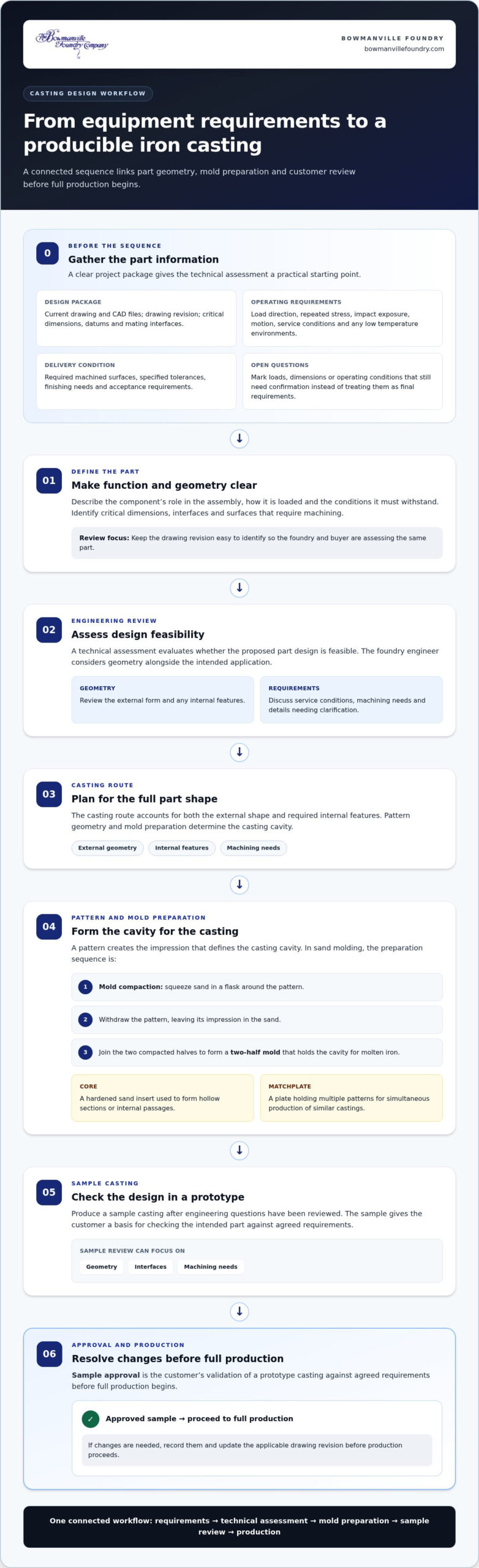
A casting design moves through a series of decisions before production begins: review the geometry, assess the casting route, prepare patterns, produce a sample, obtain sample approval, then proceed to production. Each stage connects the part’s intended function with a form that can be made and checked. For custom heavy equipment castings, early review brings geometry, internal features and machining needs into the same discussion before tooling and production plans are finalized.
How patterns, matchplates, and cores support part geometry
A pattern is the form used to create the casting cavity. In sand molding, mold compaction squeezes sand in a flask around the pattern. The pattern is withdrawn, leaving its impression. The two compacted halves are joined to make a two-half mold, which holds the cavity that will receive molten iron. The required casting shape depends on the pattern geometry and how the mold is prepared.
Where a part includes internal passages or hollow sections, a core, a hardened sand insert, forms that internal geometry within the mold cavity. A matchplate holds multiple patterns for simultaneous production of similar castings. These choices depend on the part design and production plan. The casting route should account for both the external shape and any required internal features. For historical context on the material and its manufacturing tradition, the National Park Service provides a history of iron casting.
Why design review and sample approval matter
Engineering review gives the foundry and buyer an opportunity to identify questions before full production. A feature may need clarification to determine how it will be formed, for example, or a machined surface may need a clear relationship to the casting’s geometry. Resolving these points early helps align the drawing, pattern and inspection expectations.
Sample approval lets the customer validate a prototype casting against agreed requirements before full production begins. The review can focus on whether the sample reflects the intended geometry, interfaces and machining needs. If changes are needed, record them and update the applicable drawing revision before production proceeds.
For production planning, the custom iron casting production engineering guide offers related detail. Buyers developing a part can request a technical assessment from a Bowmanville Foundry technical or sales engineer through direct contact with the foundry.
Choosing iron for heavy equipment castings: match material to duty
Material selection should follow the component’s requirements, not a general ranking of iron types. For custom heavy equipment castings, strength, ductility, wear demands, geometry and part size all inform which grade merits technical review. A grade that suits one component may not suit another, even within the same machine. The part drawing and operating conditions are essential to a sound material decision.
Start by identifying the properties the component must meet, then compare those requirements with grade-specific foundry data. Avoid assigning a grade based on a broad material label alone. The table below is a starting point for discussion, not a substitute for grade-specific values or a technical assessment.
| Iron type | Starting point for evaluation | Information to review |
|---|---|---|
| Gray Iron | Consider where the verified properties of a specific grade fit the application. | Required mechanical properties, part geometry and service conditions. |
| Ductile Iron | Nodular iron combining high tensile strength with good ductility. | Required strength and ductility, component size and operating demands. |
| Malleable Iron | A type of nodular iron used for small castings that need good tensile strength and ductility. | Part size, tensile requirements and design conditions. |
When should buyers consider Gray Iron or Ductile Iron?
Gray Iron is a candidate when the verified properties of a specific grade align with the part’s functional demands. Compare those values with the loads and service conditions rather than relying on the material name alone. Bowmanville Foundry produces three grades of Gray Iron, giving the technical review grade-specific options to assess.
Ductile Iron may merit consideration where the design calls for the combination of high tensile strength and good ductility. That description is a starting point, not a grade recommendation. The required properties still need to be matched to the component and its operating conditions. Bowmanville Foundry also produces five grades of Austempered Ductile Iron. The manufacturing processes for metal casting provide useful context for how material and manufacturing decisions relate.
Where does Malleable Iron fit in an equipment project?
Malleable Iron, a type of nodular iron, is used for small castings that need good tensile strength and ductility. Weigh those requirements against component size, geometry and design conditions, then review the relevant grade data with the foundry. This keeps material selection tied to the actual part rather than assumed similarities between applications.
Wear demands also need a project-specific review. State where wear occurs and how it relates to the part’s function, then compare that need with available grade information. Do not prescribe an iron type without the component drawings and operating conditions. For a closer comparison of selection factors, consult the iron casting grade selection guide.
How quality controls and post-processing support equipment-ready castings
A casting is ready for installation only when its delivery condition matches the equipment’s requirements. Some components may be specified as cast; others need machined features, heat treatment or a surface coating before they can enter an assembly. Define these needs by identifying the part’s functional surfaces and acceptance criteria. Include the post-processing scope in the project documents so the foundry and buyer share an understanding of what is to be supplied.
A quality management system is a structured set of procedures and processes that supports product quality and continuous improvement. For custom heavy equipment castings, it provides a framework for managing agreed requirements through review and production. Bowmanville Foundry was the first foundry in Canada to achieve ISO certification, in 1996.
What should buyers specify about finishing and inspection?
State which features require machining and identify their relevant dimensions, tolerances and surface finish requirements. Include the acceptance criteria used to evaluate the delivered component, along with any inspection documentation required by the project. Distinguish clearly between the casting condition and a post-processed component. For example, if a mounting face must be machined to meet an assembly interface, call out that face and the applicable drawing requirements rather than describing the part only as “finished.”
Record heat treatment or surface coating requirements when the application calls for them. These operations affect the specified delivery condition, so define the requirement and how the result will be accepted. Bowmanville Foundry provides post-processing services, helping buyers coordinate finishing alongside the casting. The iron casting and machining post-processing guide discusses related finishing considerations.
How does foundry experience support production confidence?
Bowmanville Foundry has produced iron castings since 1902. Its modern 38,000-square-foot plant provides the setting for this work, while a technical assessment helps relate the part’s requirements to a proposed casting route. The review can bring questions about geometry, finishing and acceptance criteria into discussion before production plans are finalized. Buyers can support the review by submitting current part information and distinguishing fixed requirements from items still under engineering review.
Clear quality and delivery requirements help make technical review more useful. They also give both parties a defined basis for discussing the casting, any post-processing and the delivered condition. To discuss the requirements for an equipment component, review your casting requirements with Bowmanville Foundry.
Prepare a custom heavy equipment casting project for technical review
A well-prepared request for quotation gives the foundry a clear view of the part, its application and the conditions for delivery. For custom heavy equipment castings, the goal is not to resolve every engineering question before the first discussion. Provide established requirements and clearly identify what still needs review. This helps the technical assessment focus on decisions that affect design and production.
What information should an iron casting RFQ include?
Assemble the current part drawing and CAD files, and identify their revision status. Include the preferred iron material or required properties, along with initial and expected annual quantities where known. Add the application and service conditions, mating components, critical dimensions and any surfaces requiring machining or other post-processing. State relevant inspection and documentation requirements, plus packing and delivery instructions.
- Part definition: drawing revision, CAD files, quantity and application.
- Operating needs: service conditions, interfaces, critical dimensions and material requirements.
- Delivery condition: required post-processing, inspection, documentation, packing and delivery requirements.
Separate fixed specifications from open questions. For example, mark a required interface dimension as established, but flag a proposed material grade or finishing detail for engineering discussion if it is not yet settled. This makes assumptions visible and helps prevent preliminary information from being mistaken for an approved requirement.
What happens after a buyer submits project details?
A foundry engineer can review the submitted information through a technical assessment, discuss a suitable casting route and clarify drawing or delivery requirements. The review may identify details that need alignment, such as how a feature relates to the proposed casting or which requirements apply to a machined surface. A technical or sales engineer can also assess project needs through an on-site visit when discussion at the equipment or facility would be useful.
Once a sample is produced, sample approval gives the customer a defined point to validate the prototype against the agreed requirements before full production begins. Document any requested changes and their drawing revisions so the accepted part definition remains clear.
To begin, send the available drawings and project details, including any unresolved questions. Bowmanville Foundry can discuss the requirements and support the technical review. Contact Bowmanville Foundry about custom castings.
Set the next project decision in motion
A casting project benefits from a clear working record that stays aligned as design decisions develop. Keep the approved drawing revision, material requirements, delivery condition and unresolved engineering questions together. Update the record when an assumption becomes a confirmed specification. This gives procurement, design and foundry teams a shared reference as the part moves from review toward production.
For custom heavy equipment castings, the next step can be a focused discussion of the component and its intended duty. You do not need every open question settled before beginning. Share the available drawings and CAD files, identify what is fixed, and flag the points that need engineering input. This creates a practical basis for discussing the project’s requirements and appropriate next steps.
Arrange a project discussion with Bowmanville Foundry to review your part information and casting requirements. A clear starting package helps turn design intent into a defined path forward.
Frequently Asked Questions
What information should I provide for a custom heavy equipment casting assessment?
Provide enough project context to distinguish the component’s required function from preferred design choices. Identify which requirements are controlled by an approved drawing, which come from an application document and which are preliminary. If different documents appear to conflict, flag the discrepancy rather than choosing one silently. This helps the technical team understand the basis for review and focus on decisions that need clarification before the project definition is finalized.
Can a foundry assess a heavy equipment casting from a physical sample?
A physical sample can help assess an existing component, especially if its history is understood. Note whether it is an unused reference part or has seen service, and describe any visible wear, damage or repair. If several versions exist, identify which one represents the intended design. These details help distinguish original features from changes caused by use, so the foundry can consider the sample in context rather than treating it as a complete specification.
How do CAD files help with custom iron castings?
CAD files can help communicate the intended three-dimensional form and clarify how features relate spatially. They are particularly useful when a part has contours or transitions that are difficult to interpret from separate views. For a clearer review, provide a neutral reference orientation and identify whether the file is a design source or a visual aid. This helps the technical team interpret the model’s purpose without assuming it overrides controlled drawing requirements.
What is sample approval in a casting project?
Use sample approval to document the buyer’s disposition of a prototype: accepted, accepted with recorded changes, or requiring further review. Keep the approval record linked to the sample identity and the design information used for the review. If changes are requested, describe them precisely so the agreed configuration is clear to both parties. This creates a traceable decision point for project communication without assuming a particular test method or acceptance standard.
Can castings be supplied with machining or other post-processing?
Yes. Bowmanville Foundry offers post-processing services, and buyers can define the intended hand-off condition for the component. Consider whether the receiving team expects a casting ready for its own finishing work or a component with specified secondary operations completed. State any interface or assembly dependencies that affect the hand-off. Clear responsibility boundaries help coordinate casting and finishing with the downstream manufacturing plan.
How should low temperature environments affect casting requirements?
Describe the cold-service scenario in terms of actual equipment use. For example, distinguish storage or idle conditions from periods when the component is operating under load. Note any expected changes in duty between those states rather than giving temperature information without context. This application detail helps the engineering discussion assess the service profile as a whole and avoid treating a single environmental figure as the only material-selection input.
What is the purpose of a core in a casting mold?
For a design with internal geometry, show how each passage or cavity connects to the component’s function. Note which openings must remain clear and whether internal surfaces form an interface or simply provide clearance. This helps the design discussion focus on the purpose and importance of the feature, not just its presence in a model. The foundry can then consider the internal geometry as part of the proposed casting design.
Does custom casting include the pattern and molding stages?
Custom iron casting production can include pattern development and mold preparation, with the part definition informing the production plan. Identify whether submitted design files represent a released design or a concept still under development. That distinction matters for planning: a changing design may need further alignment before the production approach is settled. The foundry’s technical assessment helps frame those project-specific decisions.
